
Six Record-Making Masterpieces of Civilizational and Traditional Art at Baran Auction
In four editions of the Baran Auction — a specialized auction for calligraphy, Islamic art, and traditional civilizational works — many pieces have achieved remarkable records. Six such works are introduced in this article.
ArtDayMe : Mahboubeh Kazemi, by founding and directing Baran Auction since Autumn 1395, opened a new path for traditional civilizational art in the Middle East. While the Middle East is referred to as the cradle of civilizations, a decade ago the entire mainstream art market in the region — galleries, art fairs, and auctions — focused on modern and contemporary art. Mahboubeh Kazemi-Dolabi challenged this focus by establishing Baran Auction: the first specialized auction for calligraphy and Iranian-Islamic arts in the region. Since then, four editions of the auction have been held. The event has been a turning point not only for calligraphic art of Iran and the Middle East, but also for the region’s art economy — issuing new definitions and signals for the market.
Mahboubeh Kazemi-Dolabi (born 1351 Tehran) — who from the age of 15 studied painting at the Tehran Art Workshop, one of the capital’s recognized art-education spaces, and practiced painting for many years — simultaneously engaged in tourism, especially art tourism, under which she entered gallery management in 1383. From 1388, she shaped the brand “Taraneh Baran,” entering the world of visual-arts management, and in 1391 she founded her gallery under that name. After several years of research and study, in Mehr 1395 she founded “Baran Auction, a specialized auction of calligraphy and Iranian-Islamic arts” in Tehran, opening a new field for the Middle Eastern art market. In this article, six record-making works are presented — all of them drew attention in the fourth Baran Auction by achieving impressive records.
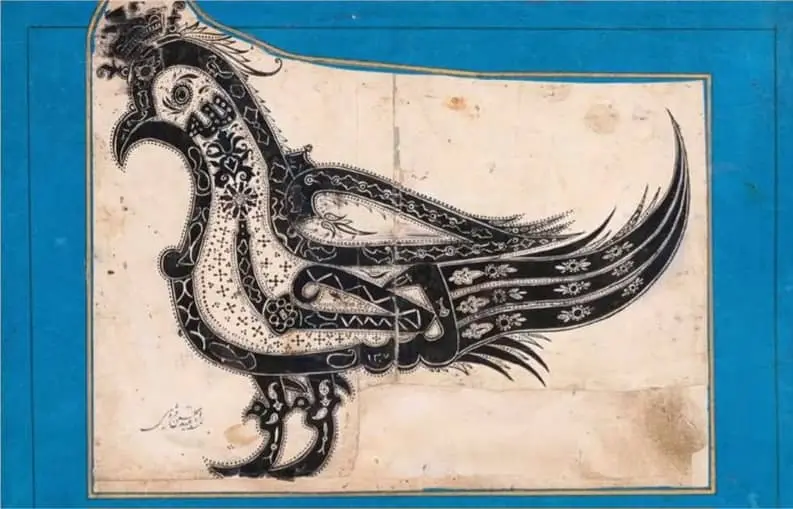
• “Morgh-e Bism-Allah” by ʿAbd-al-Ḥossein Qazvini
• Sold for 320,000,000 toman → ≈ US$ 27,100 (320,000,000 ÷ 11,800)
• Ink on handmade paper, 21 × 17 cm, date of the work: 1307 AH
“Morgh-e Bism-Allah” is one of the exemplary instances of pictorial calligraphy (figurative calligraphy), in which the lines and script are arranged to form the image of a bird. In such works, typically the phrase “Bism-Allah” or Qur’anic verses or supplications are composed in a special layout to depict a bird or other animals. The cultural and artistic importance of “Morgh-e Bism-Allah” stems from deep tradition in Iranian-Islamic art where such works served to beautify and display the calligrapher’s skill. This particular example is executed with special delicacy and precision, representing one of the ancient methods of fusing script and imagery in Iranian-Islamic art.
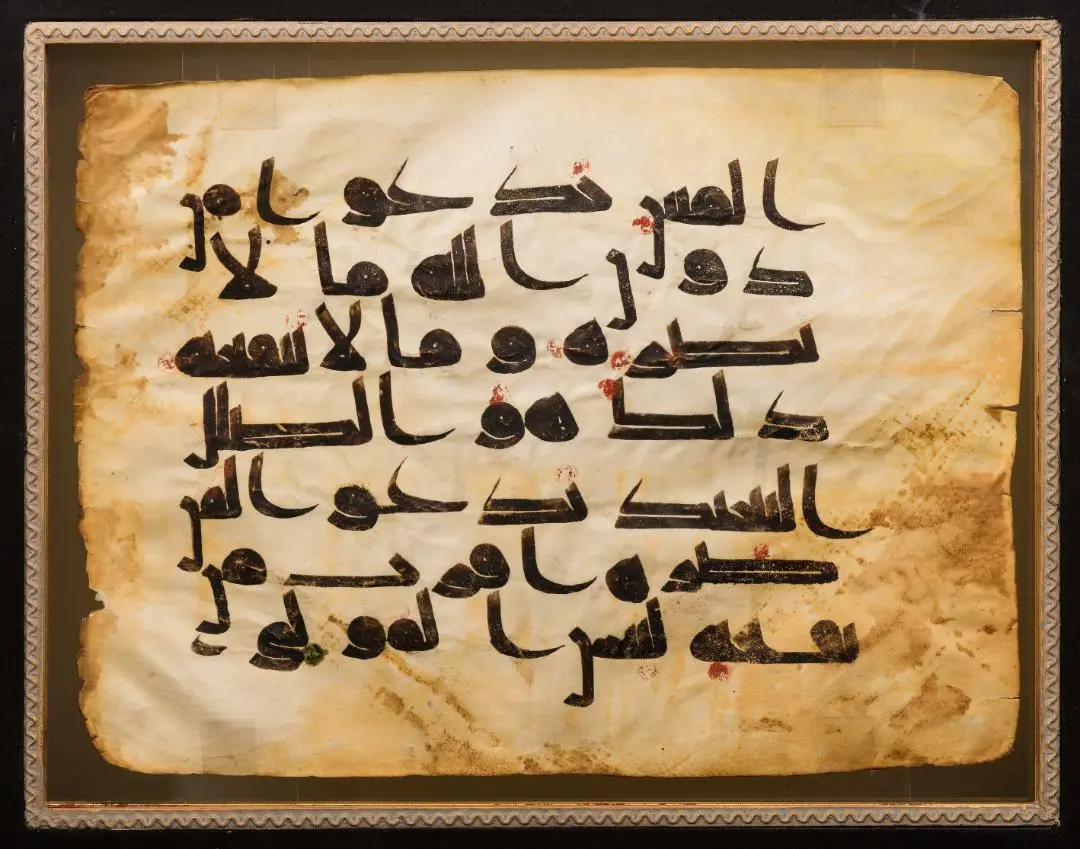
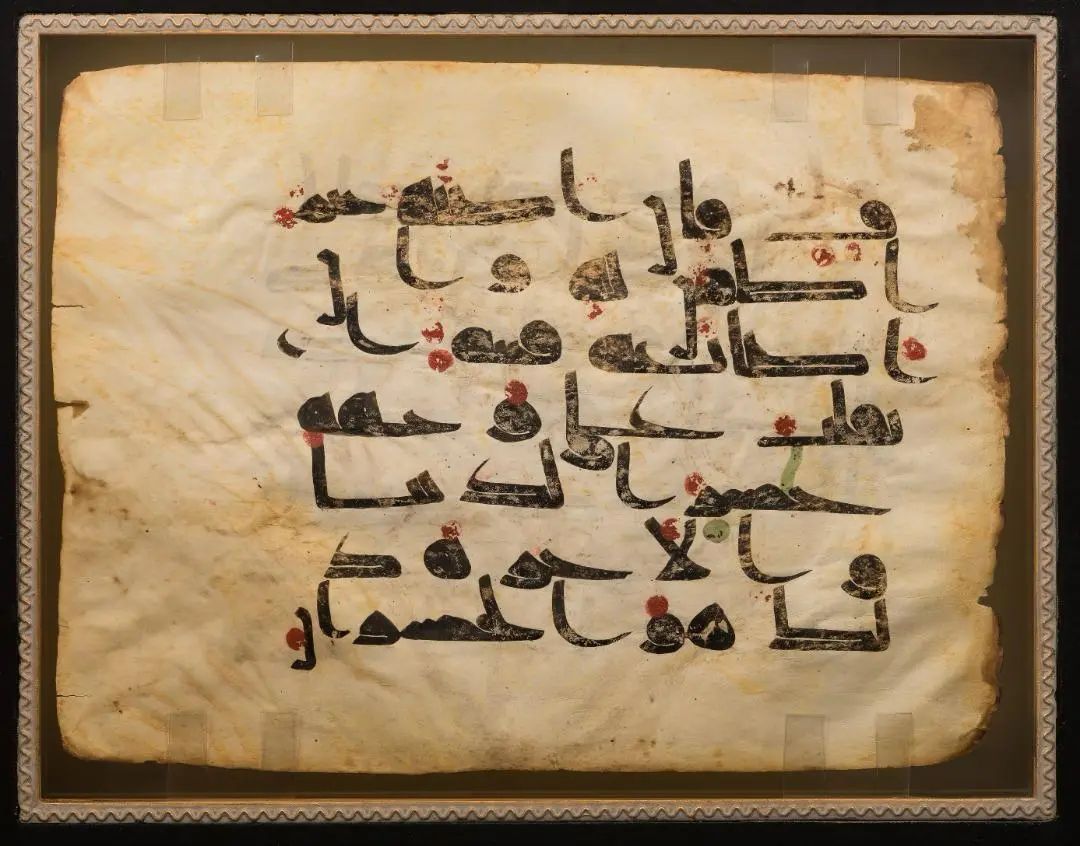
• Kufi Script [7-line, double-sided] — a leaf from the Holy Qurʾān
• Sold for 300,000,000 toman → ≈ US$ 25,400
• Handmade ink on deer skin, 37 × 27.5 cm, date: 2nd–3rd century AH
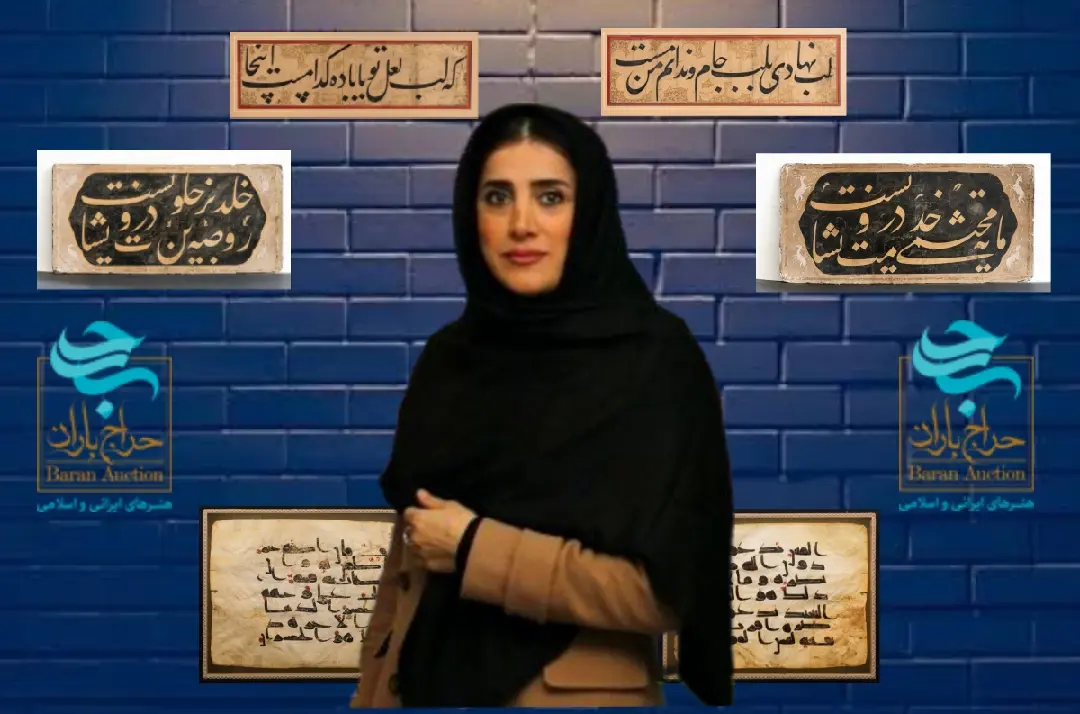
This work is a prominent example of early Kufi script, produced in the 2nd–3rd centuries AH. The Qur’anic text on this leaf is inscribed with handmade ink on deer-skin, and measures 37 × 27.5 cm, with 7 lines per page — reflecting the common method of Qur’an writing in the early Islamic period. The decisive, geometric, and minimally ornamented Kufi style underscores a spiritual atmosphere and a focus on the sacred text. The presence of red diacritical marks on some letters suggests a transitional phase from un-pointed Kufi to punctuated Kufi, made to facilitate recitation. This piece has tremendous artistic and historical importance, as it illustrates the development of Kufi script — its formation and consolidation in Islamic civilization. The use of deer-skin as writing surface underscores the preciousness attributed to the Qur’an and the meticulous care of the calligraphers. The simple frame and modest page decorations further indicate a deliberate avoidance of excessive ornamentation — emphasizing authenticity and spirituality. Such original works are highly influential in codicology studies and in tracing the evolution of Islamic calligraphy — and highlight the distinctive heritage of Iranian-Islamic culture and art.
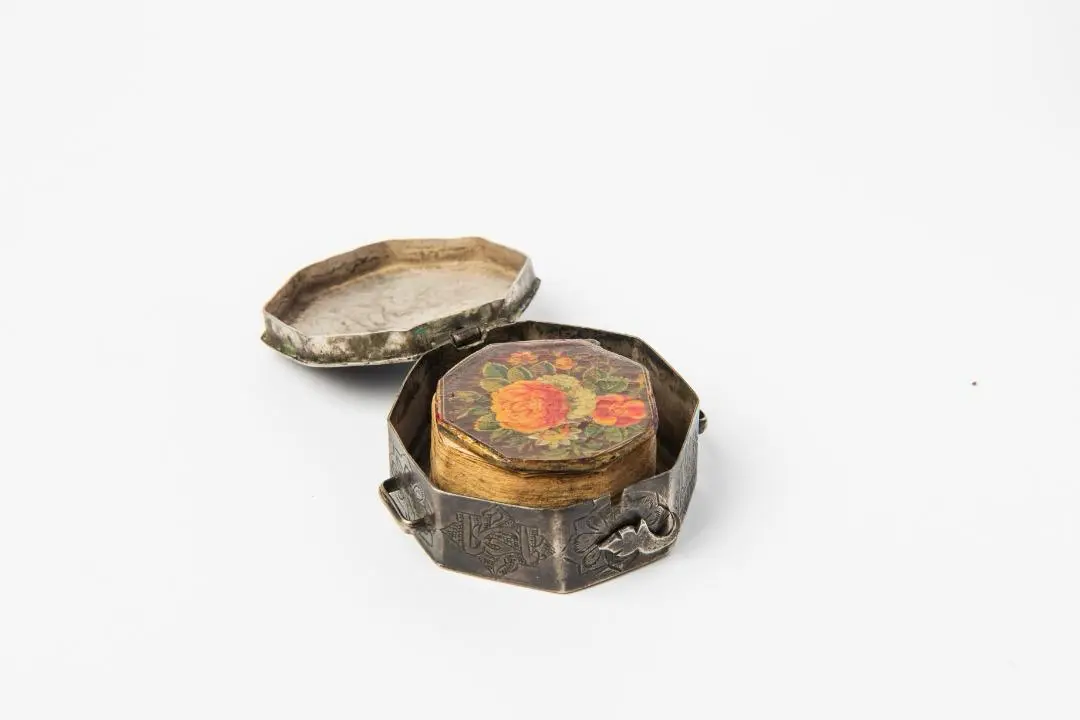
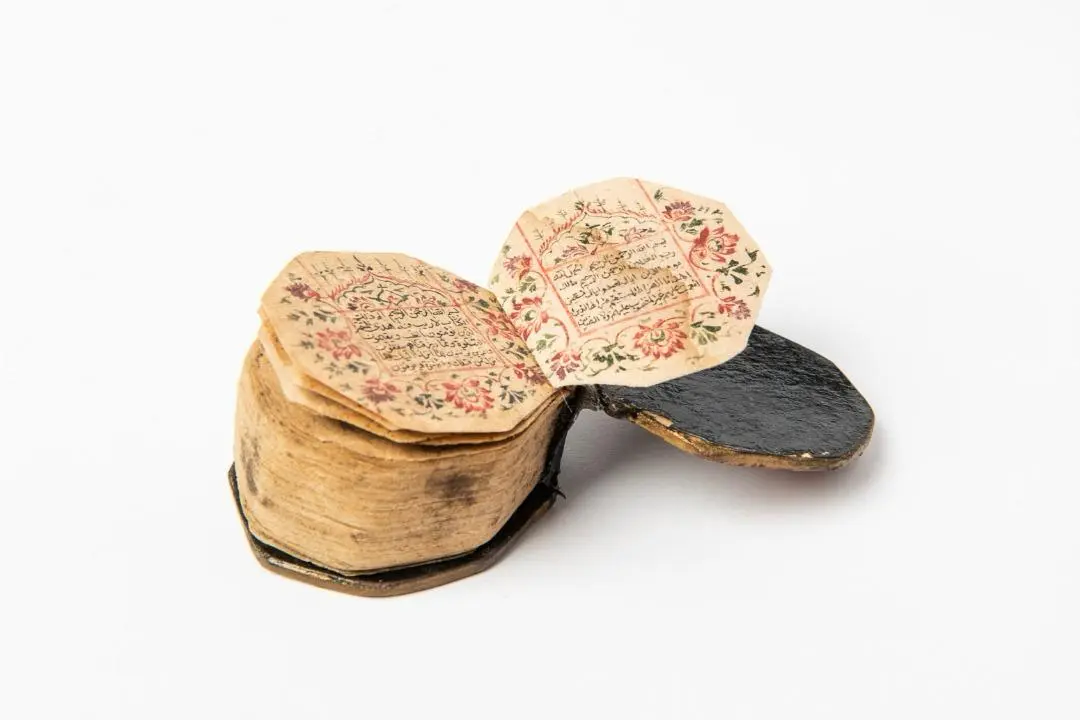
• Precious Pocket Qurʾān with a Silver Arm-band [attributed to Masiḥ Taleqānī]
• Sold for 160,000,000 toman → ≈ US$ 13,600
• Black ink on handmade paper; “ghabarnavisi” (dust-inking) technique; silver arm-band (container), 3.5 × 3.5 × 2 cm; date: Qajar period
This precious pocket Qurʾān — preserved inside a silver armband — is a remarkable example of calligraphy and book-making art from the Qajar era. The text is written with fine black ink on handmade paper using the “ghabarnavisi” technique: an extremely delicate, precise, and refined script, showcasing the scribe’s patience and skill. The octagonal pages, floral illumination, and colorful borders (as seen in the last image) create a synthesis of visual beauty and spiritual sanctity. The harmony between calligraphy and floral motifs demonstrates the Qajar artists’ decorative taste — blending religious art with delicate embellishment. The silver casing is engraved with arabesque and geometric motifs, revealing the metal-worker’s craftsmanship; inside, a multi-sided box decorated with large Qajar-style floral paintings combines metalwork, painting, and book-making into a single beautiful, harmonious object. This set was not only a practical protective cover for the Qurʾān but also carried personal and devotional significance. In sum, the present work is a brilliant example of the fusion of religious art, fine craftsmanship, and decorative art in the Qajar era.
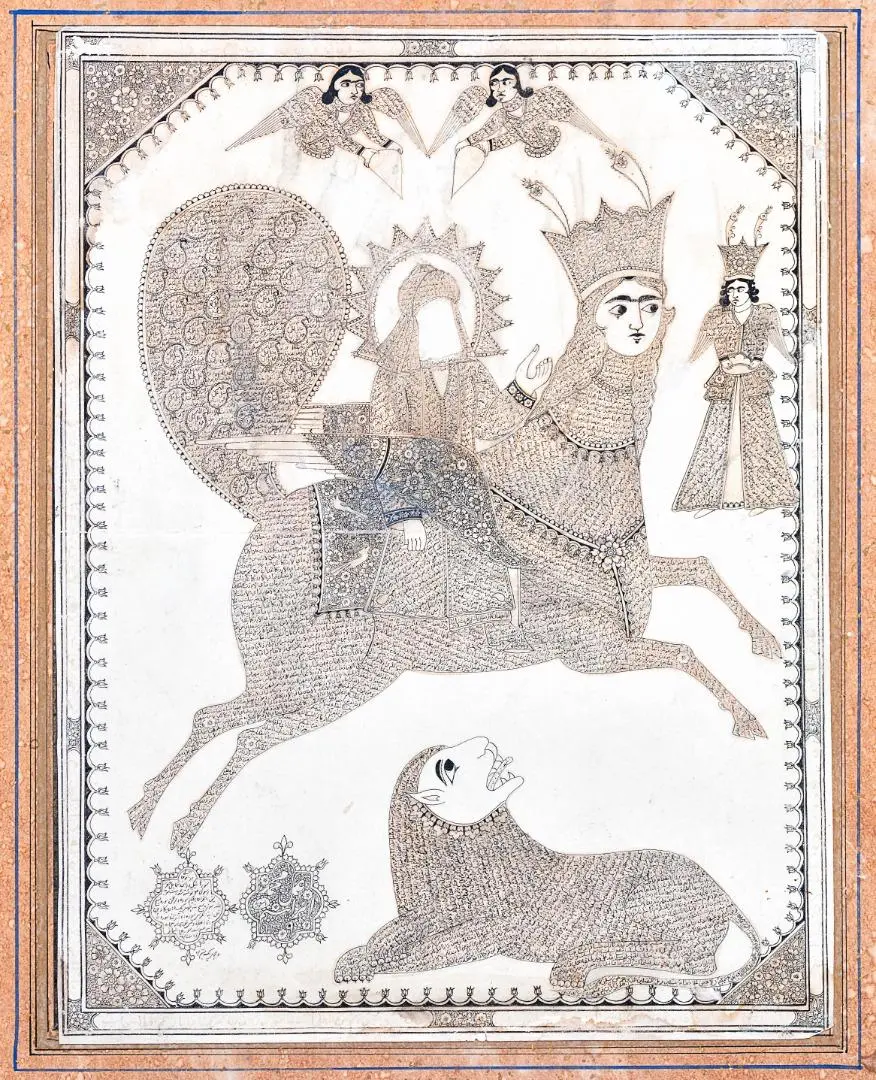
• “Miʿrāj of the Prophet (PBUH)” by Mohammad‑Ebrāhīm Zarrin‑Ghalam (13th century AH)
• Sold for 110,000,000 toman → ≈ US$ 9,300
• Ghabarnavisi (dust-inking), black ink on handmade paper, 20.5 × 27 cm; date of the work: 1309 AH
Using black ink and the ghabarnavisi technique, this piece reflects the calligrapher’s and painter’s skill. The mystical scene of the Miʿrāj (the Night Journey and Ascension of the Prophet) is depicted with symbolic elements: the Buraq (the mythical steed), angels, and a halo around the Prophet’s head. Its execution evokes the style of ghabarnavisi and narrative painting typical of the Qajar period. In Islamic tradition, the Miʿrāj is one of the greatest miracles of the Prophet, describing his night journey from the Kaʿbah to Al-Aqsa Mosque and then his ascension through the heavens. This work is a valuable example of the fusion of calligraphy and pictorial narration in Iranian-Islamic art.
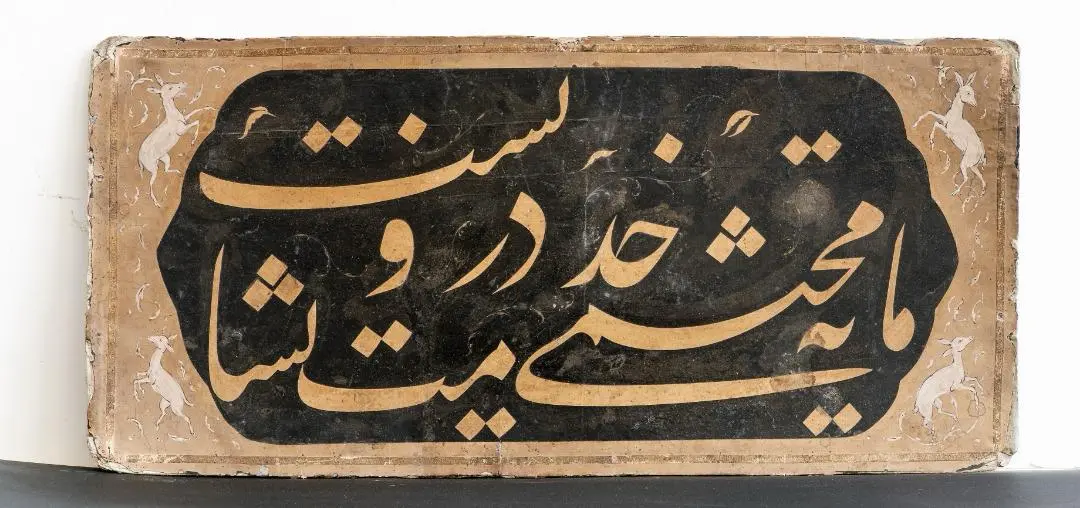
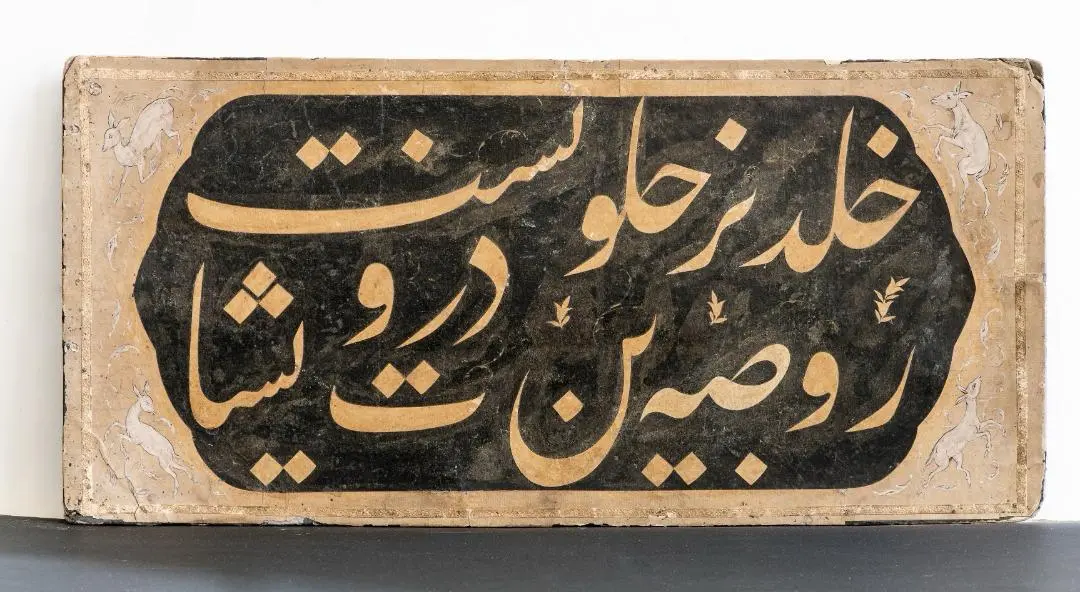
• “Qitʿa (Pieces)” — Safavid era [four pieces] attributed to Mir Emad al‑Hasani
• Sold for 80,000,000 toman → ≈ US$ 6,800
• Handmade paper, “safidÂb and gold” (white-wash and gilt) technique, cut-paper calligraphy by scissors, 56 × 27 cm; period: Safavid
In this four-piece set attributed to Mir Emad al-Hasani, we encounter a rare example of cut-paper calligraphy (qitʿa) from the Safavid period: where the calligrapher’s skill reached its zenith through the “qitʿa-sazi” technique — i.e. meticulously cutting letters from paper with scissors and mounting them on a dark background. Use of handmade paper, white-wash, and gold together with the contrast between black script and beige background gives the works a regal yet delicate appearance. The calligrapher — relying on the fluidity and graceful elongation typical of Nastaʿlīq — arranged the verses of the poet Hafez so that the visual weight of every word corresponded to the poetic meter. The framing with four white-deer motifs evokes the mystical, poetic atmosphere associated with Hafez — and, akin to the miniature-style borders from the Safavid era, bestows an illustrative dimension to the script. Aesthetically, the beauty arises from the balance between filled and empty space: the cut-out letters emerge like reliefs from the background, and the play of light over the white-wash and gold surface, contrasted against the darkness of the base, gives a sculptural sense. This light-dark contrast visually echoes the typical themes of Hafez’s poems — oscillating between wonder, love, annihilation and illumination. Meanwhile, the light-brown frame with delicate animal miniatures — a hallmark of Safavid decorative taste — serves as an “outer space” that surrounds and elevates the sanctified calligraphic text into a sacred, museum-worthy object. Altogether, this set stands as a complete example of the confluence of poetry, illumination, calligraphy, and cut-paper art in the highest tradition of Safavid artistry.
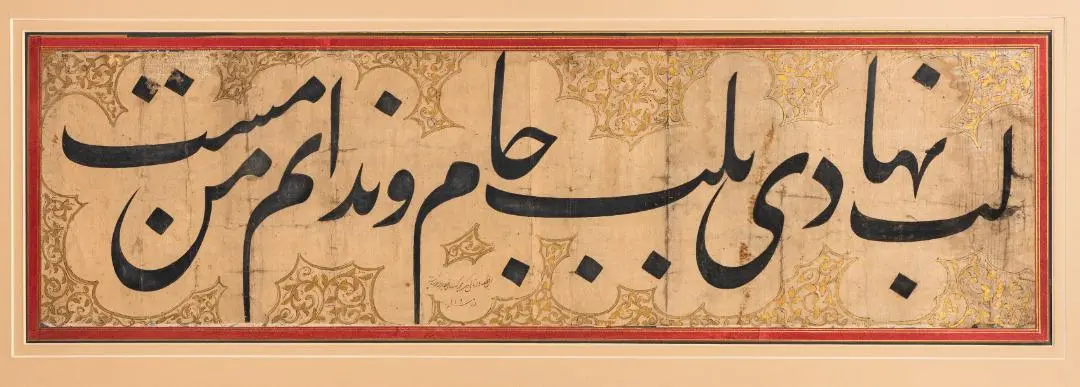
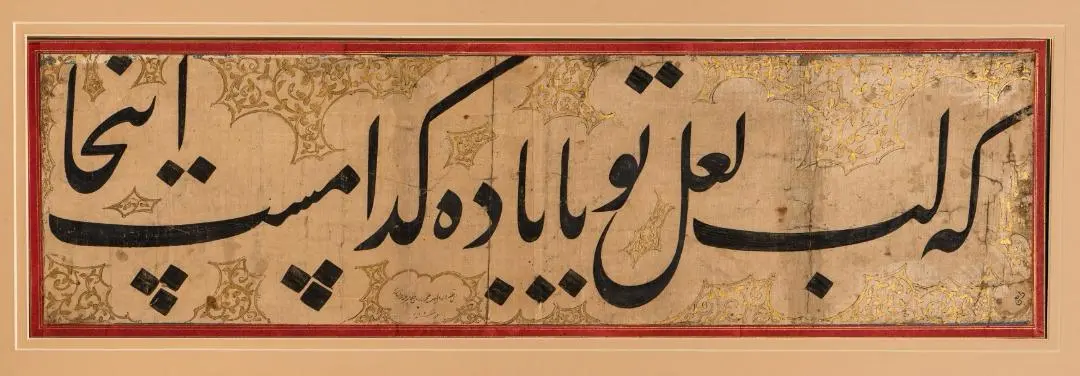
• A Two-Piece Calligraphic Panel by “Malek Mohammad”
• Sold for 65,000,000 toman → ≈ US$ 5,500
• Design and filling of letters based on Mir Emad al-Hasani’s script; gold decoration and “ḥal-kāri”, black ink on handmade paper, 23 × 82 cm
In this calligraphic panel — crafted by “Malek Mohammad” and rooted in calligraphic exercises after Mir Emad al-Hasani — the spirit of the Safavid calligraphic school becomes evident. The composition features elongated letters, a balanced interplay between the stretching of letters and blank spaces, and a confident thickness of the pen stroke — all showing that the artist, while inspired by Mir Emad, applied his own mastery in the final execution. The background is covered with gold and intricate ḥal-kāri (embellishment), and against the powerful black script a layer of visual grandeur emerges — typical of such Safavid calligraphic panels and cut-paper works. The harmony between poetic text and ornate decoration evokes an atmosphere that is at once devotional and romantic. From a visual-structural standpoint, the quality of the handmade paper and the way the black ink sits on its surface highlight the work’s antiquity and dignity. The gold-leaf decorations — with arabesque and khatāyī motifs — turn the calligraphy frame into a decorative field; the thick black letters atop that colorful richness create a striking contrast. This panel thus has both historical significance and aesthetic value: a heritage of connecting the classical script of Mir Emad with the decorative sophistication of a master calligrapher of the Safavid era, condensed into a compact, horizontal composition that embodies dignity, skill, and refined taste of its time.
LEAVE A RELPY