
At the Threshold of the UAE’s 54th Anniversary:Bita Vakili’s Painting in the Raha Gallery Collection
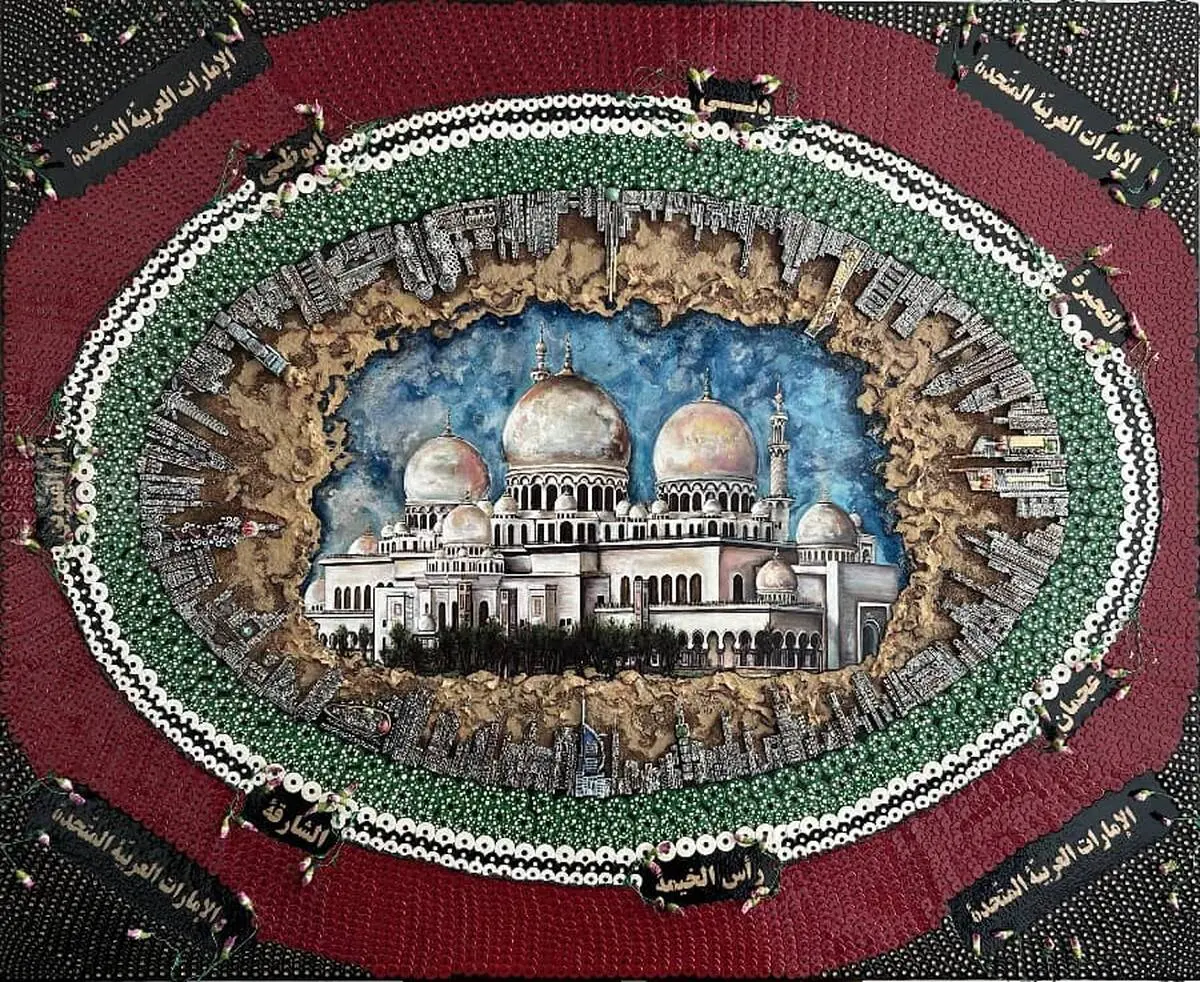
The fusion of the Abu Dhabi mosque (tradition) with the towers (modernity) re-creates a visual discourse of Emirati identity—an identity rising from the earth and reaching toward the sky. Bita Vakili’s painting, housed in the Raha Gallery Middle East Collection, illustrates that today’s UAE is the result of the coexistence of tradition and technology, faith and development, Islamic architecture and global innovation—a nation looking toward the future while never forgetting its roots. Beyond its artistic function and chromatic cohesion, the use of the UAE flag’s colors itself operates as a statement of national identity.
ArtDayMe : Founded and directed by Engineer Mohammadreza Ghaem-Maghami, the Raha Gallery Collection has been engaged in continuous cultural activity for more than two decades, focusing on elevating the art of the region and preserving a remarkable range of modernist and contemporary masterpieces by Iranian and Arab artists.
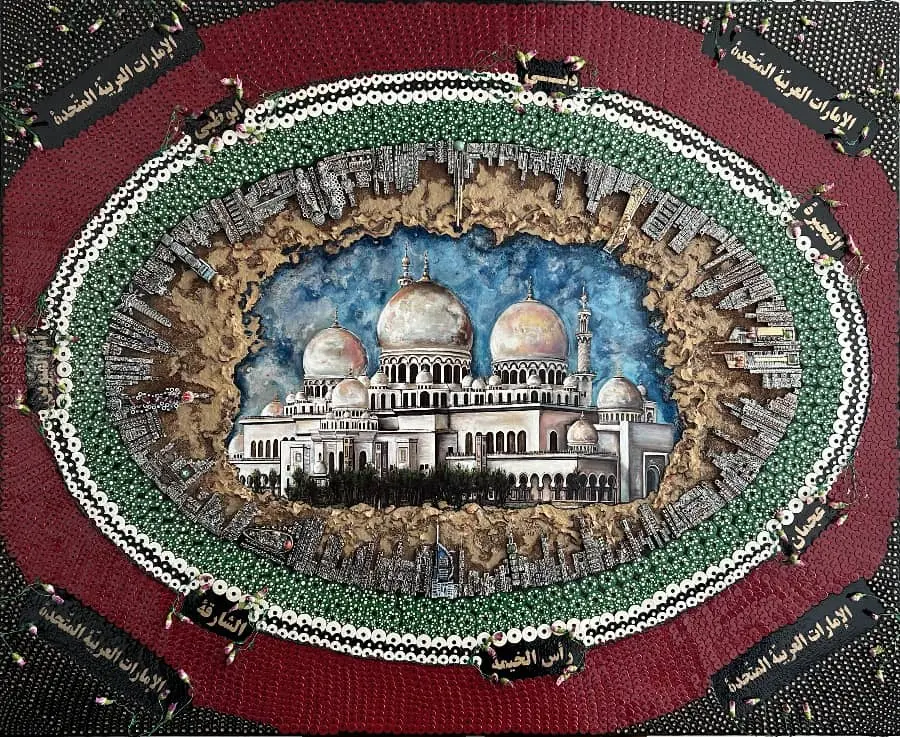
Among these works is The Splendor of Unity by Bita Vakili, created as a mixed-media painting on canvas (220 × 180 cm) in December 2025, on the eve of the UAE’s 54th anniversary.
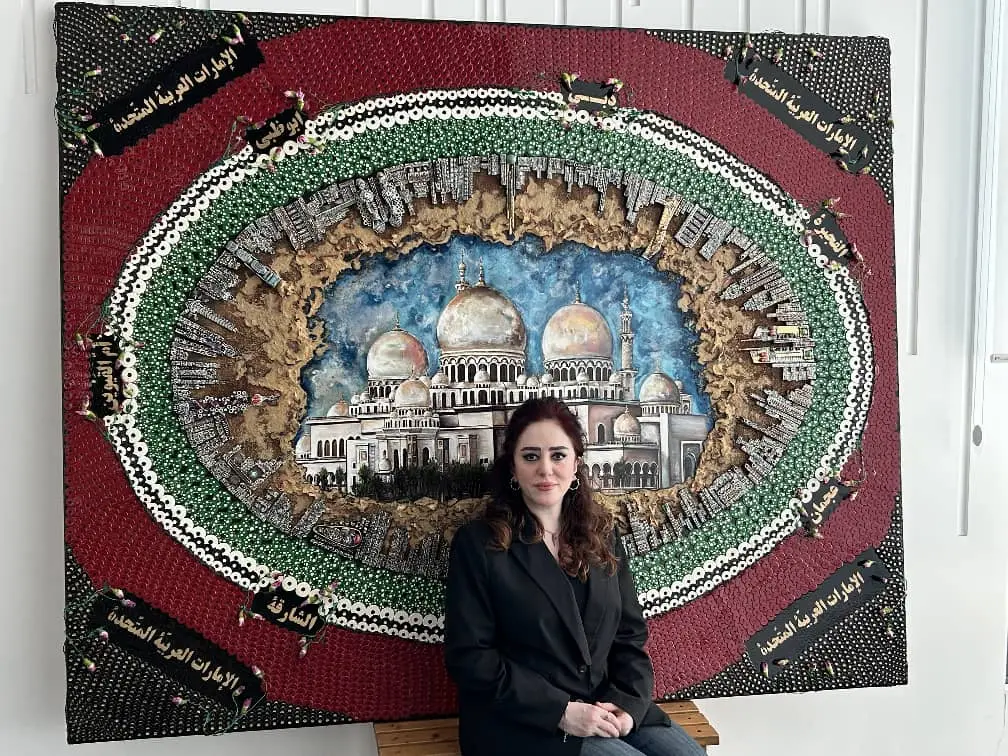
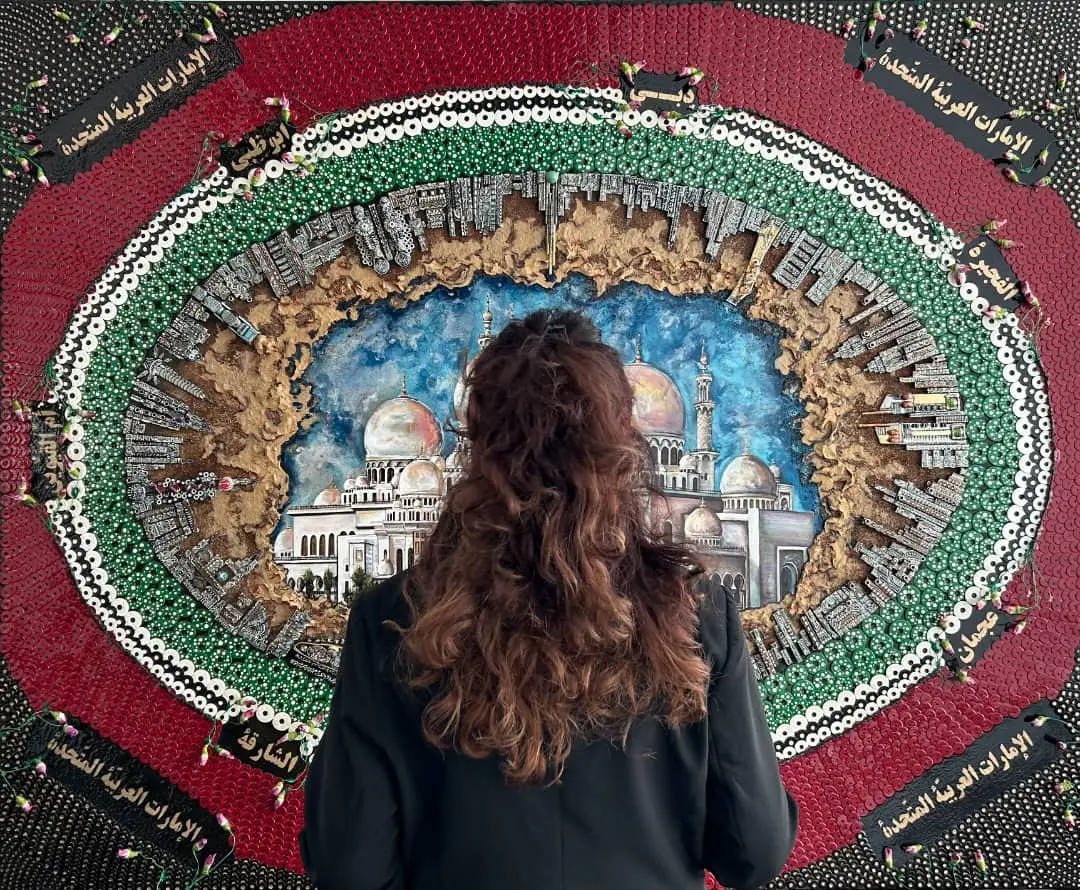
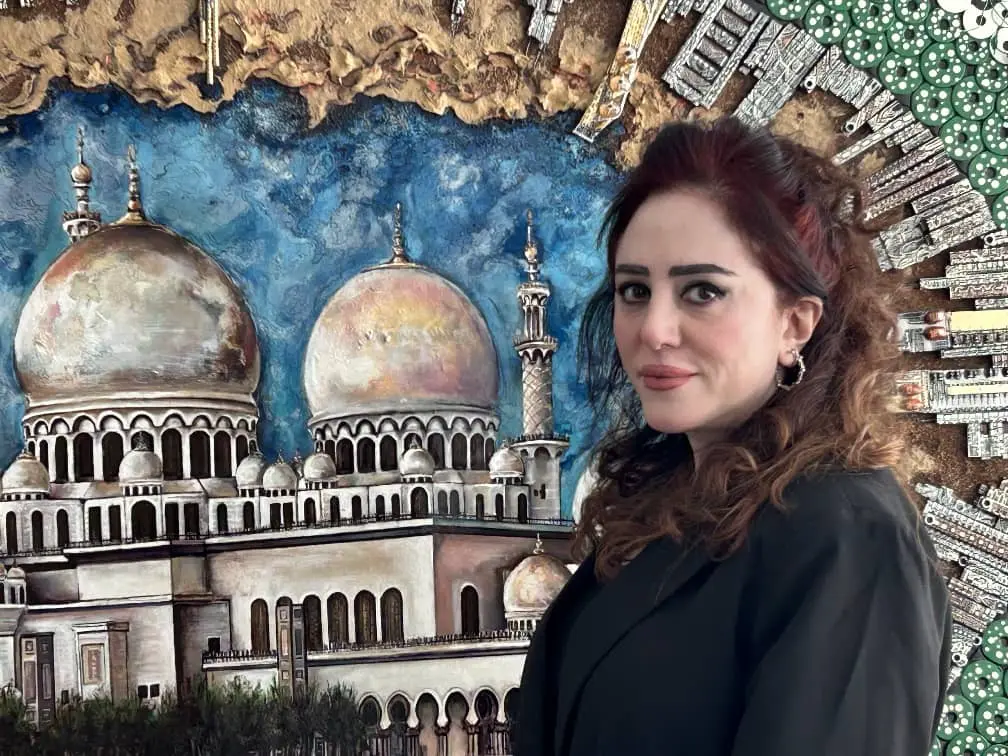
This artwork merges painting, collage, and mixed-media techniques, reflecting the spirit of Islamic architecture and the grandeur of the United Arab Emirates. At its center stands the majestic Sheikh Zayed Grand Mosque of Abu Dhabi, gleaming like a jewel suspended between earth and sky.
Surrounding the center is a circular structure of metallic elements, beads, and urban fragments, evoking skyscrapers and the rapid modern growth of Emirati cities.
Within this constellation of towers, one can recognize icons of the UAE’s architectural landscape—including Burj Al Arab, Burj Khalifa, the Museum of the Future, Dubai Diamond Tower, Cayan Tower, the Al Bahar Twin Towers of Abu Dhabi, the Jumeirah Twin Towers, and Shams Tower of Abu Dhabi.
The palette recalls the colors of the UAE flag—red, green, white, and black. These circular bands act as a protective halo around the nation’s cultural and spiritual heritage. The interplay between rough and lustrous textures stages a dialogue between past and future—earth and sand set against steel and glass.
In the black bands encircling the work, the names of the seven emirates are inscribed in Arabic: Abu Dhabi, Dubai, Sharjah, Ajman, Fujairah, Ras Al Khaimah, and Umm Al Quwain—suggesting that the artwork is not only a depiction of architecture but also a declaration of national unity.
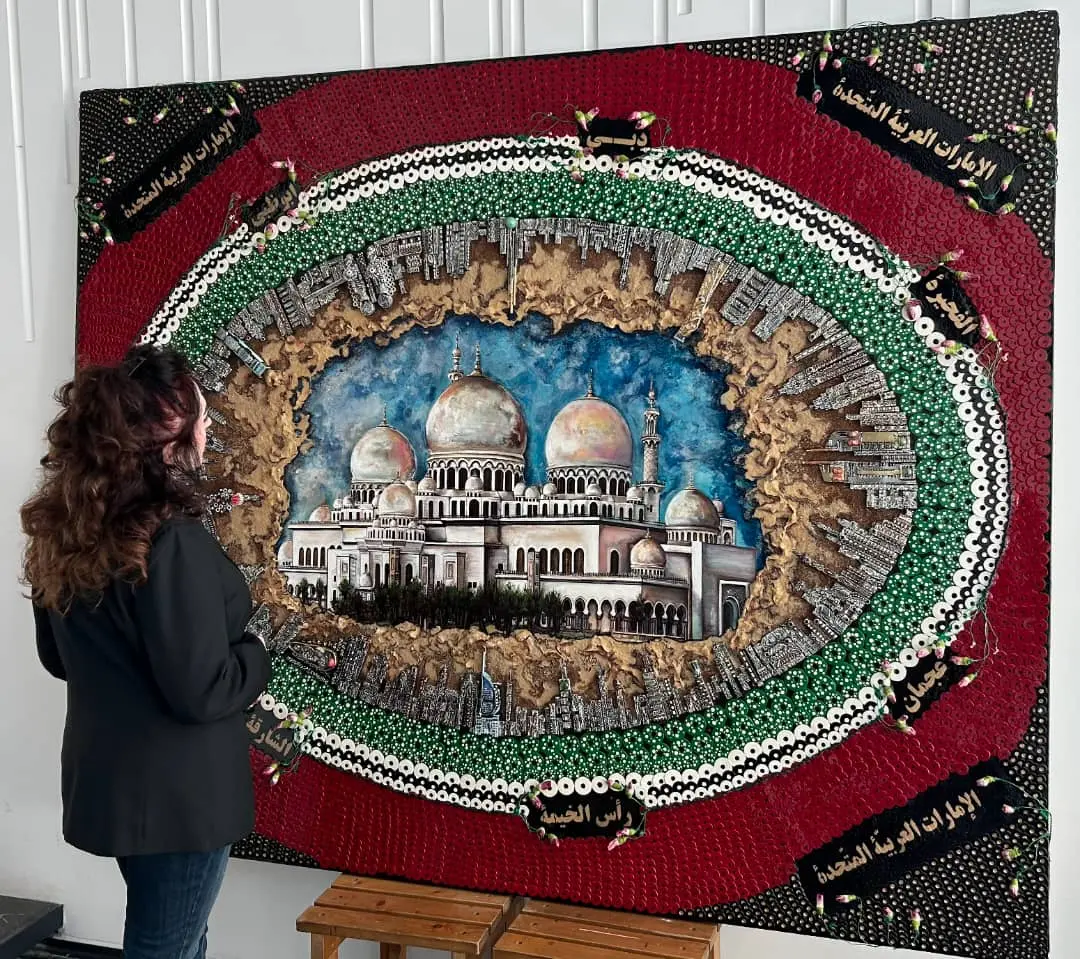
Ultimately, the piece builds a bridge between tradition and modernity—from the luminous white domes of the mosque to the shimmering silver towers—portraying a nation rooted in faith and oriented toward the future.
Unveiled in its media presentation during the UAE’s 54th anniversary, Bita Vakili’s The Splendor of Unity, housed in the Raha Gallery Collection, functions as a visual manifesto of identity, progress, national unity, and the majesty of Islamic-modern architecture.
More than a painting, it exists as an art object—an integration of painting, collage, sculptural tactility, and mixed-media techniques. At 220 × 180 cm, it presents not just an image but an immersive spatial and emotional experience.
Central Composition
At the heart of the work lies the Sheikh Zayed Grand Mosque—an intentional choice fulfilling three roles:
Semantic Center:
symbol of the UAE’s spiritual and religious foundations
Visual Center: the focal point within the elliptical geometry
Historical-Identity Center: linking the past to the future
The surrounding elliptical structure:
• grants the piece a ritualistic, emblematic presence
• evokes the geographic inclusiveness of the UAE
• continually returns the viewer’s attention to the center
This geometry resembles a modern mandala—an archetypal circular design representing unity, completion, and universality.
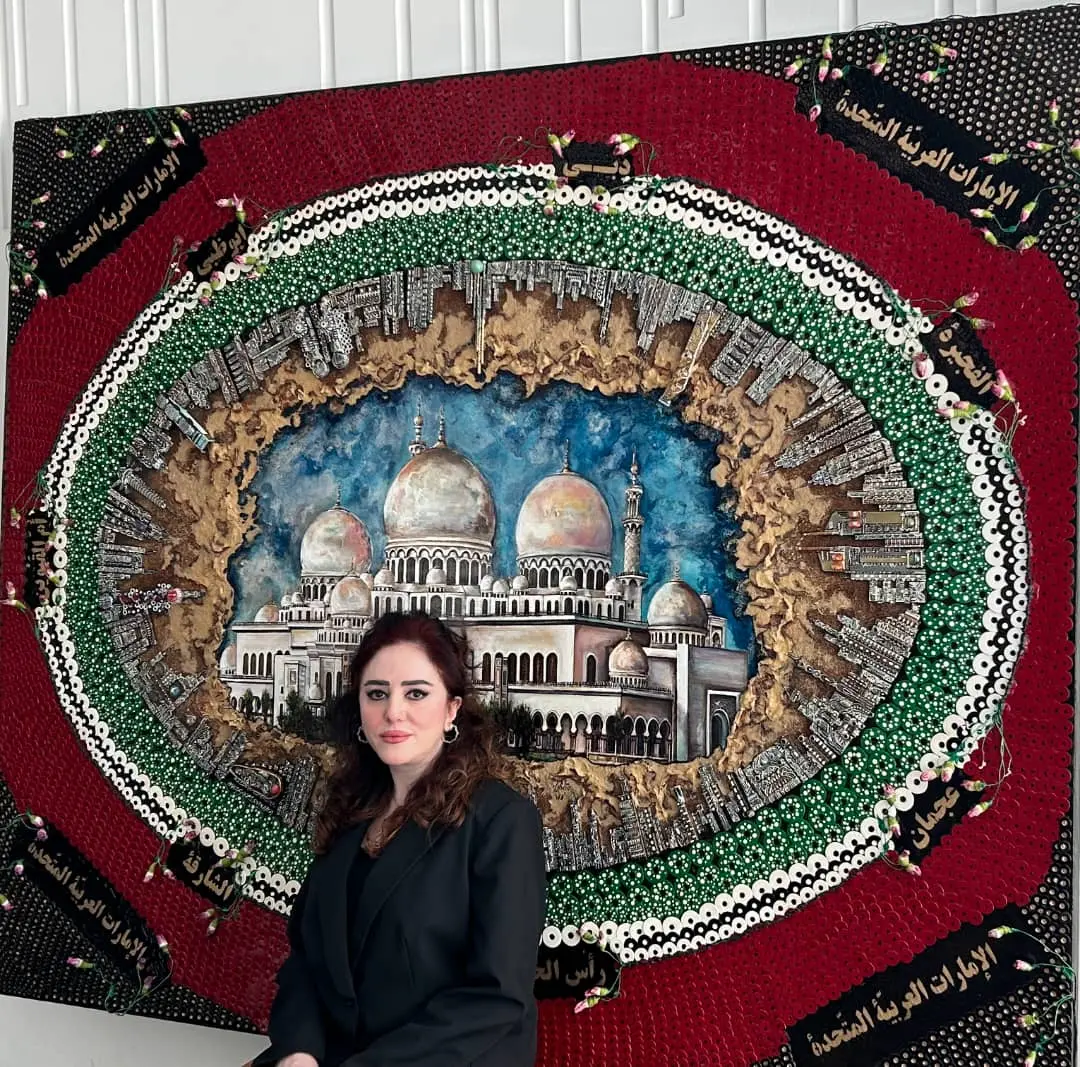
Materiality and Technique
A) Classical Painting for the Mosque
• Soft chiaroscuro
• Radiant reflections on the domes
• Controlled realism
This anchors the work in historical and aesthetic credibility.
B) Metal Collage, Beads, and Urban Fragments
These industrial materials introduce:
• a visualization of urban and technological growth
• a tangible, sculptural texture
They elevate the piece from a flat painting to a multi-layered architectural construct.
C) Fine-grained Texturing
The densely layered textures in red, green, and white (UAE flag colors) create a rhythmic flow, suggesting the nation’s energetic dynamism.
Symbolism
A) Sheikh Zayed Grand Mosque
Symbol of:
• spirituality
• unity
• serenity
• Islamic identity
• one of the most iconic architectural symbols of the contemporary Arab world
B) Skyscrapers and Urban Icons
Including:
• Burj Khalifa
• Burj Al Arab
• Museum of the Future
• Dubai Diamond Tower
• Cayan Tower
• Al Bahar Twin Towers
• Jumeirah Towers
• Shams Tower, Abu Dhabi
Symbols of:
• technological advancement
• global investment
• foresight
• modern urban vision
Their interplay with the mosque creates a renewed discourse on Emirati identity.
C) Colors of the UAE Flag
A cohesive chromatic system forming a “national identity statement”:
• Red: strength, resolve, courage
• Green: prosperity, stability, growth
• White: peace, purity, spirituality
• Black: historical depth, endurance
Conceptual Analysis
1. National Unity
The concentric rings metaphorically represent the seven emirates and their union.
2. Connection of Earth and Sky
The earthy textures surrounding the mosque and the airy blue sky behind it intertwine:
• terrestrial origins
• spiritual transcendence
3. Modernity alongside Tradition
Rather than opposition, the work emphasizes their creative coexistence.
Cultural–Historical Reading
Bita Vakili’s The Splendor of Unity, in the Raha Gallery Collection, directly references the UAE’s 54th anniversary:
Its message is clear—the UAE is a nation shaped by the harmony of tradition and innovation, faith and development, Islamic heritage and global modernity; a country that looks forward without relinquishing its origins.
Aesthetic Analysis
Geometry:
• circular composition
• balance between calm center and dynamic periphery
• contrast between soft painterly surfaces and hard industrial textures
Light and Color:
• warm light on the domes
• a slightly hazy blue sky evoking the passage of history
• repeated circular forms suggesting pulse, vitality, and motion
Visual Rhythm:
Beads and circular elements build a musical repetition.
Stylistic Classification
A synthesis of:
• architectural realism
• conceptual art
• painterly–sculptural hybrid
• urban collage
• cultural mandala-making
This pluralistic approach situates the work firmly within contemporary Middle Eastern art.
Place of the Work in Bita Vakili’s Career
Bita Vakili (b. 1973, Tehran) has devoted more than three decades to painting, with academic degrees at both B.A. and M.A. levels and significant presence on the Middle Eastern art scene—from international auction achievements to participation in over 80 exhibitions across the UAE, Canada, the USA, China, Monaco, Armenia, Malaysia, France, Germany, the UK, Oman, and Iran.
She has six notable sales at Christie’s, including her record on 18 April 2012, when her painting New York Dream sold for USD 45,000.
Bita Vakili’s works are held in major collections such as Pasargad Bank, Tourism Bank, and leading private collections.
This piece is among her most mature works in terms of material synthesis, conceptual cohesion, and visual grandeur. Vakili frequently combines:
• urban morphology
• territorial identity
• architectural elements
• adaptive collage
Conclusion
The Splendor of Unity, preserved in the Raha Gallery Collection, is:
• multi-layered
• message-driven
• identity-focused
• architectonic
• technically advanced and visually striking
It portrays the UAE as a nation:
• rising from the earth and reaching toward the sky
• encircled by unity, culture, and progress
• reconciling past and future within its architecture
A closer reading reveals the work as a cultural map of contemporary UAE—rendered as a national mandala.
This artwork belongs to the Raha Gallery Middle East Collection.
LEAVE A RELPY