
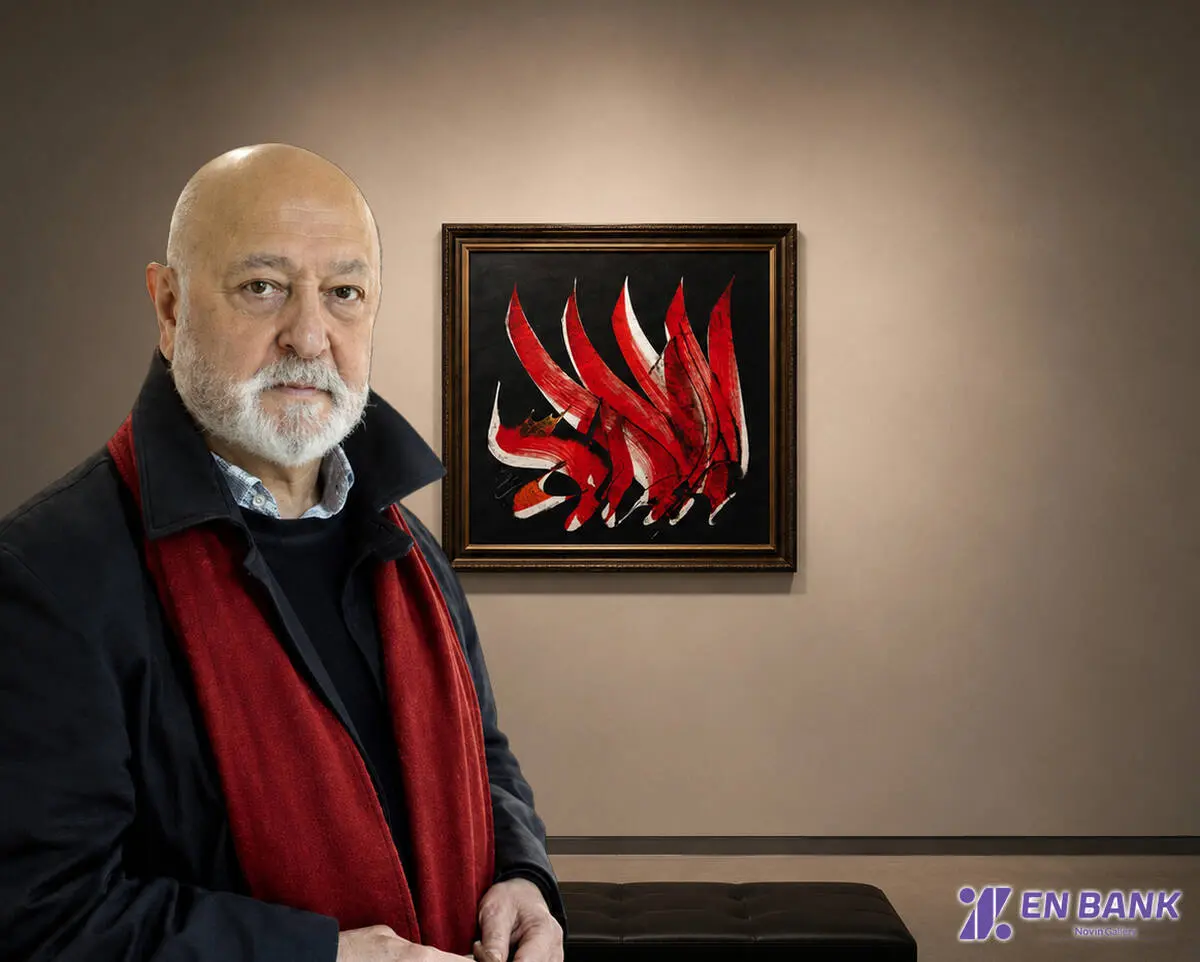
Mohammad Ehsai's Masterpiece in the Novin Gallery Collection of Eghtesad Novin Bank
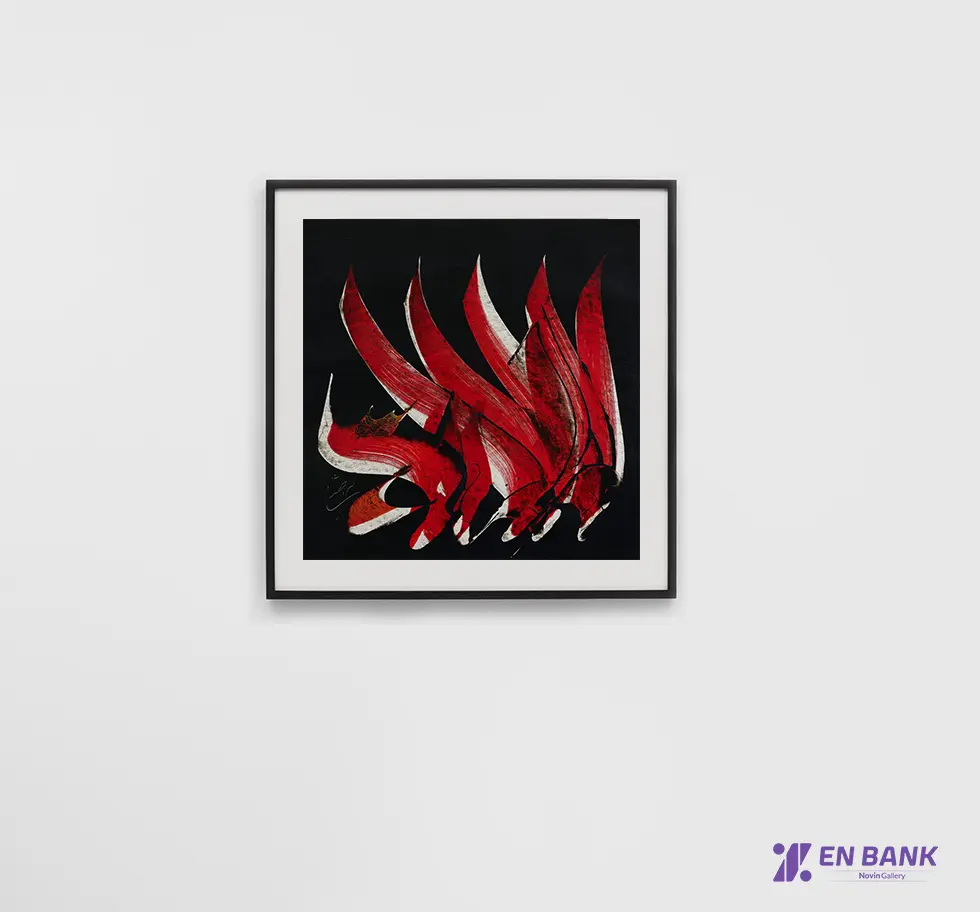
Flame-like crimson strokes rising against a deep black ground evoke an image of ascension, longing, presence, and the force of life itself. More than a calligraphic painting, the work is a visual meditation on humanity's encounter with the transcendent—a realm where word, color, movement, and meaning converge into a single expressive language. It stands among the most accomplished examples of Mohammad Ehsai's celebrated The Eternal Alphabet series and is preserved in the distinguished collection of Novin Gallery, Eghtesad Novin Bank [ENBank].
ArtDayMe | Since its establishment as Iran's first private bank, Eghtesad Novin Bank [EN Bank] has maintained a remarkable commitment to the country's artistic landscape. Through the creation of an outstanding art collection and the establishment of Novin Gallery, the Bank has emerged as one of the leading institutional patrons of Iran's visual arts ecosystem.
Among the highlights of its collection is a remarkable work by the renowned master Seyed Mohammad Ehsai, belonging to his acclaimed The Eternal Alphabet series—a body of work that has occupied the artist since the 1970s. Measuring 70 × 70 cm, the painting represents one of the defining achievements of this enduring artistic exploration.
Born in 1939 in Qazvin, Mohammad Ehsai is one of the most influential figures in the history of Iranian and Middle Eastern calligraphy and calligraphic painting. His works are housed in internationally renowned institutions, including The Metropolitan Museum of Art in New York and The British Museum in London, while his paintings have achieved landmark auction results, including sales approaching one million dollars at Christie's.
This work exemplifies one of the most significant phases of Ehsai's artistic career: the creation of a visual universe built upon sacred, mystical, and emotionally charged words. Here, the artist is not concerned with textual legibility. Instead, he transforms language into image, energy, and visual experience, allowing calligraphy to transcend the realm of writing and enter the language of painting.
_ Formal Analysis
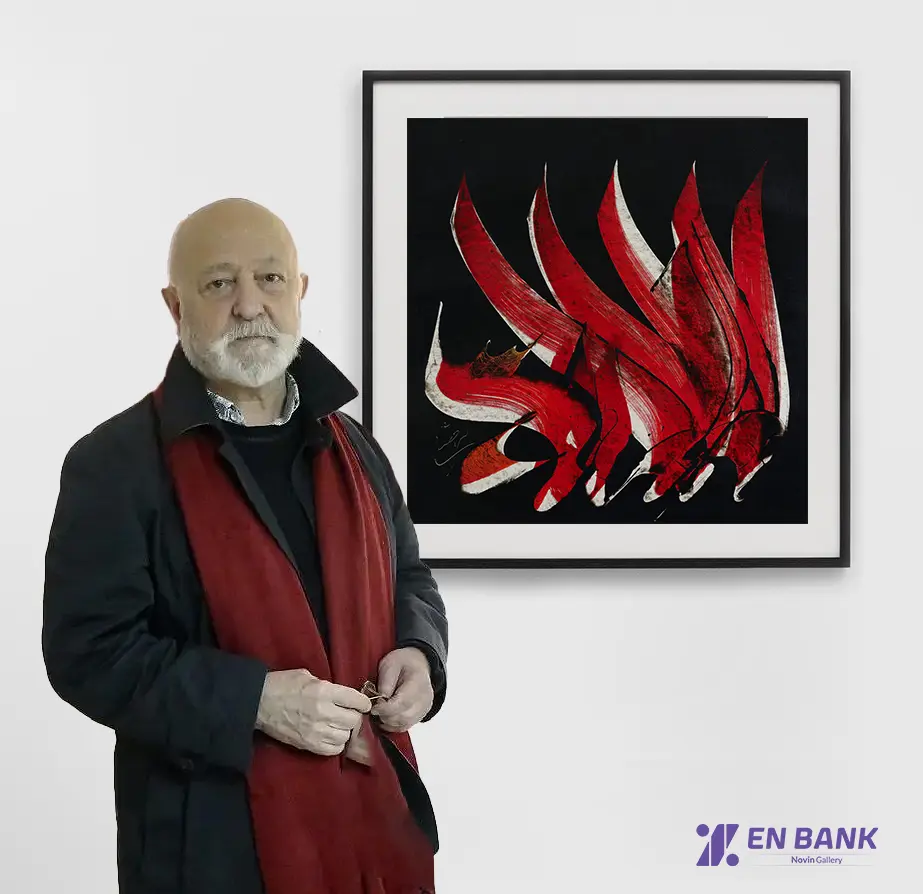
The first striking characteristic of the Ehsai masterpiece preserved in the collection of Novin Gallery, Eghtesad Novin Bank [ EN Bank] , is the overwhelming dominance of movement.
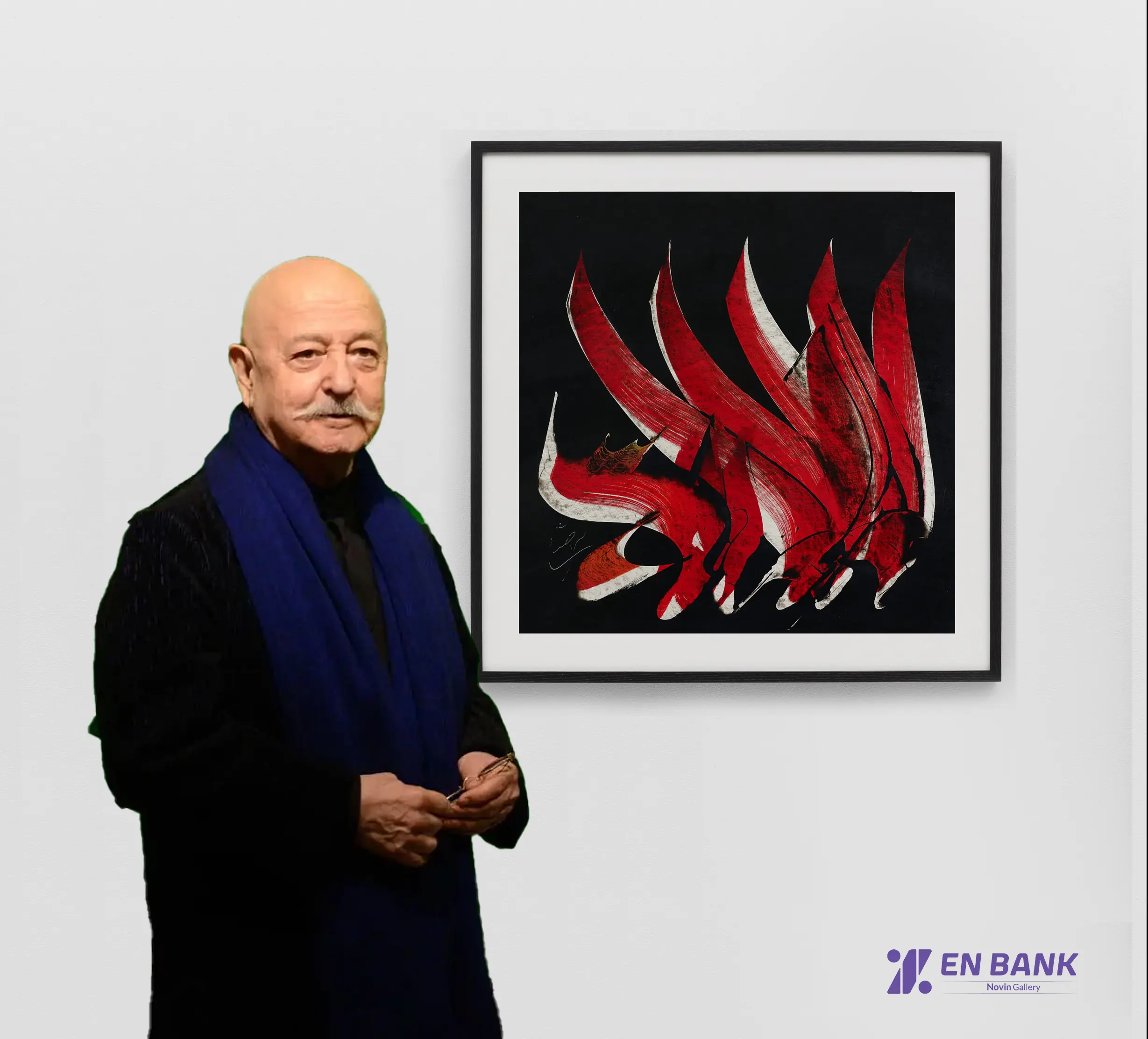
Its elongated vertical forms rise upward with explosive energy, suggesting perpetual growth and spiritual elevation. Crimson strokes emerge from darkness like untamed flames, naturally guiding the viewer's gaze toward the upper reaches of the composition.
The compressed composition, asymmetrical balance, rhythmic movement of the lines, emphasis on vertical axes, elimination of unnecessary negative space, and the dynamic tension created between vibrant color fields and fluid calligraphic forms together elevate the work to an exceptional level of artistic achievement.
Here, the forms are no longer merely letters; they have evolved into autonomous visual entities.
_ Calligraphy as Visual Experience
Although deeply rooted in the rich tradition of Persian calligraphy, Ehsai deliberately transforms classical conventions in favor of a contemporary visual language.
Exaggerated elongated strokes, constantly shifting pen widths, the liberation of traditional letter structures, and the transformation of script into volume and spatial form define this remarkable approach.
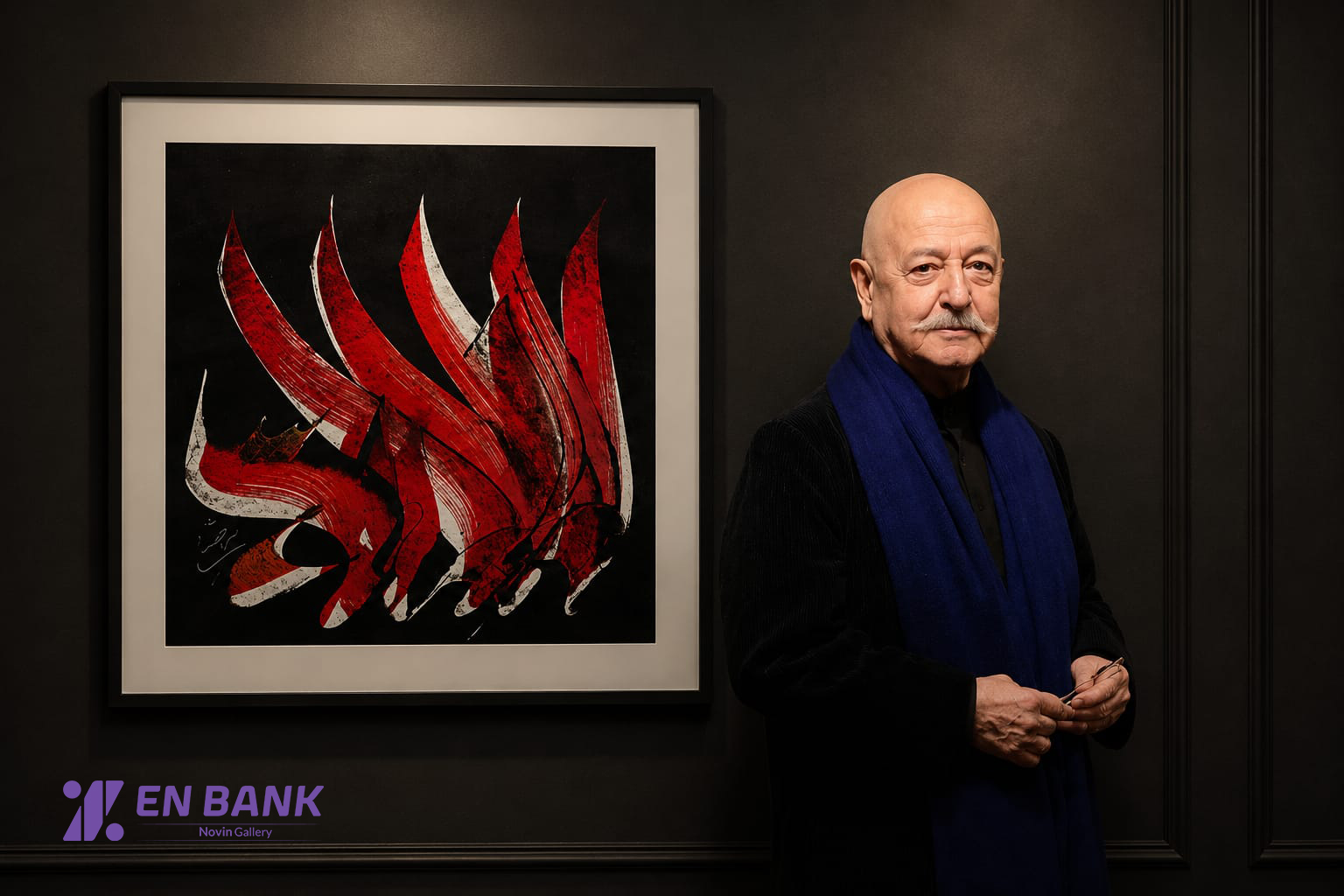
These letters are no longer intended primarily to be read—they are created to be seen, experienced, and felt.
This philosophy remains one of the defining characteristics of the Iranian Calligraphic Painting (Naqqashi-Khat) movement, of which Mohammad Ehsai is universally recognized as one of its foremost pioneers.
_An Expressive Triad of Color
Color functions not merely as an aesthetic element but as a profound psychological and symbolic language.
Red dominates the composition, evoking love, passion, vitality, sacrifice, spiritual longing, and inexhaustible energy.
The black background creates immense depth, generating an atmosphere of mystery while intensifying the radiance of the crimson forms.
White serves as the balancing force within the composition—light confronting darkness, purity countering emotional intensity, and stillness standing against movement.
Together, this triadic palette constitutes one of the most successful chromatic harmonies found throughout Ehsai's oeuvre.
_An Ascending Composition
The composition unfolds through a distinctly pyramidal and ascending structure.
The viewer's eye begins at the lower edge of the painting, circulates through its flowing curves, is drawn upward by the towering vertical strokes, and ultimately arrives at the composition's visual climax.
This ascending movement recalls the mystical concepts of spiritual journey (Suluk), ascension, humanity's pursuit of truth, and the elevation of the soul.
_A Metaphysical Space
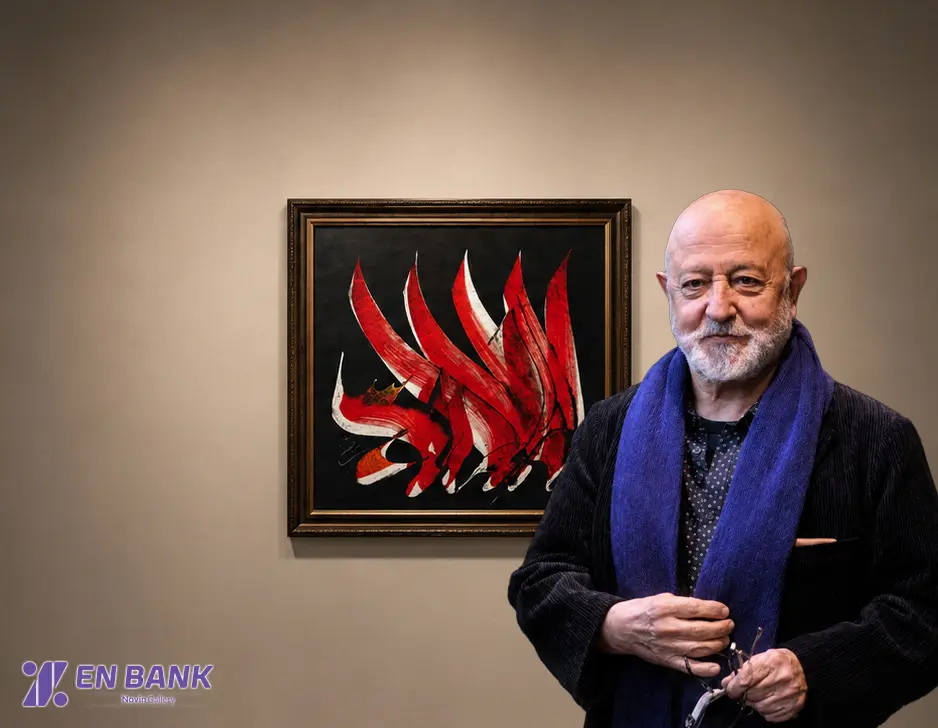
The spatial structure of the painting is established between two opposing realms: the material presence of the letters and the immaterial expanse of the background.
The absolute blackness of the ground evokes a cosmic void, as though the letters are born from the depths of darkness itself. This relationship imbues the work with a profoundly metaphysical atmosphere, inviting both contemplation and spiritual reflection. Rather than merely occupying space, the calligraphic forms appear suspended between the visible and the invisible, between earthly existence and the transcendent.
_The Origin of The Eternal Alphabet
Although the inscription cannot be read in its entirety, the forms strongly evoke the sacred phrase La ilaha illa Allah ("There is no god but God"), or perhaps simply the word Allah.
Ehsai deliberately preserves this ambiguity. It is precisely this uncertainty that allows the work to transcend literal language and enter the realm of spiritual intuition.
Within The Eternal Alphabet series, words are never treated as linguistic signs alone. They become manifestations of presence, light, divine power, and the very center of existence.
Meaning no longer resides in the act of reading; it emerges through perception and inner experience. The viewer responds emotionally before attempting intellectual interpretation.
This remarkable work by Mohammad Ehsai, preserved in the collection of Novin Gallery, Eghtesad Novin Bank, [ENBank], may be understood as an explosion of spirituality expressed through color and line. Here, Ehsai transforms calligraphy from a vehicle of writing into a medium through which the sacred may be experienced.
The flame-like crimson strokes rising against the black background evoke ascension, longing, presence, and the vital force of life. The painting is far more than an example of calligraphic abstraction; it is a visual narrative of humanity's encounter with the transcendent—a place where word, color, movement, and meaning become one.
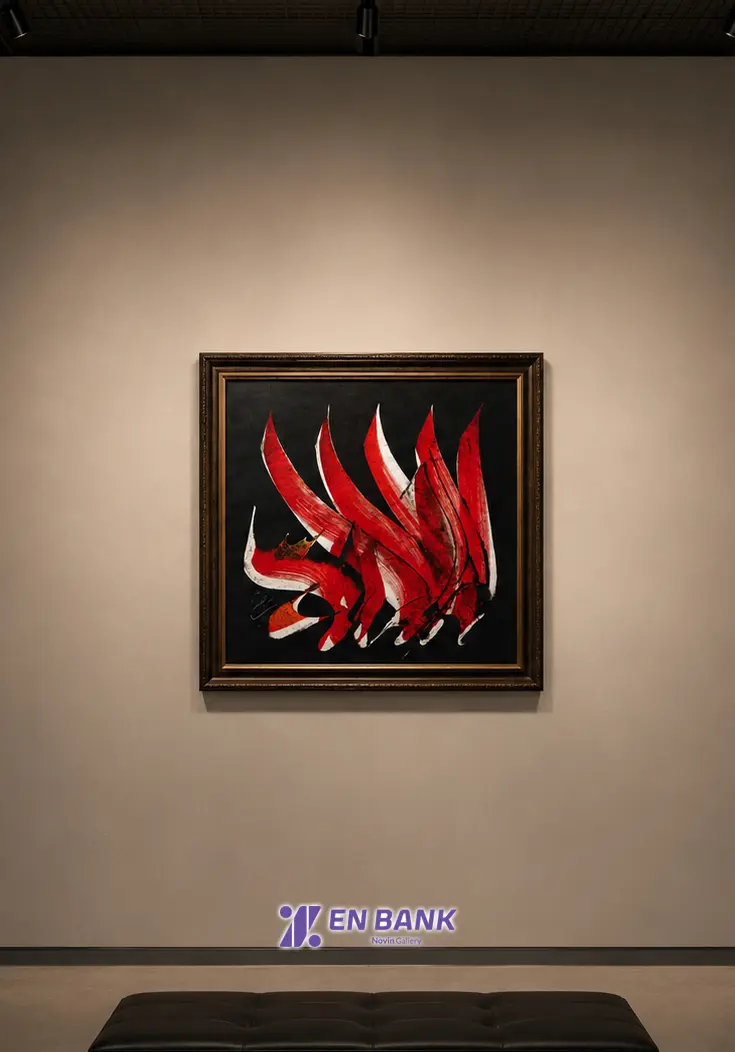
_ Novin Gallery of Eghtesad Novin Bank [ENBank] www.enbank.ir
As Iran's first private bank, Eghtesad Novin Bank [ENBank] embraced a vision of development that extended far beyond conventional financial activity from the very beginning of its establishment in August 2001. The Bank regarded culture and the arts not as peripheral concerns, but as an essential component of the nation's cultural and social capital.
Over the past two decades, Eghtesad Novin Bank has assembled an outstanding collection comprising more than one hundred significant works by many of Iran's most celebrated modern and contemporary artists. This collection is far more than a corporate asset; it represents a visual narrative of an important chapter in the history of Iranian art.
The establishment of Novin Gallery and the organization of regular exhibitions have further demonstrated that the Bank did not acquire these works merely to preserve them within storage facilities or corporate offices. Instead, it has consistently sought to create opportunities for public engagement, scholarly dialogue, and broader appreciation of these remarkable works of art.
At a time when many masterpieces of Iranian contemporary art remain inaccessible within private collections, making these works publicly available represents a meaningful contribution to cultural circulation and strengthens society's relationship with its artistic heritage.
Across the world today, leading financial institutions are evaluated not solely by their economic achievements but also by their contributions to cultural development, quality of life, and the encouragement of creativity. The experience of many internationally respected banks and financial institutions demonstrates that art can serve as a bridge connecting economy, culture, and society—a bridge through which financial capital is transformed into cultural and social capital.
Now, as Eghtesad Novin Bank [ENBank] approaches the twenty-fifth anniversary of its founding in August 2026, the institution stands at an important historical milestone—one that may mark the beginning of a new chapter in the relationship between finance and culture.
The Bank's leadership is preparing to introduce a renewed vision for the role of a financial institution within the arts. This vision extends well beyond collecting and exhibiting artworks, focusing instead on meaningful support for Iran's artistic ecosystem, the strengthening of the creative economy, expanding public access to art, and fostering new forms of collaboration between artists, audiences, and the private sector.
At a time when societies increasingly depend upon cultural capital to nurture hope, encourage dialogue, and renew collective identity, the active and purposeful engagement of economic institutions in the arts can represent far more than financial sponsorship. It is, in essence, an investment in the cultural future of society—a future in which economic development and cultural development advance together.
The twenty-five-year history of Eghtesad Novin Bank [ENBank] offers an exceptional opportunity for the institution to reaffirm its pioneering role—not only in Iran's private banking sector but also in shaping a new model of meaningful participation by economic institutions in the country's cultural and artistic life.
LEAVE A RELPY