
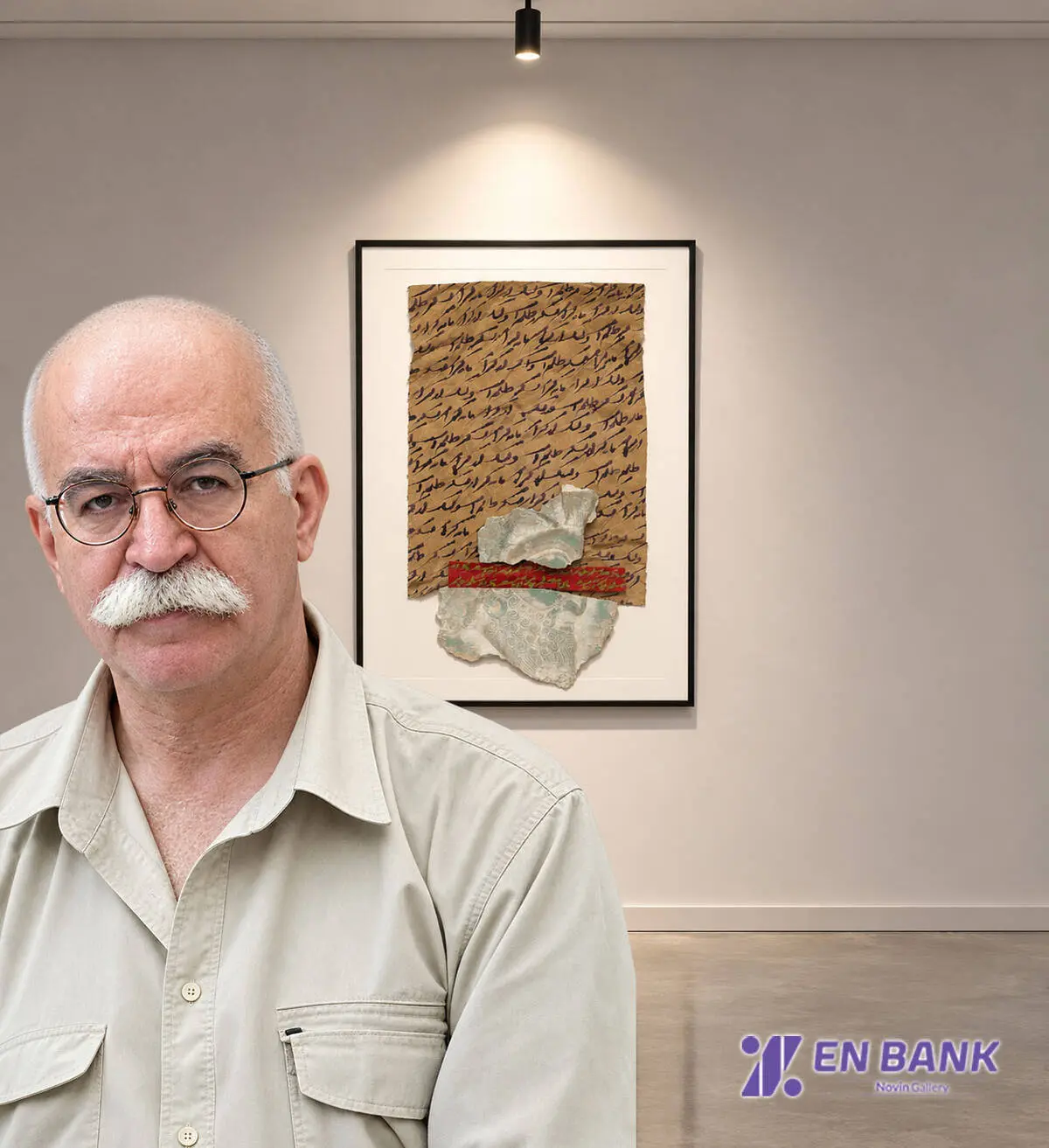
Eghtesad Novin Bank’s Novin Gallery Collection: A Distinctive Work by Mehdi Sahabi from the Achaemenid Series
This work by Mehdi Sahabi is one of his particularly distinctive creations, focusing on a reinterpretation of Iran’s historical memory and visual identity.
ArtDayMe : Eghtesad Novin Bank, Iran’s first private bank, has maintained a prominent presence in the country’s art scene since its establishment. Through the formation of a distinguished art collection and the founding of Novin Gallery, the bank has taken a pioneering role in presenting Iran’s artistic ecosystem.
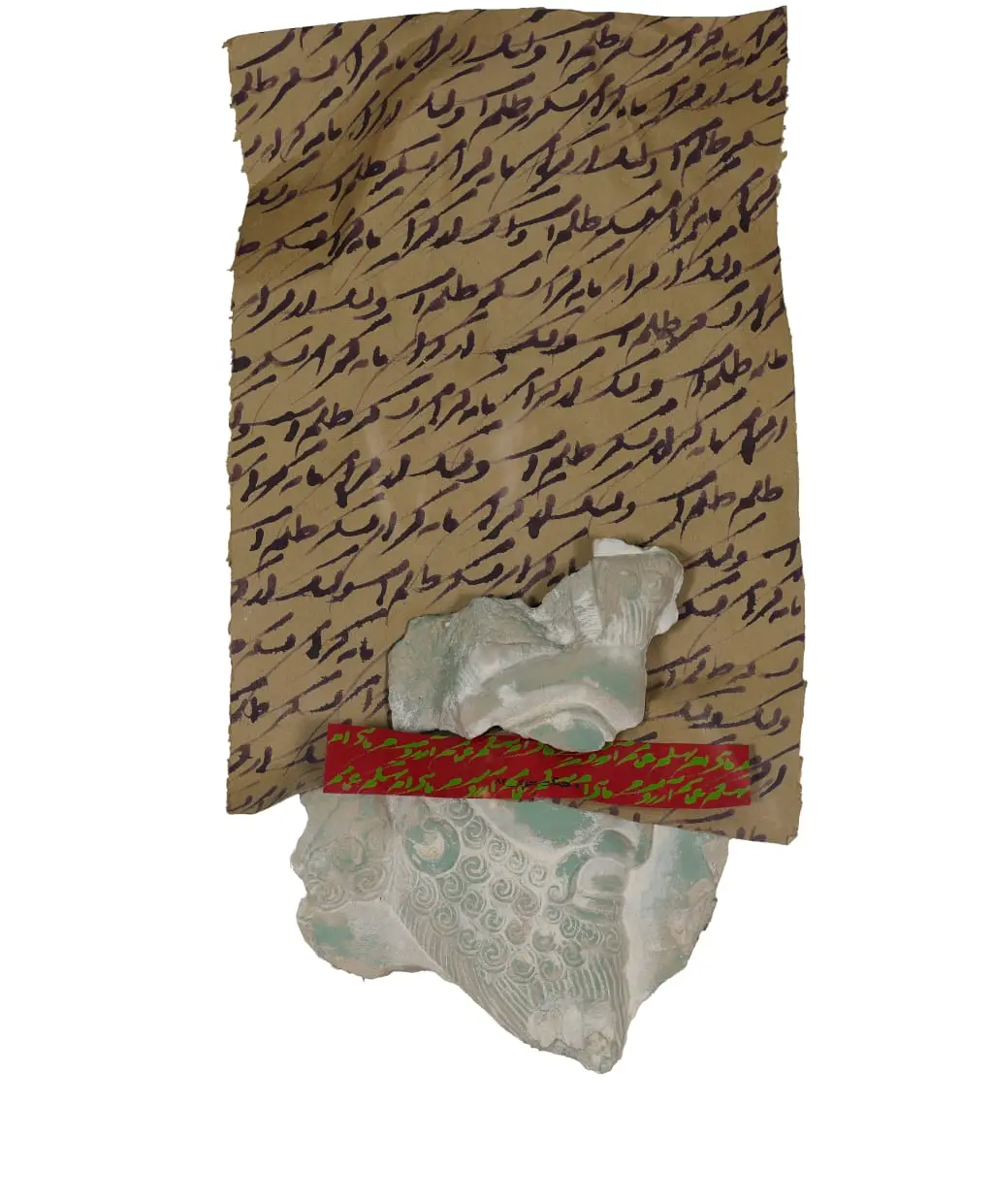
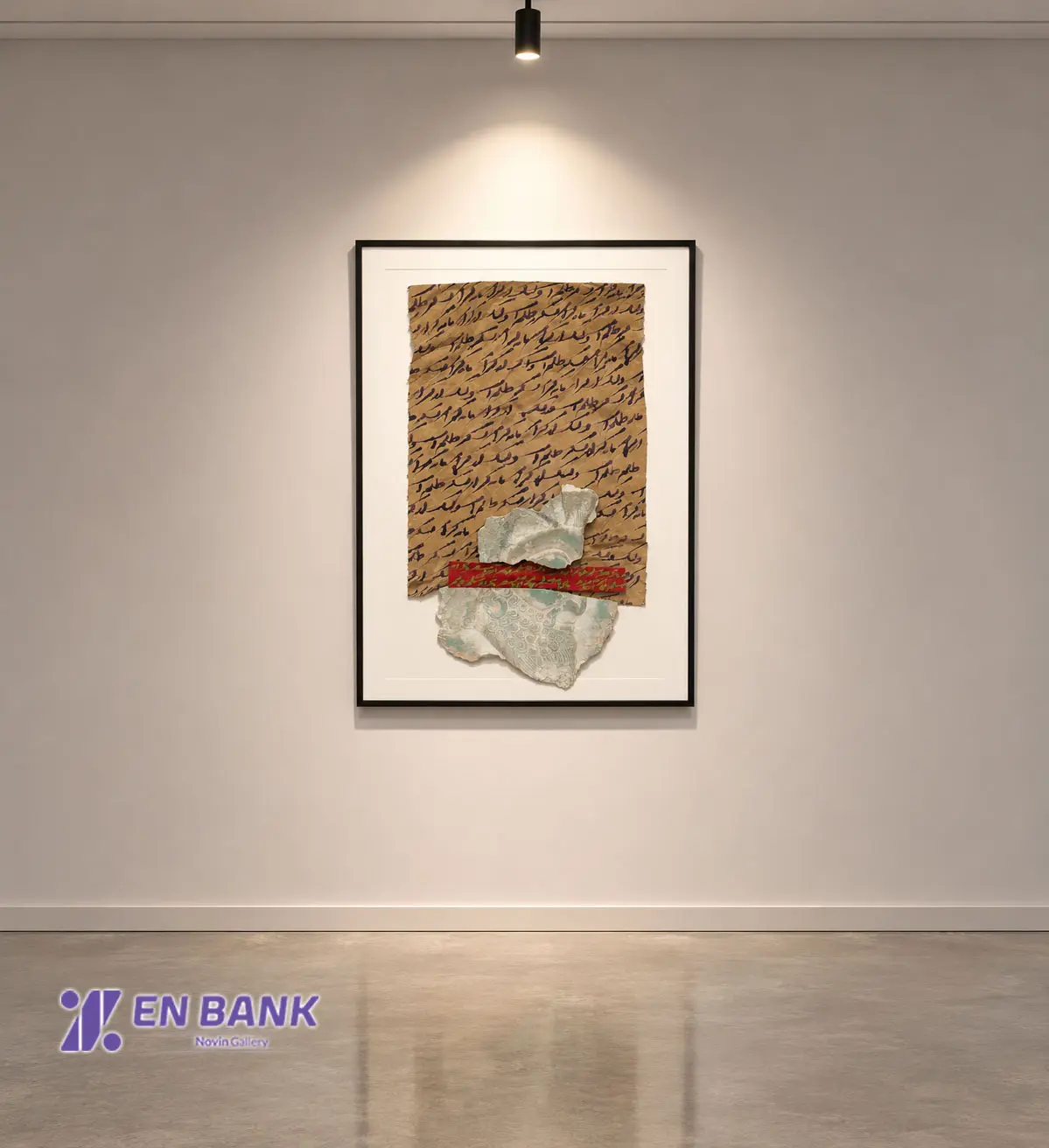
Among the notable works in the Eghtesad Novin Bank collection is an outstanding piece by the late master Mehdi Sahabi: an untitled work from his Achaemenid Series, measuring 110 × 90 cm and executed in mixed media. It offers a compelling example of the encounter between contemporary art and Iran’s historical and cultural heritage.
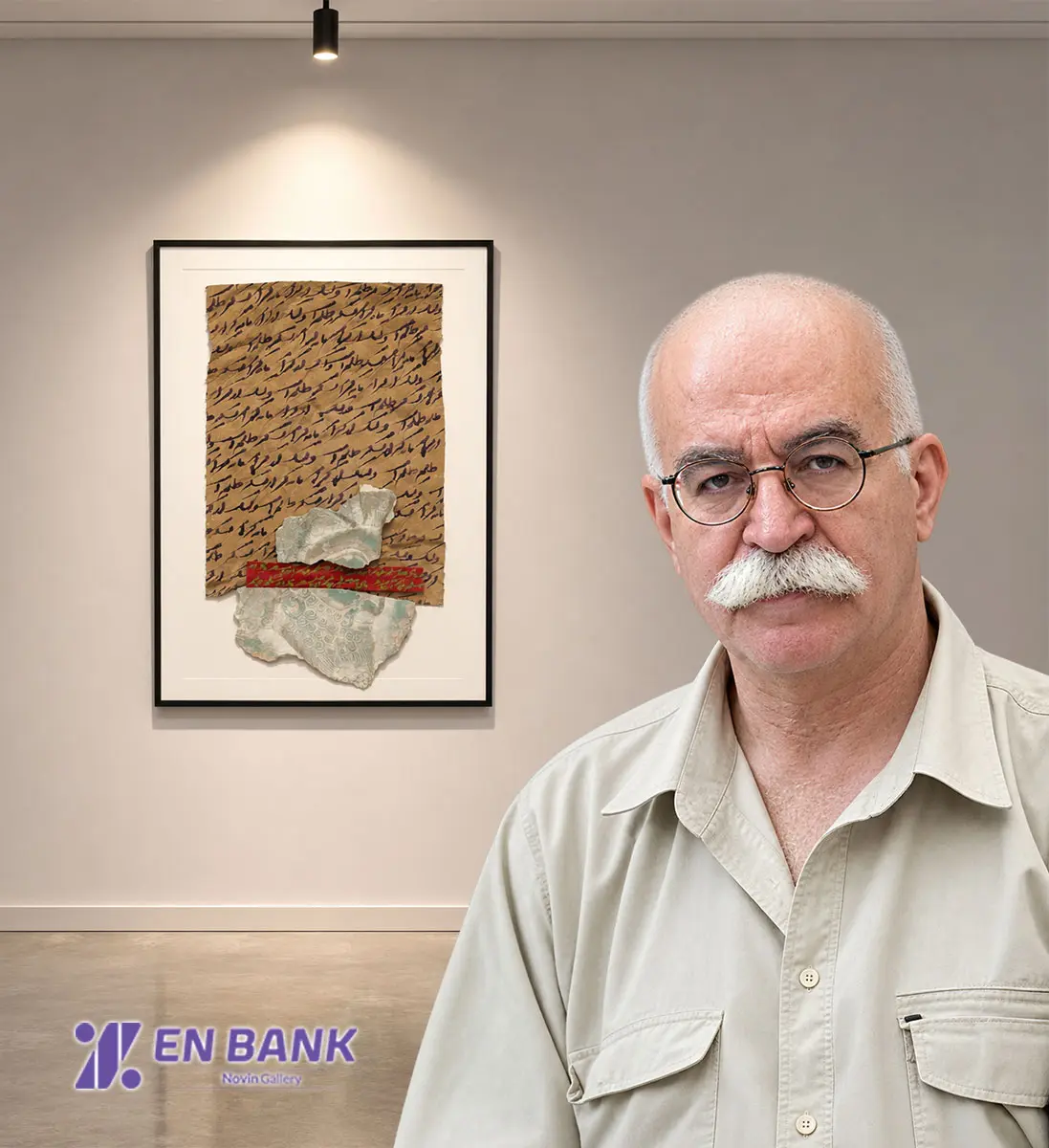
Mehdi Sahabi (February 3, 1944 – November 9, 2009) was an Iranian translator, writer, journalist, painter, sculptor, and photographer. His name is closely associated with his acclaimed Persian translation of Marcel Proust’s In Search of Lost Time. However, over the past two decades, his paintings and sculptures have increasingly attracted recognition and appreciation. This work, preserved in the collection of Novin Gallery at Eghtesad Novin Bank, is among Sahabi’s distinctive creations.
The work belongs to his Achaemenid Series, which received considerable critical attention at the largest retrospective exhibition devoted to Sahabi, A Survey of Mehdi Sahabi’s Works, held at the Tehran Museum of Contemporary Art in autumn 2021 and curated by Mojdeh Tabatabaei. The series was particularly praised at that exhibition.
Rather than directly depicting history or reconstructing the visual appearance of an ancient period, Sahabi employs written signs and elements drawn from Achaemenid art and civilisation to establish a multilayered relationship between the past, cultural memory, and the experience of contemporary humanity.
This work from Mehdi Sahabi’s Achaemenid Series brings together writing, volume, texture, and signs of civilisation within a multilayered structure. The contrast between flat surfaces and raised elements, the interplay of earthy colours and chromatic accents, and the juxtaposition of calligraphy with relief-like forms constitute some of its most significant aesthetic characteristics.
Perhaps the work’s greatest achievement lies in transforming historical heritage from something belonging exclusively to the past into a living presence within contemporary visual experience. This presence emerges not through historical reconstruction, but through the juxtaposition of fragments, signs, and layers of memory. Sahabi does not simply present the past; he invites viewers to see and read it anew.
_The Interplay of Surface and Volume
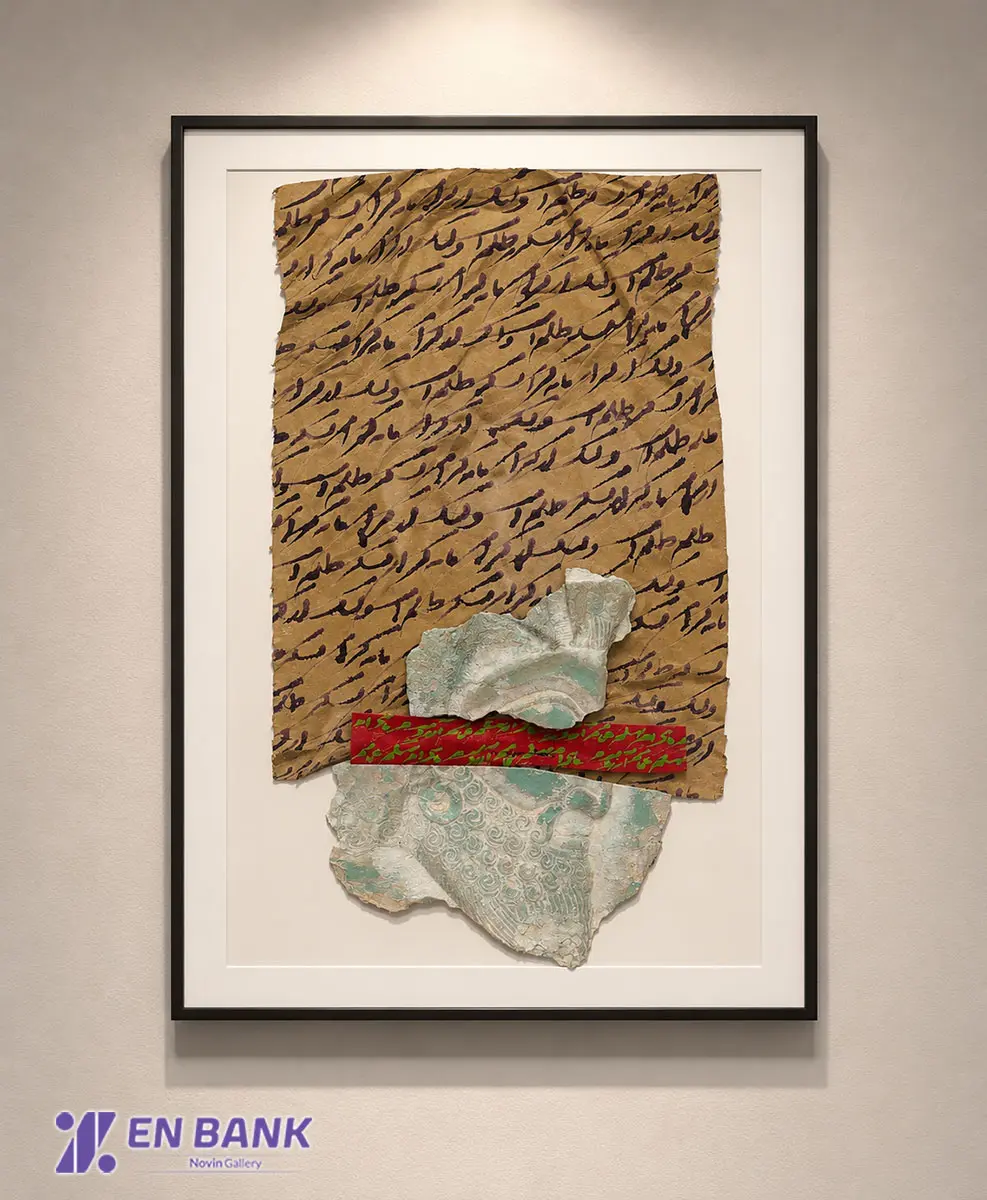
One of the first striking characteristics of Mehdi Sahabi’s work, preserved in the Novin Gallery collection of Eghtesad Novin Bank, is the juxtaposition of two distinct elements: an expansive surface with a beige background, covered in dark calligraphic lines that move diagonally and continuously across it, and a raised fragment featuring motifs and a structure reminiscent of ancient reliefs, positioned in the lower section of the composition. Although these two elements differ in material, texture, and visual language, together they form a unified and meaningful structure.
In fact, the written surface occupies most of the visual field, extending across the upper and middle sections like a historical curtain. By contrast, the raised element at the bottom extends beyond the boundaries of the principal surface, introducing a sense of depth and spatial dimension into the composition.
This opposition between surface and volume is one of the work’s most significant aesthetic features. The written plane possesses a two-dimensional, sign-based character, whereas the raised fragment, through its physical presence and natural shadows, emphasises the material and corporeal reality of the artwork. Their juxtaposition confronts the viewer with two different ways of recording history: history as written text and history as embodied form.
_Calligraphy: Language, Memory, and Repetition
The Persian-like lines covering the surface are not merely decorative elements. The density of the writing, the repetition of lines, and the diagonal movement of the strokes create a visual rhythm that guides the viewer’s gaze across the entire composition.
Here, writing becomes more than a linguistic instrument; it is transformed into a visual element in its own right. At first encounter, the complete legibility of the text is less significant than the material presence of the script, the movement of the pen, and the accumulation of signs. It is as though Sahabi, by transforming writing into a visual texture, is drawing attention to the role of language in transmitting historical memory.
_The Achaemenid Element: The Return of a Civilisational Sign
The raised fragment in the lower section of the work, with its curved motifs, repetitive ornamental patterns, and three-dimensional structure, evokes the visual language of ancient Iranian art. Its presence takes this work by Mehdi Sahabi, held in the Novin Gallery collection of Eghtesad Novin Bank, beyond an abstract composition based solely on calligraphy, connecting it to the realm of civilisational memory.
Significantly, Sahabi does not present this historical reference as an independent, complete image. Instead, he introduces it as a detached fragment, partially concealed from the viewer. This treatment reinforces the impression of encountering an object surviving from the past: an object that retains part of its original identity yet has been separated from its historical and architectural context.
Material and Texture: The Significance of Physical Presence
The use of mixed media plays a fundamental role in shaping the meaning of this work by Mehdi Sahabi. The difference between the paper-like surface and the raised fragment is not merely technical; it enables the work to move beyond the boundaries of two-dimensional painting and approach the realm of the art object and a quasi-sculptural structure.
The uneven texture and irregular edges of the written surface, alongside the raised and recessed areas of the lower element, emphasise the physical qualities of the materials. The viewer encounters not simply an image, but an arrangement of surfaces and materials, each carrying a different temporal and sensory quality. This characteristic introduces a sense of wear, antiquity, and survival into the composition.
_A Colour Palette Defined by Age and Authenticity
In this work, Mehdi Sahabi employs a relatively restrained yet meaningful colour palette. The beige and earthy background, dark brown lines, and raised fragment in shades of greyish green and white evoke the colour characteristics of historical objects and artefacts weathered by the passage of time.
Among these elements, the red band in the middle and lower sections of the composition serves as the principal chromatic accent. Its green lettering contrasts with the work’s otherwise neutral and earthy tones, drawing the viewer’s attention to the point where the two main sections meet.
From an aesthetic perspective, this colour contrast prevents the composition from becoming monotonous and lends it a distinctly contemporary quality, as though the historical past were encountering a sign of the present.
Beyond the Conventional Frame of Painting
One of the notable features of this work from Mehdi Sahabi’s Achaemenid Series is its treatment of pictorial space. The raised fragment extends beyond the boundaries of the written surface, with part of it positioned beneath the principal layer. This overlapping arrangement creates a degree of spatial ambiguity: does the historical element emerge from beneath the written layer, or do the inscriptions function as a covering placed over it?
This ambiguity establishes a visual relationship between concealment and revelation, which can be interpreted as a metaphor for the condition of historical memory. The past has neither disappeared entirely nor become fully accessible. Instead, it persists within different layers of time, allowing only certain fragments to emerge.
Conceptual Reading: History as Living Memory
On a conceptual level, the work can be understood as an encounter between two forms of Iran’s cultural heritage: its written heritage and its visual heritage. Calligraphy carries language, thought, and the record of human experience, while relief sculpture represents the enduring power of images to preserve the worldview and civilisational identity of a historical period.
The juxtaposition of these two elements prevents the past from becoming merely an archaeological subject; instead, it places history within the context of contemporary experience. Rather than reconstructing the grandeur of the Achaemenid Empire, Sahabi draws upon the surviving fragments of its visual signs. This approach opens up space for reflection on the distance between historical civilisation and contemporary humanity.
The work can also be examined within the broader context of contemporary artistic practices that engage with materials, signs, writing, and historical references. Sahabi moves beyond the conventional boundaries of painting, creating an interdisciplinary visual language through the combination of pictorial and sculptural elements.
The significance of this approach lies in its refusal to reduce history to a decorative image or an object of nostalgia. Instead, history becomes a material through which new meaning can be created.
-Novin Gallery of Eghtesad Novin Bank
Eghtesad Novin Bank, www.enbank.ir Iran’s first private bank, adopted a vision of development that extended beyond conventional economic relationships from the very beginning of its operations in August 2001. This vision regarded culture and the arts not as peripheral domains, but as integral components of the country’s social and cultural capital.
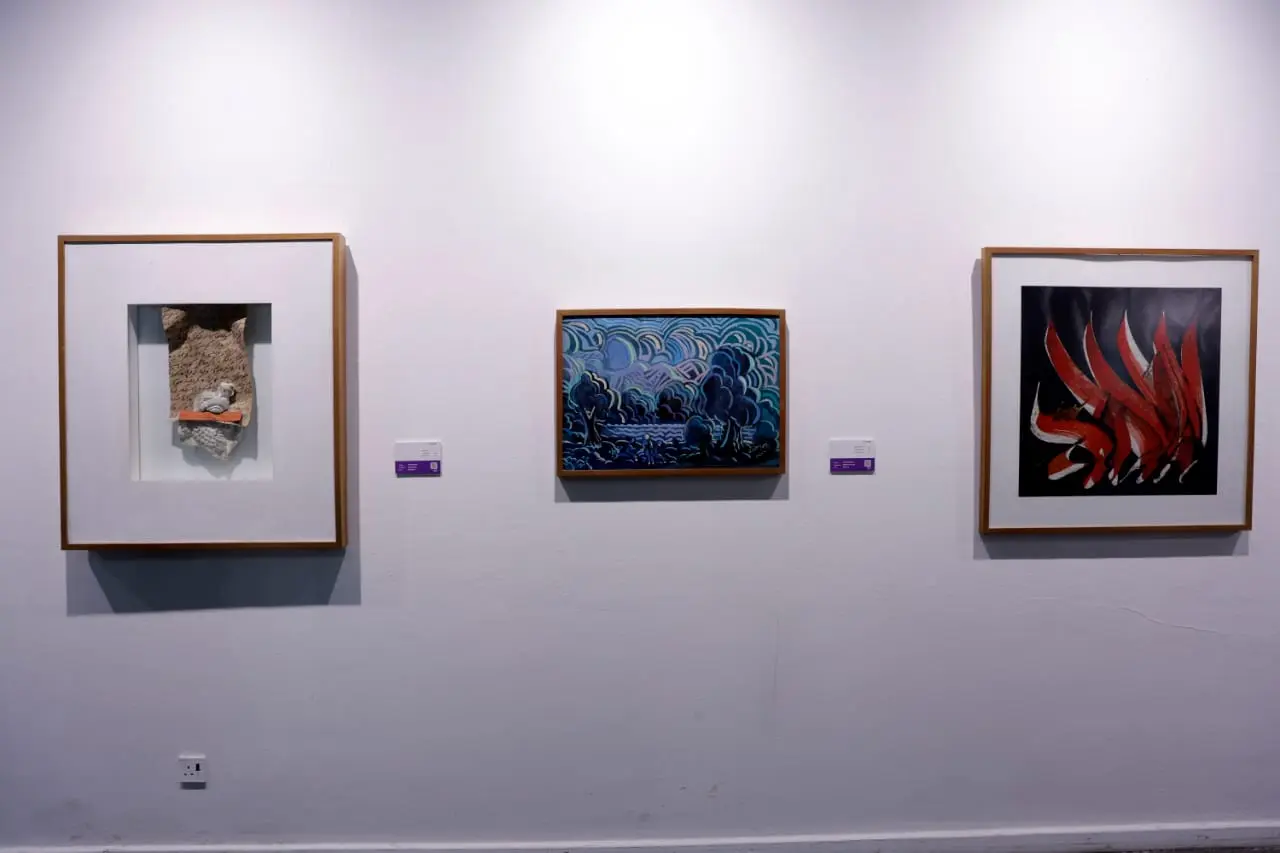
Over the past two decades, Eghtesad Novin Bank has assembled a valuable collection of outstanding Iranian artworks, comprising more than one hundred pieces by prominent and influential figures in modern and contemporary Iranian art. This collection is more than a corporate art holding; it represents a visual account of an important chapter in the recent history of Iranian art.
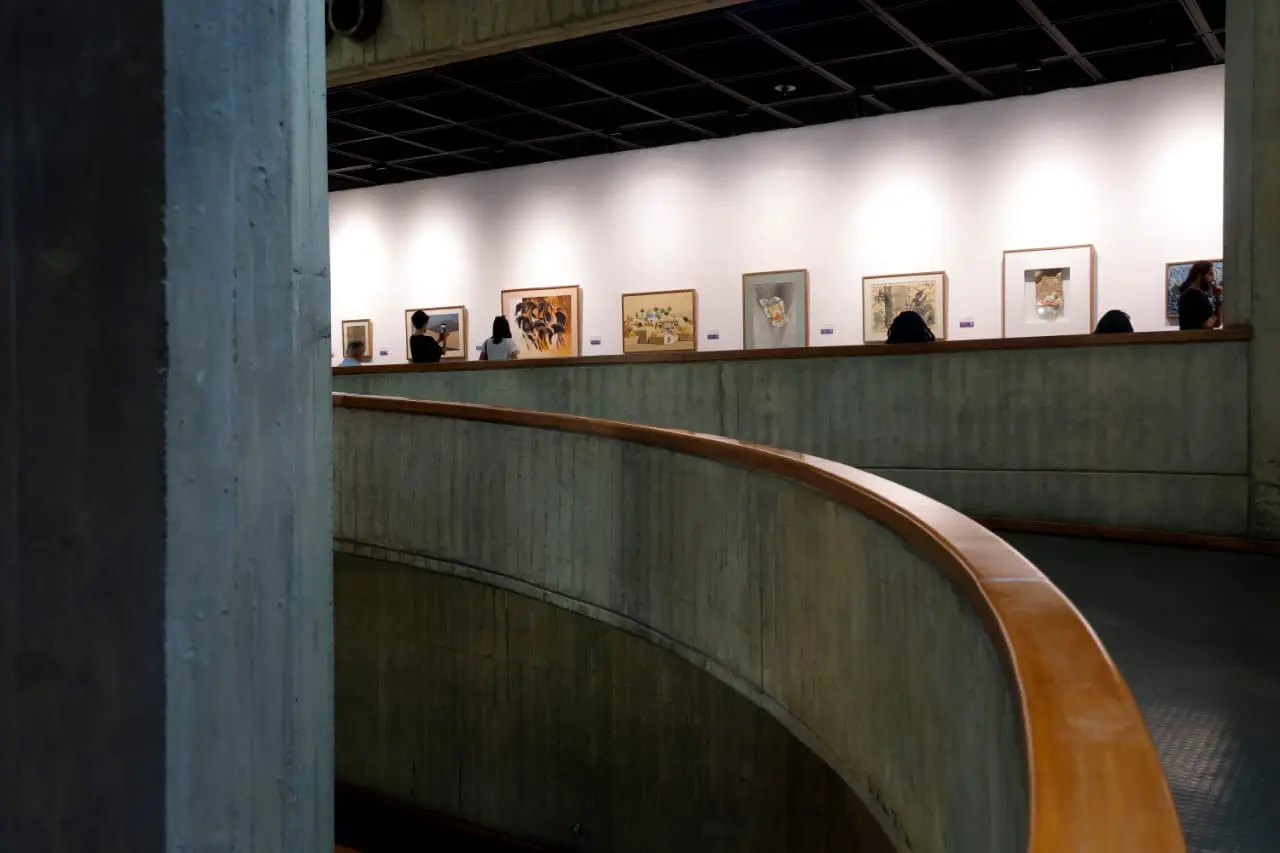
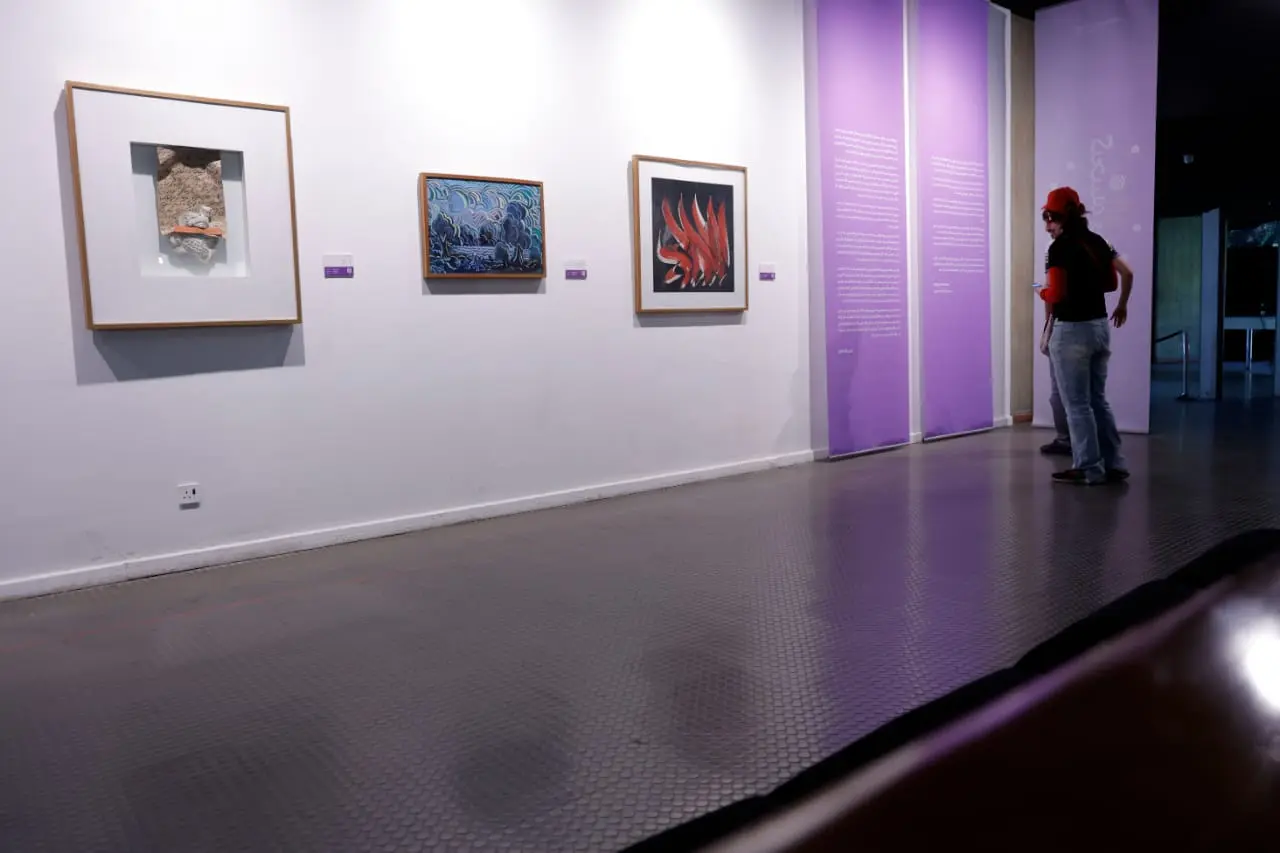
The establishment of Novin Gallery and the organisation of periodic exhibitions featuring works from this collection have demonstrated that Eghtesad Novin Bank did not acquire these artworks merely to preserve them in storage facilities or corporate spaces. Rather, it has sought to create opportunities for public engagement and critical dialogue around these works, making them accessible to audiences and the wider art community.
At a time when many significant works of contemporary Iranian art remain inaccessible to the public in private collections, exhibiting these works publicly represents a meaningful contribution to cultural circulation and strengthens the relationship between society and its contemporary artistic heritage.
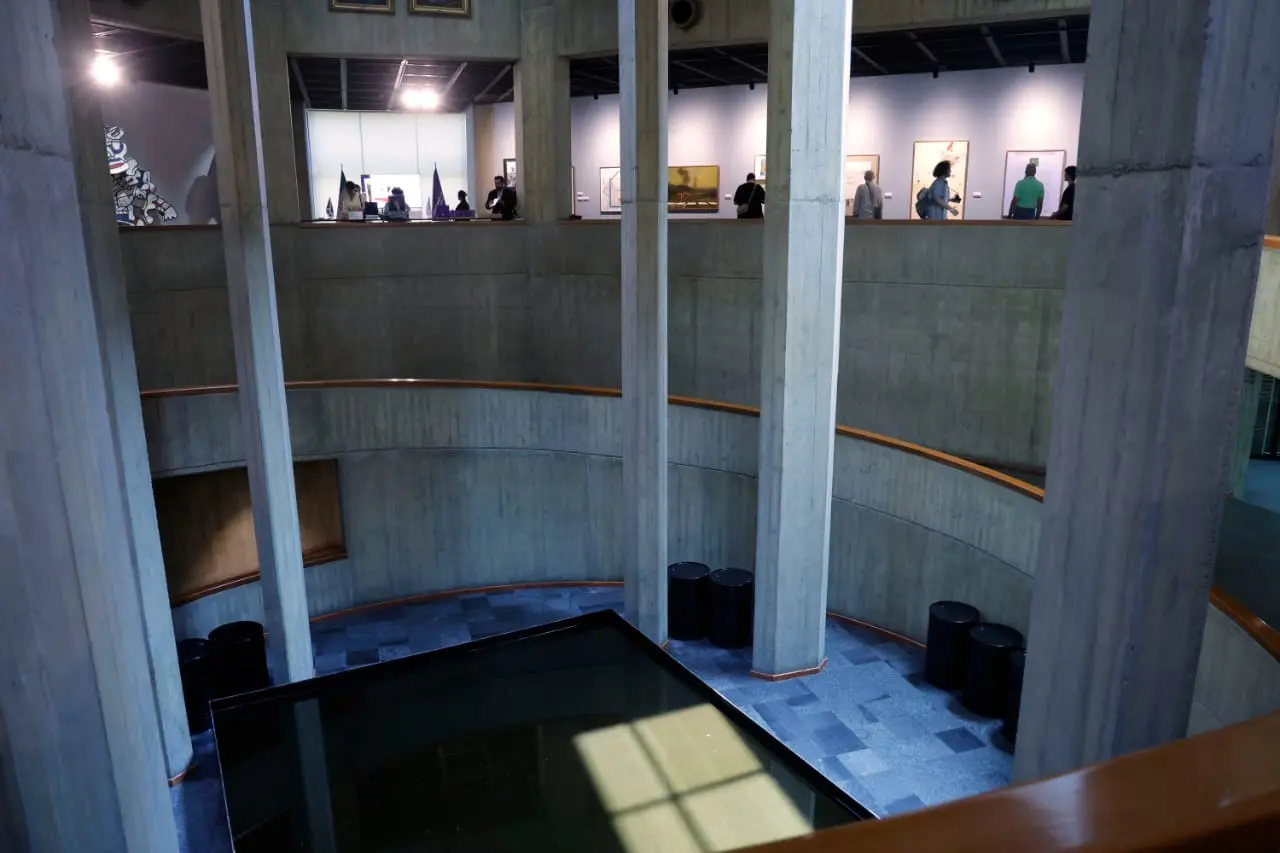
Today, major financial institutions around the world are evaluated on criteria that extend beyond economic indicators. Their contributions to improving quality of life, promoting cultural development, and supporting creativity are also essential to their social standing and institutional reputation. The experience of many respected international banks and financial institutions demonstrates that art can serve as a bridge between the economy, culture, and society—a bridge through which financial capital can be transformed into cultural and social capital.
As Eghtesad Novin Bank approaches the twenty-fifth anniversary of its establishment, it stands at an important juncture in its history, one that could mark the beginning of a new chapter in the relationship between the economy and culture.
The bank’s management is preparing to introduce a renewed vision for the role of a financial institution in the arts. This vision is intended to move beyond conventional art collecting and exhibition-making, focusing instead on meaningful support for Iran’s artistic ecosystem, strengthening the creative economy, expanding public access to art, and establishing new platforms for interaction among artists, audiences, and the private sector.
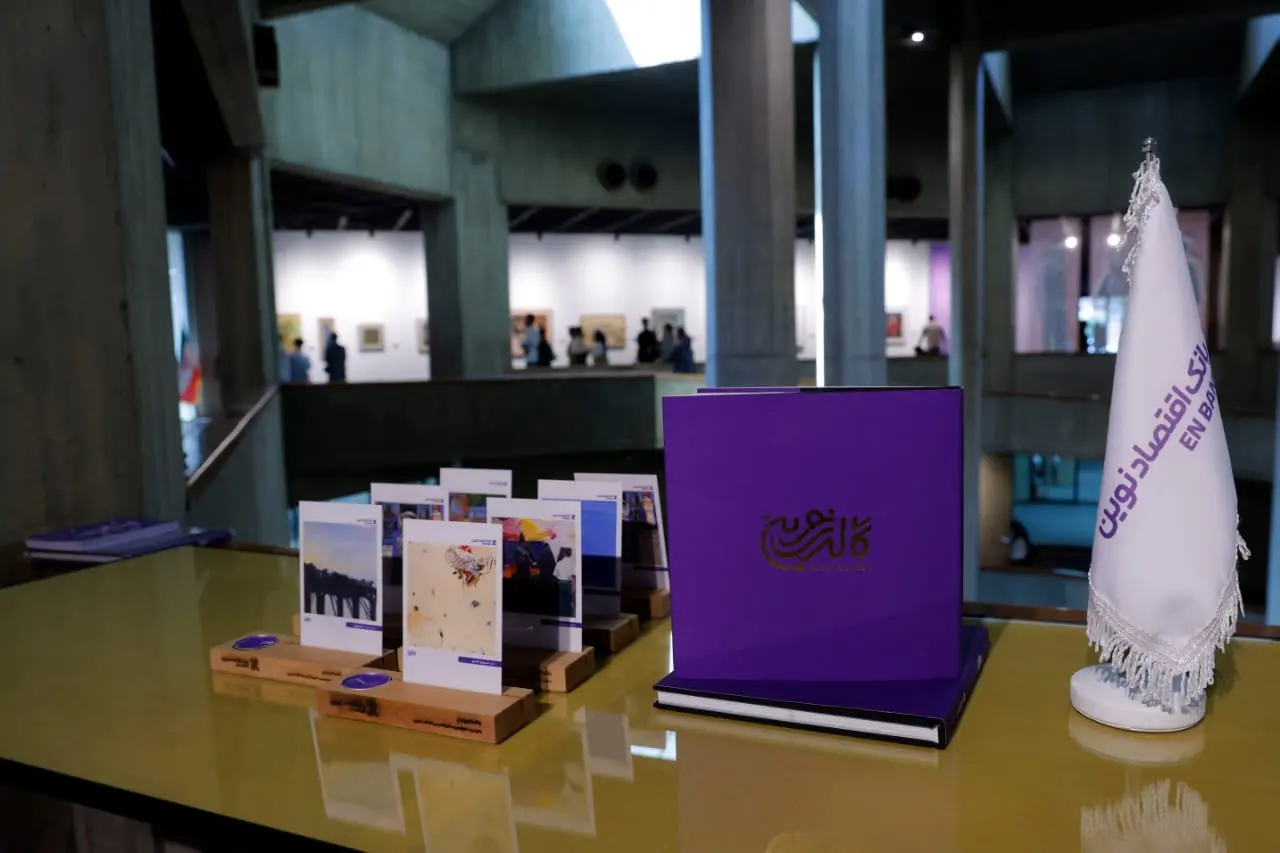
At a time when societies need cultural capital more than ever to strengthen social hope, collective dialogue, and the renewal of identity, the active and purposeful involvement of economic institutions in the arts can serve a role that goes far beyond financial support. Such engagement represents an investment in the cultural future of society—a future in which economic and cultural development are understood as mutually reinforcing processes.
The first quarter-century of Eghtesad Novin Bank’s activities offers an important opportunity for the institution to reaffirm its pioneering role, not only in private banking but also in shaping a new model for the participation of economic institutions in Iran’s cultural and artistic life.
LEAVE A RELPY