
Fatemeh Ahmadian and the Beautiful Sorceress; Reimagining “Rostam’s Fourth Trial” Between Myth, Temptation, and Contemporary Art
From an aesthetic perspective, this work occupies a space somewhere between epic art, Persian miniature painting, folklore, fantasy, and decorative art—and this is the pinnacle of Fatemeh Ahmadian’s artistry.
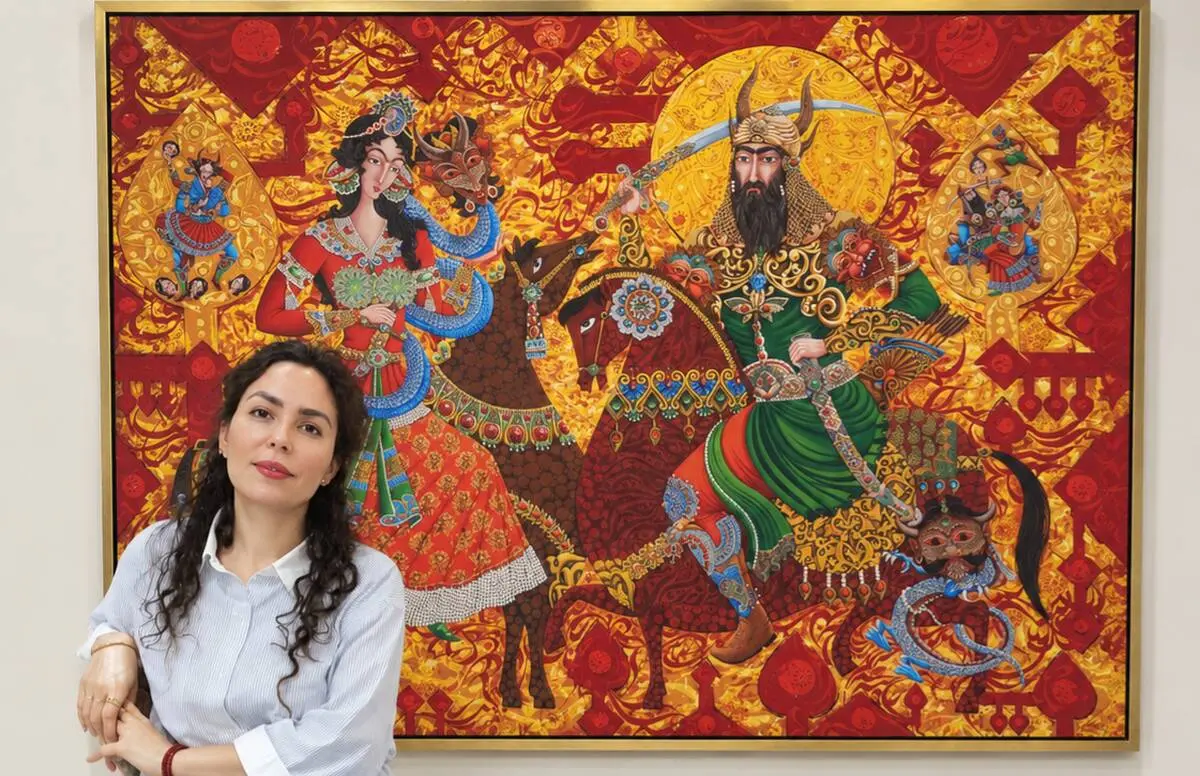
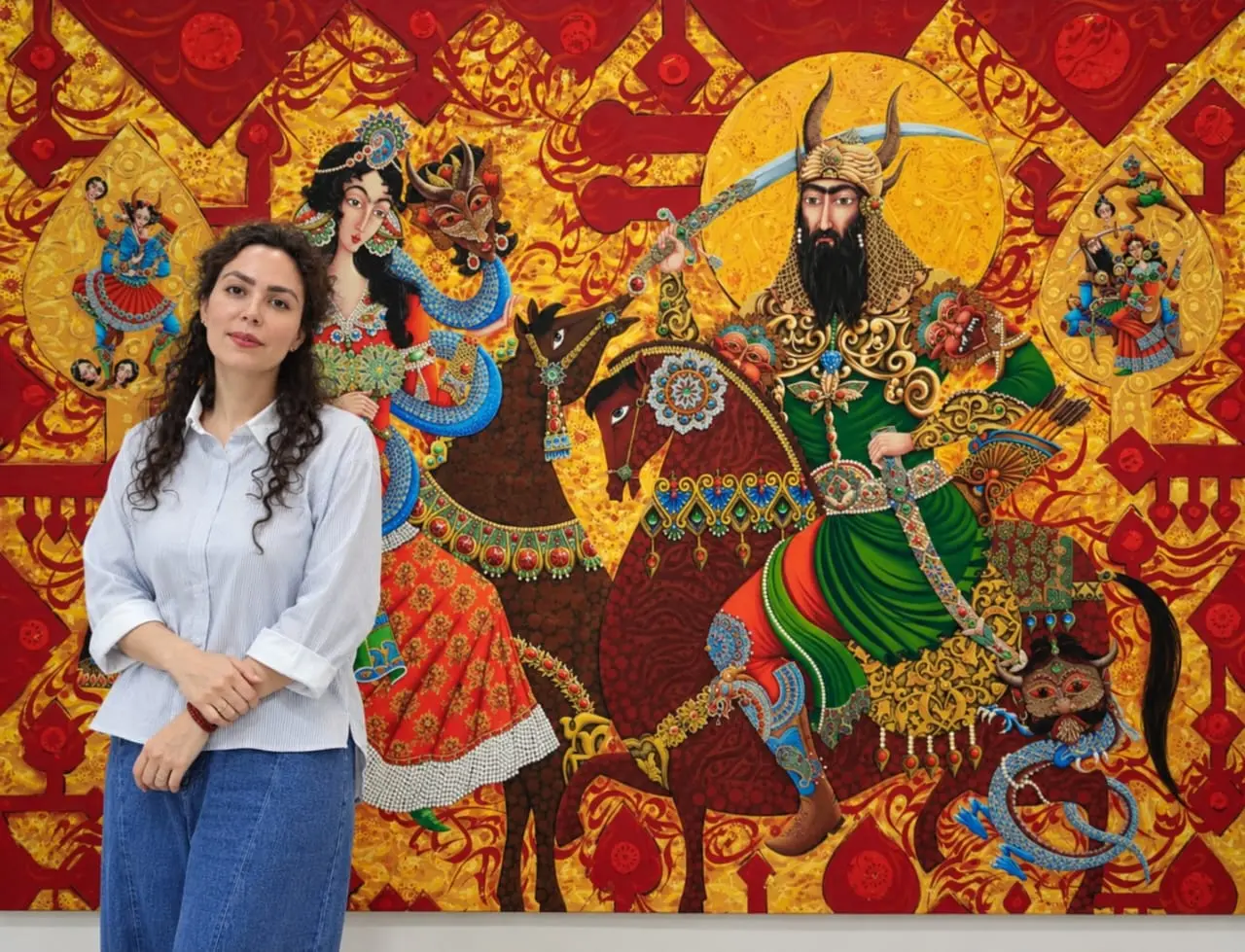
ArtDayMe :We take a closer look at “Rostam’s Fourth Trial; Rostam’s Battle with the Sorceress,” a painting by Fatemeh Ahmadian (born 1982, Khansar).
Created in 2021 in oil on canvas, measuring 160 × 200 cm, this work can be regarded as one of those paintings that do not merely illustrate a literary narrative, but transform it into a new visual system.
In “Rostam’s Fourth Trial; Rostam’s Battle with the Sorceress,” Ahmadian does not simply reconstruct one of the scenes from the Shahnameh of Ferdowsi. Instead, she builds a bridge between several Iranian visual traditions: coffeehouse painting, Qajar visual and decorative motifs, Saghakhaneh symbolism, and ultimately her own personal visual language.
The result is a vibrant, dense, multilayered image in which myth, ornamentation, narrative, and the psychology of contemporary humanity exist simultaneously.
_ The Shahnameh as Raw Material for Painting
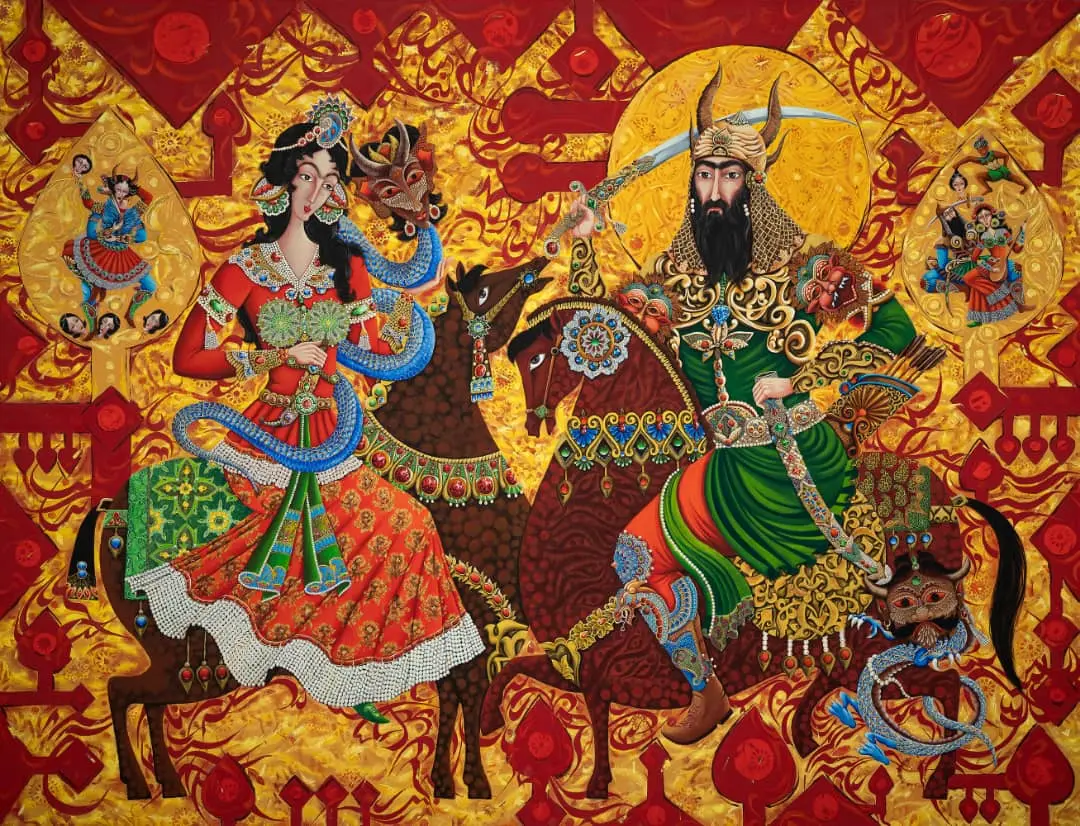
Through the title of the work, “Rostam’s Fourth Trial; Rostam’s Battle with the Sorceress,” Fatemeh Ahmadian takes the viewer directly into the world of the Shahnameh of Ferdowsi. Yet what Ahmadian does is not literary illustration in its classical sense. She extracts a narrative moment from the text and transforms it into a symbolic scene about choice and discernment.
Here, Rostam is not merely a hero fighting an evil force; he represents a human being confronted by something whose true nature is not easily discerned.
This very point separates the epic narrative from its historical-storytelling dimension and turns it into a contemporary question: Can human beings recognize the truth behind an alluring appearance?
From this perspective, the sorceress in Ahmadian’s painting is less an “evil monster” than an embodiment of temptation; and this choice constitutes one of the work’s most significant conceptual dimensions.
_A Scene Between the Stage Curtain and Miniature Painting
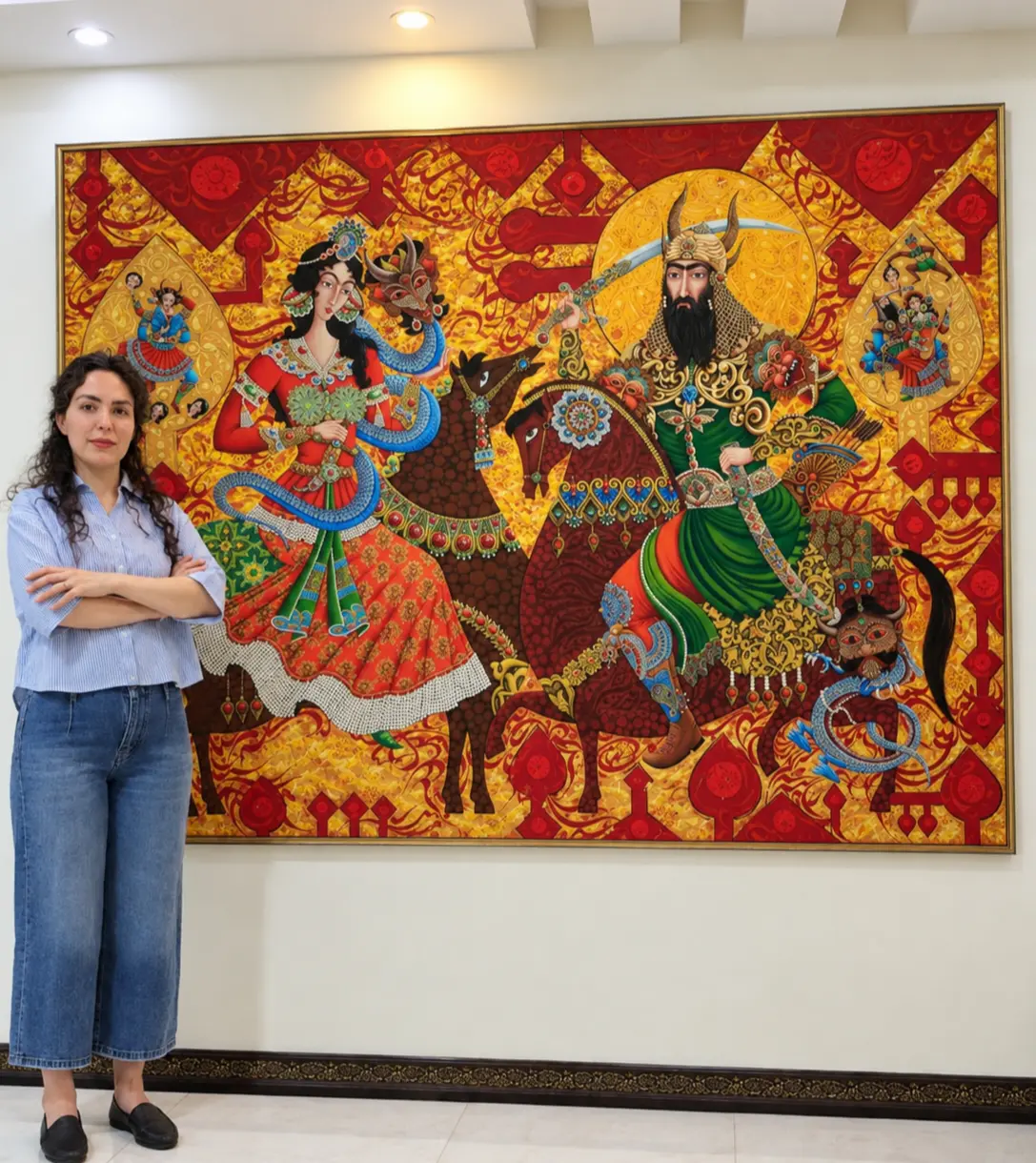
The large dimensions of 160 × 200 cm have enabled the artist to organize the scene as an expansive narrative field. Rather than relying on naturalistic spatial depth, the composition is closer to the logic of a narrative tableau.
Rostam, the horses, the sorceress, and the surrounding figures are positioned within a relatively compressed pictorial plane, while various elements fill the painting almost to the edges of the canvas. As a result, the viewer’s eye encounters less of a conventional “vanishing point” and instead moves among the figures, patterns, colors, and details.
This quality is particularly reminiscent of the tradition of coffeehouse painting, in which narrative takes precedence over the realistic representation of space.
At the center of the work, Rostam and his horse carry considerable visual weight, while the horse’s body, through its movement and curvature, creates a powerful diagonal axis within the composition.
In contrast, the sorceress, with her red clothing and theatrical pose, creates another visual force. This contrast is, in fact, the conceptual opposition at the heart of the work: power versus seduction, will versus temptation.
_Gold for Myth, Red for Temptation
One of the most striking aspects of the painting is its color system.
The dominance of gold, yellow, red, orange, green, and blue creates a highly saturated and energetic atmosphere. Here, color is not merely a means of beautifying the image; it is itself part of the language of the narrative.
Gold and yellow transport the work into a mythical, ritualistic, and non-realistic realm. These colors are also connected to traditional Iranian ornamentation and the visual splendor of historical periods of the past.
Red, by contrast, has an exceptionally powerful presence—a color that can simultaneously signify blood, danger, love, desire, violence, and temptation. This multiplicity of meanings makes red particularly compatible with the character of the sorceress.
Green and blue, present in the garments and details, temper the visual intensity of the reds and golds while simultaneously giving the work a kind of miniature-like chromatic rhythm.
Thus, the palette of the work can be described not as a naturalistic palette, but as a symbolic and theatrical one.
_Line as the Music of the Painting
Fatemeh Ahmadian’s use of curved, winding, and decorative lines in the background is particularly significant. They are not merely patterns and ornaments; they create a kind of visual music.
The movement of the lines in the background corresponds with the movement of fabrics, jewelry, the horses’ bodies, and even the figures’ limbs. In this way, line moves beyond being a boundary or decorative element and becomes a unifying force throughout the entire image.
This quality can be understood within the Iranian tradition of the coexistence of line, pattern, and image—a tradition in which the surface of an artwork is never entirely neutral or empty.
Even in sections where writing does not literally exist, the linear quality of the patterns creates a kind of calligraphic association.
_Space; Eliminating Depth to Strengthen Myth
Fatemeh Ahmadian has consciously moved away from three-dimensional representation and naturalistic perspective. The space of the work is predominantly flat, layered, and planar.
This flatness is a deliberate choice that corresponds with the mythical nature of the subject. Within such a space, the figures do not exist within a specific historical time; rather, they inhabit a kind of mythic time.
For this reason, the sorceress, Rostam, the horses, and the surrounding figures appear more like characters inhabiting an independent narrative universe than human beings standing in a real physical location.
_Moving Beyond the Simple Binary of Good and Evil
One of Fatemeh Ahmadian’s most compelling decisions concerns the face of the sorceress: contrary to expectation, she has not depicted the sorceress as an ugly and terrifying creature, but has given her a beautiful, refined, and even seductive appearance.
This choice changes the meaning of the story.
If evil always had an ugly face, recognizing it would be easy; but the real challenge for human beings begins when deception appears in the guise of beauty.
From this point, the work enters the realm of psychology. The sorceress can be understood as a metaphor for anything that, through its attractive appearance, leads a person away from their path: power, desire, wealth, fame, relationships, promises, or even a fabricated image of happiness.
Consequently, Rostam’s battle with the sorceress can be understood not merely as an external confrontation, but as humanity’s struggle with its own inner weakness of discernment.
_Symbolism; From the Horse and the Hero to Hybrid [Composite] Creatures
The horse in this work is not merely a means of transportation for Rostam. The powerful presence of the animal forms part of Rostam’s heroic identity, while its decorative and exaggerated forms transform it into an almost mythical element.
Alongside it, hybrid [composite] creatures, mask-like faces, and secondary figures move the work away from a purely human narrative and give it a dreamlike, ritualistic, and folkloric quality.
These creatures can be regarded as part of the story’s psychological universe—a world in which the boundaries between human, animal, demon, magic, and myth are entirely permeable.
_Creating Distance from Coffeehouse Painting
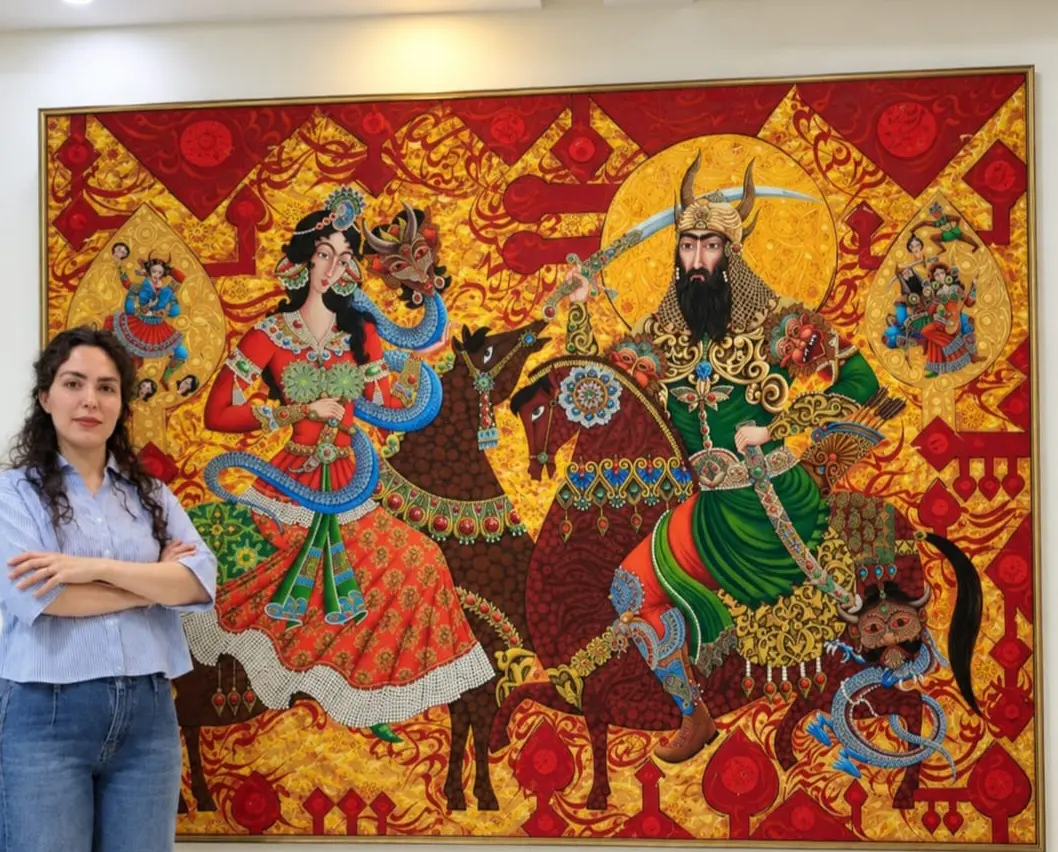
The work clearly enters into dialogue with the tradition of coffeehouse painting, but also has clear differences from it.
In coffeehouse painting, narratives drawn from the Shahnameh, epic literature, religion, and history were presented in a direct, powerful, and theatrical visual language. Fatemeh Ahmadian preserves this narrative spirit, but combines it with much stronger departures from that tradition, greater visual distance, more saturated colors, and her own contemporary visual language.
Therefore, the work can be regarded as a kind of urban and contemporary reinterpretation of the logic of Iranian narrative tableaux.
_The Connection with Qajar Art and the Saghakhaneh School
The influence of Qajar-period ornamentation can be observed in the variety of decorative motifs, jewelry, clothing, facial treatment, and the richness of the pictorial surface.
At the same time, the presence of symbols and the composite quality of the work resonate with the logic of the Saghakhaneh School—that is, a conscious return to indigenous signs and elements of Iranian visual culture and their transformation into material for a modern visual language.
The important point is that Ahmadian does not historically reconstruct these sources. She appropriates, combines, and reinterprets them. This is precisely where the work moves from the reconstruction of tradition toward the creation of a personal language.
_Visual Aesthetics or Part of the Meaning?
The abundance of ornamentation may, at first glance, appear to serve merely an aesthetic purpose; however, in this work, ornamentation also performs another function.
The densely patterned and highly detailed surface prevents the viewer from “reading” the image too quickly.
The eye is compelled to pause, move among the figures, and discover the details.
This has an intriguing relationship with the subject of the work: the visual world, like the narrative world, is a world in which appearance and inner reality are not the same.
On the surface, everything is lavish, beautiful, and seductive; beneath this splendor, however, an ethical and psychological struggle is taking place.
Fatemeh Ahmadian’s choice of oil on canvas for such a project has enabled her to create layers of color, luminous depth, details in clothing and jewelry, and a variety of textures.
In this work, oil paint serves less the purpose of realism than that of constructing a rich and densely layered surface. In other words, the painting draws upon the material qualities of oil paint to approach a quasi-miniature-like and decorative character.
_The Return of Myth to Contemporary Life
The significance of the work in the contemporary moment lies precisely here: Why do Rostam and the sorceress still hold meaning for us?
Myths remain alive when they are capable of adapting themselves to new concerns. Ahmadian similarly transforms Rostam from a historical-mythical hero into a symbol of contemporary humanity confronting mechanisms of deception.
In contemporary society, deception does not necessarily have a frightening face; it may be beautiful, attractive, glamorous, and even desirable. Thus, the sorceress in this painting can offer a contemporary reading of a very ancient question: How does a human being distinguish between appearance and truth?
_The Sorceress as the “Other Within”
From a psychological perspective, one can take this reading even further.
The sorceress is not necessarily an external being. She can be understood as a part of the human psyche—the desiring, tempting, and rationalizing part that draws a person toward something they know they should not approach.
In this reading, Rostam is not fighting the “Other”; rather, he is confronting the possibility of falling within himself.
The beauty of the sorceress acquires a deeper meaning here as well: “Temptation becomes truly powerful when it can make itself appear desirable.”
Fatemeh Ahmadian has conceived the concept of her work in such a way that it naturally evokes these readings in the mind of the viewer.
_Aesthetic Value; Between Epic and Fantasy
From an aesthetic perspective, the work occupies a space between epic art, Persian miniature painting, folklore, fantasy, and decorative art, and this is the pinnacle of Fatemeh Ahmadian’s artistry.
This combination has created a distinctive visual space—neither entirely traditional nor entirely modern.
The strength of the work lies precisely in this in-between condition: the viewer encounters both a familiar image and something that cannot be placed precisely within any one of the established categories.
_Rewriting Myth in a Personal Language
The work’s principal innovation should not be sought merely in its technique or outward appearance. Its significance lies in changing the perspective on a familiar narrative.
For Iranian audiences—and even for audiences across the Middle East—the Shahnameh is filled with established visual images. Rostam, the demon, the horse, the battle, and the sorceress all have a visual history. The artist’s challenge is to create a new image without losing the identity of the narrative.
By beautifying the sorceress, densifying the pictorial surface, combining the coffeehouse-painting tradition with Qajar ornamentation, and employing Saghakhaneh symbols, Fatemeh Ahmadian effectively transforms the Shahnameh from a literary text into a field of visual dialogue between the past and the present.
“Rostam’s Fourth Trial; Rostam’s Battle with the Sorceress” can be regarded as a painting about the struggle between discernment and deception; yet its value cannot be reduced to its moral message alone. The work operates on several levels simultaneously: at the first level, it recounts an epic narrative from the Shahnameh; at the second, it draws upon the visual heritage of coffeehouse painting, Qajar art, and the Saghakhaneh School; at the third, it creates a mythical world through decorative aesthetics and saturated colors; and at the fourth, it transforms an ancient story into an entirely contemporary question concerning desire, deception, appearance, choice, and human will.
Perhaps the most important feature of the work is precisely that the sorceress has not been made ugly. She is beautiful—and that is exactly what makes her more dangerous. In Ahmadian’s world, evil does not necessarily arrive with a monstrous face; sometimes it appears through the most beautiful colors, the most sumptuous garments, and the most appealing faces. From this perspective, the most golden and beautiful part of the image may simultaneously be the site of danger.
And this is precisely where the painting moves beyond the retelling of a Shahnameh story and becomes a human experience: perhaps Fatemeh Ahmadian’s suggestion in this beautiful painting is that, in the contemporary age, being Rostam is not merely about possessing the power to fight; it is also about having the ability to see the truth behind appearances.
_Fatemeh Ahmadian’s Artworks
Fatemeh Ahmadian [born 1982, Khansar] holds a bachelor’s degree in Islamic Arts, specializing in Ceramics and Sculpture, from the Isfahan University of Art. In 2021, her painting “Prophet Jonah” (Younes Nabi), measuring 160 × 200 cm, was purchased by a Dubai-based collector in a private transaction for $4,500.
Fatemeh Ahmadian’s works have attracted the attention of the art community and art market because of their distinctive worldview and the particular themes of her works. The concepts behind Ahmadian’s paintings are such that, at first glance, they appear classical and traditional, while after several minutes, their contemporary dimensions become apparent. This distinctive conceptual quality, together with her strong draftsmanship, has contributed to the growing reception of her works.
LEAVE A RELPY