
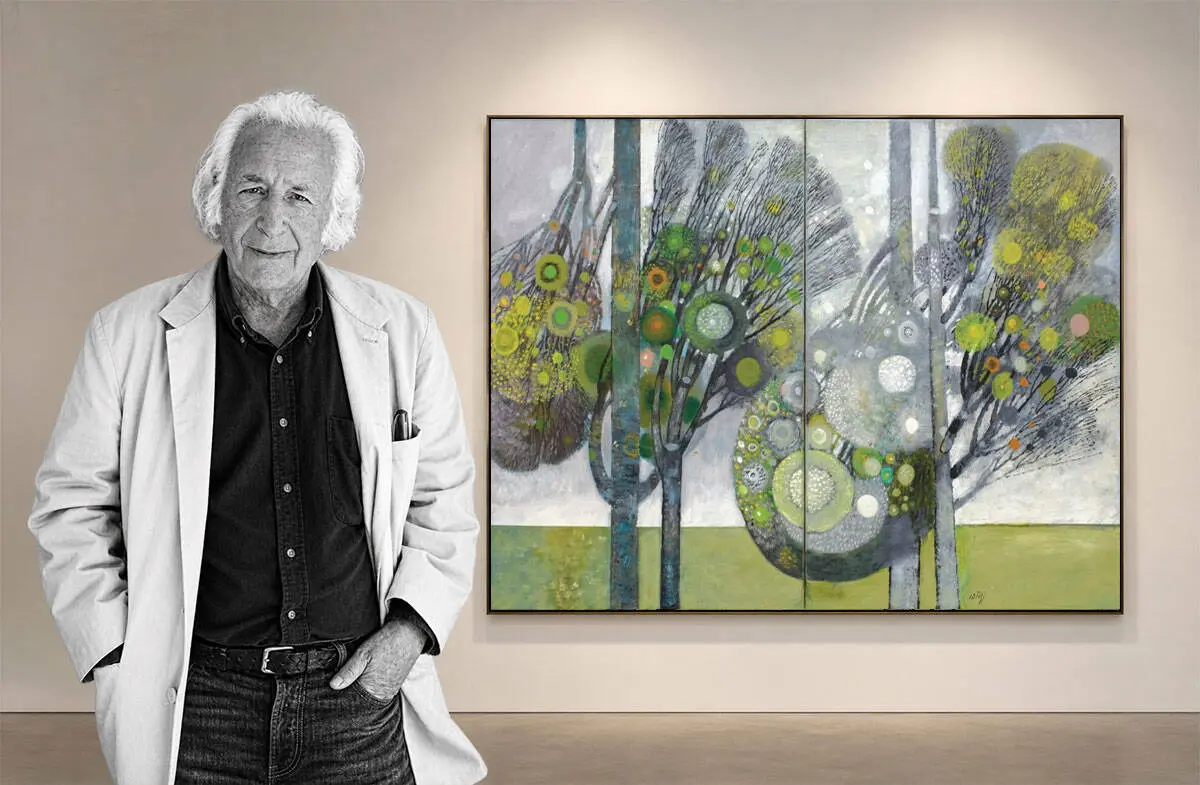
Abolghasem Saidi in the Reha Gallery Collection | The Most Colourful Immortal Trees
The trees of Abolghasem Saidi, abundant in colour and light, distinguish his work from that of other nature-oriented painters. He creates an independent poetic world, perhaps rooted in nostalgia, yet overflowing with life—as though no autumn could ever harm it.
ArtDayMe : Founded and directed by Mohammadreza Ghaemmaghami,
the Reha Gallery Collection has maintained a continuous cultural presence for more than two decades, focusing on the advancement of regional art. The collection preserves a diverse range of modernist and contemporary masterpieces by Iranian and Arab artists.
Among these works is a remarkable painting by master artist Abolghasem Saidi. Executed in oil on canvas in the late 2000s, the diptych consists of two panels, each measuring 90 × 147 cm, with an overall dimension of 180 × 147 cm.
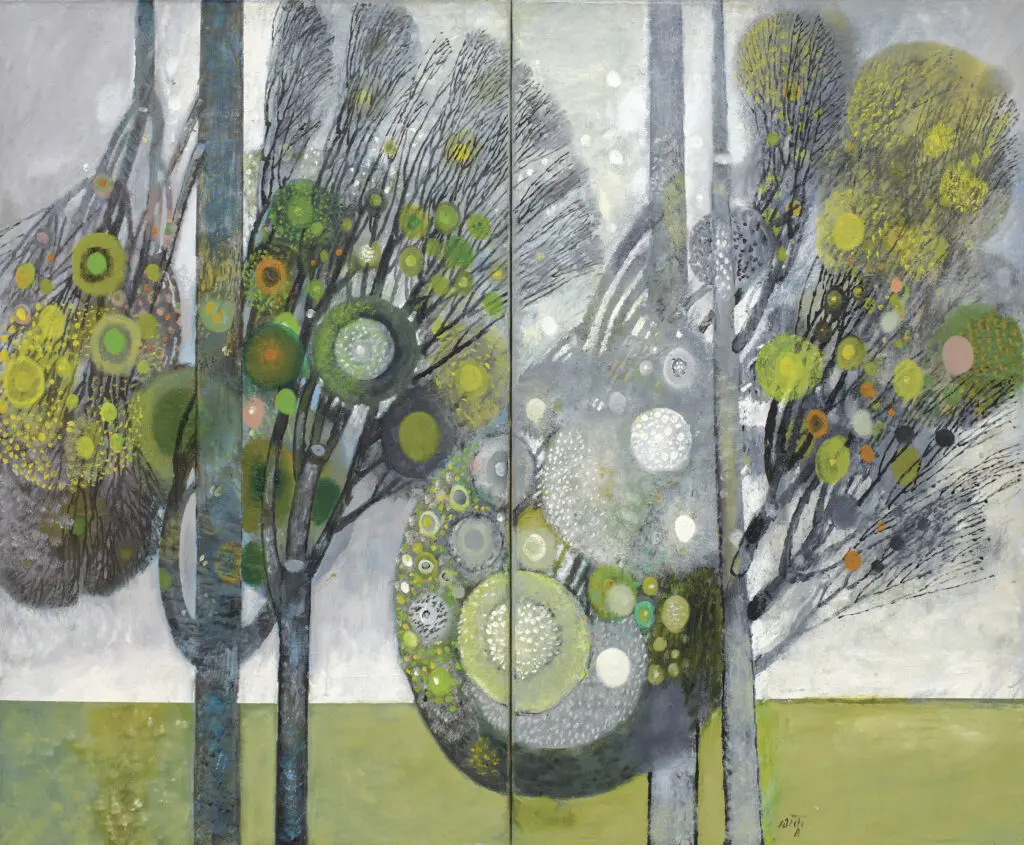
Recently presented at the 26th Tehran Auction, the painting had previously been sold at Bonhams Dubai in October 2009.
Abolghasem Saidi (born 15 August 1925) is now 101 years old. He graduated from the École Nationale Supérieure des Beaux-Arts in Paris (École des Beaux-Arts, or Beaux-Arts de Paris) in 1955. Between 1954 and 1957, he exhibited his works at the Salon des Jeunes Peintres and major annual exhibitions in Paris, winning the Painters' Prize in 1960. His works were also presented at several editions of the Tehran Biennial. He received the Ministry of Culture and Arts Award at the Second Tehran Biennial in 1961 and the Grand Prize at the Fifth Tehran Biennial in 1966. His paintings have appeared in numerous other solo and group exhibitions in Iran and internationally. He has lived in Paris since 1950.
1. Trees Overflowing with the Joy of Life
In this painting, which belongs to one of Saidi's best-known series, the artist constructs a distinctive and self-contained natural world that has become his artistic signature. Here, nature is reimagined through sensory experience and the deliberate organisation of pictorial elements. The trees, vibrant with colour, vitality and radiance, seem immune to the passage of seasons, emanating an enduring sense of hope and renewal.
2. Dynamic Composition
One of the first striking features of this painting by Abolghasem Saidi, preserved in the Middle Eastern collection of Reha Gallery, is the contrast between the vertical extension of the trees and the horizontal expanse of the ground. The elongated trunks, upward-reaching branches and dispersed crowns occupy most of the canvas, while the horizontal green band along the lower edge acts as a visual foundation, counterbalancing the vertical density. This interplay creates a tension between upward movement and stillness. Although rooted in the earth, the trees seem to transcend the limitations of stability, extending their branches into the luminous background.
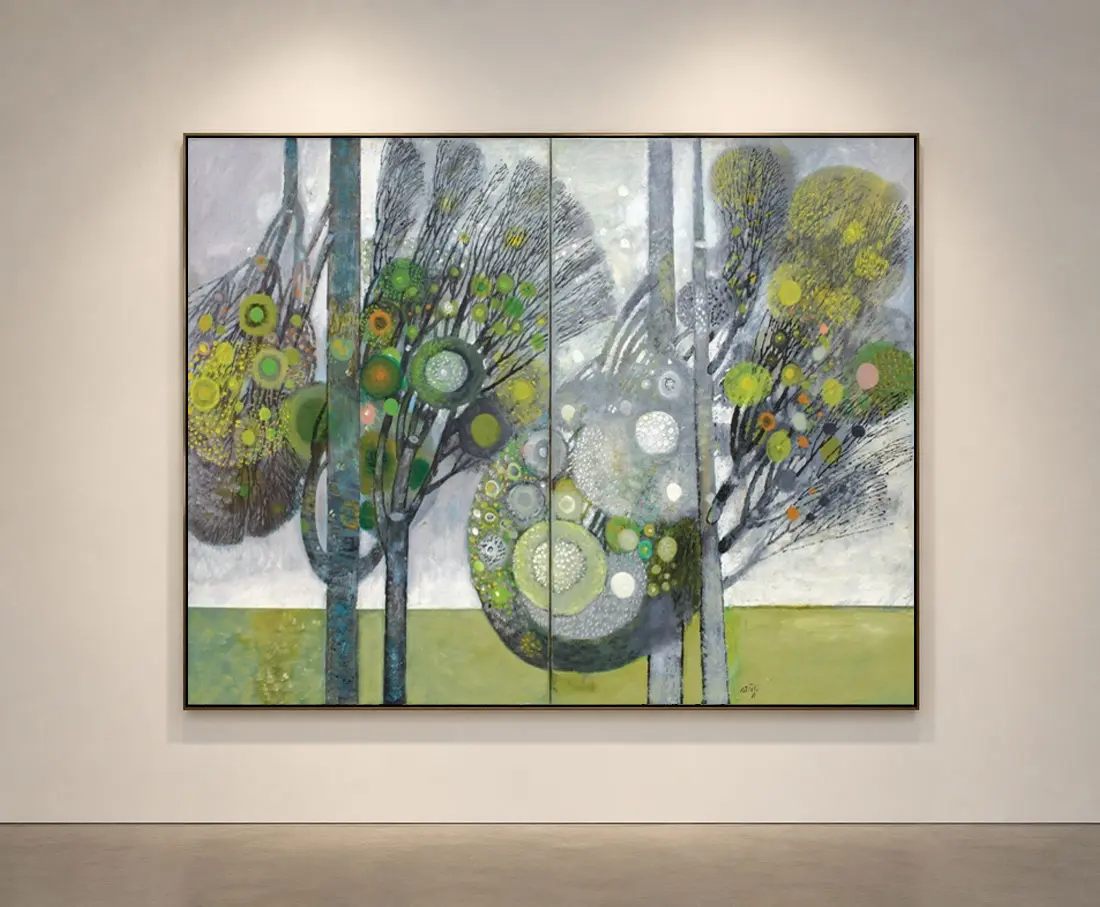
At first glance, the composition appears dense and crowded, yet this density never descends into visual disorder. The relatively straight trunks, diagonal branches and circular forms each perform a distinct role in directing the viewer's gaze. The eye moves between elongated lines and coloured spots, continually shifting between details and the overall image. The painting's balance is not symmetrical; rather, it emerges from the distribution of visual weight across both sides of the composition. Darker, denser trees are set against lighter spaces, creating a dynamic equilibrium.
3. Form, Line and Rhythm
Line plays a constructive role in this work by Saidi. Numerous slender branches spread across the space like a network of diverging pathways. These lines are not merely botanical details; they are fundamental elements that establish texture, direction and movement. Their repetition generates a rhythm reminiscent of organic growth—a process that does not follow a single centre but expands along diverse and irregular trajectories.
Set against this linear network are circles and oval forms scattered throughout the tree crowns and central areas of the composition.
The contrast between slender lines and rounded shapes is one of the painting's most significant visual devices. The lines set the gaze in motion, while the circles interrupt that movement, inviting the viewer to pause. Their recurring interplay creates a visual rhythm that keeps the eye engaged across the entire canvas, without relying on a narrative or a definitive focal point.
4. The Radiance of Colour
In this painting, colour moves beyond the logic of naturalistic representation and becomes an independent force in the organisation of the image. Various shades of green, ranging from dark and olive tones to lighter, yellowish greens, interact with greys, whites and cool blues. Yellow accents and occasional touches of orange create points of visual emphasis, bringing energy to the pictorial surface.
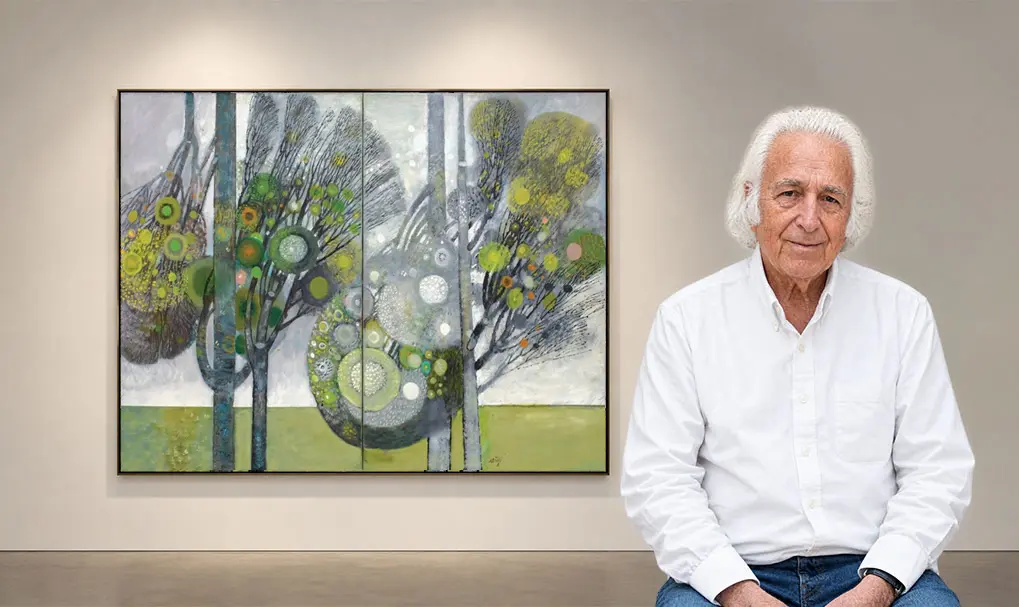
Light, too, does not appear to originate from a single identifiable source. Instead, it is perceived through the distribution of luminous colours and their contrast with darker areas. This quality distances the painting from conventional illusionistic depth, giving the space an atmosphere suspended between mistiness and radiance. The light background separates the trees without entirely defining their boundaries. Consequently, distance and depth are established more through variations in colour value and the density of lines than through geometric perspective.
_ The Tehran Auction Catalogue's Commentary on Abolghasem Saidi's Painting in the Reha Gallery Collection
The catalogue of the 26th Tehran Auction includes the following analytical commentary on this work:
In Abolghasem Saidi's paintings, nature appears less as a subject to be represented and more as a field for painterly experience. He does not depict nature as the eye sees it; rather, he reconstructs it as it is experienced through memory and emotion.
In the present work, there are no explicit or direct references to Iranian artistic tradition. Nevertheless, the painting remains connected to a cultural and aesthetic environment in which nature, gardens, trees and the poetic experience of landscape occupy a profound place. The significance of this approach can be understood in relation to one of the central questions of modern Iranian painting: how an artist can arrive at a personal visual language that remains deeply rooted in Iranian experience without directly reproducing historical motifs.
At first glance, this painting appears to be a landscape of trees and plants. Gradually, however, it moves away from the direct representation of nature and becomes a self-contained world, independent of external reality. Here, trees, branches, flowers, colours and light each become elements in the construction of a distinct pictorial order.
The diptych format may evoke a succession of windows, as though the landscape were being viewed not through a single, unified field of vision, but through two separate frames. Although the two panels form a single landscape, they do not entirely merge into one another. Each panel possesses a degree of visual autonomy while simultaneously continuing the other. As a result, the painting occupies two positions at once: on the one hand, it is a window opening onto nature; on the other, it openly asserts itself as a painted surface. This awareness of the pictorial surface is one of the work's distinctly modern qualities. Saidi does not allow the viewer to become completely absorbed in the illusion of landscape.
The trees in this painting are less indicators of a specific location than the principal structural elements of the composition. Their vertical trunks divide the pictorial surface into multiple sections, creating a visual rhythm that is disrupted by the free, branching movement of their limbs. The contrast between the column-like trunks and the dispersed movement of the branches intensifies the painting's internal tension. Nature here seems less like a calm, static landscape and more like a living entity in the process of expansion. The trees are not entirely fixed within this luminous space; some appear to be emerging, while others seem to be fading away. From this perspective, the painting possesses a quality suspended between presence and absence.
The painting's palette is equally important in shaping its poetic atmosphere. Different tonalities of green, from olive and greyish greens to lighter, more vivid shades, appear alongside yellow, white, grey and occasional warm colours. Yet the colours rarely appear in pure, flat forms. They are mostly blended with one another, acquiring a dusty, weathered quality. The luminous background also plays a significant role. The white and grey spaces between the trunks function as more than empty areas; they create a sense of mist and ambiguity. As a result, the light in the painting is not clear, natural daylight. Instead, the viewer encounters a light steeped in memory, as though it has travelled through mist, distance or recollection.
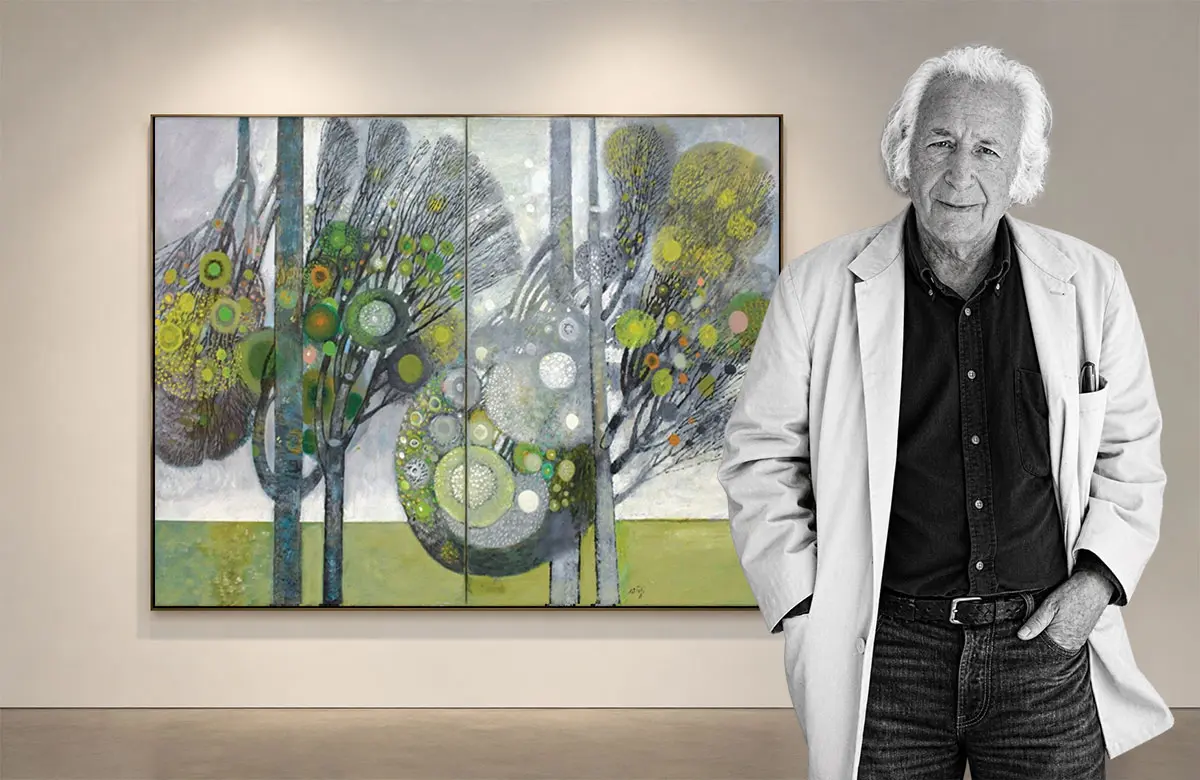
This painting belongs to the Reha Gallery Collection in the Middle East.
LEAVE A RELPY