
The UAE at 54 and the Painting of Mehrdad Fallah
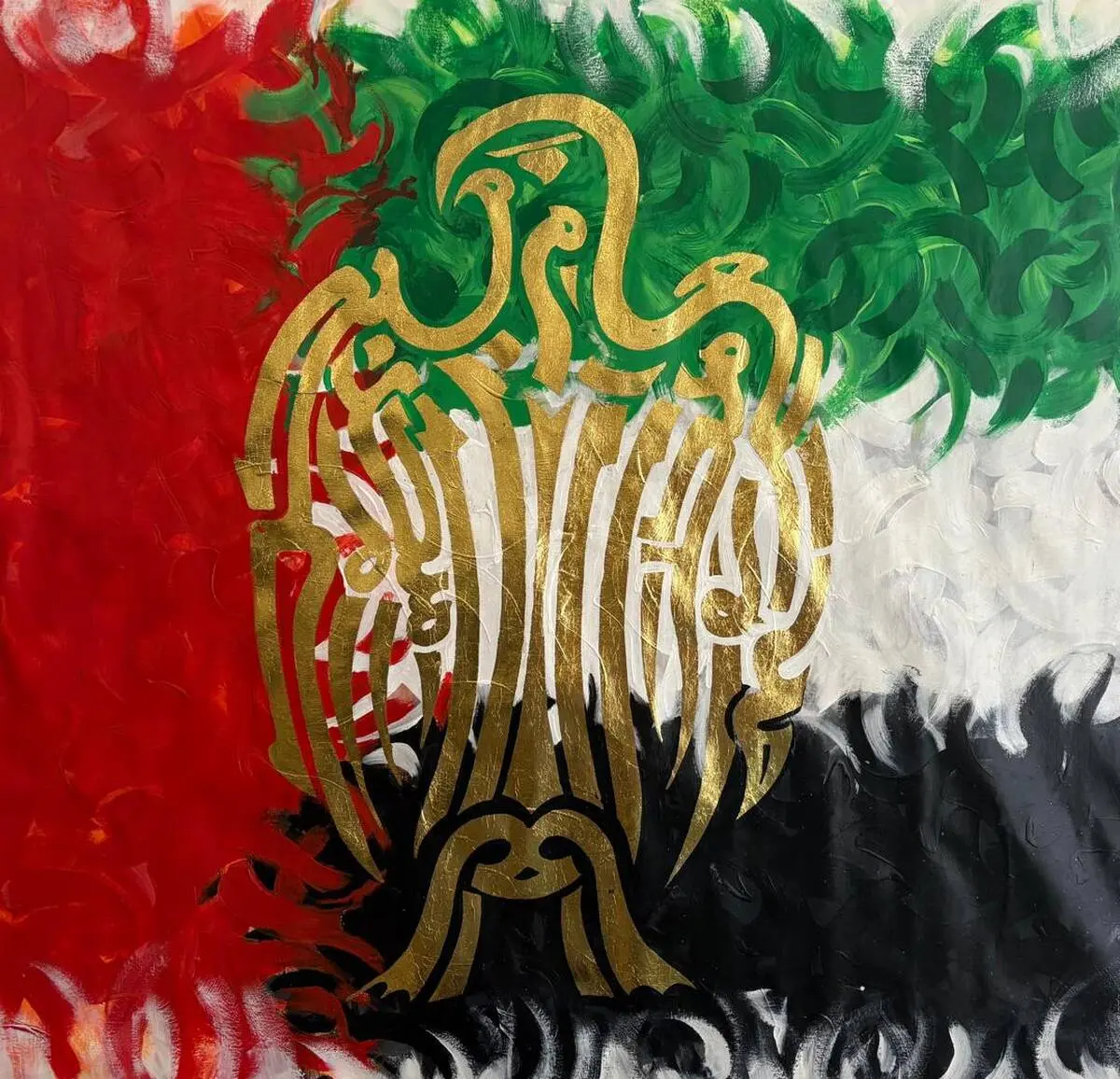
In this mixed-media work, Mehrdad Fallah presents a contemporary visual narrative of the UAE’s national identity through an eloquent interplay of color, texture, composition, and symbolic form. The presence of gold—applied with genuine gold leaf—emerges like a sacred radiance against the textured background, a luminosity that unmistakably conveys notions of grandeur, prosperity, and flourishing. It reflects today’s UAE as a young yet powerful and internationally recognized nation.
ArtDayMe: At first glance, Mehrdad Fallah’s 104 × 102 cm mixed-media painting appears as a vibrant visual celebration of the UAE’s 54th anniversary—an exuberant stage where color, texture, and line come alive simultaneously.
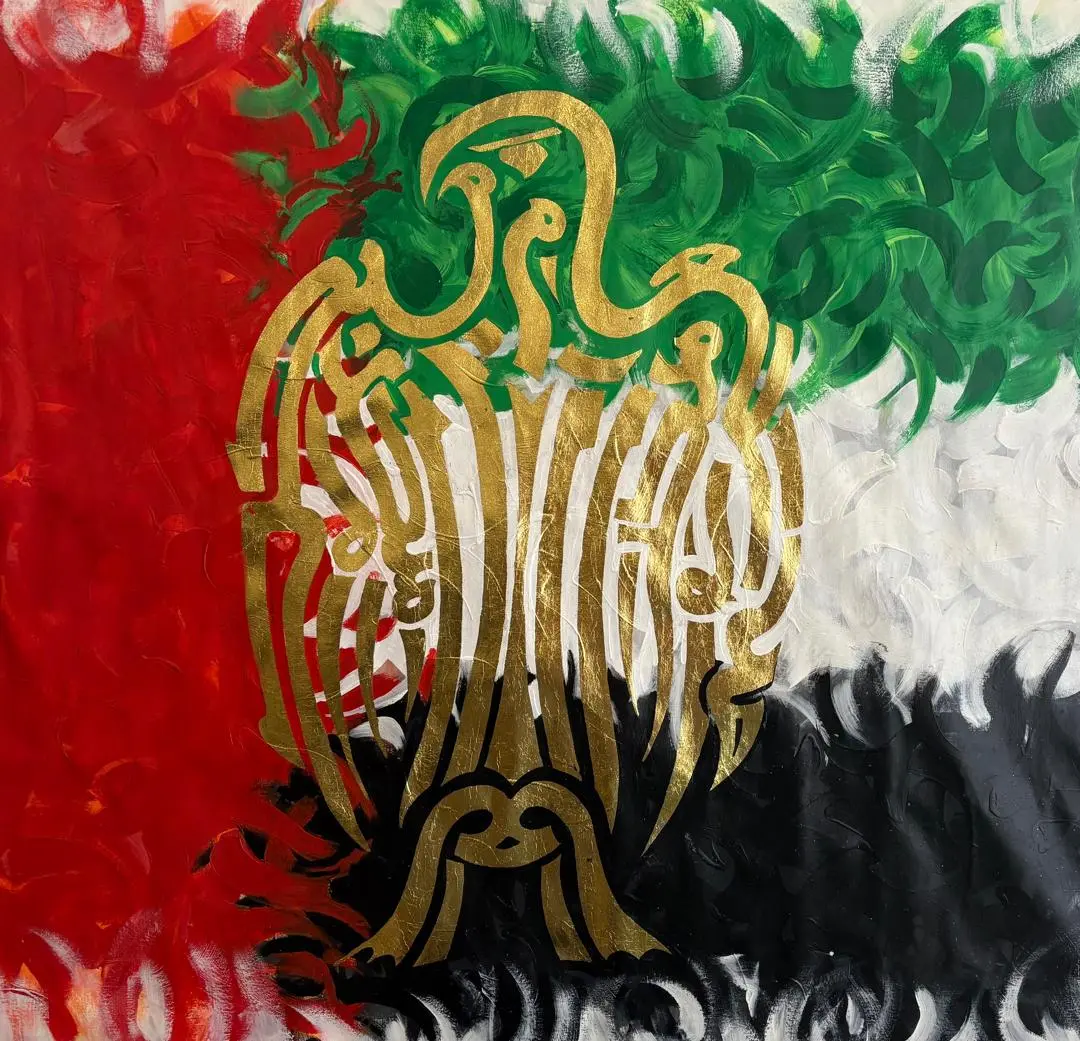
The surface of the canvas is covered with the four familiar colors—red, green, white, and black—immediately evoking the UAE flag. Yet Fallah avoids rigid, static bands; instead, his flame-like waves of color break the boundaries and create an energetic, pulsating space. At the center of this chromatic convergence, a majestic golden eagle rises—a reference both to the UAE’s official emblem and, through its interwoven linear structure, to Persian-Islamic calligraphy. The result is a symbol of shared affinity and cultural correspondence.
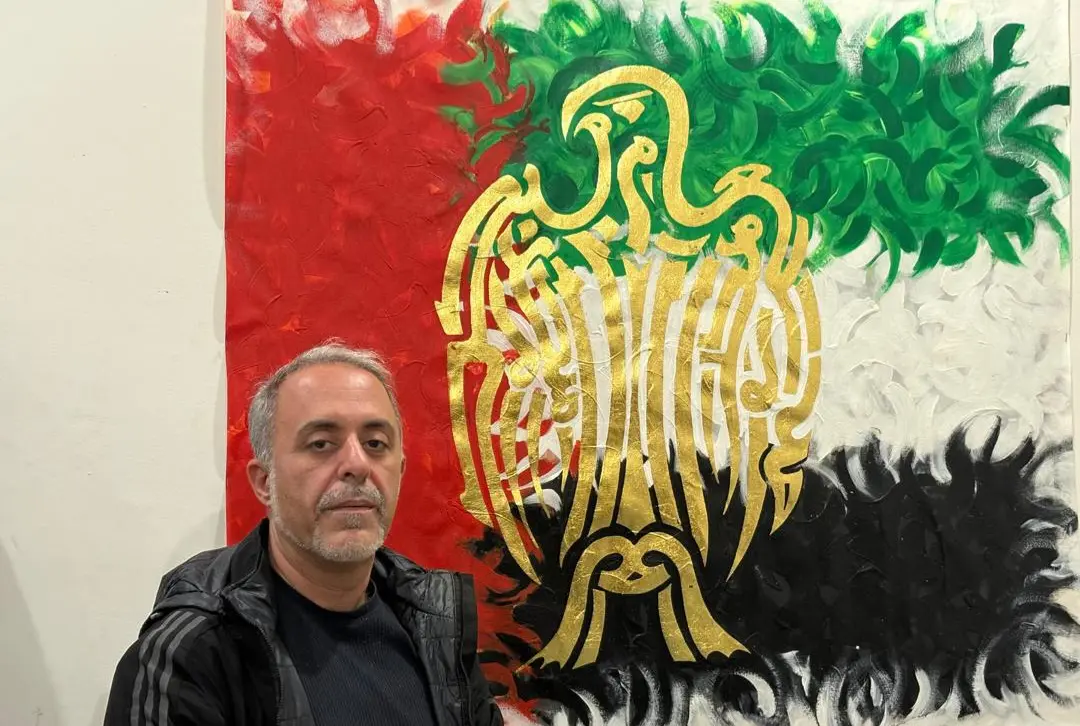
The first striking element of the painting is its tactile, physical quality. Thick, swirling brushstrokes lend the surface an expressive, improvised character, inviting the viewer not only to “see” but almost to feel the texture with their eyes. This living surface transforms the notion of a national celebration from a formal emblem into an eruption of collective emotion, as if the colors represent the people—moving from the four corners of the flag toward the center, toward the eagle, and ultimately toward a shared identity.
The gold leaf, glowing against the contrasting background, bursts forth like a sacred light—a visual metaphor for magnificence, vitality, and wealth. It mirrors the UAE as a young nation that has rapidly achieved strength, prominence, and confidence.
In terms of design, Fallah consciously employs the principle of central emphasis. The eagle stands not only at the geometric center of the canvas but also at its conceptual core. All lines and chromatic waves radiate inward toward it. The bird’s form is constructed through elongated, curved strokes reminiscent of a calligrapher’s intimacy with the pen—as though an unwritten text of belonging, praise, and prayer is embedded within the body of the creature.
This fusion of an Arab national symbol with Iranian visual heritage positions Mehrdad Fallah as a “transnational” artist who articulates the UAE’s national discourse through a regional aesthetic language anchored in his own roots. Such a dialogue is legible both within the broader Middle Eastern art scene and within the cultural exchanges between Iran and the UAE.
From a semantic perspective, the painting stands at the intersection of power and delicacy. The eagle, long a Middle Eastern emblem of political authority, vigilance, and awakening, is here constructed through soft, rhythmic curves that resemble beauty in motion. Fallah thus proposes a renewed vision of the homeland—one whose strength lies not merely in rigidity but also in flexibility, coexistence, and an embrace of diverse cultures.
In this interpretation, the UAE’s 54th anniversary becomes more than a historical number—it signifies the threshold of maturity for a nation that has leaped from the sands and borders into global visibility, now standing beneath the wings of a golden eagle that looks confidently toward the future.
The painting can be read as a visual manifesto in which the flag transcends its official symbolism and transforms into a living, fluid organism—one that pulses, burns, dances, and ultimately materializes as a calligraphic eagle.
Through mixed media and the principles of color, texture, composition, and symbolic storytelling, Fallah crafts a contemporary reflection on UAE identity—one that resonates with Iranian audiences as well, emerging from a visual lineage that has long surpassed geographical borders in search of new meanings of “home,” “nation,” and “future.”
Mehrdad Fallah was born in 1975 in Tehran. He grew up in a traditional family, but this was no ordinary home: it was also the birthplace of one of the most important pioneers of modern Iranian painting—Sadegh Tabrizi. The late Tabrizi, Fallah’s maternal uncle, became his mentor and formative teacher.
Mehrdad Fallah’s works have appeared in four different auctions, all selling above their initial estimates:
• Tehran Auction, 21st edition (October 2024): 187 million tomans
• Second National Auction (2015)
• Goharan Auction
• A charity auction in Los Angeles
Mehrdad Fallah rtworks have been exhibited multiple times across England, Switzerland, Italy, Belarus, Cyprus, Turkey, the United States (Los Angeles), Dubai, and, of course, Iran. His entry into professional art dates back to age 23 (1998), when he presented a reverse-glass painting exhibition at Gallery 66, followed by six solo shows—the most prominent being the widely noted “Lion with Calligraphy” exhibition at Art Center Gallery in 2015.
Over the years, Fallah has created numerous works that merge painting with Iranian symbolic traditions, ultimately developing a distinct artistic signature. He is recognized among the painters who draw from Iranian pictorial heritage to create modern and contemporary art. His well-known series—Lions, Roosters, and Marvels of Creation—brought him significant acclaim.
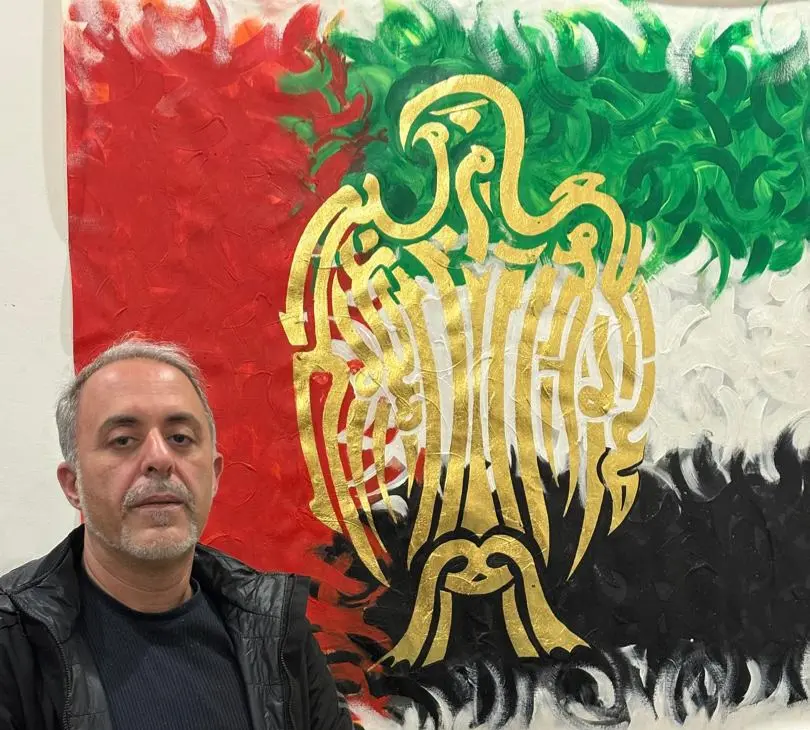
Many art specialists regard Mehrdad Fallah as one of the contemporary heirs and revitalizers of the Saqqakhaneh School.
LEAVE A RELPY