
Faramarz Pilaram and the Sacred Rotation in the Raha Gallery Collection
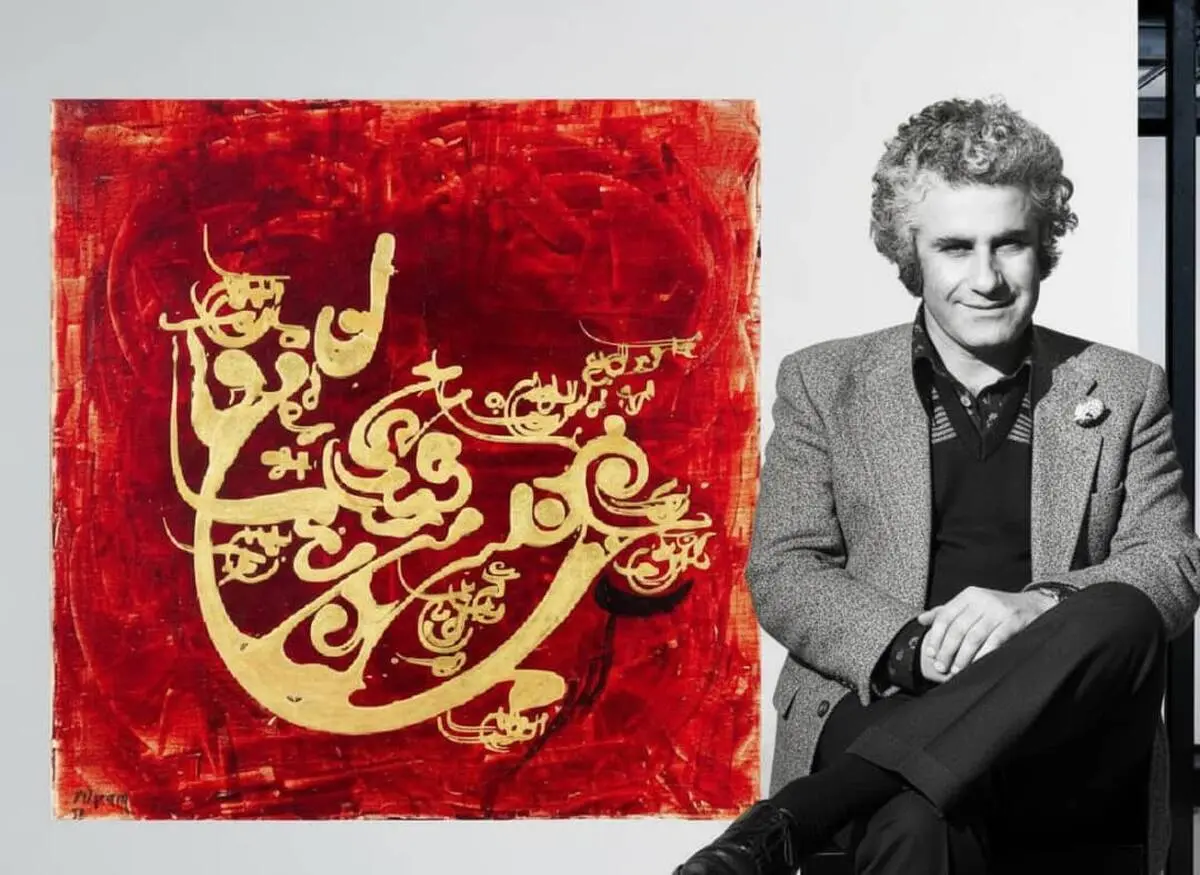
This painting by the late master Faramarz Pilaram is a rare example of the fusion of script, color, rhythm, texture, and ritual in modern Iranian art. It demonstrates how Pilaram transformed the language of calligraphy into a painterly one—a language neither textual nor purely abstract, but one that preserves Iran’s cultural memory within the framework of modernism.
ArtDayMe : The Raha Gallery Collection, founded and directed by Engineer Mohammadreza Ghaem-Maghami, has been actively engaged in cultural work for over two decades, with a sustained focus on elevating the art of the region. The collection preserves an important range of modern and contemporary masterpieces by Iranian and Arab artists.
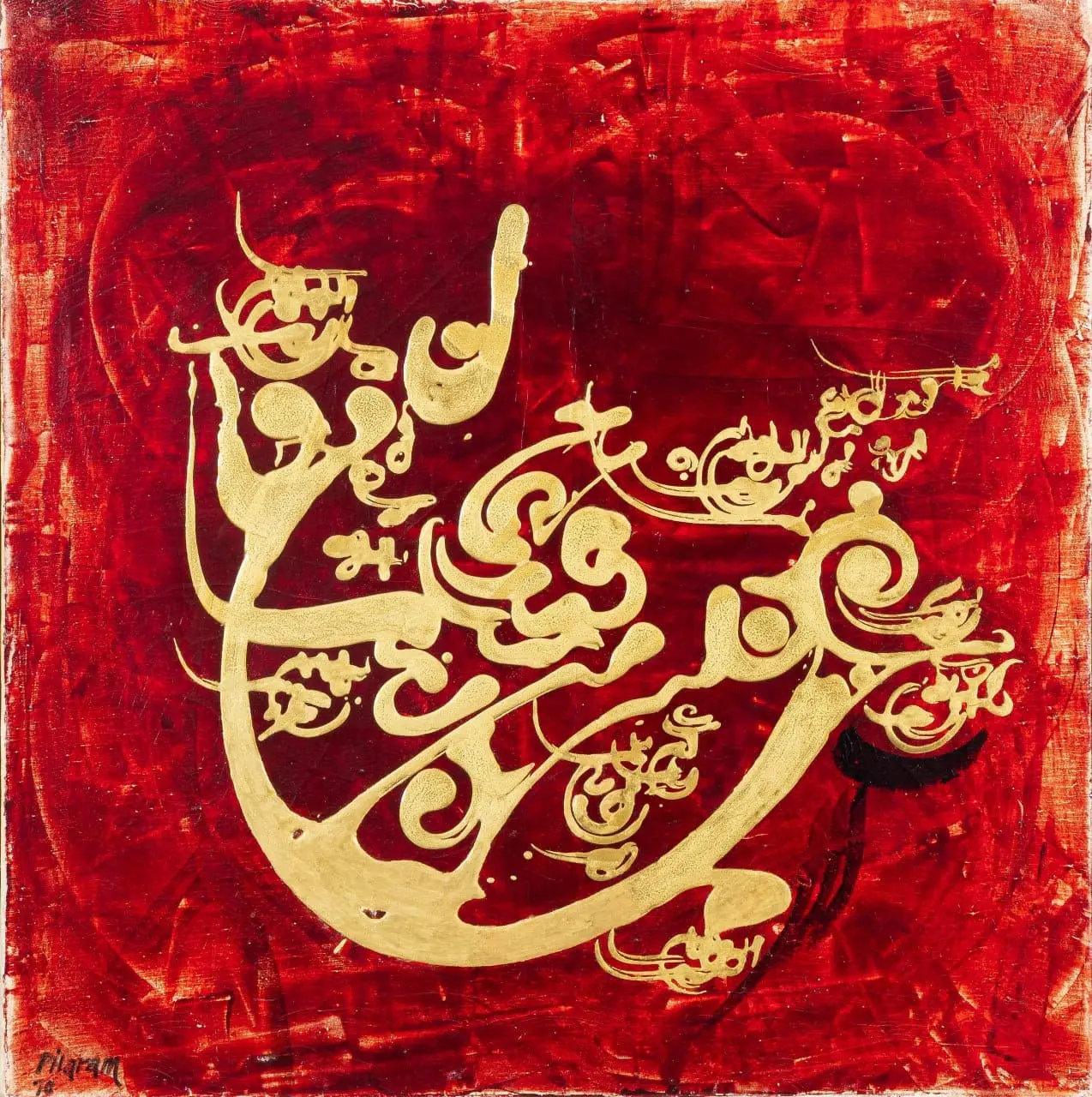
Among these works is a distinguished untitled painting by the late master Faramarz Pilaram, a landmark figure in Iranian art. Known within artistic circles as part of his Composition series, the work was created in the 1970s using oil on canvas and measures 68 × 69 cm.
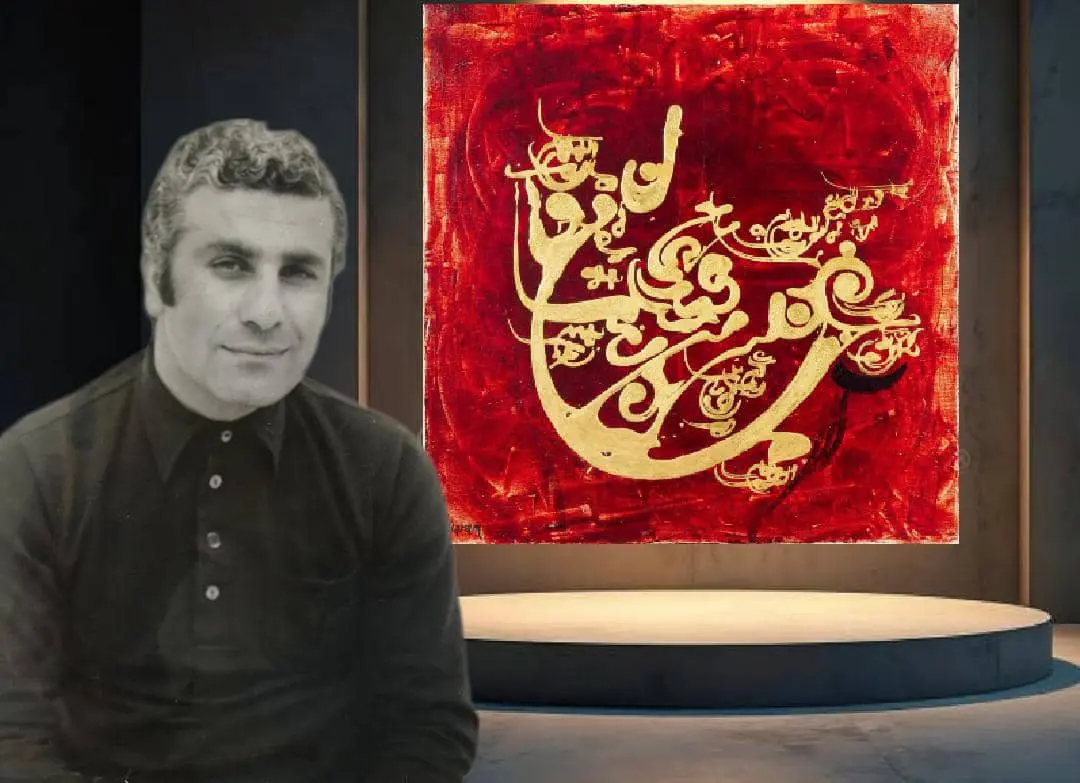
Faramarz Pilaram (April 10, 1936 – September 1983) was a painter, calligrapher, and one of the pioneering figures of Iran’s Saqqakhaneh School. He was academically trained at the Faculty of Decorative Arts and soon emerged as a leading force in shaping the visual language of modern Iranian art.
In 1962, following his success at the Tehran Biennial, his works were exhibited in the Iranian Pavilion at the Venice Biennale, earning significant acclaim. The Museum of Modern Art (MoMA) in New York acquired one of his works shortly after. Exhibitions such as Contemporary Iranian Art in Monaco (1964), Contemporary Iranian Art in the United States (1968), and multiple international awards further marked the achievements of a master who had only 47 years to present his artistic brilliance.
Today, prominent museums—including Sa’dabad Palace, the Museum of Fine Arts, the Tehran Museum of Contemporary Art, and the Islamic Art section of the Metropolitan Museum of Art—house his works.
The Pilaram painting preserved in the Raha Gallery Middle East Collection belongs to the artist’s mature period. During this phase, Pilaram—one of the founders of the Saqqakhaneh movement—crafted a unique visual language that merged Iranian calligraphy, modern painting, and regional symbolic aesthetics. The 1970s were the defining decade of his “calligraphic painting,” when script moved beyond narrative function and became an independent artistic subject.
From a formal perspective, the movement and dynamism of line form the core of the work.
The golden lines are elongated, fluid, and energetic, propelling the pictorial field with spiraling and rotational forces. Pilaram’s mastery lies in creating forms unique to himself—forms sometimes echoing Kufic-Banna’i, decorative Naskh, or even Tughra-like shapes, yet completely liberated from the rules of handwritten script.
Here, the lines are not meant to be read but to be seen; meaning emerges through form alone.
Compositionally, the work reveals an underlying geometric structure that showcases the artist’s peak sophistication in his fourth decade of life. The central organizing form is a large, incomplete circle that anchors the composition. This circular schema evokes Eastern mandalas, suggesting unity, centrality, and cosmic rotation.
The spiraling movement from the center outward generates a vortex-like form, reminiscent of whirling dervishes.
The color palette commands the viewer’s attention:
The saturated, deep, multilayered red of the background—enhanced by brush textures and scratches—suggests ritual, antiquity, and sacred space. This red recalls the cloths and votive textiles found in Saqqakhaneh settings, while simultaneously expressing heat, rhythm, and intensity.
The golden lines exude ceremonial grandeur, echoing the symbolic role of gold in Iranian religious art—inscriptions, shrines, illuminations. The tension between red and gold creates a molten-metal luminosity across the canvas.
In terms of symbolism, red (earth/matter) and gold (light/spirit) coexist in both contrast and harmony.
Pilaram worked with highly textured, dense oil paint during this period, producing deeply layered, almost engraved surfaces. These textures evoke an emergence from history. The execution of the lines suggests the use of a broad reed pen or a soft palette knife; pigment gathers visibly at the edges. The gold appears applied in a smooth, uniform manner—reminiscent of gold leaf but controlled with painterly precision.
Pilaram approached calligraphy as a cultural archetype. He removed it from the domain of language and reframed it as a visual DNA of Iranian identity—an element rooted in the past yet reimagined through modernity.
The work’s ambiguity is intentional: it is unreadable yet conveys the sensation of writing.
This ambiguity bridges the sacredness of traditional calligraphy with the existential uncertainty of modern art.
The painting clearly contains ritualistic aspects: the gold-and-red palette, the circular form, and the spiraling structure all point to a meditative, liturgical, and cyclical sensibility.
This piece stands as a quintessential example of Saqqakhaneh aesthetics:
the use of religious and ritual motifs without narrative content; the transformation of calligraphy into painterly form rather than inscription;
the fusion of traditional art with Western abstract modernism;
and the emphasis on sacred ornamentation—gold, red, circular form.
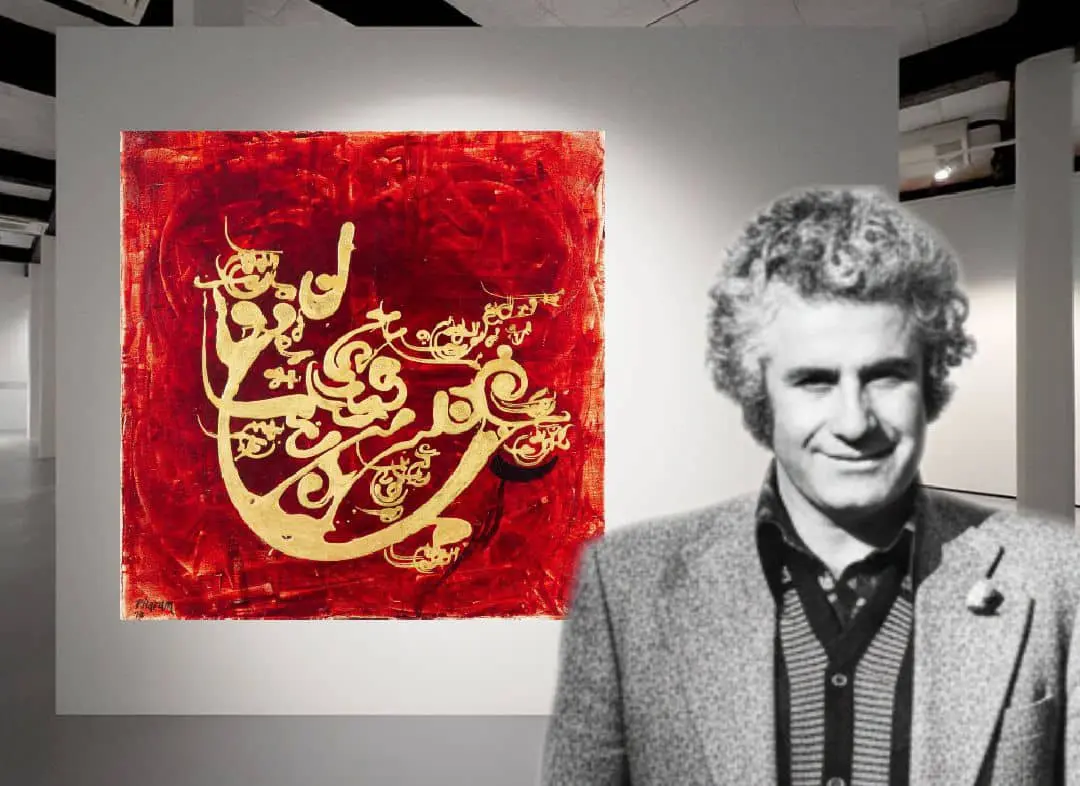
The 1970s—the decade of this work’s creation—was a turning point for Iranian art as it moved toward international visibility. Through works like this, Pilaram articulated a vision of contemporary Iranian visual identity that was neither purely traditional nor derivative of Western modernism.
In this period, he reached the height of his ability to “structure the line,” and his visual signature became fully defined.
This painting by the late master Faramarz Pilaram is a rare synthesis of script, color, rhythm, texture, and ritual in modern Iranian art. It exemplifies how Pilaram transformed calligraphy into a painterly language—one that is not narrative, not purely abstract, but a vessel of Iran’s cultural memory within modernism.
The work belongs to the Raha Gallery Middle East Collection.
LEAVE A RELPY