
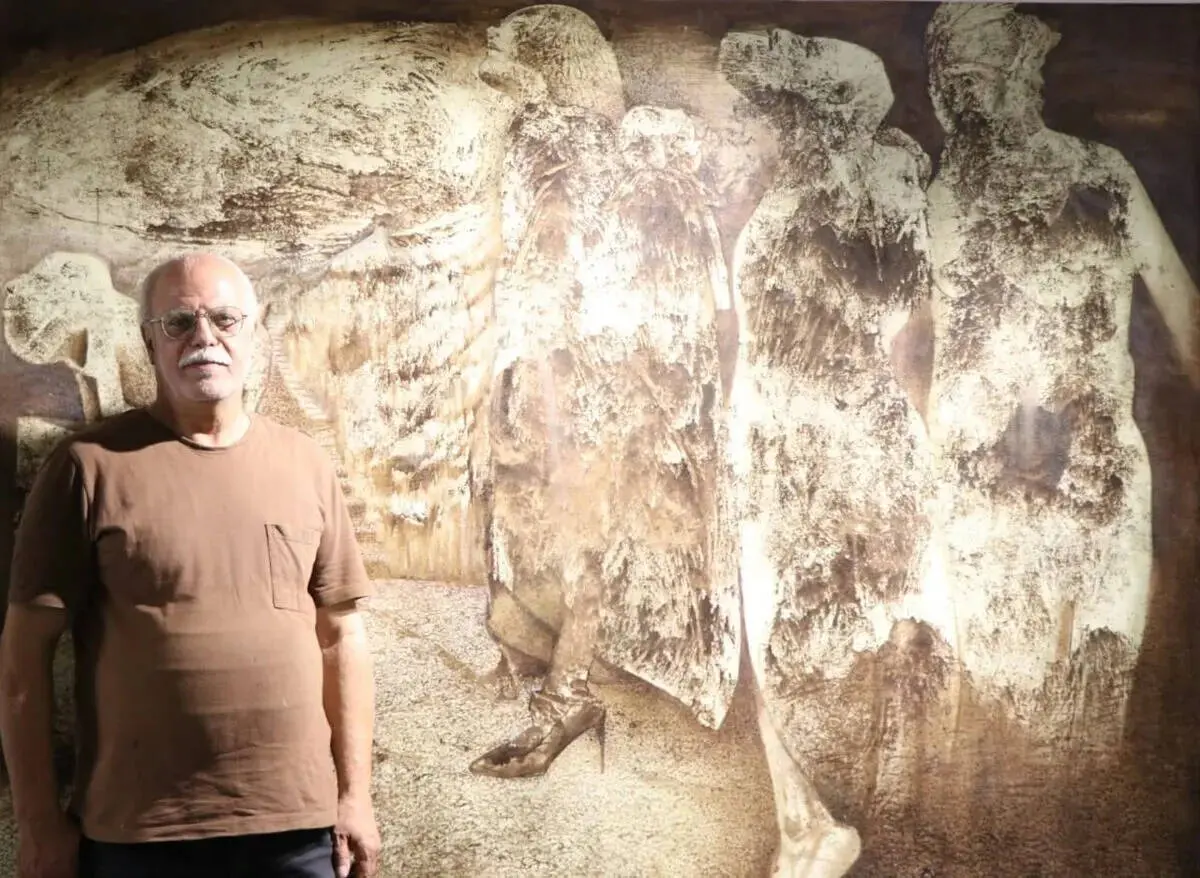
Majid Kamrani and In Zero Area: Where the Human Still Exists, but There Is No Space for Being /"Laloghlo" at MAAD Gallery
The closer we move toward the faces, the less we encounter identity and the more a kind of ambiguity emerges—an ambiguity that forms one of the work’s fundamental semantic foundations: the body is intensely present, while identity remains largely absent.
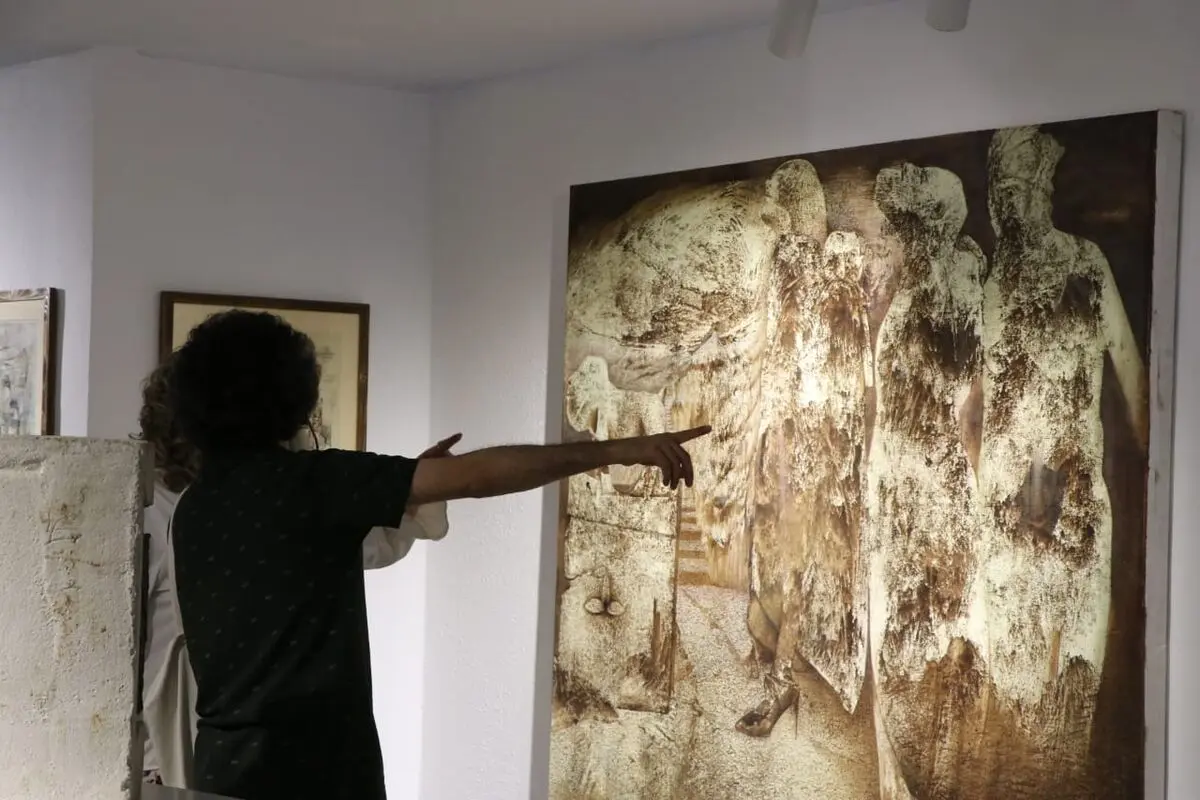
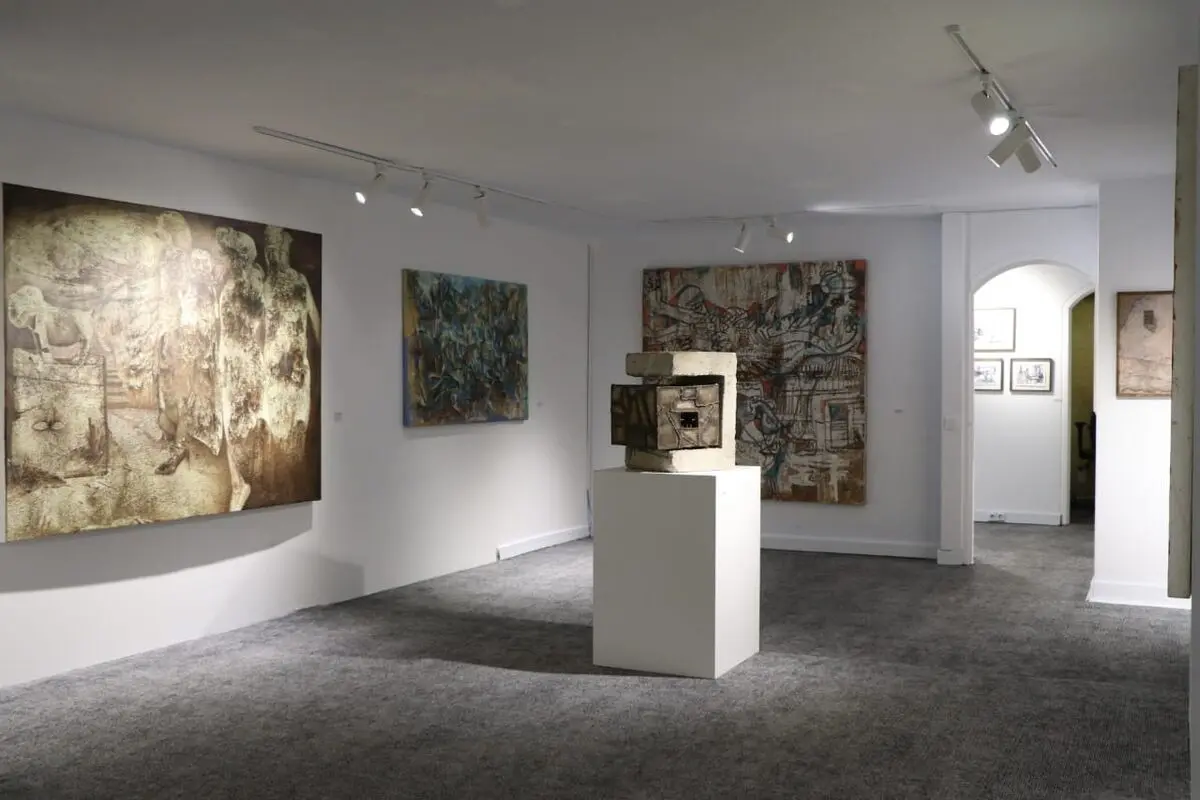
These days, MAAD Gallery is presenting the exhibition Beyond the Wall, This Side of the Window, curated by Sepideh Zarrat, as part of the Tehran Art Month event. Among the works that have drawn considerable attention in the exhibition is a painting by
Majid Kamrani, titled In Zero Area. Executed in oil on canvas and measuring 200 × 150 cm, the work offers a particularly compelling field for observation and interpretation. Below, following a brief biography of the artist, we examine and analyze this distinctive painting.
_About Majid Kamrani
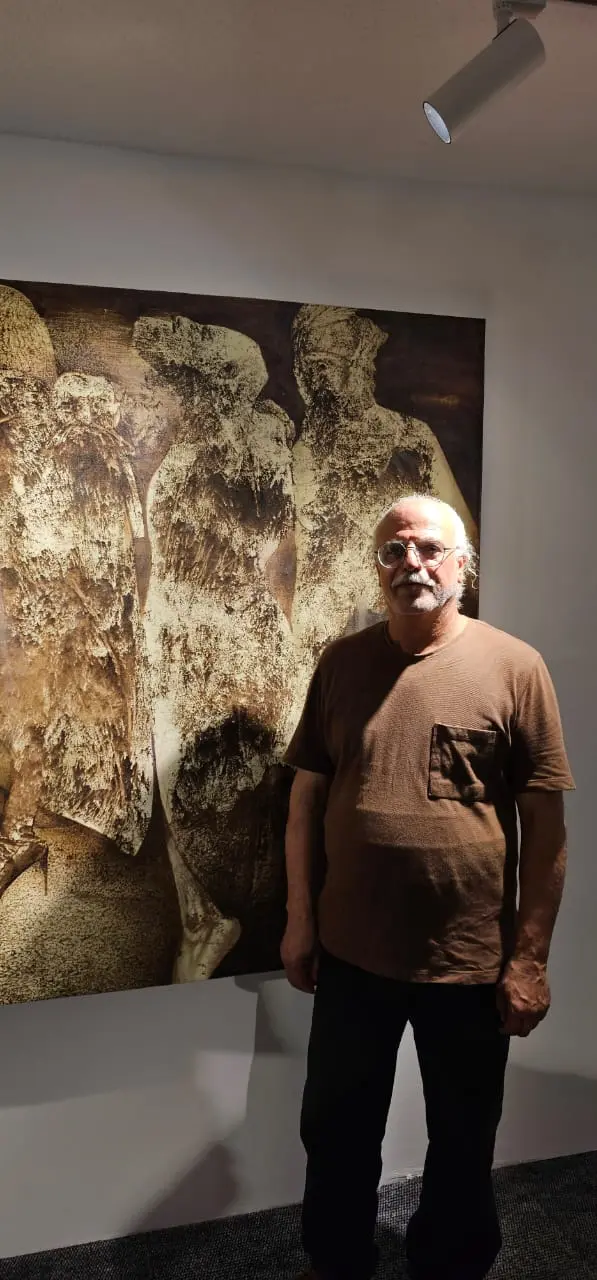
Majid Kamrani was born on June 5, 1964, in Miandoab, West Azerbaijan Province. Known by the artistic name “Laloghlo"
he studied humanities. Kamrani describes himself as a self-taught artist, explaining that he learned painting by studying the works of other artists, reading books on art, and visiting artists’ studios.
In addition to teaching privately at his own studio, Kamrani has, over the past four years, taught as a visiting lecturer at the University of Art and Architecture in Babolsar, Mazandaran Province.
_Humans Without Identities
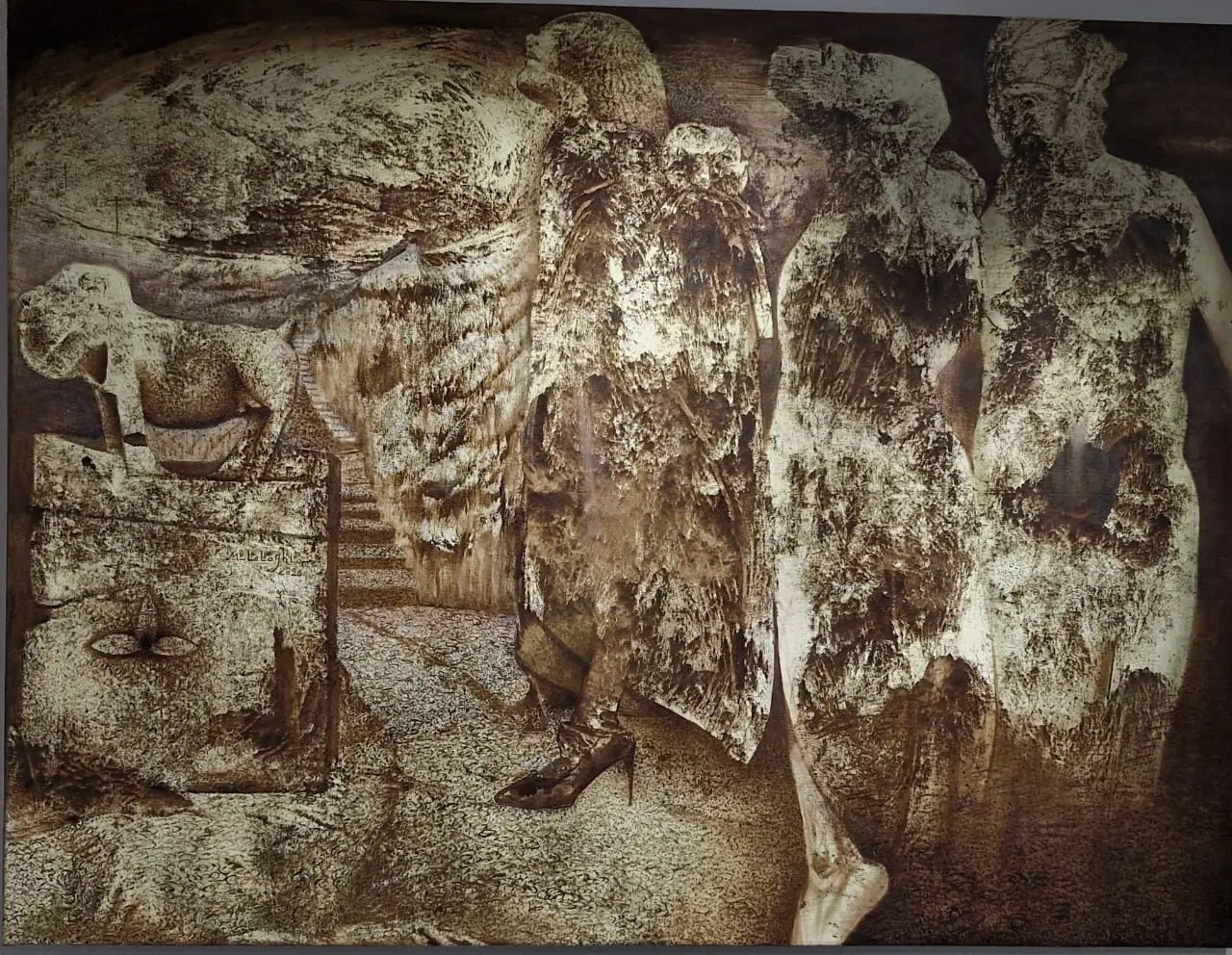
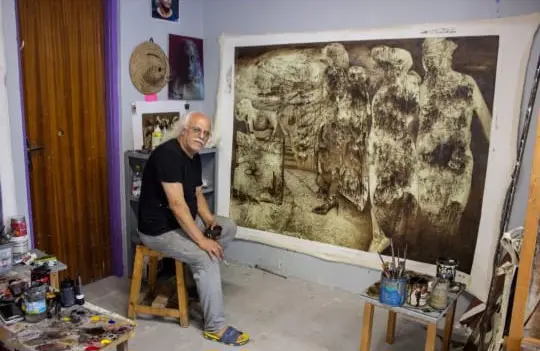
At first encounter, In "Zero Area" draws the viewer’s curiosity through its depiction of several human figures: bodies standing or sitting beside one another in an undefined space. Yet the work is far removed from a straightforward figurative scene. The faces gradually dissolve; the bodies become absorbed into the textures and shifts of light and darkness across the surface; and the enclosed, cave-like space appears just as unstable as the figures inhabiting it.
What remains is not a clear narrative, but rather a human condition—a state suspended between presence and absence, memory and reality, individuality and anonymity.
In Zero Area is among those paintings that cannot be fully apprehended through a single, cursory glance. The work asks the viewer to stay, look again, and contemplate the relationships between its different elements. This quality of suspension is one of the most significant characteristics of Majid Kamrani’s painting.
Several large-scale human figures emerge at the center and toward the right side of the composition. Their bodies are clearly recognizable, yet their faces lack the details that would transform them into identifiable individuals. This is not a “portrait” in the classical sense. Kamrani does not appear interested in telling the viewer who these people are; what matters is their existence.
The large figure on the right occupies the greatest share of the pictorial surface. Its elongated, almost full-length form, together with the lighter tone of the body against the background, constitutes the viewer’s initial point of visual contact. Yet the closer we move toward the face, the less the identity of the character reveals itself.
From this confrontation emerges one of the work’s central tensions: the body is intensely present, while identity remains largely absent.
The same occurs with the other figures. They stand alongside one another, yet no explicit relationship between them is apparent. It is as though a group of human beings has gathered in an enclosed, stone-like space without necessarily being “together.” From this perspective, the painting can also be read as an exploration of human solitude within a crowd.
_Composition: From Density to Emptiness
In organizing the image, Kamrani has created a dual composition. The right side of the painting is dense, heavy, and filled with bodies, while the left side offers a more open space, containing elements such as a staircase, architectural surfaces, and a seated, totemic sculpture-like figure.
At first glance, this division may appear straightforward, but in practice it guides the eye along a complex trajectory. The gaze moves from the monumental figure on the right to the central bodies and then returns toward the left and into the depth of the image. In this way, the work has no single focal point and instead keeps the viewer engaged in continuous visual movement.
Yet the painting’s central paradox lies here: despite the presence of several monumental human bodies, the image does not convey a sense of fullness; at the same time, it evokes a profound sense of emptiness.
It is precisely here that the title In Zero Area acquires its significance.
_When Area Becomes a Mental Concept
In its primary sense, “area” is a geometric and measurable concept—something to which a numerical value can be assigned. But the addition of “zero” shifts the concept from physical measurement into the realm of meaning.
How can one exist in a space with zero area?
The work does not necessarily provide a direct answer to this question, but it constructs an image around precisely this contradiction: human beings occupy a canvas measuring 200 × 150 cm, yet it is as though there is no actual space available for their presence. The bodies are large, while their psychological space has contracted.
From this perspective, “zero” can signify emptiness, absence, an ending, anonymity, or even a point of beginning. Zero is both the end of a count and a point from which counting can begin again. Thus, contrary to what one might initially assume, the title is not merely a description of a place; it can serve as a key to entering the psychological state of the painting.
_Loss of Color: A Memory That Has Lost Its Color
One of the first visual characteristics of In Zero Area is its restricted color palette. Browns, grays, creams, and bone-like tones cover almost the entire surface of the painting. There are no saturated or energetically vibrant colors.
This choice distances the work from the present. The image acquires the quality of a memory, an old document, or a weathered photograph—as though something has been brought from the past into the present, while that past has gradually lost some of its details over time.
Here, color is not merely an aesthetic choice. Color carries time.
The varied brown and cream tonalities, which reveal diverse textures through the artist’s particular painting technique, are not simply the colors of walls, clothing, and ground. They create a timeless atmosphere in which everything appears slightly old, weathered, and distant.
_Erosion: Technique or Subject?
Perhaps the painting’s most important characteristic is its texture. The surface is highly active as a result of the manner in which the paint has been applied. In many areas, the paint is neither smooth nor uniform; stains, abrasions, and dense surface variations affect the faces, bodies, and stone-like environment.
As a result, it seems as though the boundary between human beings and their surroundings has disappeared.
The bodies are no longer completely separate from the space around them. Parts of the wall, ground, and darkness seem to penetrate them, while the figures themselves appear to have settled into the enclosed, cave-like environment.
This characteristic means that the painting is not simply a representation of decay and age; rather, the image itself seems to have undergone a material process of erosion.
Kamrani simultaneously constructs and destroys the image. He creates the figure, yet partially obscures it; he reveals the face, yet removes its details. The result is an image perpetually suspended between revelation and disappearance.
_A Staircase That Leads Nowhere
On the left side of the work, a rudimentary stone staircase constitutes one of the important elements of the composition. A staircase can symbolize movement and transition: movement from one level to another, ascent, descent, or passage.
Yet in In Zero Area, this movement has no clear destination.
The path disappears into the pictorial space and does not arrive at any definitive end. Thus, rather than functioning merely as an architectural element, the staircase can become a sign of directionless movement—a journey whose destination remains unknown.
Opposite this path stand the large, upright bodies. They do not move; they are present.
This contrast between movement and stillness adds another layer to the composition of the work.
_The Small Figure and the Question of Solitude
The seated, totemic figure on the left is small in comparison with the large bodies on the right. This difference in scale does not appear accidental. The monumental bodies dominate the pictorial surface, while, in contrast, the small sculptural figure occupies a corner of this visual world with an almost passive and introspective presence.
This figure may be regarded as a symbol and manifestation of a belief. Yet more important than assigning it a definitive meaning is the role it plays within the overall structure of the image: it introduces the presence and weight of another being without explaining the narrative.
Kamrani does not complete the story. He offers fragments of a story and leaves its continuation to the viewer’s imagination.
_A Painting Between Reality and Memory
In terms of its execution, In Zero Area belongs to the realm of contemporary figurative painting, yet through the distortion of its figures, restricted palette, pronounced textural qualities, and psychological atmosphere, it also approaches an expressionistic mode of representation.
Nevertheless, the significance of the work cannot be reduced to a stylistic label. Its importance lies in its transformation of external reality into a subjective experience.
What we see is not necessarily a real place; it may be the image of a memory. A memory in which faces have gradually faded, architecture has changed, and its inhabitants can no longer be recognized with the same clarity they once possessed.
From this perspective, the weathered textures of the work acquire another meaning: perhaps the painting is about something that time has taken partially away from us.
_ Finally: Where Is “Zero”?
The power of In Zero Area lies not in providing answers, but in generating questions.
The painting does not ask the viewer merely to see several human beings standing within an architectural space. Instead, it confronts us with larger questions: Where is human identity? What remains of a human being? Does physical presence necessarily mean truly being present? And can one exist among others while continuing to live within a void?
Perhaps, ultimately, zero area is not a measurement but a condition: a space in which the body still exists, while identity is gradually disappearing; a place where human beings stand beside one another, yet the distance between them remains unbridged.
In this work, Kamrani loses nothing by removing some of the details. On the contrary, he transforms ambiguity into the principal material of the painting.
And perhaps that is why In Zero Area continues after the act of looking has ended: it persists in the viewer’s mind, where the image is no longer merely a scene, but becomes a question about being, disappearance, and the space a human being needs in order to exist in the world.
LEAVE A RELPY