
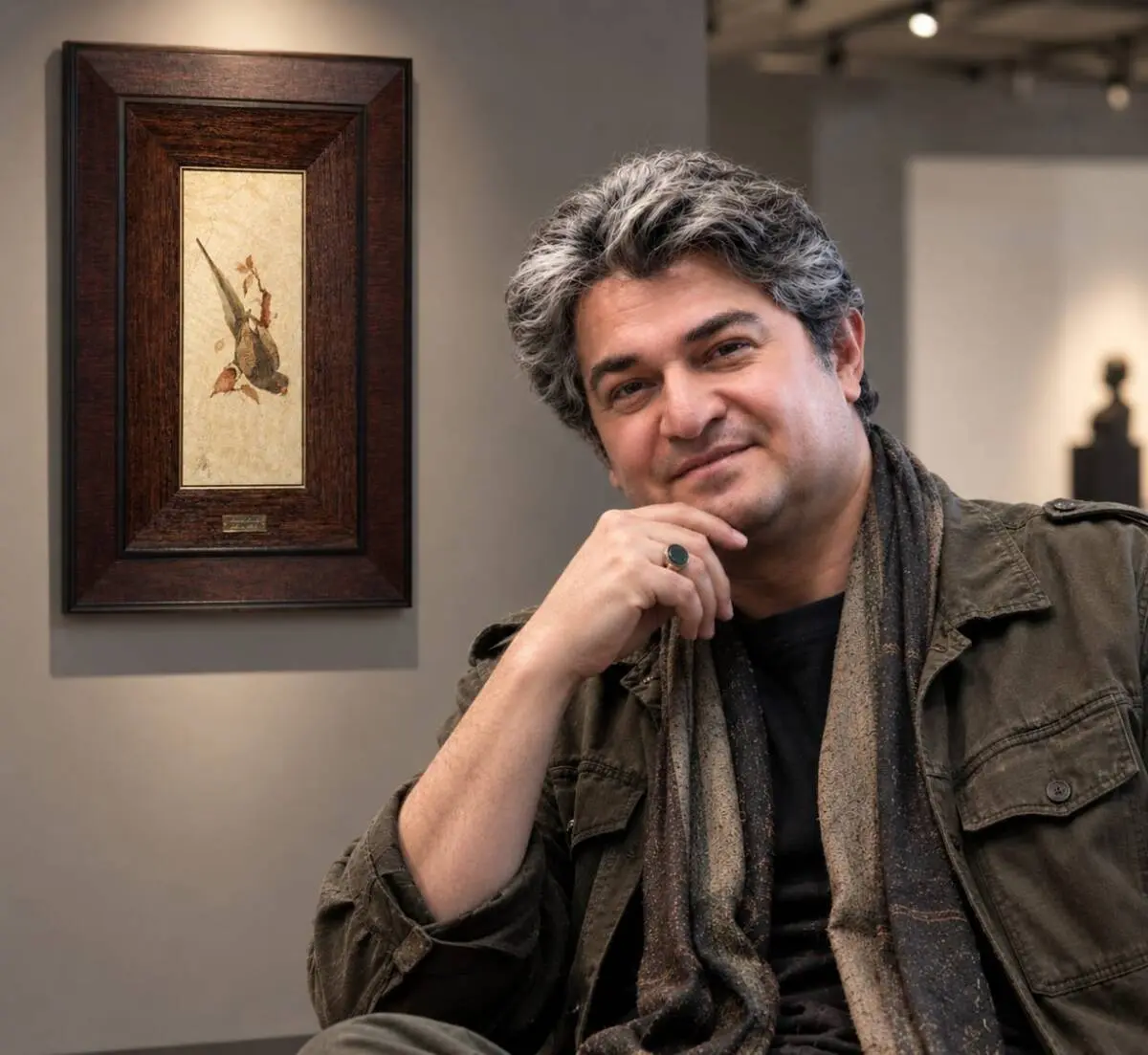
Mohamadali Vadood and Forest Heart / From Italy’s A’ Design Award to Kavian Auction
The wooden artwork Forest Heart by Mohamadali Vadood, created using his distinctive “Naqsh-Bandi” technique, impressed the A’ Design Award in Italy in 2019; an art form born from wood and committed to the environment, inviting us to look at nature with greater attention and understanding
ArtDayMe : We examine Forest Heart, a wooden artwork by Mohamadali Vadood [Kermanshah, 1978], remarkable and innovative in both its artistic creation and environmental dimension. Interestingly, the work has also received recognition from two important perspectives: artistic credibility and the art market. It was selected by the prestigious A’ Design Award in Italy in 2019, and seven years later, in 2026, the work was presented at Kavian Auction, a private auction house in Tehran, where it was sold for $8,800.
Interestingly, both A’ Design and Kavian Auction have published texts about the work from the perspectives that matter to their respective institutions. These texts can be traced through their websites and catalogues. Here, we republish both texts to examine how Forest Heart has been interpreted and valued from the perspectives of these two institutions of art and the art market.
_ The A’ Design website and Mohamadali Vadood’s Forest Heart
DESIGN NAME: Forest Heart
PRIMARY FUNCTION: Wood Picture
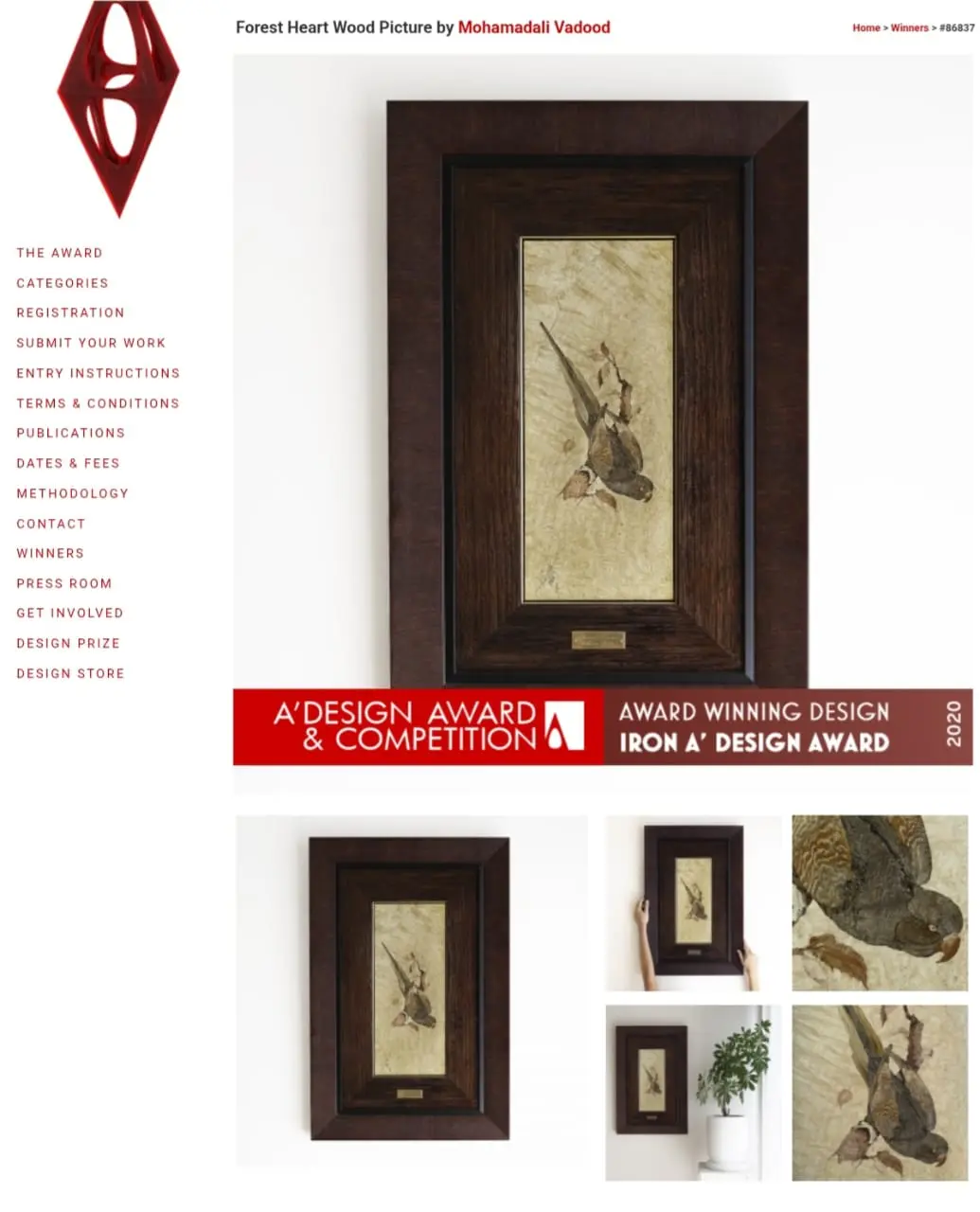
INSPIRATION:
Natural wood structure, consisting of a variety of colours, illusory lines, special texture and darkened and bright spots with special makeup during the growth of the tree, can broaden any individuals' horizon in many impossible to imagine ways. The cutting angle of the wood makes these motifs look even more varied on the surface of a piece, cut from the main wood. With this discovery of what the cutting angle leads to what l am thinking of, l came up with this idea that I would find a base for this to control the patterns, lines and colors of the wood to create an originally incredible image based on the nature of wood and not manual changes.
UNIQUE PROPERTIES / PROJECT DESCRIPTION:
This art project tries to fulfill three intended purposes:
1. Taking a fresh look at wood to explore a new perception in it and to harmonize with its pure nature as well, so we can come up with original ideas to create real art.
2. Applying an innovative technique in working with wood and also in using common tools so we could achieve adequate quality in our performance.
3. Discovering, creating and defining new ways to gain desired images by tracing natural patterns in pieces of wood and making a synthesis between them.
OPERATION / FLOW / INTERACTION:
In this project-like work of art you can see a specific way of working with wood using the fewest pieces and mainly benefiting from the natural colour and also texture of the wood so you can build up a perfectly complete image, which actually cannot be repeated or copied as patterns in each piece are naturlly unique. Thus, it can be artistically used as a piece of decoration, specifically in wood-based decorated spaces on the wall or a shelf. As for the transformation, it could be carried in a box of the same size and as it deos not weigh that much or take up much space, it does not matter a special transport.
PROJECT DURATION AND LOCATION:
This work was created, in Tehran, started and finished in 2010, and to find appropriate woods they were provided from different places. It took 6 months to accomplish the project as it turned out to be time-consuming to find desired wood pieces.
FITS BEST INTO CATEGORY: Fine Arts and Art Installation Design
PRODUCTION / REALIZATION TECHNOLOGY:
Defining a geometrical table based on cutting angles plus a method of cutting for even 1 mm pieces, and trying to have desired wood patterns and spots by restoring in perfect conditions like natural moisture percentage, etc. to benefit from bacteria activity were the main production phases. The types of wood, they were haloxylon for the body and the head, barberry for the tail, fig for the feet, tree of heaven for the nose and the leaves, acer monspessulanum (keykom) for the leaves again, jujube for the beak, European ash for the background and wenge for the margin. The tools were coping saw, plane, sanding paper, nail and hammer.
SPECIFICATIONS / TECHNICAL PROPERTIES:
The size is 35 in 60 cm. The thickness of wood sheets were 4 mm. The number of pieces are 47. The weight is 700 gr. All the colours and shades are chosen carefully to seize the natural fortuities in the woods.
TAGS:
naqshbandi, wood pattern tracing, marquetry, wood pattern, double cut, wood texture, wood cut, coping saw, wood character, wood art
RESEARCH ABSTRACT:
Naqshbandi is a new method or attitude which is used to create this piece and aims to benefit from connecting lines, expanding textures from one piece to another, and deciding upon the true light shade, not just the colour contrast and various tonalities as it is usual in other works of marquetry. It requires the artist to make a full-hearted attempt to harmonize themselves with the nature of wood as much as possible, and help them grow a clear perception of their work and gain a direct inspiration from natural fortuities given by wood. So, the whole thing will finally sound the art of nature in the eye of beholder.
CHALLENGE:
Defining geometrical patterns of cuts so that pieces of wood could save their original patterns, overcoming the thickness of cutline without using primer, and coming up with the idea of what I call Double-cut at the time of sanding to prevent the destruction of sub-patterns and sub-textures and save the main image are the parts of this work that ended up being its challenges.
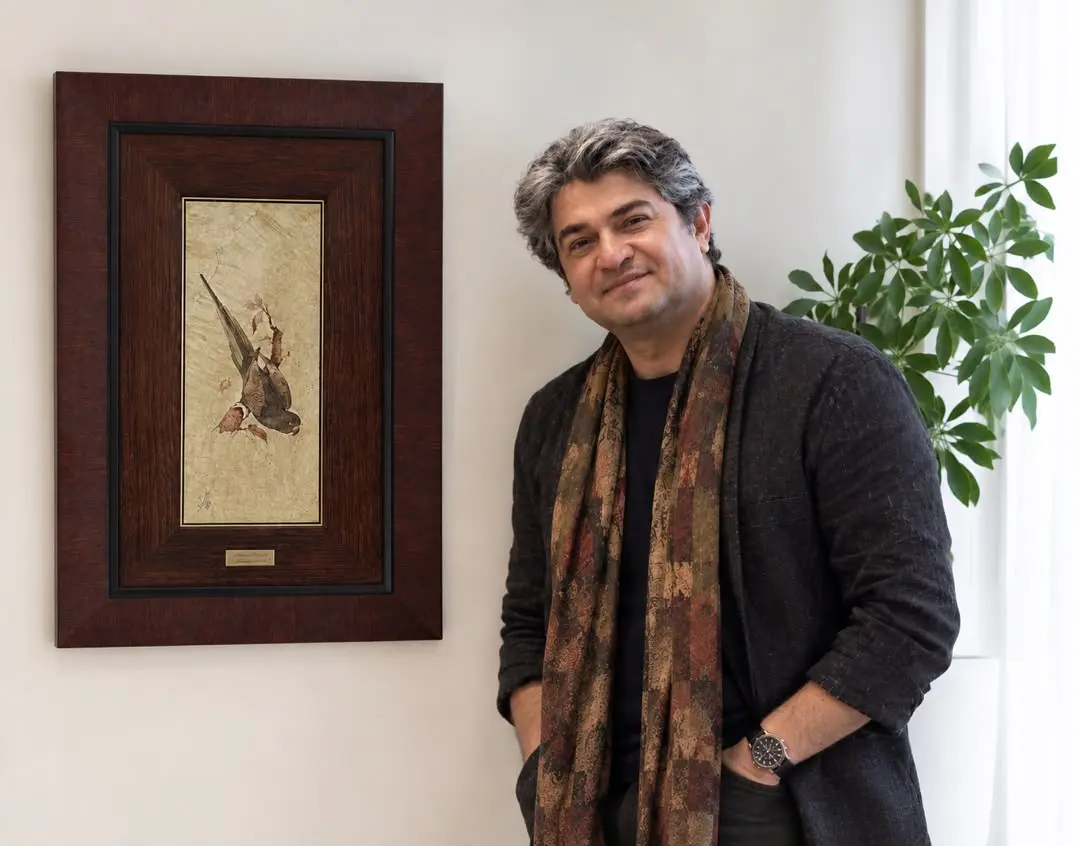
TEAM MEMBERS : the artist and the founding father of the method: Mohammad-ali Vadood
The end of the A’ Design website article.
_Kavian Auction Catalogue Text on Mohamadali Vadood’s Forest Heart
The Autumn Bird: Inscribing Life onto the Memory of Wood
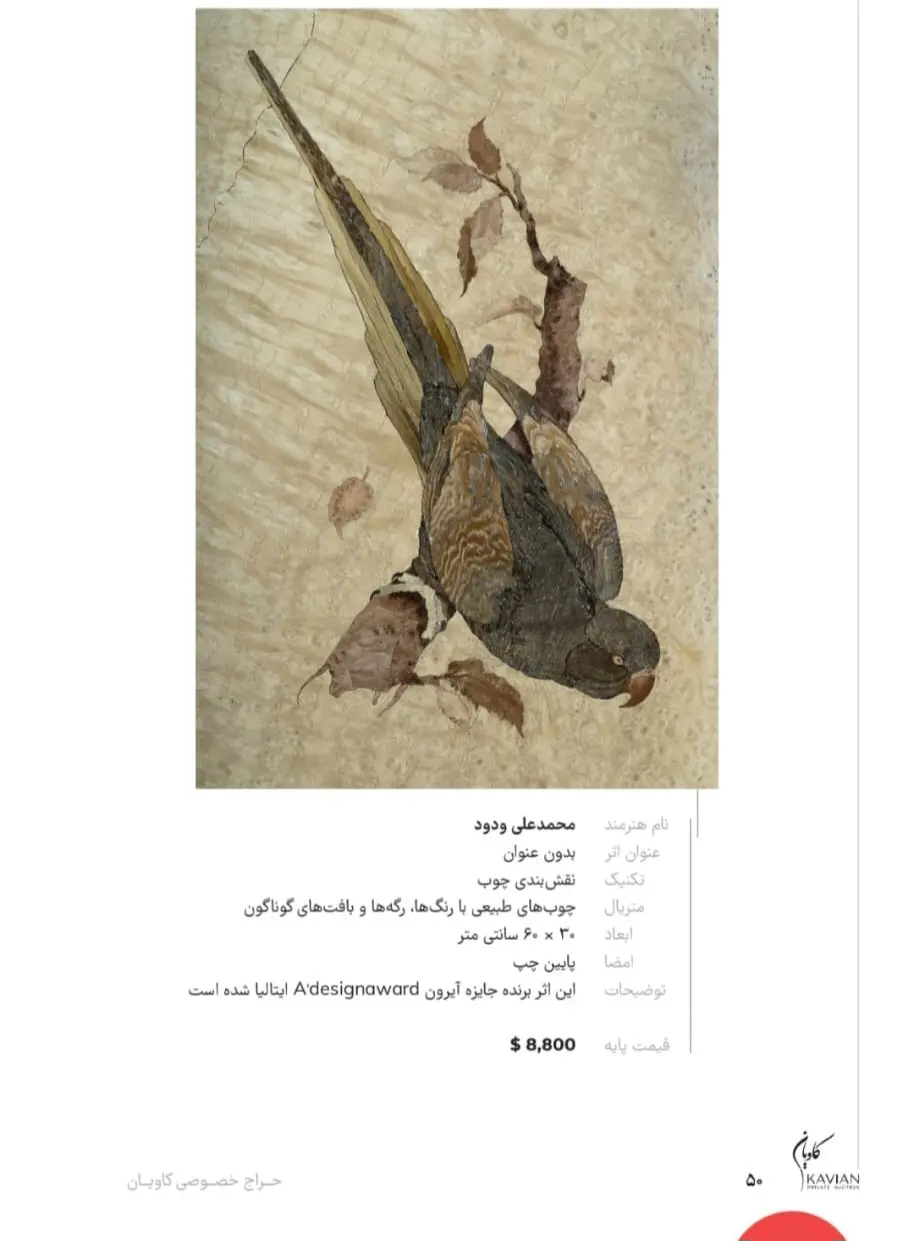
Mohamadali Vadood, an artist, researcher, and university lecturer, is a recognized figure in Iran’s traditional arts and wood-based arts. He began his professional career in the late 1990s, in connection with traditional arts revival classes organized by the Cultural Heritage Organization and the wood-art workshops of Iran’s Traditional Arts Research Institute.
This environment, together with his proximity to distinguished masters and access to historical and research resources, provided the foundation for developing his precise understanding of Iran’s artistic heritage.
Vadood subsequently established and managed specialized workshops in sculpture, stone carving, and wood arts; taught at numerous universities; founded the Vadood Wood Arts Institute; and worked with national and international institutions, playing an influential role in the education, research, and development of traditional arts.
His First-Degree Artistic Medal, the title of 2022 Man of the Year of the World Crafts Council, and the international “Creative Hand” distinction have further established his position as an artist with a distinctive style in the field of wood arts.
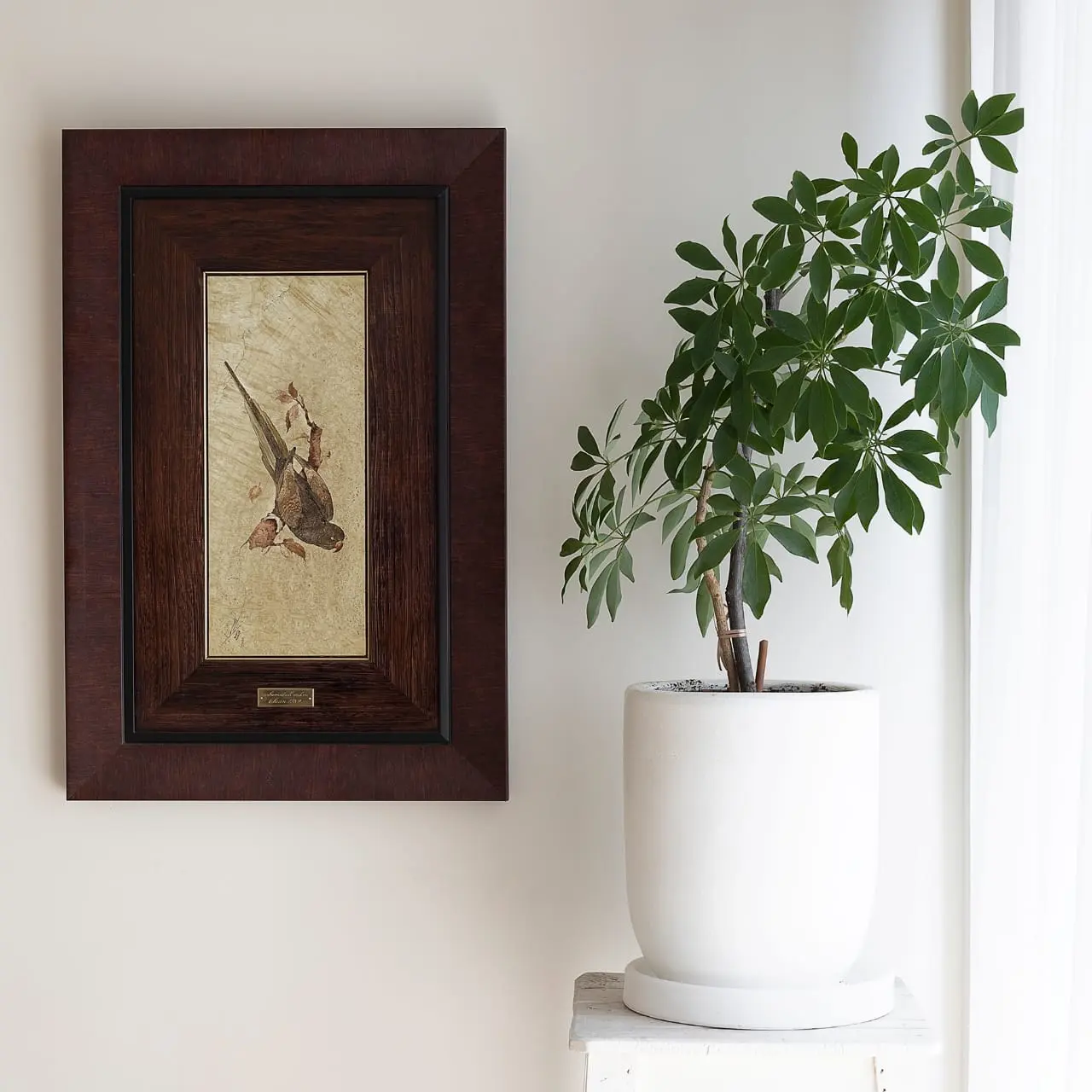
The present work was executed using the Naqsh-Bandi technique on wood and represents a notable example of Vadood’s approach to material, nature, and narrative.
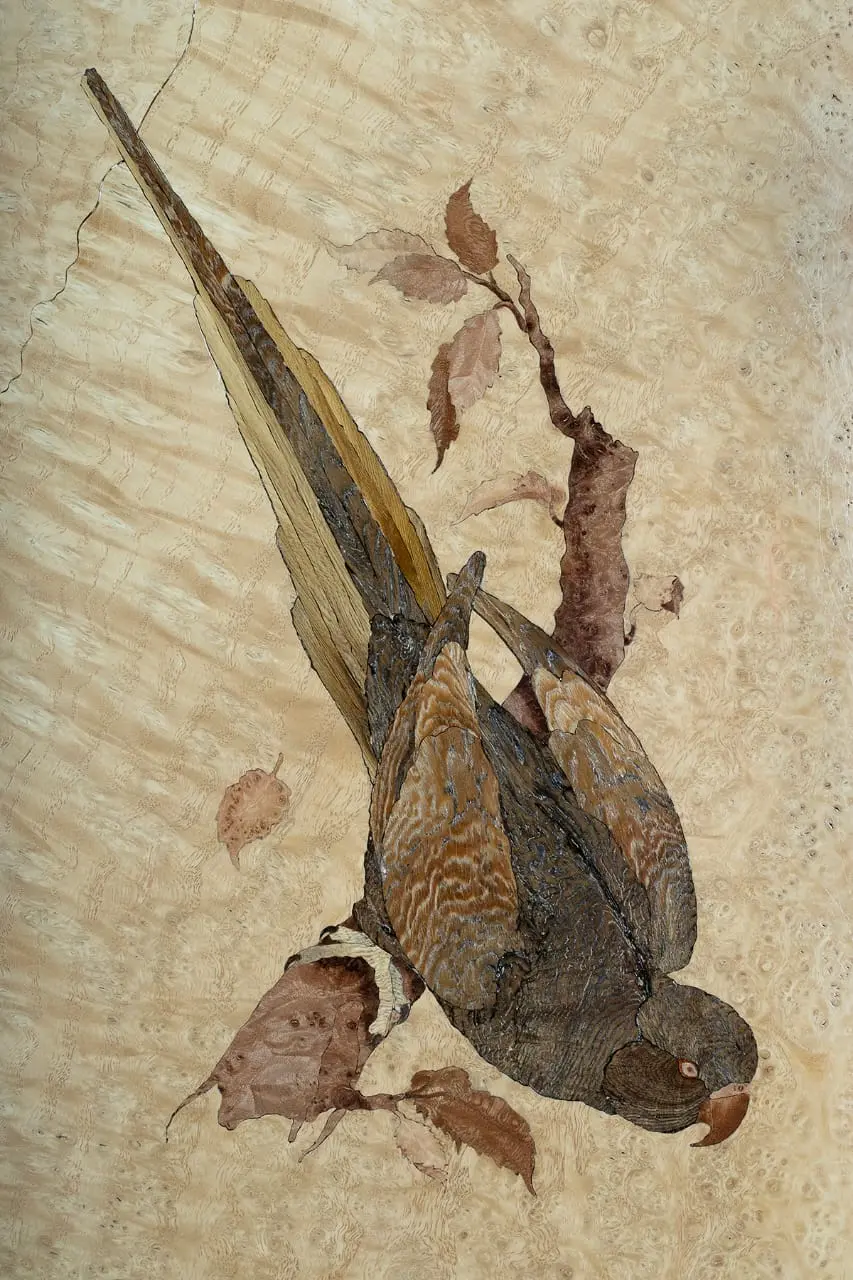
In this work, a bird appears in the midst of landing, falling, or suspended movement, set against a surface of light, undulating wood. The composition is built around the bird’s elongated diagonal movement: a long tail extending toward the upper section of the image, tightly folded and highly detailed wings, and a lowered head with a curved beak that creates the principal visual focus near the bottom of the frame.
This bodily position evokes a moment between flight and stillness; an unstable moment in which movement has become memory and life stands on the threshold of silence or a return to nature.
The significance of the work lies above all in the carefully measured relationship between image and the material of wood.
Vadood does not use wood merely as a background or a support for the image. Instead, he draws upon its natural grain, knots, waves, and variations in color to construct the visual world of the work. The light-colored ground, with its animated and living textures, creates a quiet yet dynamic space, as though the movement of air, the passage of time, and the memory of the tree itself are flowing across the surface.
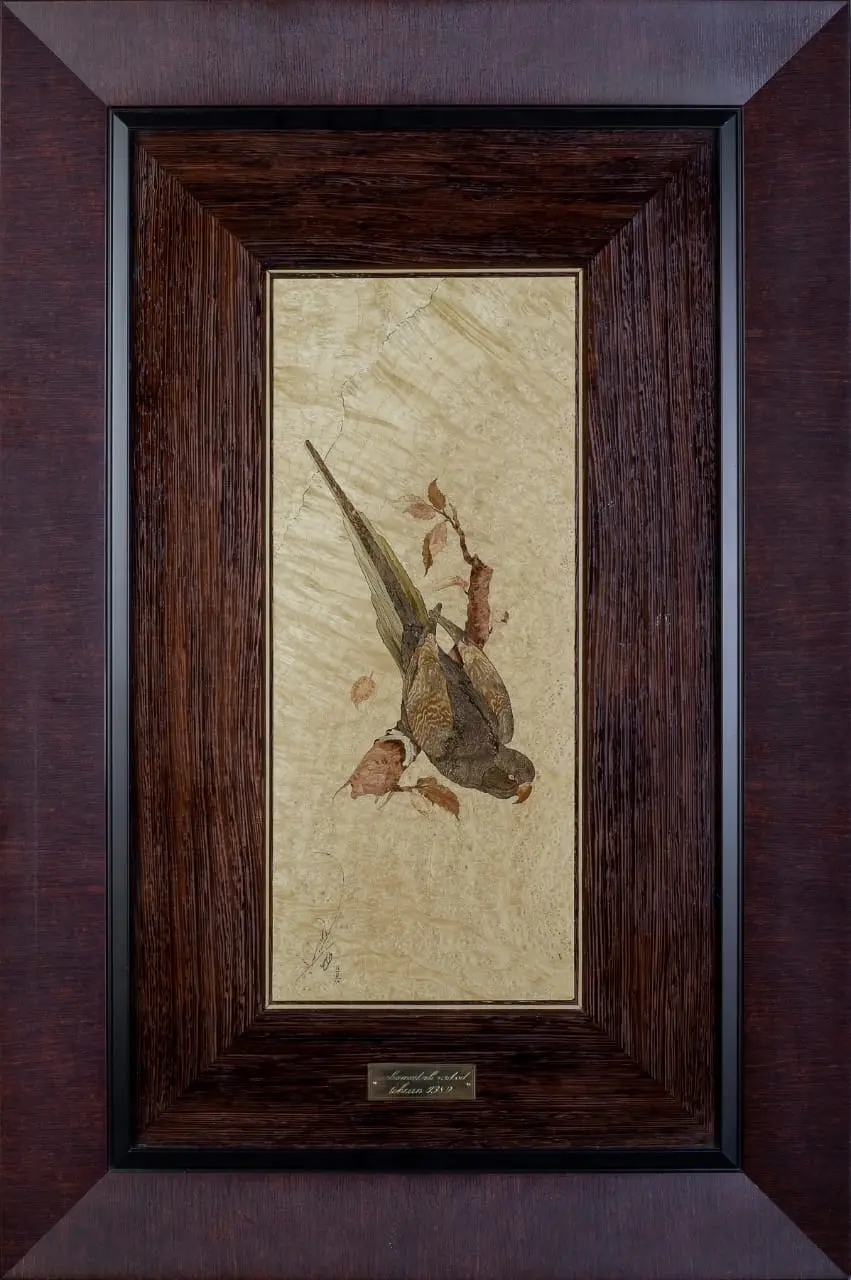
Against this background, the body of the bird is formed from pieces of darker wood in shades of brown, gray, and gold, with variations in texture taking the place of conventional painting. In this way, light and shadow, volume, feathers, wings, and skin emerge not through painting, but from the inherent qualities of the material itself.
The presence of scattered leaves around the bird brings the work closer to the realm of autumn, erosion, and the cycle of life. The leaves, with their earthy colors and subtle transparencies, appear to float around the figure, creating a poetic and melancholic atmosphere.
The bird, meanwhile, is not merely a natural or decorative subject, but a sign of movement, vulnerability, and return. Since the bird, leaves, branches, and background all emerge from wood, a kind of conceptual kinship is established between subject and material: nature, through its own substance, retells the story of nature.
This characteristic takes the work beyond the level of craft and transforms it into a meditation on material, time, and memory.
In Vadood’s artistic world, imagination and reality meet along a fluid boundary. He regards art as a space for narrating possibilities that have not found an opportunity to emerge within history and culture. His works therefore attempt to make the unseen visible and to reread worlds concealed within cultural memory.
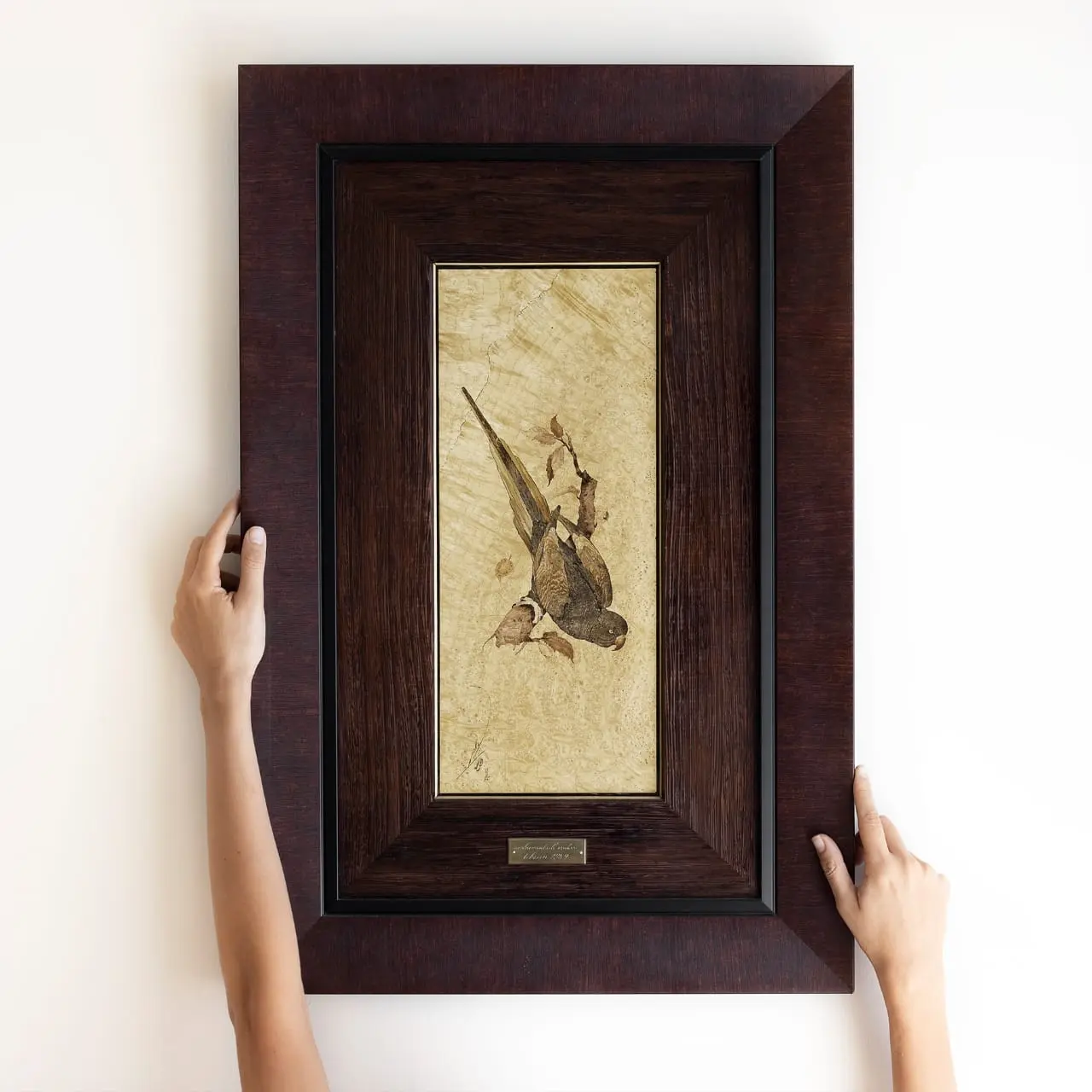
In this work as well, the inverted bird can be understood as an image of an unfinished event, an interrupted flight, or a quiet return to the source.
Through precise control of form, a conscious selection of wood, and fidelity to the natural character of the material, the artist creates an expression that is rooted in the tradition of Iranian wood arts while simultaneously possessing a contemporary, contemplative, and personal perspective.
Overall, this work by Mohamadali Vadood is an outstanding example of contemporary Naqsh-Bandi on wood, in which technical skill, a profound understanding of material, and narrative imagination exist in a carefully balanced relationship.
The bird, set against living wood grain and autumn leaves, becomes a metaphor for life, time, descent, and return. Through its visual tranquility, refined execution, and intrinsic connection between material and meaning, the work clearly reflects Vadood’s position in the continuation and renewal of Iran’s traditional and wood-based arts.
_Mohamadali Vadood’s Artworks
Over the past several years, Mohamadali Vadood has succeeded in developing an expanding audience and market for wood art through a distinctive and recognizable personal language. Signs of this trajectory can now be found both in private collections and in auction records.
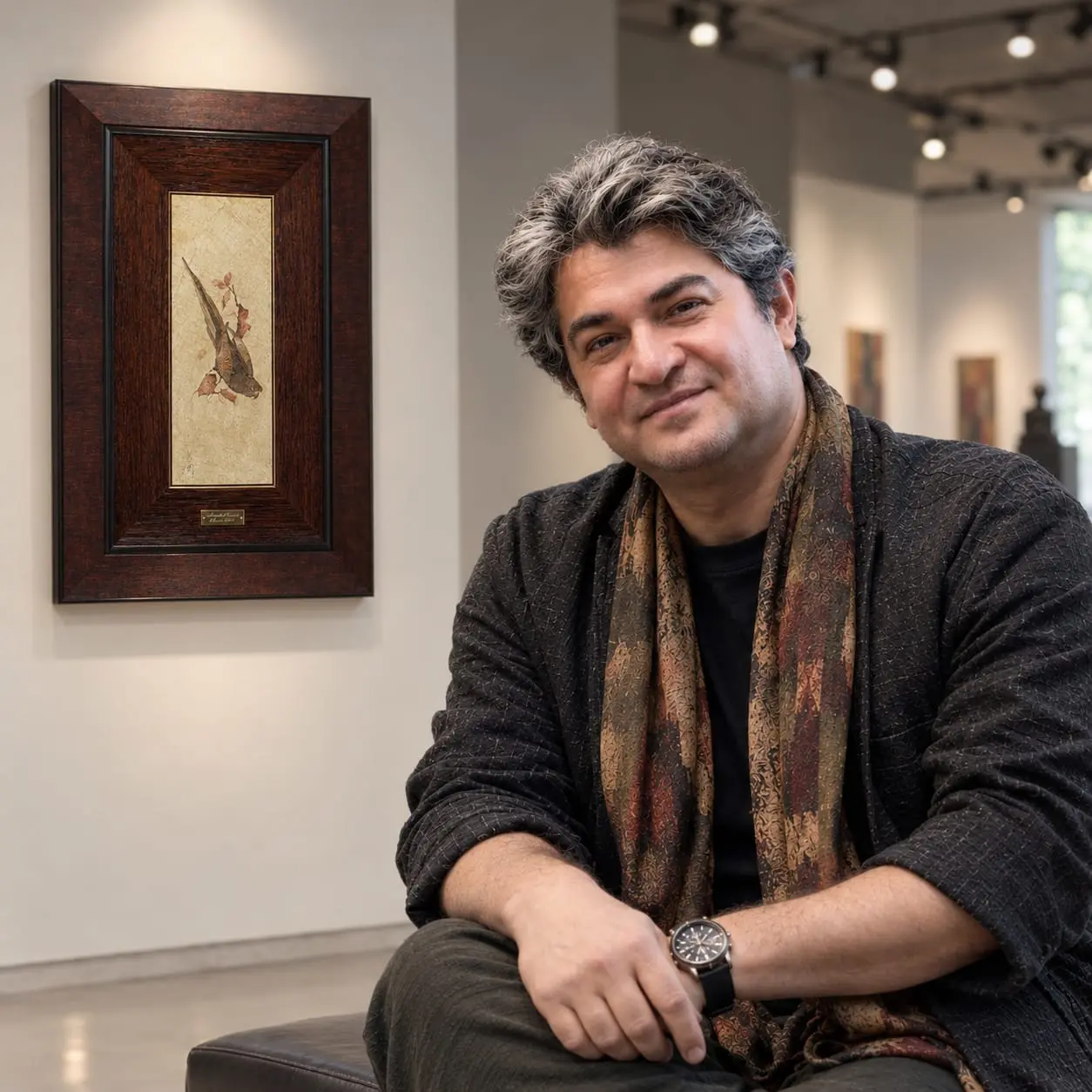
At Kavian Auction 2026, a 30 × 60 cm work executed using the Naqsh-Bandi technique and selected in the Fine Arts category of the A’ Design Award in Italy was sold for $8,800.
Meanwhile, the wooden sculpture Morgh-e Malakut from the series The Assembly of Thirty and One Birds, created in collaboration with Shadi Habib and awarded the Bronze Medal among Italy’s Best Designs of 2019, was sold at Tehran Auction 2026 for 1.65 billion tomans, equivalent to approximately $9,700.
These figures, alongside his record of receiving the international Creative Hand distinction; the title of 2022 Man of the Year at the International Crafts Awards in India; the title of Top Wood Arts Master in Asia and the Pacific in 2026; several titles and selections at the A’ Design Award in Italy and the Kioskedia Awards; lifetime membership in the Global Designers Consortium; membership of the Arts Council of the National Elites Foundation and the Specialized Traditional Arts Group of the Academy of Arts; and the First-Degree Artistic Medal, constitute part of the symbolic capital of the brand that Vadood has built over the years.
Part of the significance of this artistic brand can also be seen in the trajectory of his works after their creation. His works are held in the digital collection of MOOD Museum in Italy, the museum of the Research Institute of National Arts of Iran’s Ministry of Cultural Heritage, and the Tabriz Islamic Art University Museum, as well as in private collections belonging to Professor Givo Khalili, Engineer Abbasi and Abbasi Gallery, Engineer Hassan Golchinpour and Masnegar Gallery, Engineer Esmail Ghods, Dr. Farshid Bozorgi, and Engineer Meysam Moradimanesh.
From a market perspective, what is significant about Vadood is the simultaneous formation of a personal artistic language, professional credibility, an international record, collecting history, and auction sales. Together, these elements transform an artist’s name from a personal signature into a recognizable artistic brand within the market.
LEAVE A RELPY