
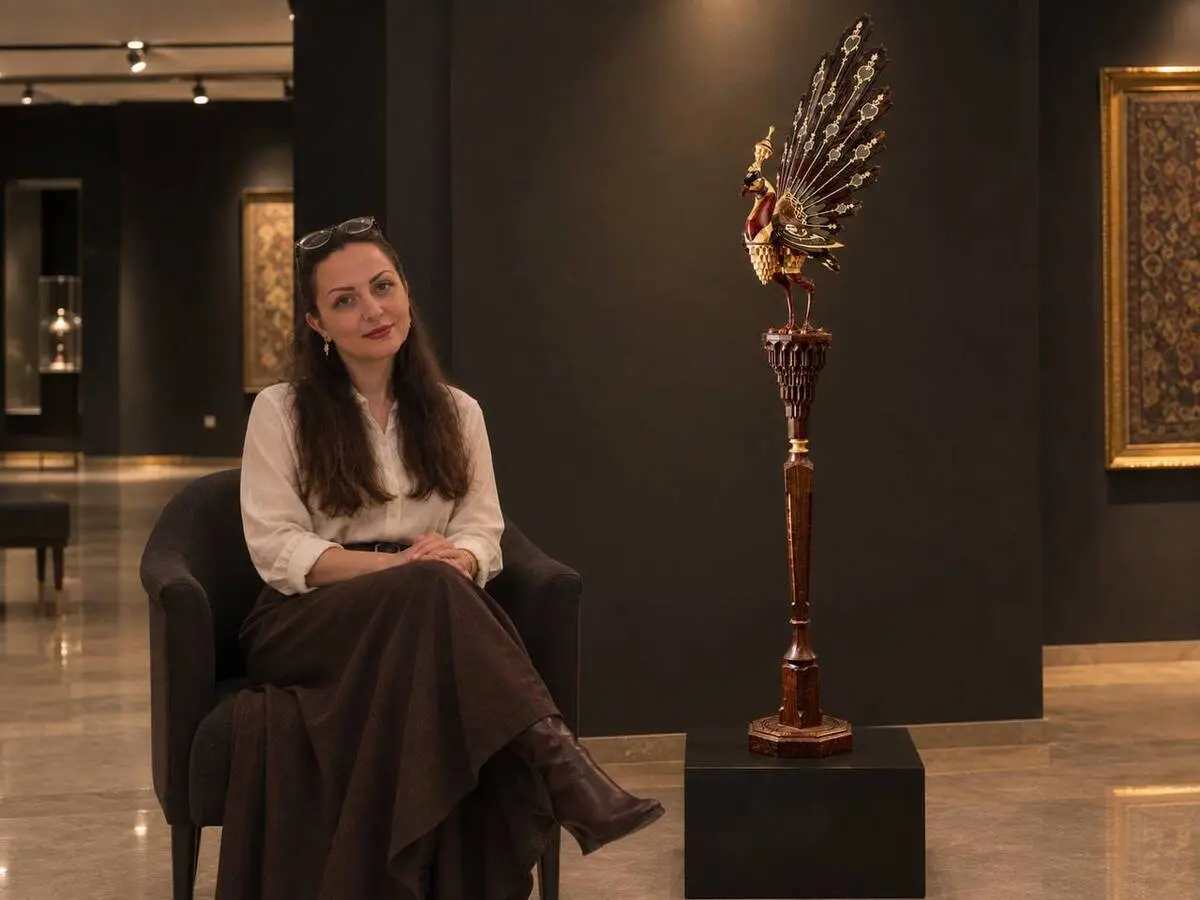
Shadi Habib and The Bird of Heaven: Seven Art Forms, from A'DESIGN to Tehran Auction
This is the fascinating story of a captivating sculpture that brings together seven art forms, including sculpture, muqarnas, marquetry, woodcarving, and more. The wooden sculpture The Bird of Heaven, from the Thirty and That One Bird series, is a collaborative work by two renowned wood artists from the Middle East whose work has attracted attention from A'DESIGN in Italy to the Tehran Auction: Shadi Habib and Mohamadali Vadood. In this article, this enduring work is examined from Shadi Habib's perspective.
ArtDayMe : Among the works of Shadi Habib [born 1986, Tehran], the wooden sculpture The Bird of Heaven, from the Thirty and That One Bird series, is a unique example of the coexistence of wood, art, history, and environmental concerns. It brings together seven traditional arts and woodcraft techniques—including muqarnas, marquetry, woodcarving, woodturning, sculpting, levelled woodcarving, and pierced woodcarving—in a single sculpture, executed with exceptional artistic precision and technical skill.
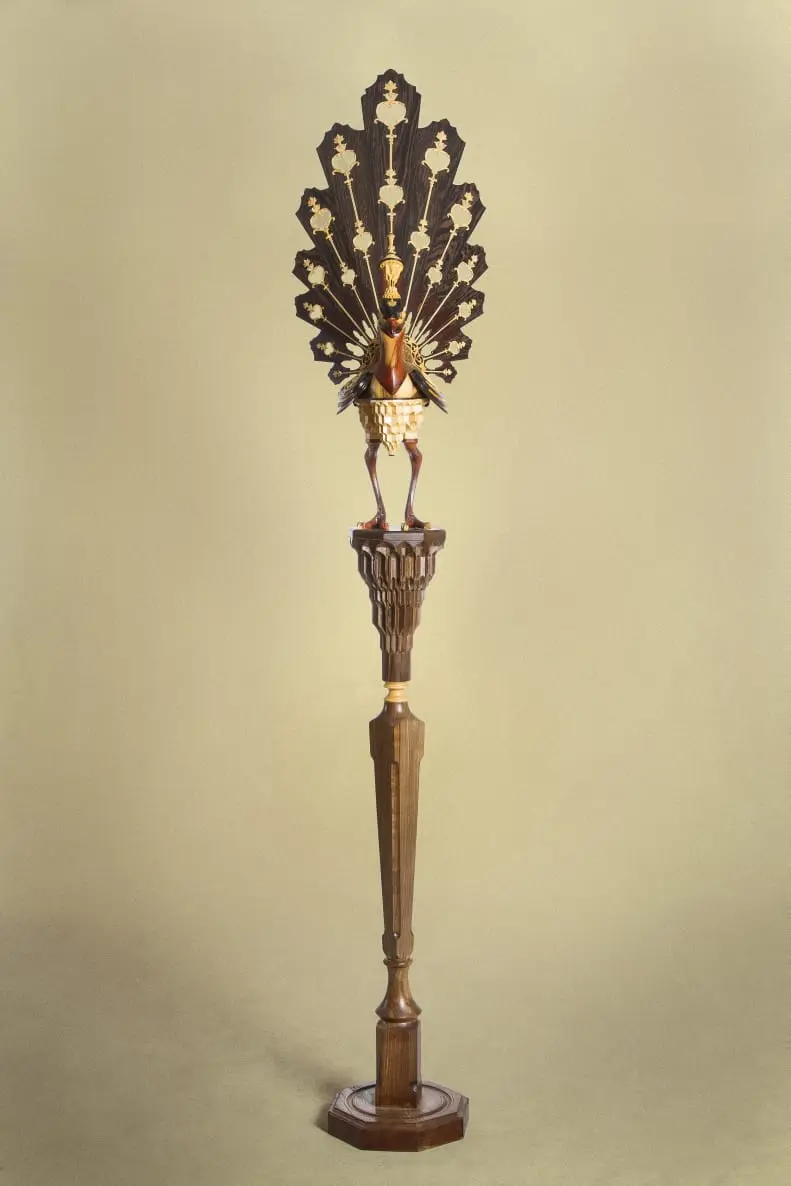
The work's concept and method of execution simultaneously connect two distinct realms: artistic expression and an engagement with environmental concerns.
The journey of this remarkable work demonstrates that the attention it has received has not remained confined to the realm of artistic experience. The Bird of Heaven has attracted recognition within the art world and subsequently entered the art-market sphere.
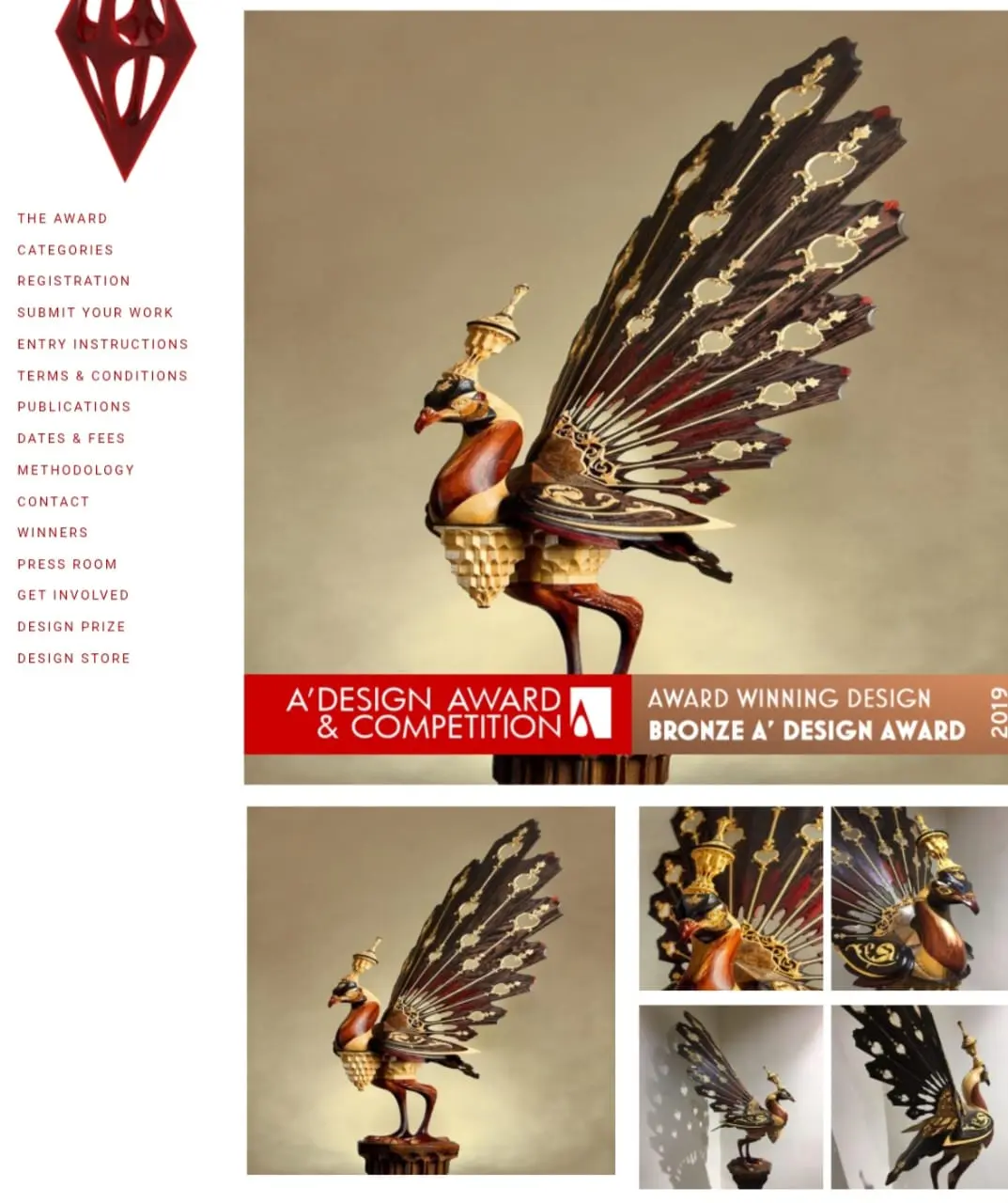
In 2019, the prestigious A'DESIGN Award in Italy selected this work as a featured winner. Seven years later, in 2026, it was presented at the 25th Tehran Auction, where it was hammered at IRR 1.65 billion, equivalent to approximately USD 9,700.
Alongside these two milestones, there is an important opportunity for a renewed reading of the work: both institutions that played a role in this journey have published their own written accounts of The Bird of Heaven. A'DESIGN presented the work on its website, while Tehran Auction introduced and discussed it through its website and catalogue, each from a different perspective and according to a different institutional logic.
Below, we republish both texts so that we can directly observe how a work of art is described, interpreted, and ultimately valued in two different contexts: from the perspective of an international design-award institution and from that of an art auction house.
Before reproducing these two analyses, however, it is important to understand which aspects of the work were more specifically shaped by Shadi Habib, considering her areas of expertise.
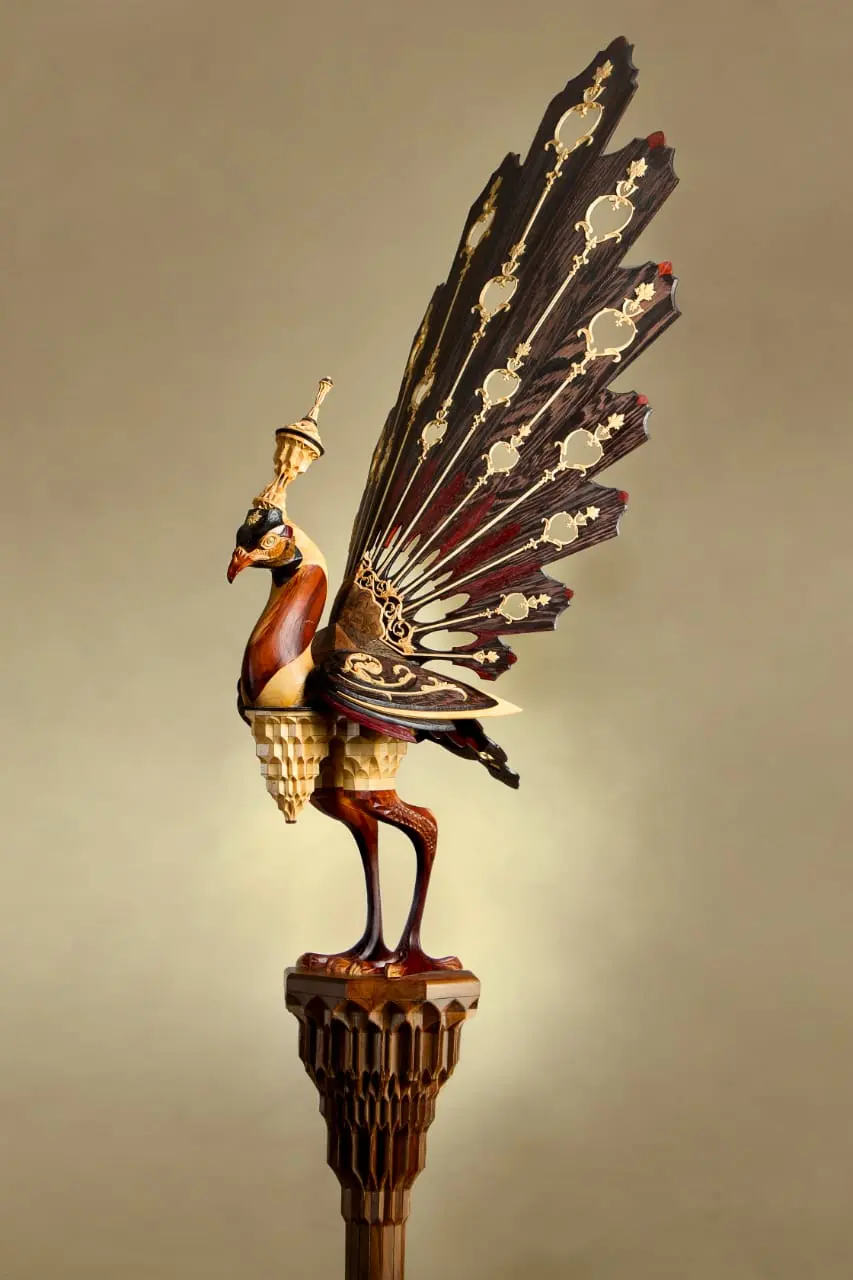
Shadi Habib's Art Forms in The Bird of Heaven
Naturally, a collaborative artwork is the result of shared ideas and execution, and distinguishing the individual contribution of each artist can be extremely difficult—particularly in the context of traditional Iranian arts, where collective work by several masters on a single ceremonial or traditional artwork has a long-established history known to the art world.
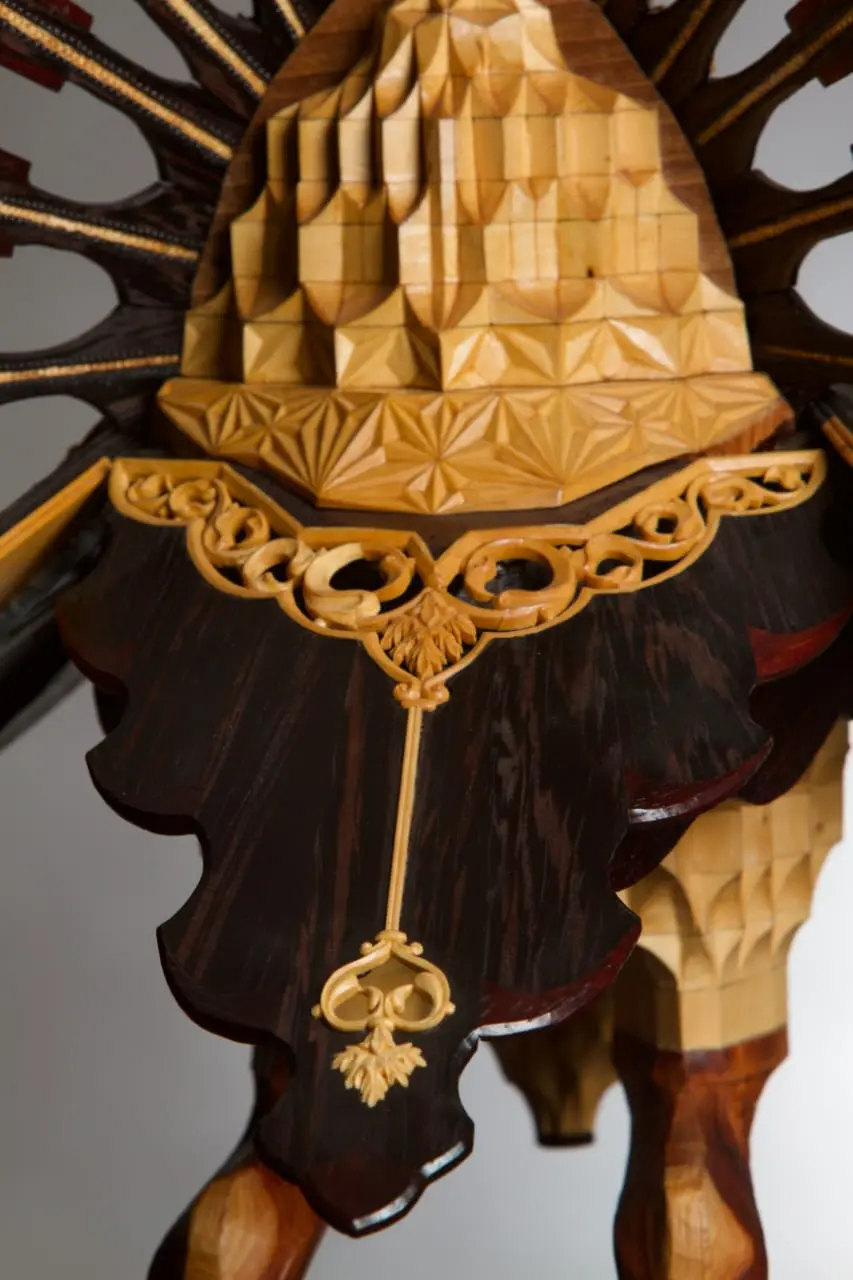
Nevertheless, in a specialised art article, understanding the particular areas of expertise of each artist can be interesting.
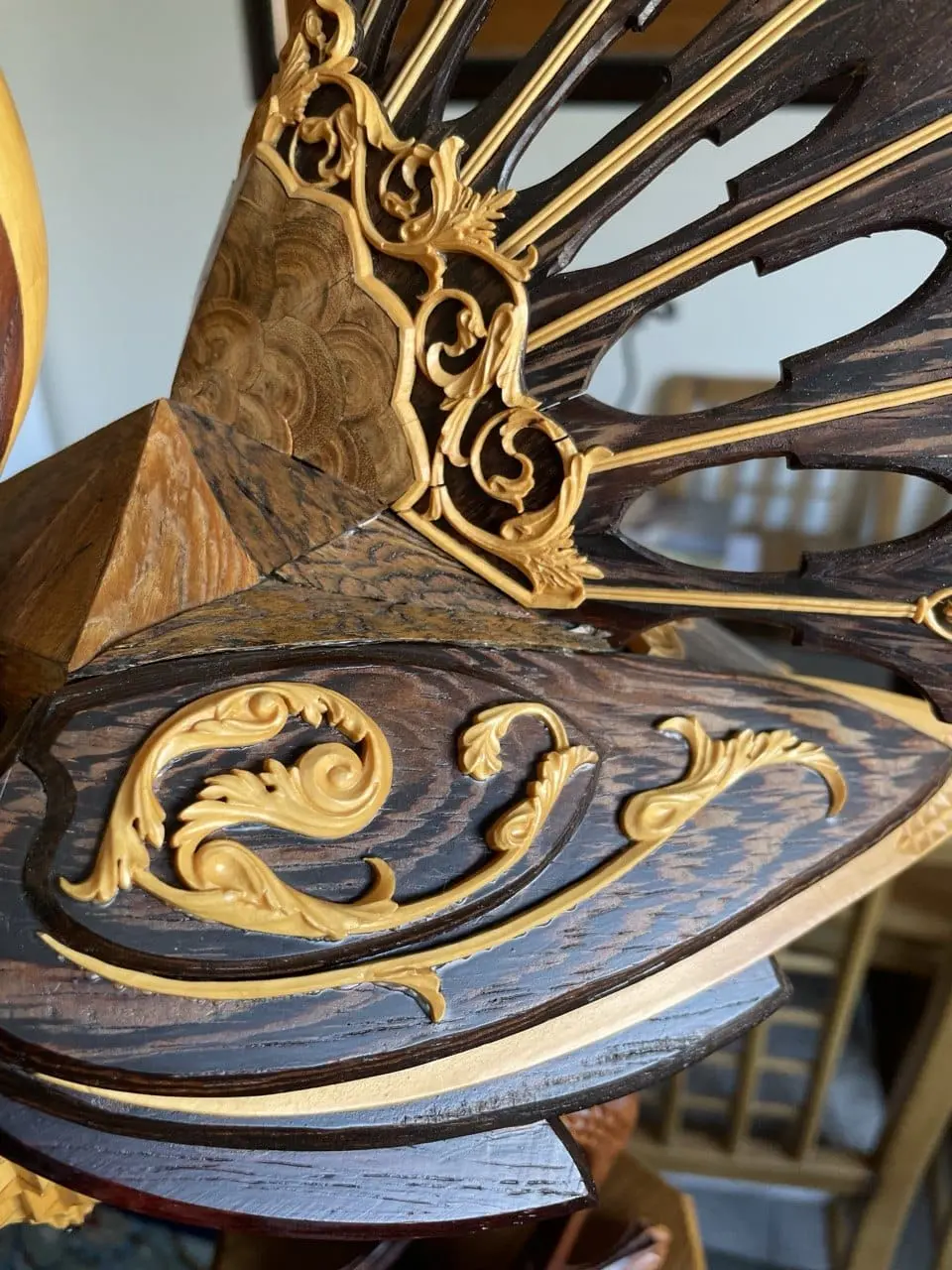
In this work, in addition to her collaborative contributions, Shadi Habib worked specifically on the pierced woodcarving sections of the tail, beneath the tail and on the wings, as well as on parts of the levelled woodcarving on the tail.
The A'DESIGN AWARD Website's Presentation of The Bird of Heaven
Work Name:
The Bird of Heaven
Primary Function:
Wooden Sculpture
Team Members (2):
Shadi Habib and Mohamadali Vadood
Inspiration:
This work was inspired by the story of Prophet Abraham, in which God resurrected three birds that had been cut into pieces, with their parts placed upon three different mountains, so that Abraham could witness their resurrection.
This story led us to believe that art, like a divine phenomenon, can create new life and form by bringing together pieces of dead wood and employing a variety of artistic techniques.
To realise this concept, seven different art forms and techniques—including sculpture, muqarnas, marquetry, woodcarving, and other woodworking techniques—were combined with various types of wood, including jujube, tagh, boxwood, robinia and rosewood.
Unique Features / Project Description:
Among the various arts and techniques employed in this work, particular attention has been devoted to muqarnas. Muqarnas is a remarkable and highly beautiful art form traditionally used primarily in architectural design and ornamentation. It creates geometric structures through the arrangement of repeated and orderly components.
Because of the difficulty involved in executing this art form and the limitations imposed by its design, which often result in repetitive forms, muqarnas is gradually disappearing. Creating a new application for muqarnas required an innovative method that could allow the art form to move beyond the symmetry and repetition imposed by its geometric limitations.
For this purpose, I developed an innovative method that we call “Leveling Muqarnas.” Unlike the traditional method, in which muqarnas is constructed by placing small pieces next to one another or carving it from a single large piece, this method arranges the components in different layers and divides them, according to the form and design, into layers of varying thicknesses. The muqarnas patterns are then carved onto these layers.
The lower section of the body of The Bird of Heaven was created using the Leveling Muqarnas technique, while the crown of the work was designed and executed using traditional muqarnas. This difference makes it easier to compare the two methods and demonstrates the capabilities of this beautiful art form.
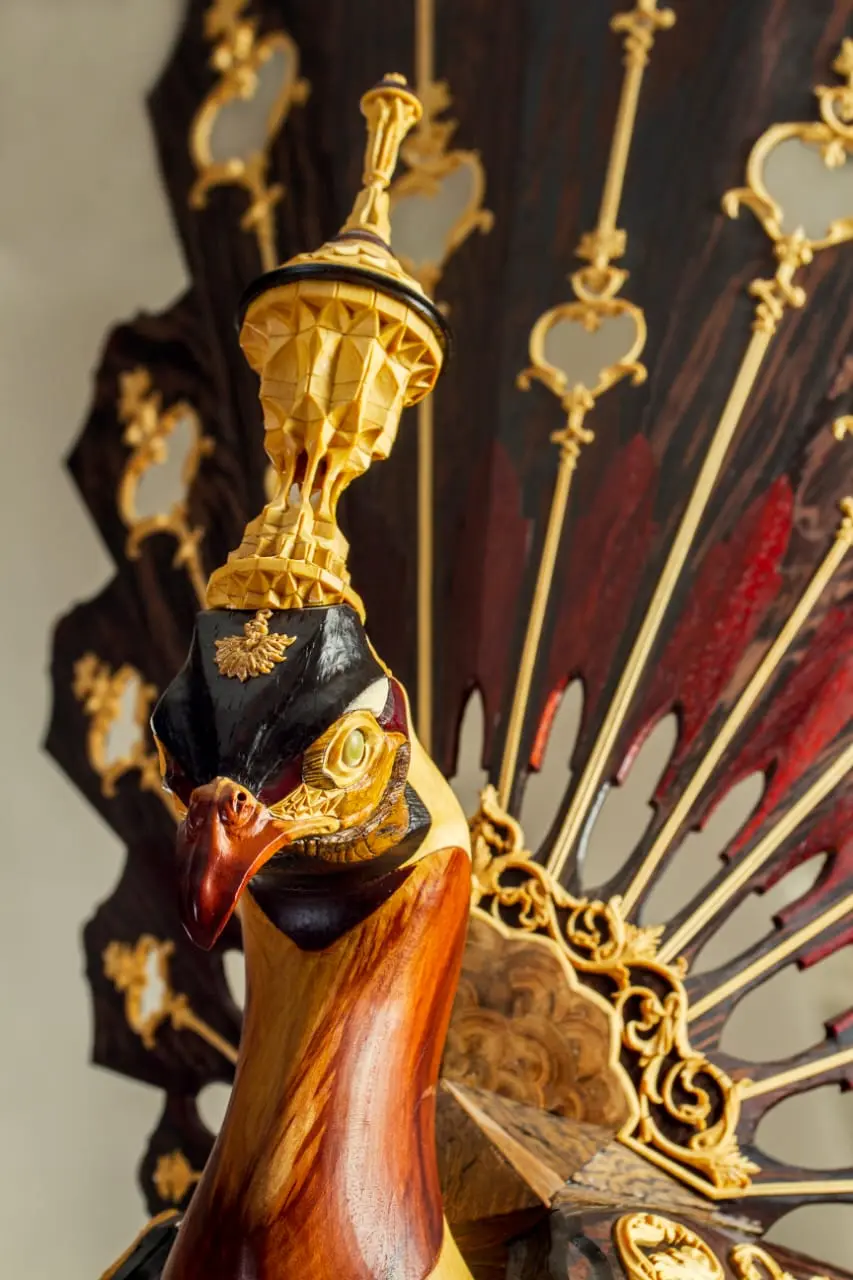
Throughout the execution of the work, an effort was made to use the natural colours of the wood rather than painting the wood. For example, the light and dark tones of the bird's neck are derived from a single piece of jujube wood, while all the colours visible on the bird's head are the natural colours of the woods used.
The eyes are made from shells from the Persian Gulf. These shells were cut in such a way that the pupils are actually formed from the natural deposits found inside the shells, with each eye made from a single piece.
Execution / Process / Interaction:
The work is essentially a static sculpture and cannot be transformed into another form.
The initial design concept was developed through the selection of the most appropriate bird form—one capable of responding to the practical limitations arising from the simultaneous application of muqarnas, sculpture, ornamentation and other techniques to a single figure.
Therefore, the work relies to a considerable extent on the capabilities of the various artistic disciplines employed in its construction. These disciplines were brought together and ultimately integrated into a single, coherent form within the bird's body.
To distinguish the different disciplines during the execution process, the components of the work were shaped using the different natural colours of the woods. In this way, a spectrum of colours reminiscent of a rainbow was created, appearing as different parts of the bird's body placed alongside one another.
Project Duration / Location:
The project began in 2017.
Production Technology / Execution Techniques:
Muqarnas, woodcarving, traditional Iranian pierced woodcarving, Iranian marquetry, woodturning, sculpture, and wood inlay are among the arts and techniques brought together in the execution of this work, allowing the central concept to be more fully realised in the form of a three-dimensional design.
Various types of wood, including jujube, Millettia laurentii, boxwood, rosewood, tagh and robinia, together with natural shells from the Persian Gulf.:
Specifications / Technical Features:
90 × 40 × 40 cm
30 × 30 × 120 cm
Keywords:
Art, traditional art, sculpture, design, wooden artworks, wood art, woodworking, muqarnas, woodcarving
Research Summary:
All stages of the work were carried out using the artistic knowledge, expertise and experience of the team members.
Team Members (2):
Shadi Habib · Mohamadali Vadood
_Tehran Auction's Website and Catalogue Presentation of The Bird of Heaven
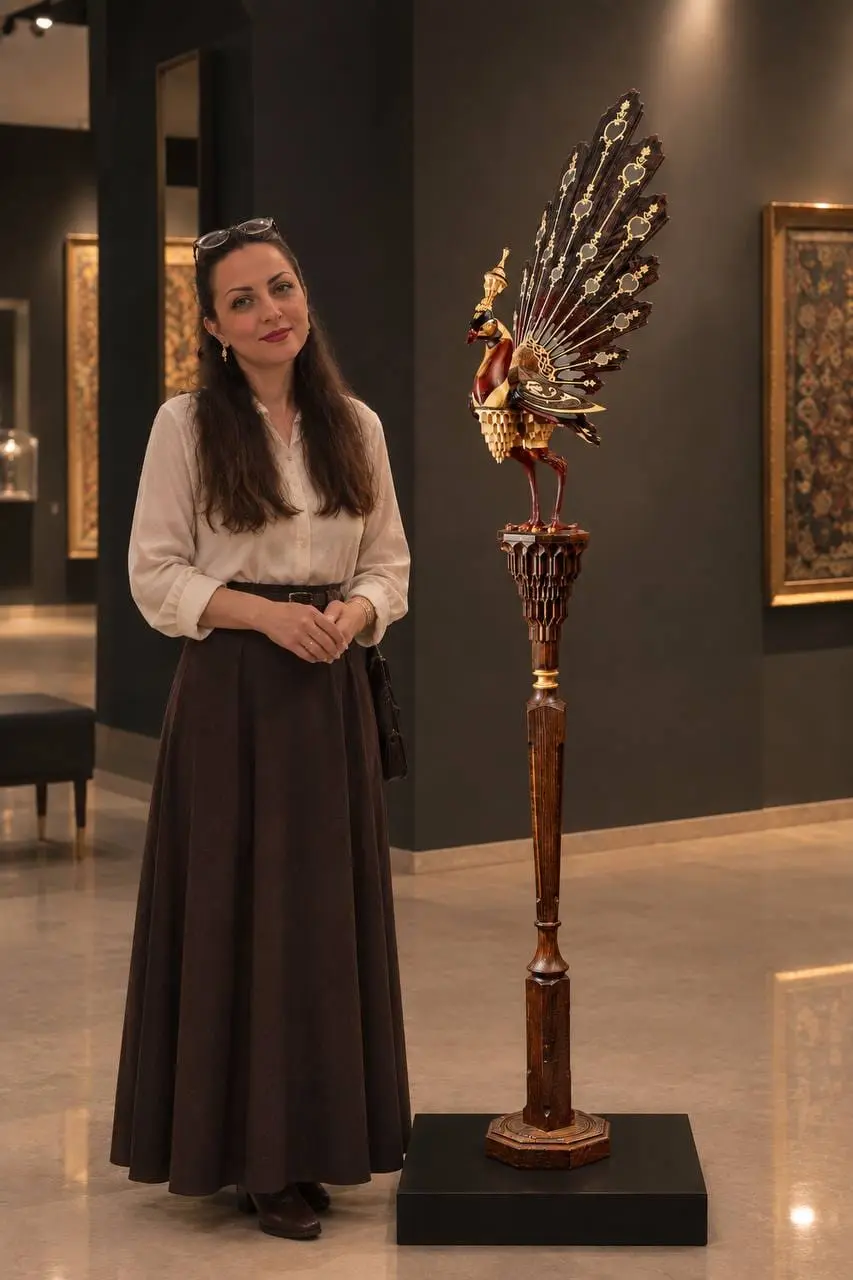
The Bird of Heaven is a wooden sculpture by Mohamadali Vadood featuring pierced woodcarving ornamentation by Shadi Habib. The work embodies a creative and distinctive design based on various traditional Iranian techniques of wood construction and ornamentation.
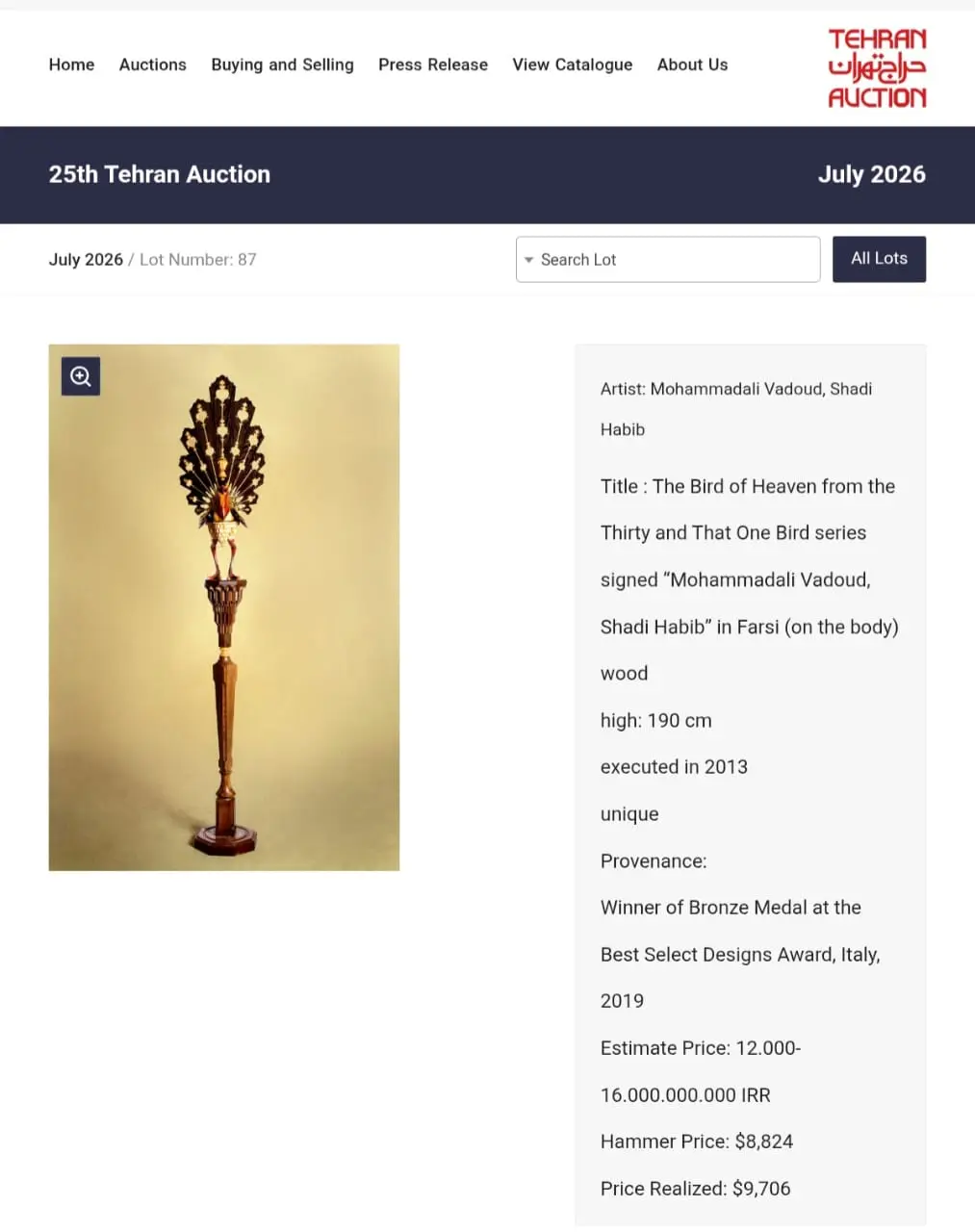
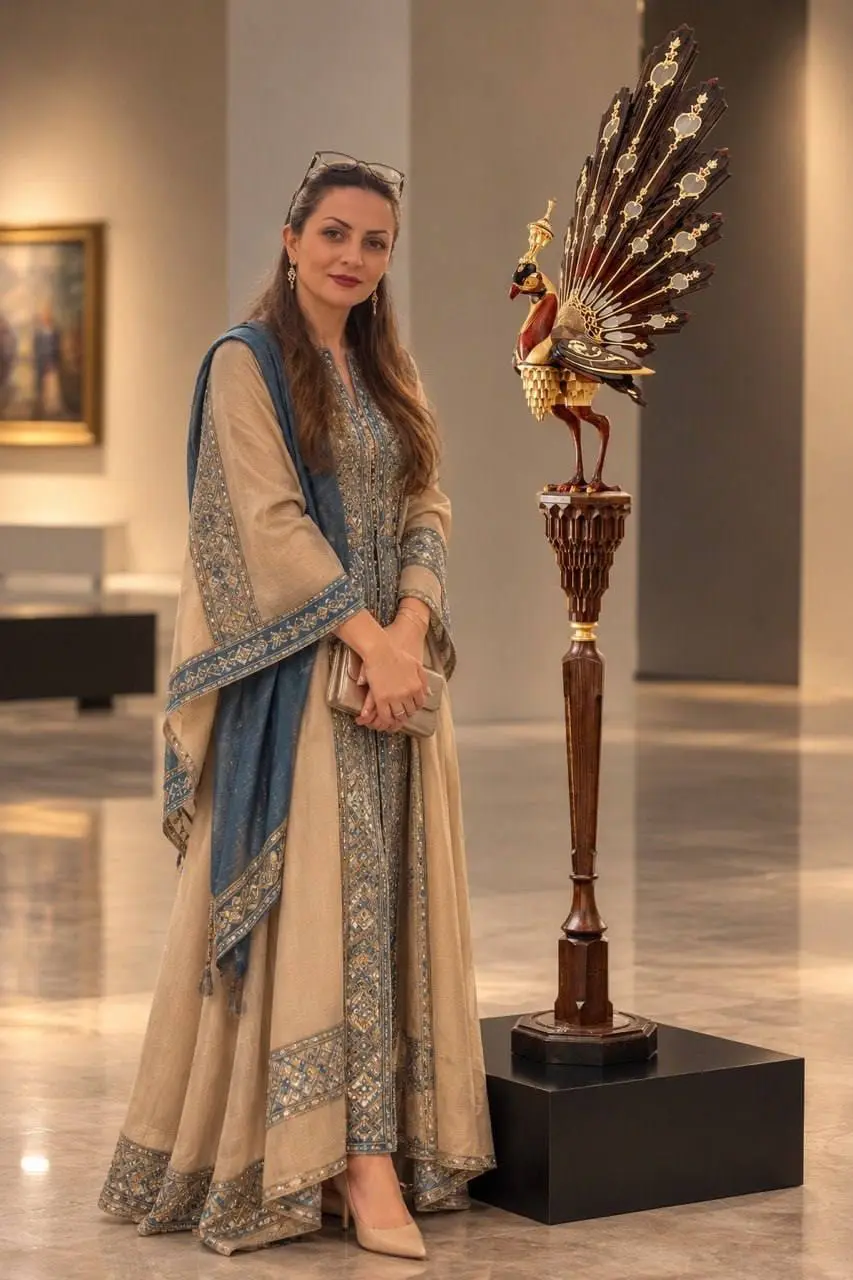
Seven ancient and traditional Iranian art forms—including muqarnas, marquetry and marquetry-woodcarving, woodturning, sculpting, levelled woodcarving, and pierced woodcarving—are interwoven in this work to create a figure that can be contemplated from both aesthetic and existential perspectives.
First, from an aesthetic and formal perspective, the bird closely resembles the metal peacocks of the glorious Safavid period and the birds of alam used in Ashura rituals as bearers of the celestial throne. This reflects the artist's return to ancient visual roots and the aesthetic achievements of Iranian art, alongside the influence of intellectual traditions and Shiite culture.
In this beautiful sculpture, instead of hard metal, layered wood, marquetry, levelling and traditional volumetric techniques have been employed, followed by the delicate pierced woodcarving ornamentation. Through the skill of the hand and the refined feminine gaze of Shadi Habib, these details are placed upon the bird's body, bringing delicacy and precision to their highest level of splendour.
This perspective, accompanied by enthusiasm and respect for the artistic traditions of earlier periods, can also be seen in the design of different parts of the bird's body. Mohamadali Vadood employed muqarnas in the design of the lower abdomen and crown of the bird—a form of art that achieved its most magnificent expression in the spatial divisions of Islamic architecture, particularly in the ornamentation of the iwans of Islamic mosques, and which reflects the artist's engagement with and contemplation of other Iranian art forms.
Although the overall form of the bird is rooted in naturalism and remains faithful in design to the peacock, its combination with abstract and geometric forms reveals the dominant tendency of Iranian aesthetics toward geometric and abstract motifs alongside delicate ornamentation.
The use of Persian Gulf shells for the bird's eyes, and their skilful carving to create pupils based on the shells' actual texture and to produce depth in the gaze, together with the use of the natural colours of various woods, constitutes another distinctive feature of this delicate and unique work, demonstrating the artist's mastery in the sophisticated use of form and content.
The harmony of colours and textures among the various woods can be seen throughout the work: acacia wood for the tail feathers, wenge for the canopy, jujube for the neck and legs, walnut for the muqarnas and base elements, teak for the feathers, oak for the base plinth, and boxwood for the pierced woodcarving and muqarnas.
This work reflects the Eastern conception of the realm of existence and the constant presence of the Divine in every moment of being.
According to the artists, this beautiful bird is one of a series of thirty birds created with reference to the Sufi concept of the unity within multiplicity in Islamic mysticism and to the semantic connections between the thirty parts of the Qur'an, the Simurgh of Ferdowsi's Shahnameh, and the thirty birds of Attar.
The choice of the name The Bird of Heaven confirms this perspective. In Islamic mysticism, the bird of the soul, possessing a celestial and divine nature, is imprisoned within the cage of the body and seeks liberation through returning to its origin and the heavenly paradise, singing in longing for that return. The peacock, with its beautiful and varied colours and its association with the paradisiacal and otherworldly, was therefore chosen in accordance with this conception.
Shadi Habib's Artworks
Shadi Habib [born 1986, Tehran] is an artist with an academic background who has developed her professional career through the intersection of graphic design, handicrafts and wood arts.
She holds a degree in Graphic Design from Shariati University, a bachelor's degree in Handicrafts from Alzahra University, and a master's degree in Handicrafts from the University of Art in Isfahan. She also works as a university lecturer.
From an art-market perspective, Shadi Habib's wooden artworks have been receiving growing attention, with her works traceable through museum and private collections as well as their entry into auctions. The most significant point in this trajectory came with her participation in the 25th Tehran Auction in 2026 with the wooden sculpture The Bird of Heaven, created in collaboration with Mohamadali Vadood. The work was hammered at IRR 1.65 billion, approximately USD 9,700. The work had previously received recognition in the prestigious Italian design competition A'DESIGN AWARD in 2017.
The Abbasi Museum Gallery in Arak also acquired one of Shadi's works in 2023 and subsequently put it on display.
Alongside these sales, Shadi Habib's works are held in collections including the digital collection of Italy's MUD Museum, the Museum of the National Heritage Research Institute, the Tabriz University of Art Museum, and private collections.
In recent years, Shadi Habib has received international titles and awards at art events in the United States and Italy.
In 2022, her work Centaur received the title of Best in Show in the international ALL Figurative/Portrait competition organised by Contemporary Art Gallery Online in the United States.
In January 2025, at the 14th All Women Art Exhibition organised by Light Space & Time Online Art Gallery in the United States, her work BIRDS' BATTLEFIELD received Third Place in the 3 Dimensional category.
Her achievement of Third Place in two consecutive years, 2018 and 2019, at the international Italian design competition A'DESIGN AWARD further underscores the international recognition of her artistic work.
Shadi holds a First-Degree Artistic Certificate in Sculpture and is a member of the Policy Council of the National Skills Olympiad. Her record also includes First Place and the First-Degree Art Medal in Wood Arts at Iran's Shamse Festival.
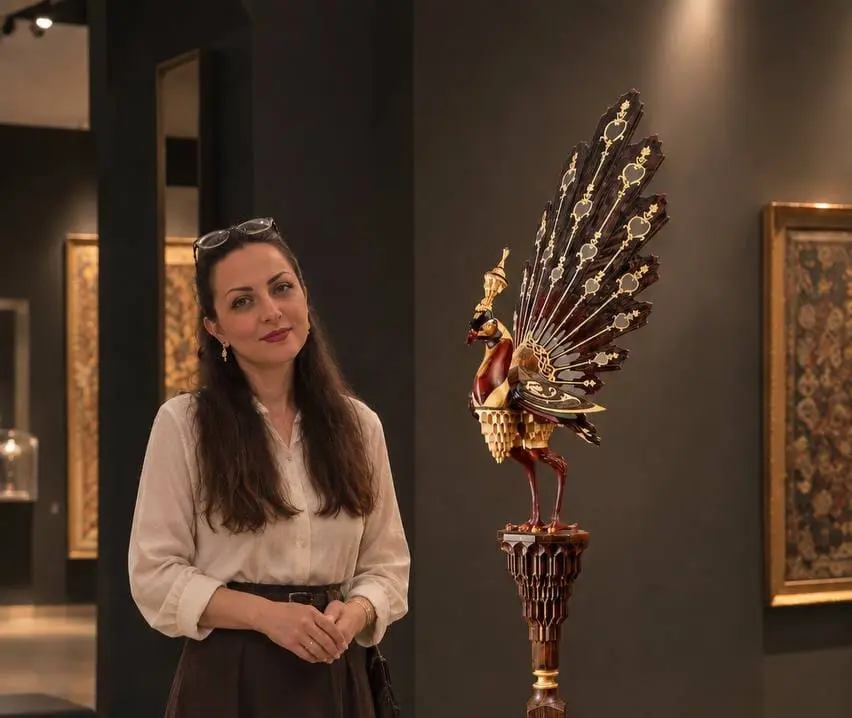
This noteworthy combination of academic education, expertise in wood arts, international awards, institutional collections, and a record of sales in the formal art market presents the image of an artist who has connected the traditional material of wood with the contemporary language of sculpture and design, while simultaneously establishing her position within the art market.
LEAVE A RELPY