
Mohamadali Vadood: From “A Shot at Hyrcania” to “Utopia WOOD ALL WOOD” — The Tree Wounded by a Bullet 250 Years Ago
A tree, wounded by a bullet approximately 250 years ago, eventually finds its way to Mohamadali Vadood, inspiring him to create A Shot at Hyrcania. The work emerges from the concept of his internationally developed project, WOOD ALL WOOD, in which some of the wood fragments used are themselves a century old. The composition moves between geometry and organic form, density and void, color and texture, repetition and difference, and, ultimately, the natural memory of the forest and human intervention. The artist’s achievement lies in transforming these fragments into a unified visual system while preserving the distinct identity of every individual piece.
ArtDayMe : We examine an extraordinary, entirely wood-based work by
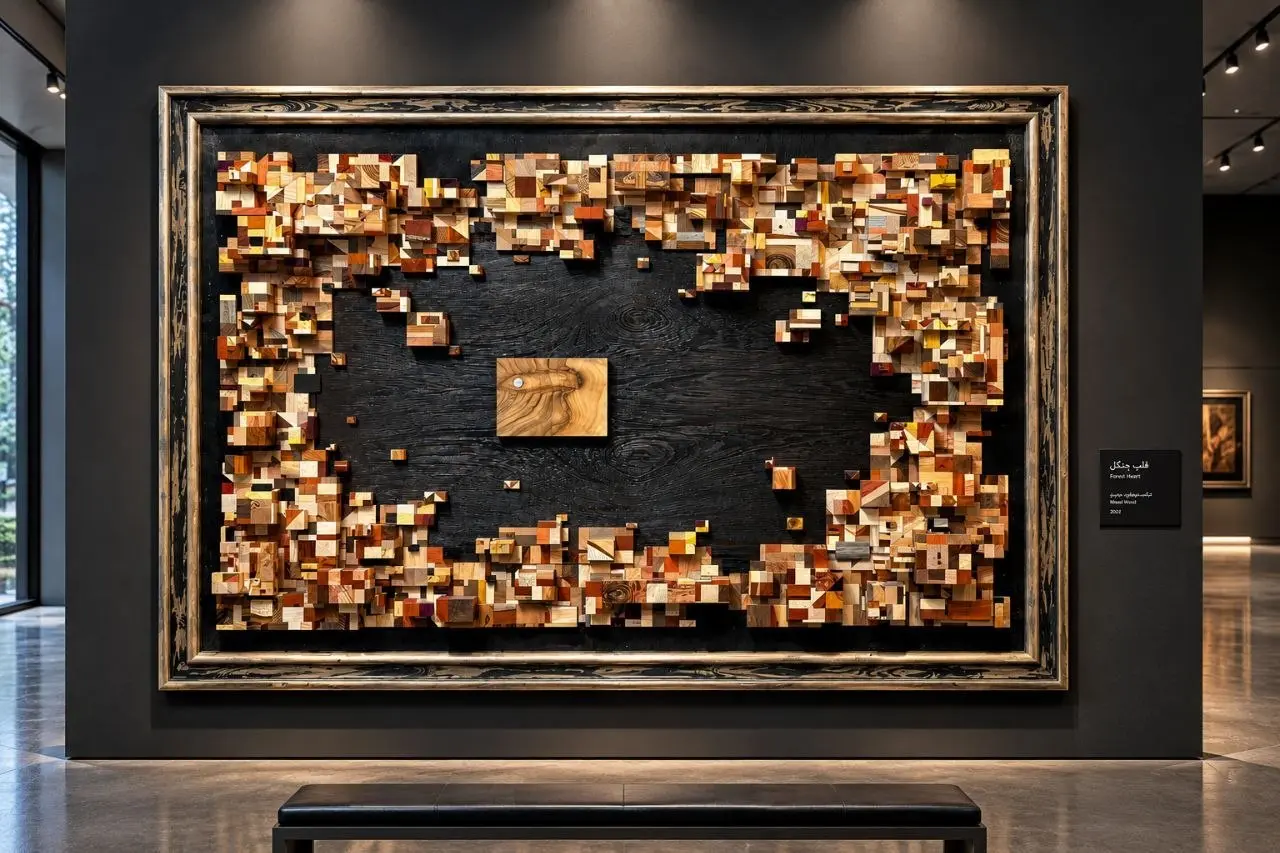
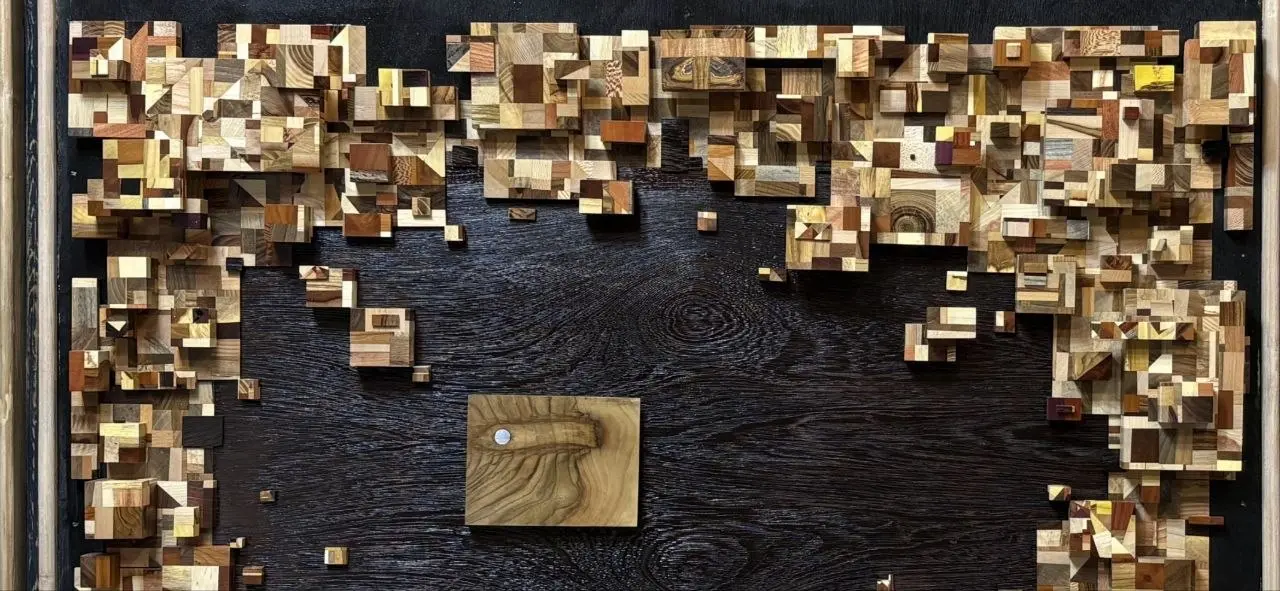
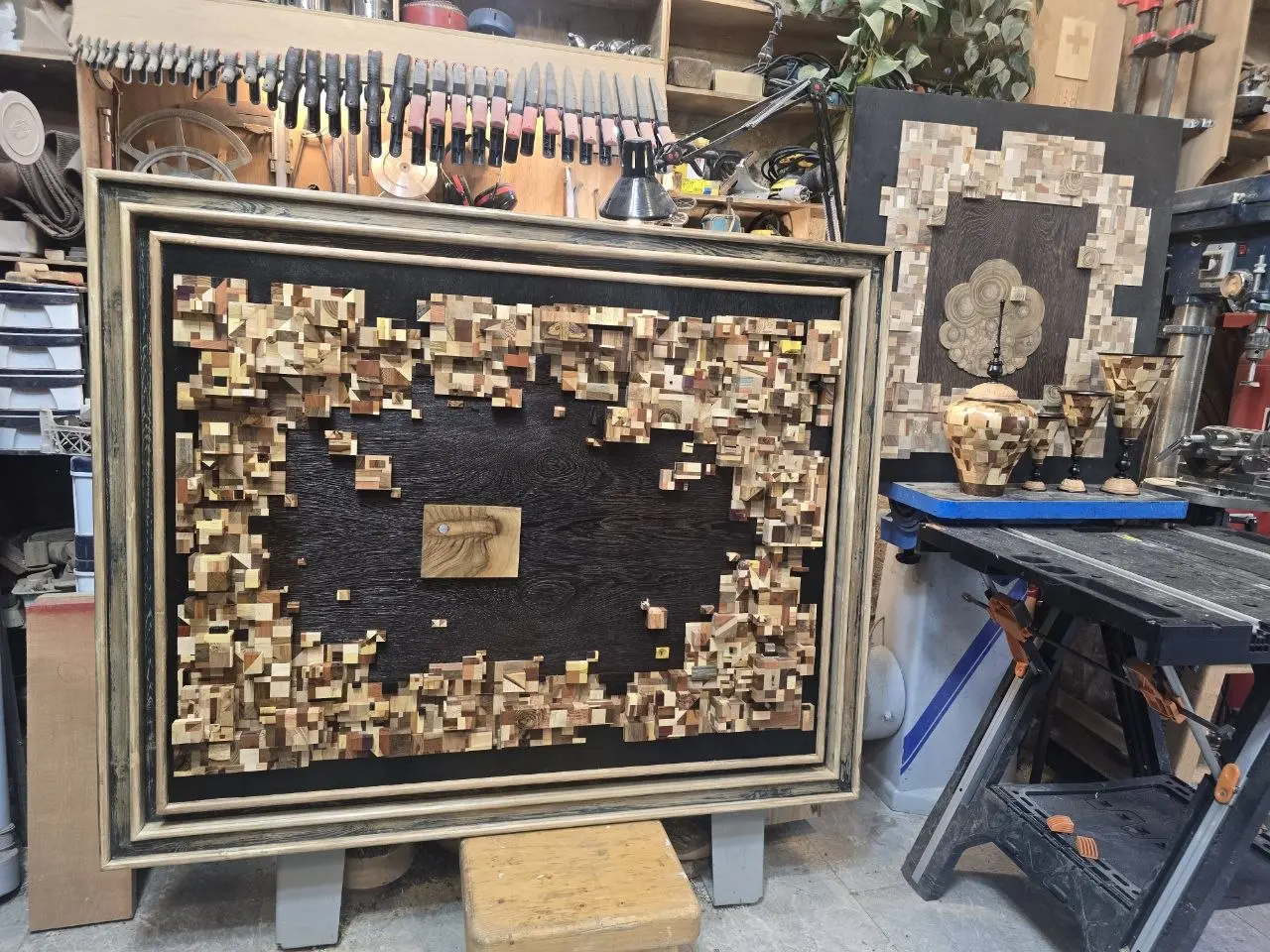
Mohamadali Vadood, an artist, researcher, and designer specializing in wood art. Titled A Shot at Hyrcania, the work measures 115 × 140 cm and was created between 2025 and 2026 using 40 types of wood. Its origin lies in a remarkable historical piece of timber with a compelling story. The work was purchased by Meysam Moradi manesh and is now held in his art collection.
Vadood’s entirely wood-based A Shot at Hyrcania rests on a multifaceted balance: between geometry and organic form, density and void, color and texture, repetition and difference, and, ultimately, natural memory and human intervention. Its achievement cannot be measured solely by the technical skill involved in assembling wooden fragments. Its principal significance lies in transforming these pieces into a visual system in which each component retains its individual identity while contributing to a larger whole. In doing so, the artist elevates wood beyond its conventional role as a material for making objects, turning it into a medium through which to contemplate time, memory, order, and the possibility of re-creation.
1. A Remarkable Piece of Wood and a 250 -Year-Old Lead Bullet
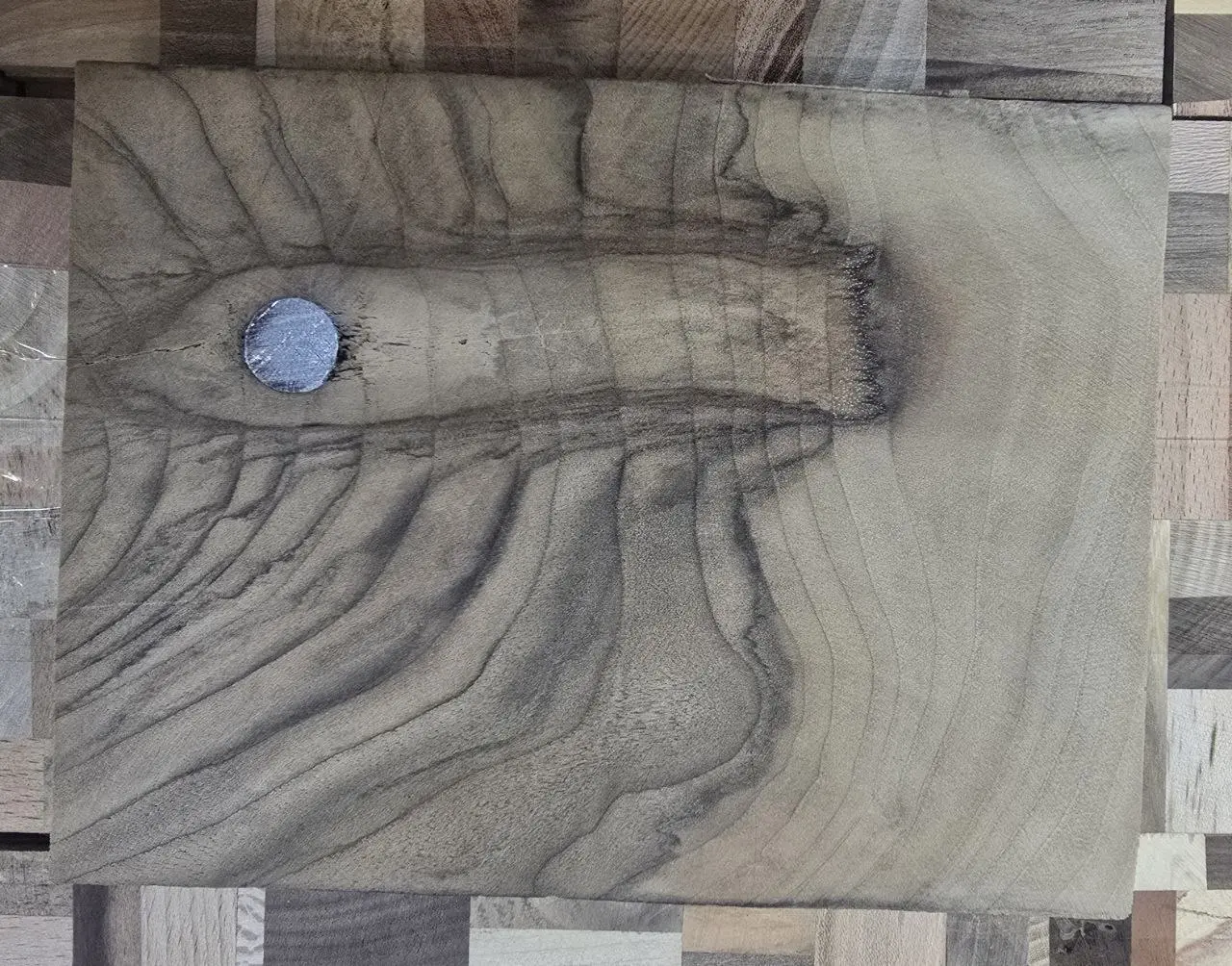
The defining feature at the heart of this work is the accidental discovery of a spherical lead bullet, believed to be associated with early muzzle-loading firearms of the Afsharid period. It was found embedded deep inside a tree trunk while the wood was being cut. This discovery became the starting point for the work’s creation and gave rise to its title.
2. Mohamadali Vadood’s Fascinating Account of Discovering a Bullet Inside a 250-Year-Old Walnut Tree
Mohamadali Vadood’s account of discovering a bullet that had struck a walnut tree approximately 250 years ago is particularly compelling:
“In 2010, when I was teaching as a visiting lecturer in the master’s program at Tabriz Islamic Art University, an event took place that, years later, would become one of the most significant artistic and intellectual experiences of my life: a direct encounter with a historical narrative that had remained concealed inside a tree for nearly two centuries.
“It was Thursday evening. Finally, after an entire academic semester had passed, the timber we had ordered arrived at the university from northern Iran. The students, who had spent the intervening months preparing their abstract sculpture designs and eagerly awaiting the wood, enthusiastically approached the logs, ready to transfer their ideas from the realm of drawing into the material world.
“Among them, Ms. Fatemeh Bahramnejad selected a walnut log to create an abstract sculpture with figurative tendencies. After transferring the design onto the surface of the wood, we began cutting along the sculpture’s outline. In the middle of the process, however, we suddenly heard an unusual sound as the saw struck a hard object. It was distinctly different from the familiar sound of cutting wood.
“When the cut was completed and the two sections separated, we encountered an astonishing and unsettling sight: a spherical lead bullet embedded deep within the tree’s body.
“The bullet’s penetration path, the point at which it had stopped, and the surrounding wood that had grown around it were clearly visible in the cross-section. The tree had preserved the evidence of the event within its own structure, unable to recount it in human language. It was as though an incident lasting only a brief moment had continued to exist in the memory of the material, gradually becoming enclosed within new layers of wood as the tree grew.
“What stood before us was not merely an old bullet. We were confronting a material document bearing witness to the collision between violence and nature, and to the continuation of life in its aftermath.
“In consultation with Ms. Bahramnejad, we modified the original design so that the section containing the bullet could be separated from the sculpture. I preserved that piece as an exceptional specimen, whose value extended beyond the physical and aesthetic qualities of the wood to encompass the story it had revealed.
“Subsequent investigations and preliminary examinations suggested that the bullet’s shape and dimensions were consistent with spherical lead ammunition used in historical muzzle-loading firearms. Based on these initial assessments, a possible connection to the period spanning the Afsharid and Zand dynasties was considered. This would place the bullet approximately two to two-and-a-half centuries before its discovery.
“However, establishing its precise date would require specialized metal analysis, historical documentation, and archaeological evidence. Without such investigations, a definitive dating is not possible. Nevertheless, independently of its exact age, the undeniable presence of the bullet inside the tree and the evidence of growth and repair in the surrounding wood remain significant. These traces indicate a considerable interval between the moment of impact and the discovery.
“Throughout that long interval, the tree had continued to live. It had incorporated the wound into its structure, grown around it, and entrusted part of human violence’s history to its biological memory.
“For me, this proposition was no longer merely a poetic expression. It had become an objective reality that I could see and touch in the cross-section of the wood.
“This specimen remained among my workshop materials and artistic experiments for years—not simply as a rare object, but as an open question concerning the relationship between humanity, nature, violence, and time.
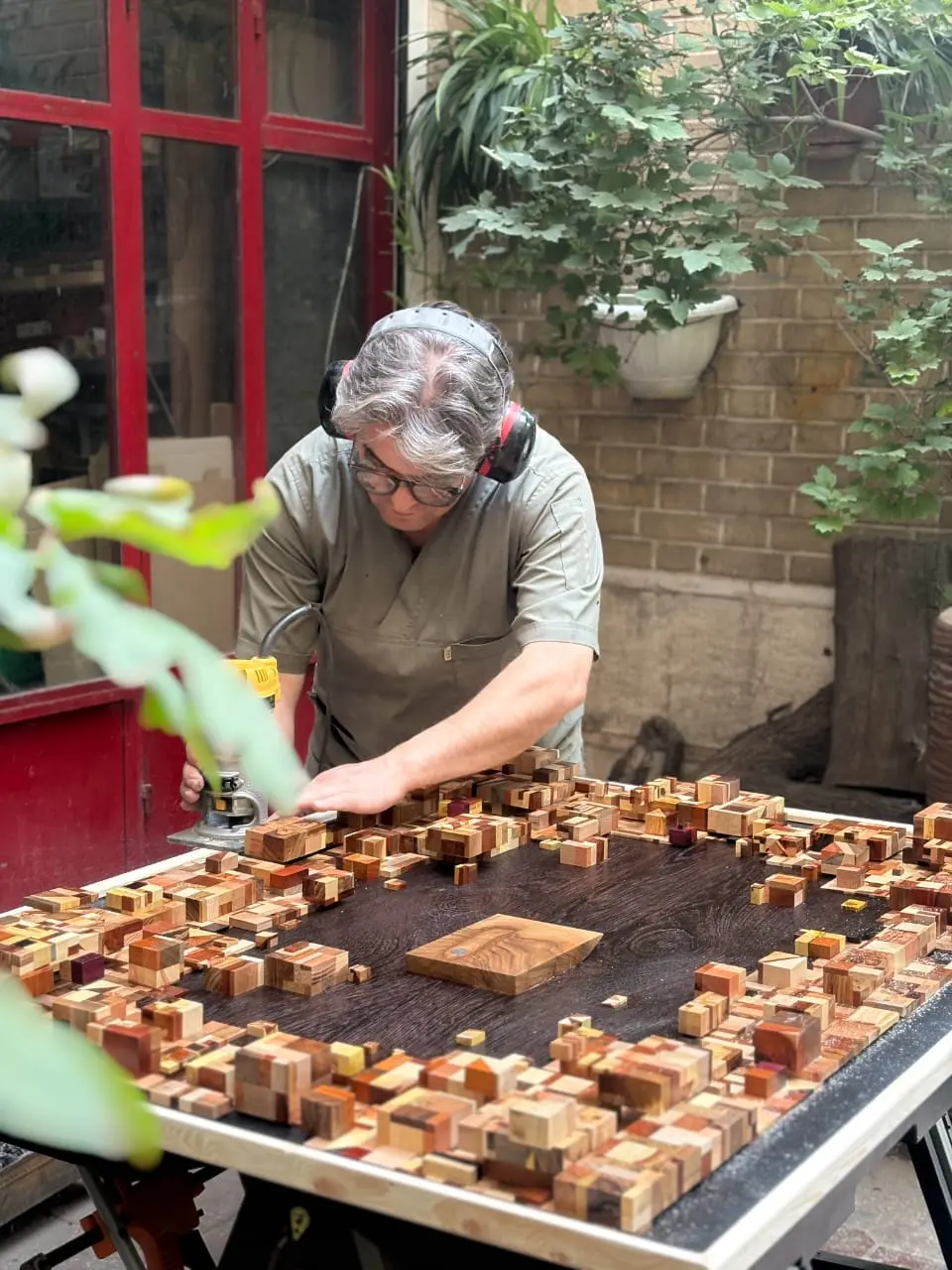
“Years later, this very piece of bullet-struck wood became the central element of A Shot at Hyrcania, part of the Memories of Hyrcania series. In this work, large and small wooden fragments, each possessing different colors, textures, and natural characteristics, gather around this material document, forming a multifaceted structure of presence and testimony.
“Together, these fragments are more than the constituent elements of a visual composition. They can be understood as a collective body of witnesses, each retaining an independent material identity while joining a unified structure through a shared memory. Differences are not erased; instead, they make a common narrative possible.
“The light and dark woods, the contrasts in color, the variations in dimensions and elevations, and the relationship between the central space and the surrounding fragments all contribute to the same meaning: a wound that once formed in the isolation of a tree’s body is now situated among a collective of witnesses, transformed from a concealed experience into a visible narrative.
“For me, the significance of this discovery cannot be reduced to the bullet’s possible age. What makes this piece an exceptional document is the coexistence of two distinct histories within a single material body: the history of violence at the moment the bullet struck and the biological history of a tree that continued to grow afterward.
“Human history records many events through written documents, oral accounts, and monuments. Nature, however, has its own ways of preserving traces of the past. Growth rings, changes in texture, enclosed wounds, and signs of repair can all carry information about a tree’s biological experience. Reading these traces requires specialized knowledge and caution against premature conclusions. Nevertheless, such material evidence can open new horizons for an artistic engagement with history.
“A Shot at Hyrcania emerged from precisely this kind of encounter: a historical object, a living organism, and a contemporary experience brought together. The bullet comes from the past; the wood has retained time within itself; and the artwork connects the two, transforming them into a question addressed to the present.
“Ultimately, the work attempts to shift the focus of our attention: from the moment of impact to the years that followed; from the instrument of violence to the memory that preserved it; and from the wound to the possibility of continued life.
“The bullet was fired, but the tree did not stop growing. Time passed, yet the traces of the event remain legible.
“A Shot at Hyrcania tells the story of a wound preserved in the memory of matter—and of life that continued despite it.”
3. Wood in Contemporary Art
In contemporary wood art, material is sometimes more than material: the material itself bears witness to a narrative. Mohamadali Vadood’s notable work A Shot at Hyrcania begins at precisely this point, where wood ceases to be merely a substance to be shaped and becomes a bearer of time, injury, memory, and the continuity of life.
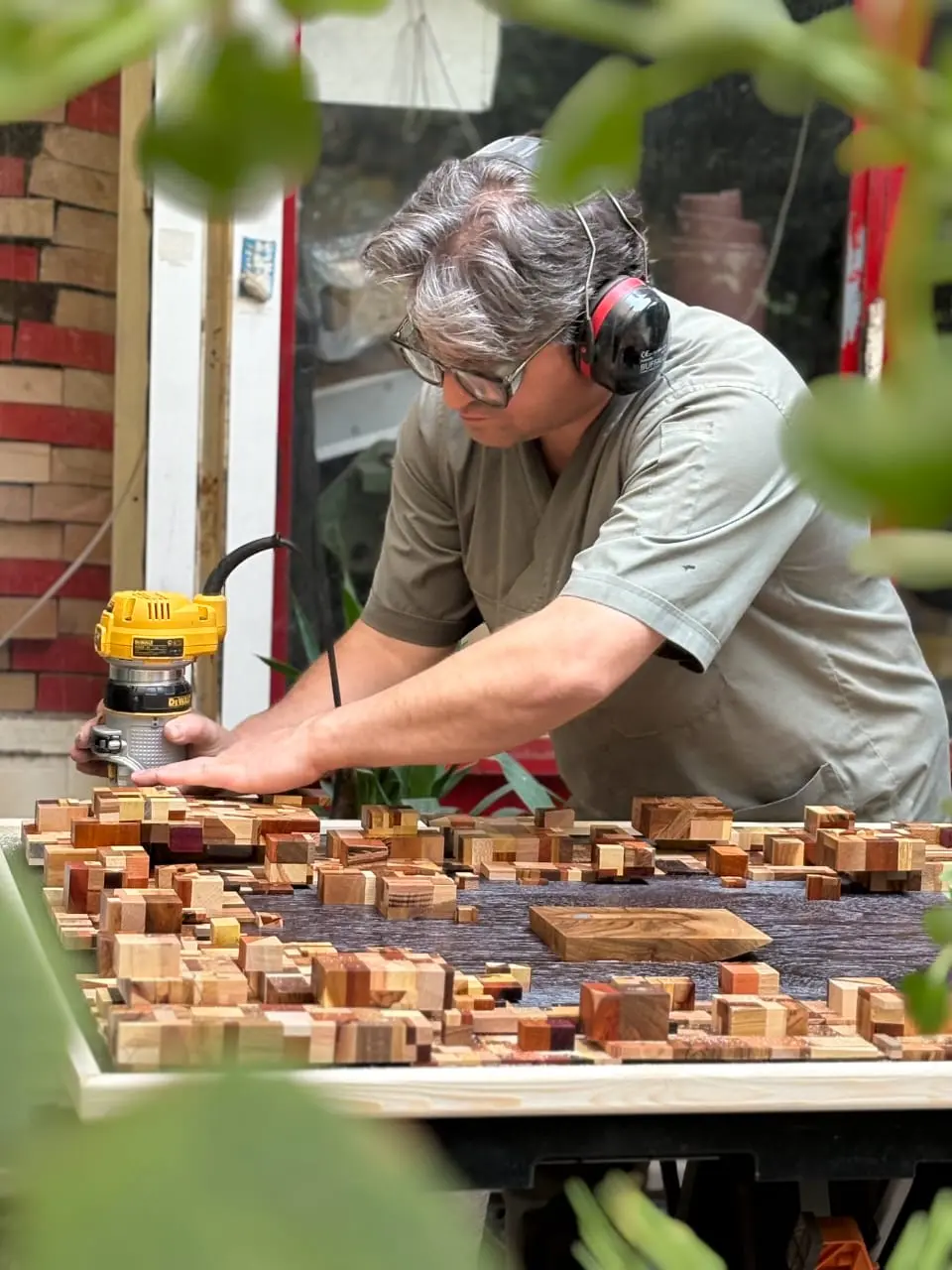
The work belongs to the Memories of Hyrcania series, while Vadood’s other project, Utopia WOOD ALL WOOD, is also clearly present within its structure. In WOOD ALL WOOD, Vadood works with small and large wooden remnants left over from production processes, drawing on their naturally diverse colors and the traces of their material histories. These fragments preserve aspects of nature’s history and humanity’s relationship with it.
4. “A Shot at Hyrcania”: When a Tree Becomes a Historical Document
A Shot at Hyrcania emerged from an encounter with a piece of Hyrcanian walnut wood containing a lead bullet. The bullet’s penetration path remains visible in the wood’s structure, while the tree, over the years, grew around the injury and enclosed it within newly formed layers.
Here, the tree is not merely carrying an object; the tree itself has become a document.
At first glance, the bullet appears to be the center of the narrative. Yet the true significance lies not in the bullet itself, but in the memory that has accumulated around it. The wood has not forgotten the incident; it has rewritten it within its own substance. Growth, repair, and the passage of time have become part of its testimony. This reading is closely connected to Vadood’s nature-oriented artistic perspective.
The arrangement of numerous wooden fragments around this central element is neither a reconstruction of a natural landscape nor a decorative treatment of a surface. Instead, the pieces surround the incident like layers of collective memory, as though silent witnesses had gathered to record and preserve what happened to the body of the forest.
Differences in species, color, texture, dimensions, grain direction, and height give each fragment an independent material identity. Together, they create a structure with a quasi-social and narrative character.
At the center of this field lies the wounded wood—not as an image of violence, but as material that has transformed violence into memory.
5. Human History and the Memory of Nature
On another interpretive level, the work resonates with narratives from Iranian history, including accounts concerning Nader Shah’s passage through forested regions and a bullet that reportedly failed to strike him. In some versions of these accounts, subsequent political and familial developments have been linked to the incident.
Within A Shot at Hyrcania, this historical narrative does not function as a reconstruction of a specific event. Rather, it enters the work as an echo of the relationship between power, violence, chance, and memory.
In contrast to human history, which is frequently recorded through names, decrees, and documented events, the tree recounts history in another language: through growth rings, texture, wounds, and repair.
6. Does Nature Forget Injury and Destruction?
The fundamental question raised by the work is this:
If human beings forget an event, does nature forget it too?
The answer lies within the material itself.
Unlike a paper document, wood, as a once-living material, does not merely record an event; it lives with its consequences. Every new layer formed around an old wound is simultaneously evidence of injury and evidence of continued life. The wound is not the end of the narrative. It marks the beginning of a prolonged process of survival, enclosure, repair, and remembrance.
As Mohamadali Vadood puts it: “The bullet is fired, but the tree continues to grow. The event ends, but the material continues to tell its story.”
Perhaps the most concise expression of this work is the statement that has become one of the central ideas of the Memories of Hyrcania series: “The material itself is a witness to the narrative.”
The work incorporates 40 types of wood from the Hyrcanian forests and other regions, including:
Hyrcanian maple, oak, hornbeam, beech, Helikaln (as named in the Persian source; the botanical identification requires verification), Baland-Mazou oak, walnut, barberry, ebony, Venge, purpleheart, rosewood, hazel, pear, Kerat, acacia, apple, Azad, weeping willow, plane tree, apricot, white poplar, cypress, yew, eucalyptus, Russian olive, tree of heaven, alder, Khoj, Kikem, persimmon, Khormandi, elm, ash, Ouja, Malach, Amrood, Shirdar, and pine.
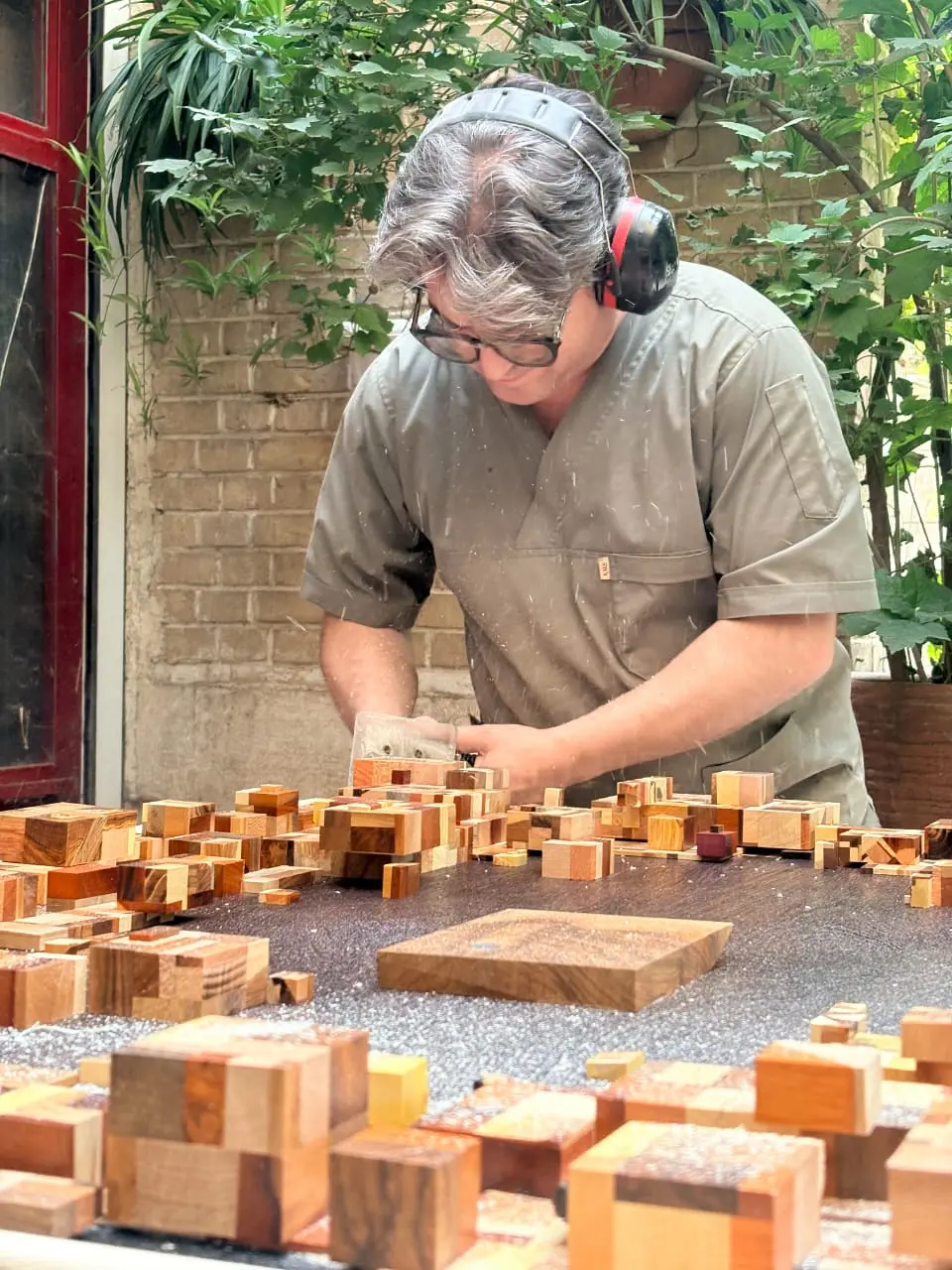
Much of this material diversity is characteristic of Vadood’s WOOD ALL WOOD project. His creative innovation lies in an original technique of irregular assemblage, through which he creates hundreds of forms and narratives, each increasingly rich in meaning and visual appeal.
In a recent media interview, Vadood explained how the fragments in WOOD ALL WOOD are assembled into installations, a process also evident in the present work:
“Their arrangement follows two algorithms: one based on random patterns, and the other on compositions determined by the natural colors and textures of the wood. Each artwork has an arrangement distinct from every other.”
7. An Aesthetic Analysis of Mohamadali Vadood’s Entirely Wood-Based Work
Mohamadali Vadood’s work can be understood as an example of wood art moving beyond the realms of handicraft and decorative composition into sculpture and contemporary art. Here, before serving as a means of constructing form, the material carries history, memory, and traces of natural life. Wood is not simply a substance used to create an image; every fragment, with its particular color, texture, grain, knot, and geometry, contributes to a complex visual system. At first glance, the viewer encounters an abundance of wooden pieces in varying dimensions and colors. Closer examination, however, reveals that this multiplicity has been organized within a carefully considered framework, producing a coherent structure with its own internal logic.
Measuring 115 × 140 cm, the work exceeds the scale of a small, readily graspable object and becomes a surface that offers the viewer both an intimate and a distant experience. From afar, we encounter an overall geometric, almost architectural composition. As we approach, this unity breaks down into a network of details, chromatic variations, textural differences, and small volumes. This movement between whole and part is one of the work’s most important perceptual mechanisms: the eye first apprehends the general order, then disperses among the numerous components, and finally attempts to rediscover the relationships connecting them.
The composition is built around a decisive relationship between two contrasting conditions: the density of wooden fragments around the perimeter and the openness of the central void. The accumulation of pieces along the edges creates an internal frame that directs the gaze toward the center. Contrary to expectation, however, the center does not reproduce the same density. Its relatively uncluttered, dark surface provides visual breathing room and prevents the multiplicity of elements from descending into complete disorder.
This void is, in fact, an active element in the architecture of the composition. The surrounding fragments, with their projections, recessions, and differences in size and height, do not create a perfectly uniform boundary. Consequently, the resulting frame possesses an organic quality despite its overall coherence, as though it had emerged through growth, accumulation, and erosion rather than from the execution of a rigid geometric plan.
Balance in this work does not depend on exact symmetry. Although the distribution of fragments creates an overall sense of equilibrium, the visual weight of different sections varies. Differences in size, color, and depth prevent the formation of a mechanical order. This asymmetrical balance gives the composition energy: rather than settling into a repetitive pattern, the eye continually moves between different points.
The center is marked by a distinct wooden fragment. Compared with the numerous smaller elements surrounding it, this piece possesses greater visual clarity and concentration, organizing the movement of the gaze like a focal point. The contrast between this singular element and the dense network around it lends the composition a contemplative quality: one identifiable component stands against a world of multiple, dispersed elements.
One of the work’s most striking aspects is its chromatic system, which draws on the inherent colors of wood rather than artificial coloration. Cream, pale beige, honey, golden yellow, light brown, oak, reddish-brown, and dark burnt-brown tones coexist with limited areas of deeper color, creating a rich spectrum of tonal variation. Without relying on harsh, disconnected contrasts, this diversity establishes a lively and continuous visual rhythm.
Here, color and texture are inseparable. A light-colored fragment may be distinguished sharply from another of a similar overall hue because of its dark grain. Conversely, two pieces of comparable color may acquire entirely different visual qualities through variations in grain direction and surface treatment. Color, therefore, is not merely a surface characteristic; it emerges from the interaction of hue, texture, orientation, and light.
The predominance of warm colors reinforces the sense of proximity and material presence. Their warmth contrasts with the broad, dark background, allowing the lighter pieces to appear more prominent and volumetric. The background is not simply a contrasting color; it functions like visual silence, making the chromatic voices of the wood perceptible.
Importantly, despite its considerable diversity, this palette does not fall into mere decorative display. Differences in color help clarify the structure and reveal the boundaries between individual pieces. Color thus performs two functions simultaneously: it creates visual pleasure and articulates the work’s underlying structural logic.
In Mohamadali Vadood’s A Shot at Hyrcania, the picture plane is no longer uniform. Wooden fragments of different heights, thicknesses, and orientations shift the boundaries between relief, volume, and image. This is significant because the viewer is no longer looking at an image to be read exclusively through sight, but at a structure that asserts its physical presence.
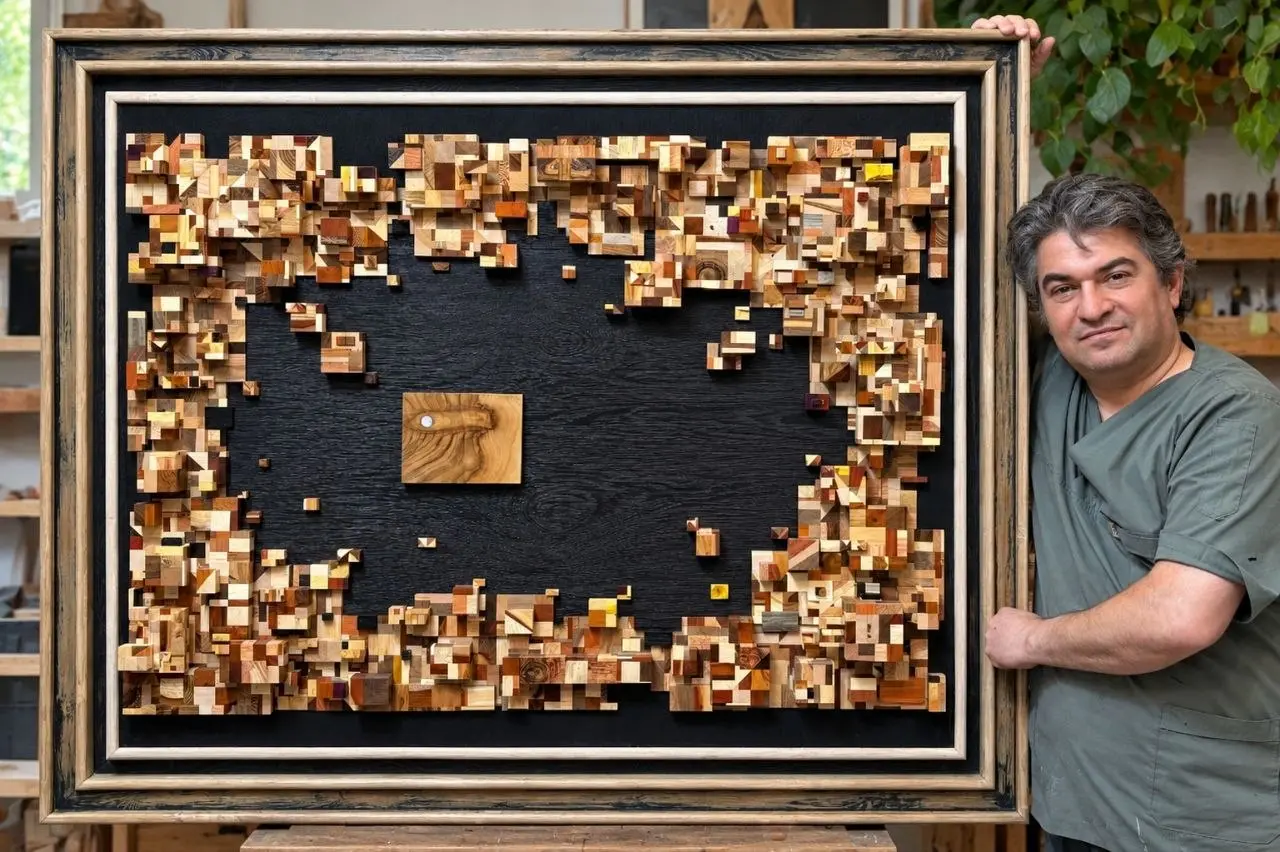
Small shadows between the fragments and their raised surfaces create depth through differences in level. As a result, the work’s appearance can change according to lighting conditions and viewing angle. Under oblique light, a fragment may develop a pronounced texture and shadow, whereas under direct illumination, the same piece may appear brighter and flatter. This dependence on light transforms the work from a static image into a variable visual experience.
From the perspective of the aesthetics of material, the work’s value lies in the fact that the wood has not been forced to conceal its natural characteristics. Knots, grain patterns, chromatic variations, and traces of growth remain integral to its visual identity. Rather than homogenizing the material, the artist uses its irregularities to distinguish one component from another. The result is an order that emerges from difference rather than from its elimination.
The repetition of squares and rectangles is the composition’s primary source of rhythm. Yet what distinguishes the work from a simple geometric pattern is repetition accompanied by variation. No sequence of fragments is entirely uniform. Dimensions change, some elements project forward while others recede, and chromatic differences continually redirect the viewer’s gaze.
This condition can be compared to musical rhythm, in which repetition makes a pattern recognizable while variation prevents monotony. In Vadood’s work, the small wooden units function like successive beats, but their differences in size and color prevent the rhythm from becoming completely uniform. Density increases and decreases across different sections, producing a wave-like movement across the surface.
At the same time, the repetition of quadrilateral forms lends the work an architectural character. The fragments recall construction materials, the constituent units of a city, and the components of a larger system. Yet the architectural resemblance remains suggestive rather than literal, because the natural characteristics and irreducible differences of the wood prevent the work from becoming a wholly industrial structure.
The use of 40 types of wood from the Hyrcanian forests and other regions introduces another dimension to the work’s interpretation. The diversity of species brings with it a corresponding diversity of colors, textures, grain patterns, and material qualities. From this perspective, the variety of materials is not merely an opportunity for visual richness; it is a fundamental principle of the work’s organization.
In a conventional composition, an artist might reduce material differences or conceal them beneath a uniform coating to achieve unity. Here, however, unity emerges through the preservation of differences. Each fragment retains its individuality while forming part of a larger whole. Its identity acquires meaning not in isolation, but through its relationship with the other elements.
This characteristic also opens the work to interpretations extending beyond aesthetics, including relationships between part and whole, individual and society, difference and coexistence. Such readings should nevertheless be understood as possible interpretations rather than definitive meanings that follow automatically from the diversity of the wood.
The work’s place within the Memories of Hyrcania series and its relationship with the Utopia WOOD ALL WOOD project open up a broader conceptual horizon. In this context, the use of fragments left over from production processes shifts attention away from untouched raw material toward material that remains from earlier cycles of labor and fabrication.
Wood here is both a remnant of nature and a bearer of human intervention. Part of its identity derives from the tree’s growth, while another part comes from cutting, selection, finishing, and placement. The work takes shape at the intersection of these two histories: the natural history of the material and the history of its use by human beings.
From this perspective, the concept of “utopia” can also be connected to the work’s method of organization. A collection of dissimilar elements, each retaining its particular characteristics, comes together to create a new structure. This structure is neither a simple return to nature nor an imitation of industrial order. Rather, it represents an attempt to discover a different kind of order by rearranging what already exists.
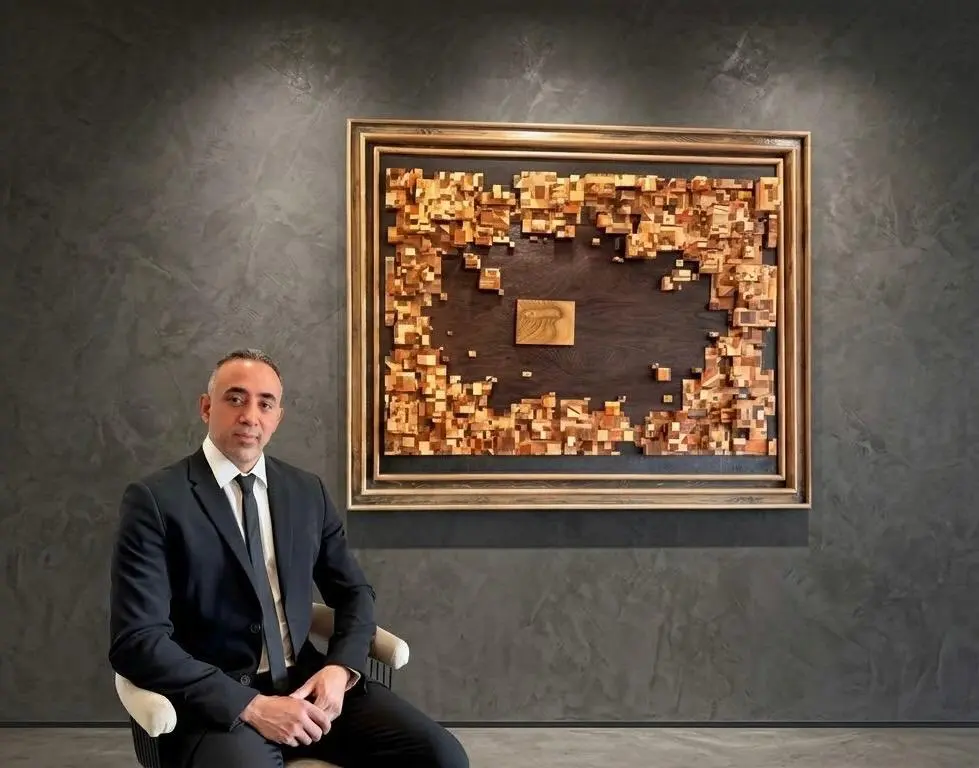
Mohamadali Vadood’s A Shot at Hyrcania was purchased by Meysam Moradi Manesh and is held in his private art collection.
8. Mohamadali Vadood’s Art Market and Auction Prices
Over the years, Mohamadali Vadood has developed an expanding audience and market for wood art through a distinctive and recognizable artistic language. Evidence of this trajectory can now be found in private collections as well as auction records.
At Kavian Auction Tehran in 2026, a 30 × 60 cm work executed using his Naqsh-Bandi technique, selected in the Fine Arts category of Italy’s A’ Design Award, achieved a hammer price of US$8,800.
His wooden sculpture The Bird of Heaven, from the series The Thirty Birds and That One Bird, created in collaboration with Shadi Habib and awarded a bronze medal among Italy’s selected best designs in 2019, sold for 1.65 billion tomans at the 25th Tehran Auction in 2026, equivalent to approximately US$9,700, according to the figures supplied.
These results, alongside Vadood’s receipt of the international Creative Hand award; the title of Man of the Year at the 2022 International Crafts Awards in India; recognition as a leading master of wood art in the Asia-Pacific region in 2026; several titles and selections at Italy’s A’ Design Award and the Kioskedia Awards; lifetime membership in the World Designers Consortium; membership of the Arts Council of Iran’s National Elites Foundation and the Traditional Arts specialist group of the Academy of Arts; and receipt of the First-Class Artistic Merit Award, form part of the symbolic capital of the artistic brand he has developed over the years.
The significance of this artistic brand is also reflected in the subsequent destinations of his works. His pieces are represented in the digital collection of Italy’s MOOD Museum, the museum of the Research Institute of National Arts under Iran’s Ministry of Cultural Heritage, Tourism and Handicrafts, and the museum of Tabriz University of Art. His works are also held in private collections associated with Professor Giv Sharifi; Engineer Abbasi and Abbasi Gallery; Engineer Hassan Golchinpour and Masnegar Gallery; Engineer Esmail Ghods; Dr. Farshid Bozorgi; Engineer Meisam Moradimanesh; and others.
LEAVE A RELPY