
Why Was Mohamadali Vadood Named Asia-Pacific’s Outstanding Master of Wood Arts?
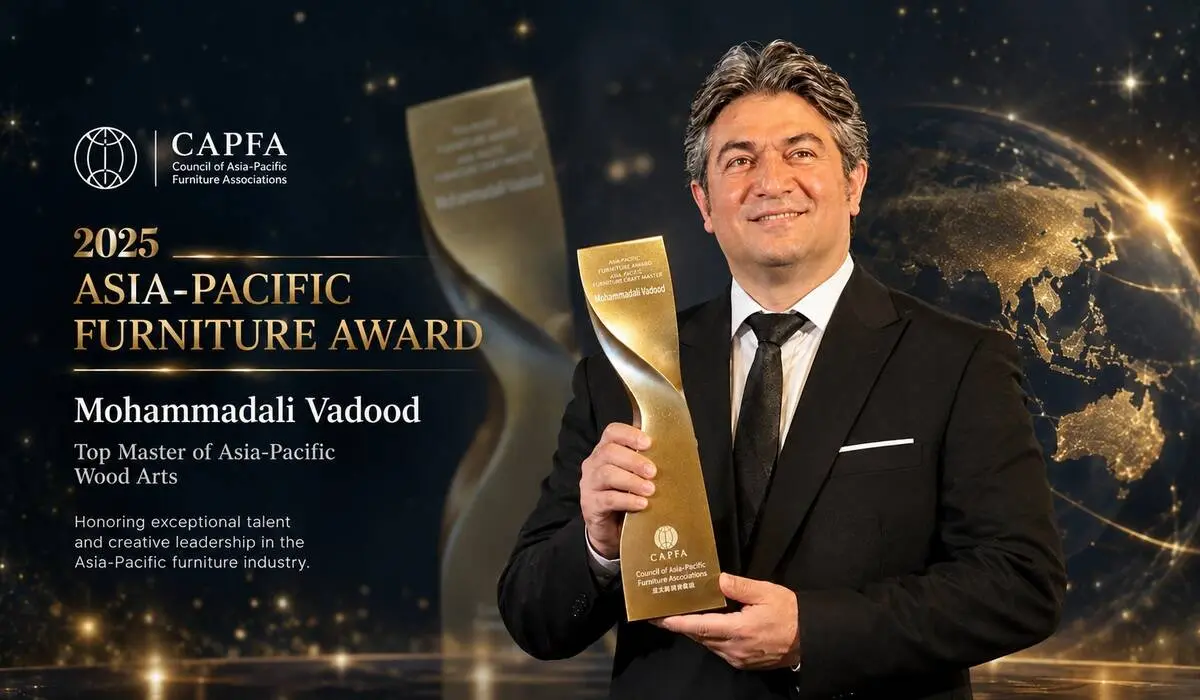
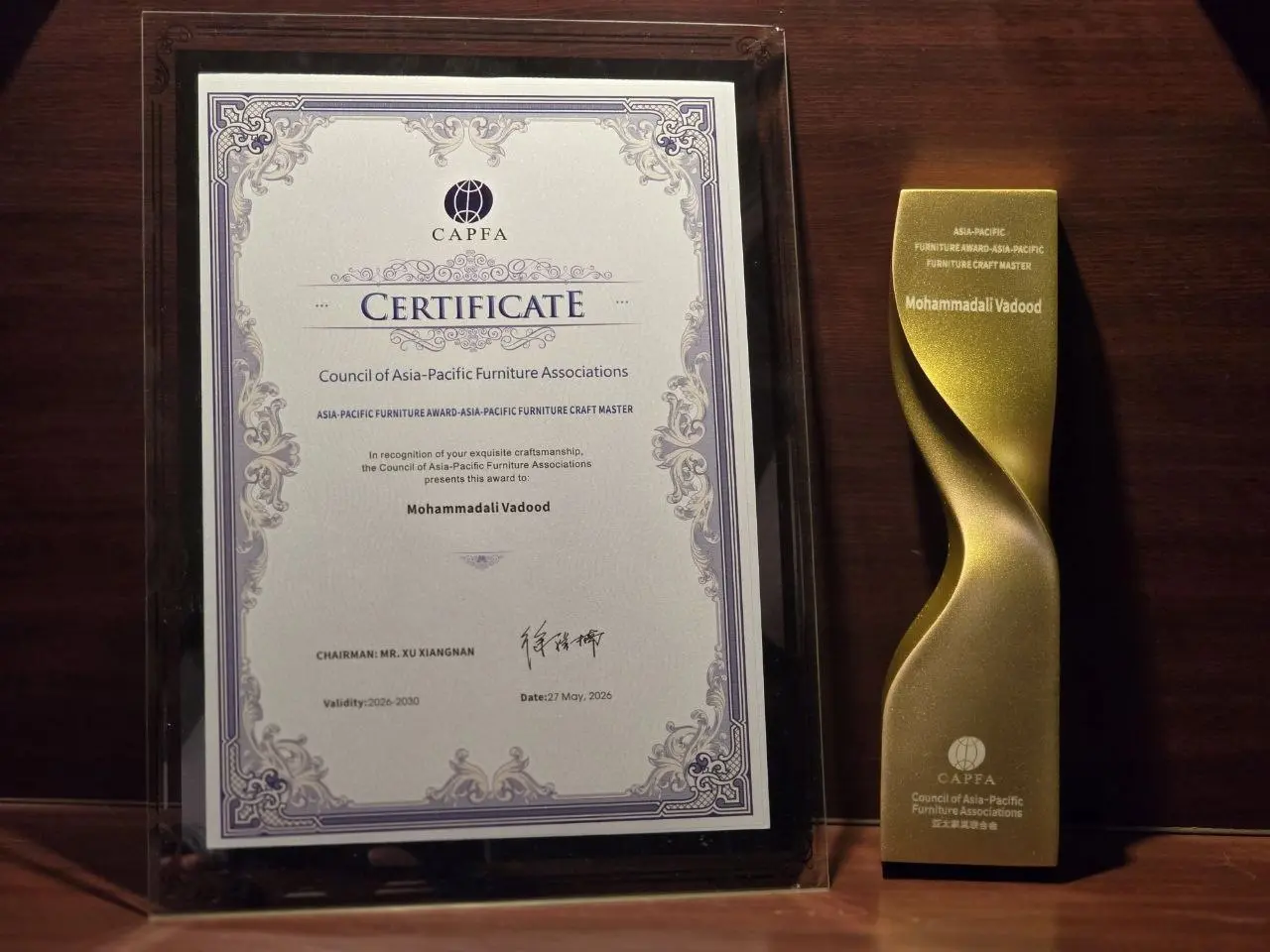
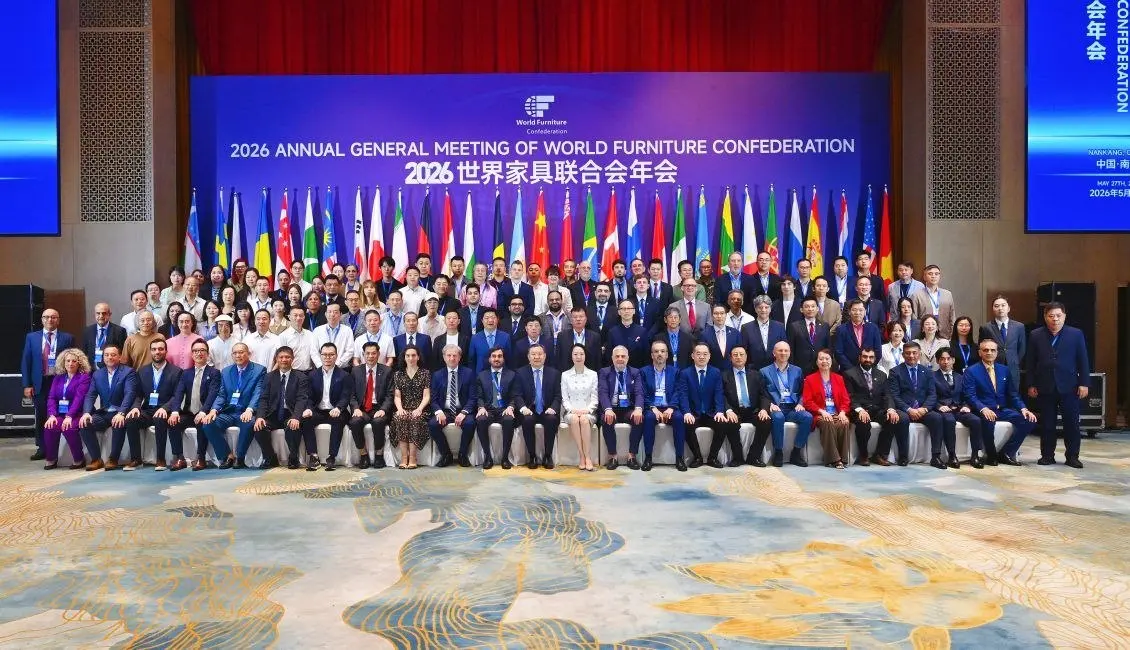
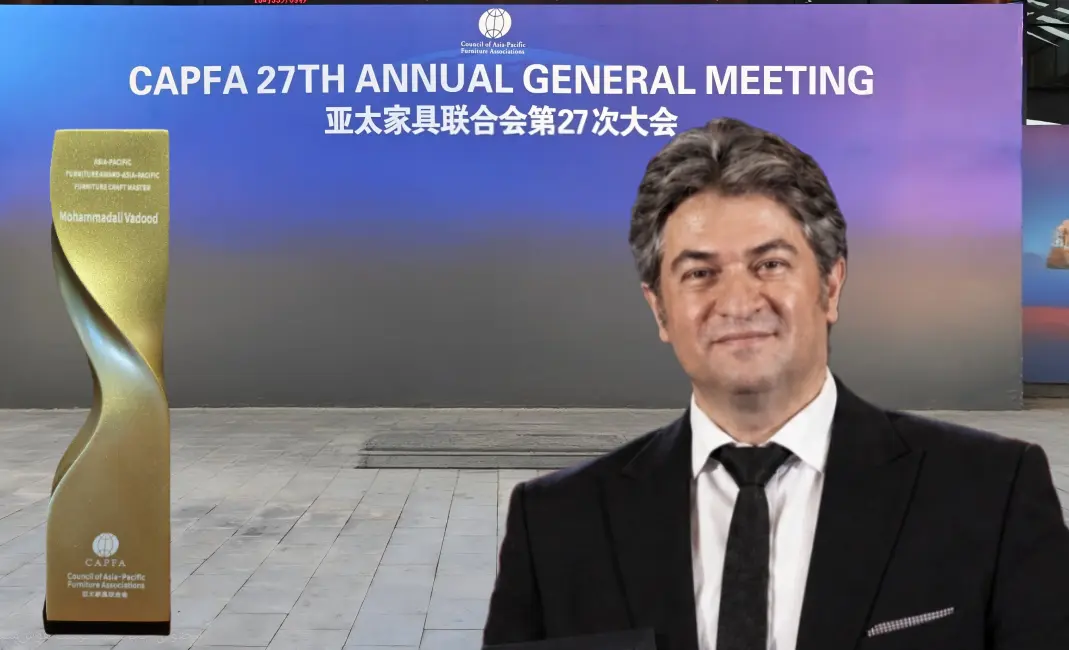
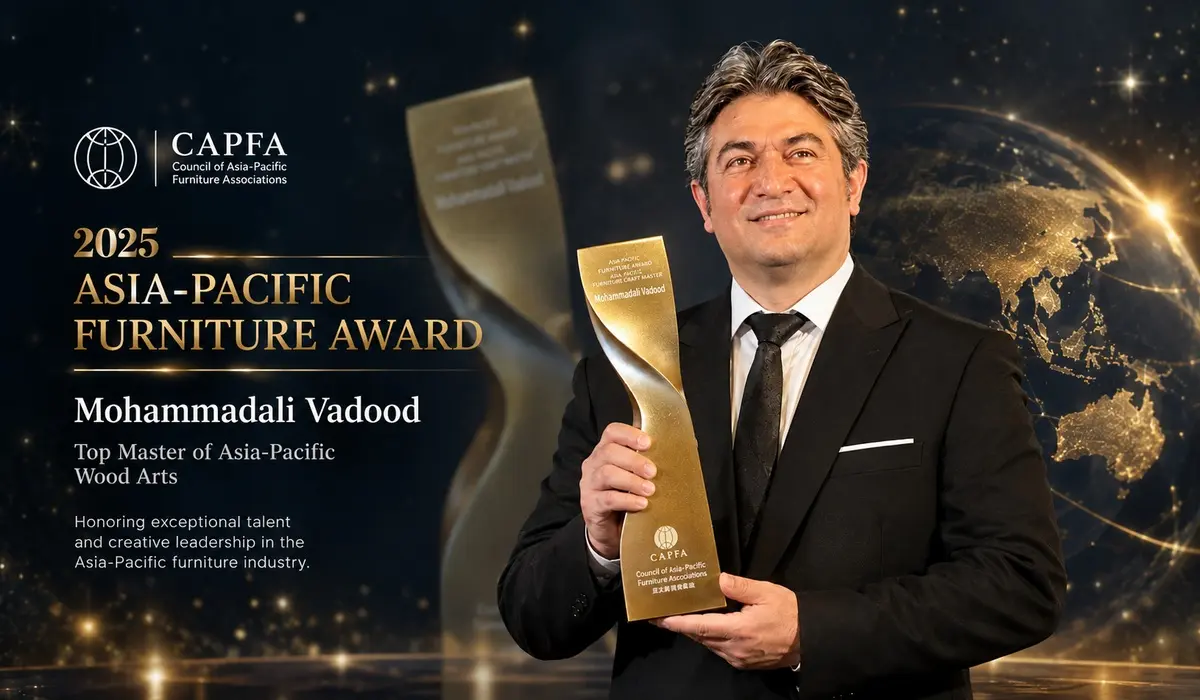
Last week, at the international CAPFA 2025 event in China, Iranian artist and sculptor Mohamadali Vadood was selected as the “Outstanding Master of Wood Arts of Asia and the Pacific” for 2025.
ArtDayMe : The selection of Mohamadali Vadood, an Iranian artist and sculptor, for the title of “Outstanding Master of Wood Arts of Asia and the Pacific” in 2025 offers an opportunity to examine a professional journey in which wood art moves beyond the boundaries of traditional craftsmanship and engages with contemporary design, research, technology, social development, and environmental responsibility.
But why did Mohamadali Vadood receive this title? The answer lies in a series of interconnected activities, ranging from developing innovative ways to use leftover wood and reinterpreting the potential of Iran’s traditional arts to designing specialized tools, creating artworks that draw on the natural characteristics of wood, and contributing to the institutional development of traditional and applied arts.
Beyond the individual distinction, the significance of this selection lies in the opportunity it creates to introduce the potential of Iranian wood art to an international audience and to raise a broader question: How can a nation’s artistic heritage be connected to the needs and language of the contemporary world?
_ How Did Mohamadali Vadood Receive This Title?
The Council of Asia-Pacific Furniture Associations (CAPFA) is an organization that facilitates cooperation among national furniture industry associations and related sectors, including design and wood-based industries, across the Asia-Pacific region. Its activities encompass industrial cooperation, knowledge exchange, and the development of professional relationships in the furniture and interior design sectors. CAPFA’s official website and membership information reflect its role within the region’s furniture industry cooperation framework.
According to information published about Mohamadali Vadood’s nomination, the Iran Federation of Wood Industries, Furniture and Interior Architecture nominated him for the title, and his professional background and selected artworks were reviewed as part of the evaluation process. The Iranian federation has been a member of CAPFA since 2014 and, according to information provided in connection with this nomination, has served as the council’s vice president since 2023.
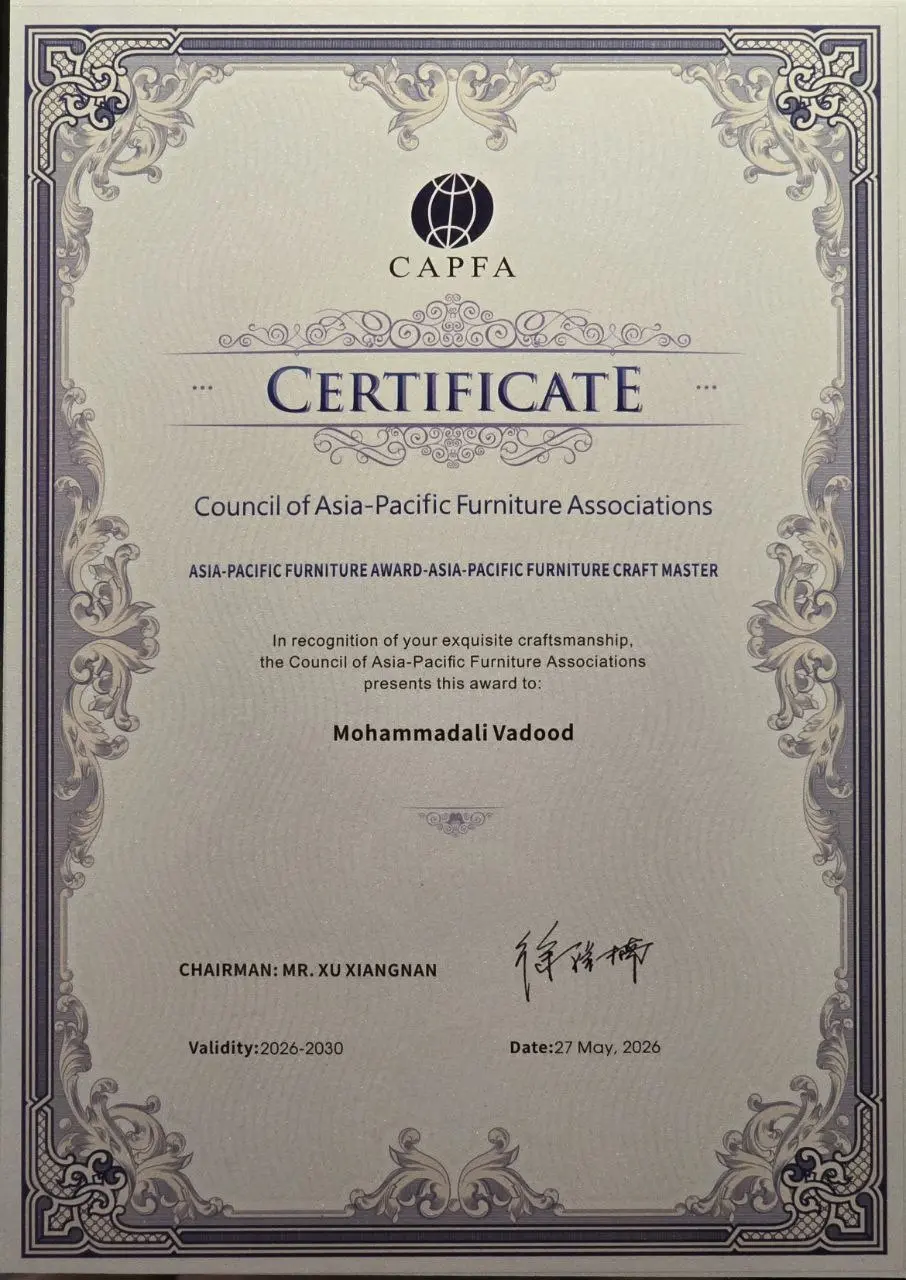
An important point is that Vadood was nominated for his expertise in wood arts, although his professional activities extend well beyond sculpture and decorative objects.
Design, research into artistic heritage, the development of specialized tools, and the integration of technology into traditional crafts are other dimensions of his career that help explain the significance of this selection.
_Mohamadali Vadood’s Wood All Wood Utopia: Turning Wood Waste into Opportunity
One of the reasons Mohamadali Vadood may have been selected as the “Outstanding Master of Wood Arts of Asia and the Pacific” in 2025 is his research-driven, practical project in the field of wood: Wood All Wood Utopia.
The project focuses on the creative use of small wood offcuts left over from manufacturing processes, transforming them into valuable, handcrafted products.
Its central method is Irregular Wood Mosaic.
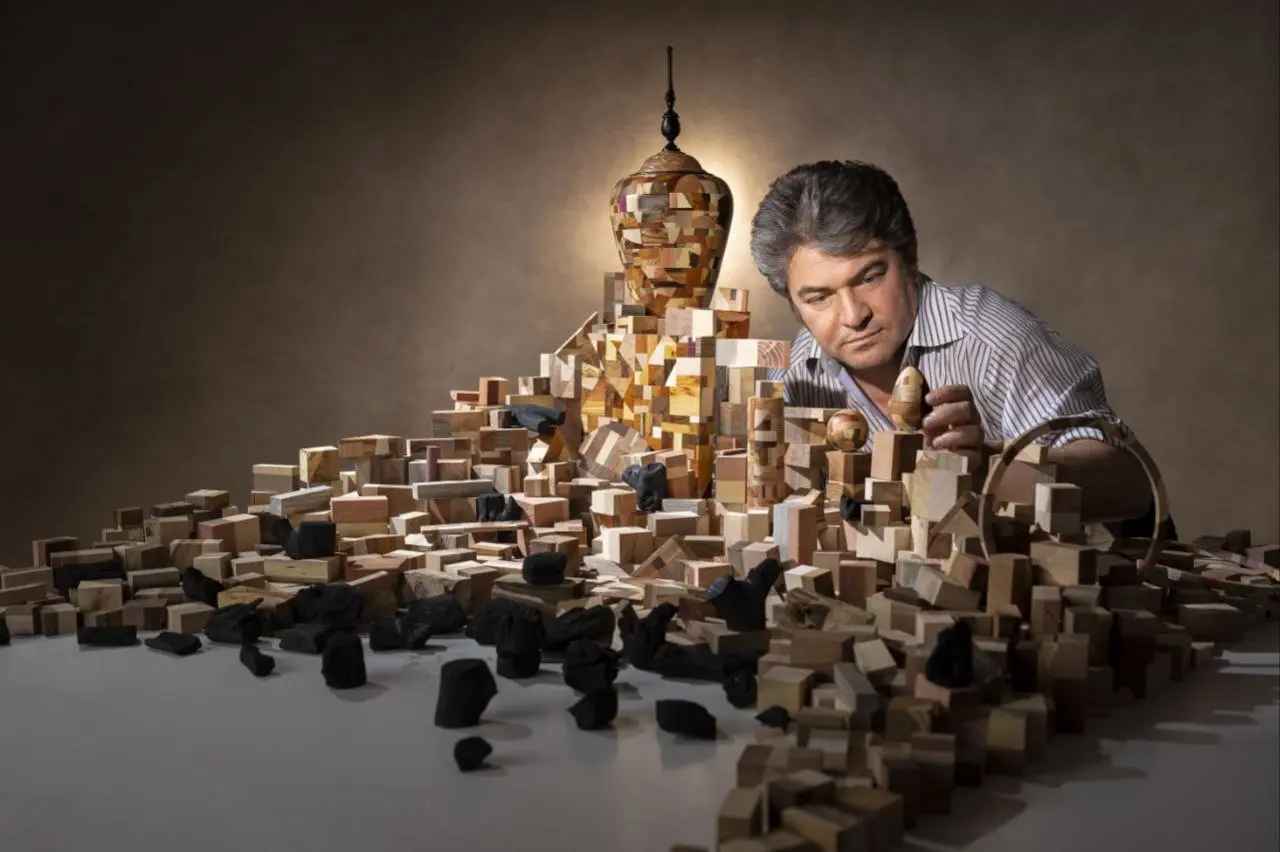
Under this approach, wood fragments are not treated merely as waste. Instead, they become materials with the potential to form new compositions and contribute to the creation of original artworks and products.
The significance of this idea extends beyond material reuse. The Wood All Wood project seeks to connect artists, craftspeople, communities, and environmental advocates, thereby creating opportunities for social participation, the development of a circular economy, and greater environmental responsibility.
From this perspective, a small piece of wood is more than the remnant of a manufacturing process; it carries part of a tree’s natural memory and can continue its life in a new form. This approach connects material economics with artistic and cultural thinking, demonstrating how a method of making can become a platform for rethinking the relationship between human beings and nature.
The project’s central motto reflects this philosophy: “Utopia is not a destination; it is a way of life.”
_ Vadood and Two Decades of Wooden Muqarnas: Reinterpreting Heritage Through Contemporary Design
The second major dimension of Mohamadali Vadood’s work, which may have contributed to his selection, is his nearly two decades of research into the contemporary reinterpretation of wooden muqarnas—a traditional architectural art form associated with Iranian architecture and its rich geometric structures, visual rhythms, and complex construction techniques.
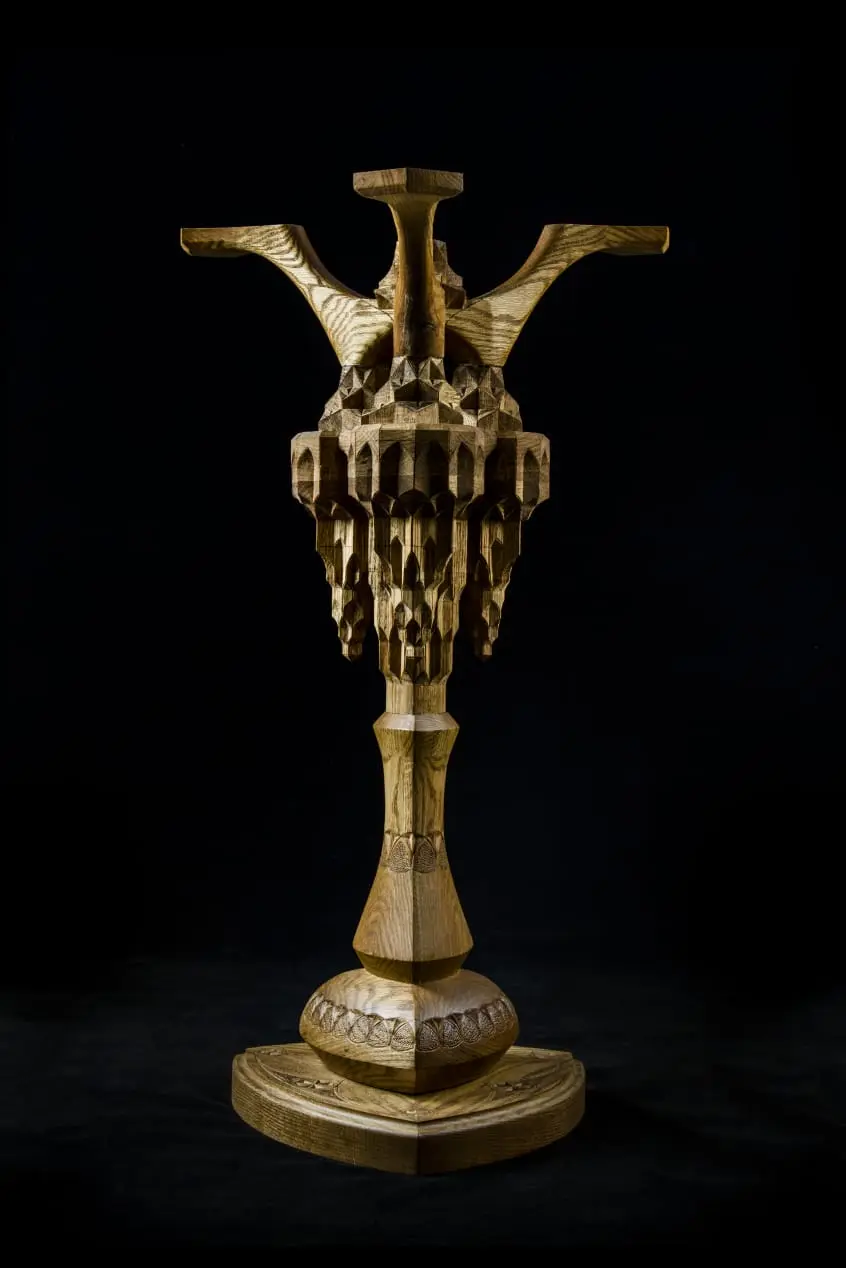
The objective is not simply to reconstruct historical examples or reproduce familiar forms. Rather, it is to understand the structural logic and aesthetics of muqarnas and explore how its potential can be adapted for accessories, decorative elements, furniture, and interior architecture.
This approach moves heritage beyond the realm of historical preservation and turns it into a resource for design and innovation.
Tradition, in this context, is not an obstacle to contemporary creativity. It is a body of structural and visual knowledge that, through careful study and reinterpretation, can respond to present-day needs.
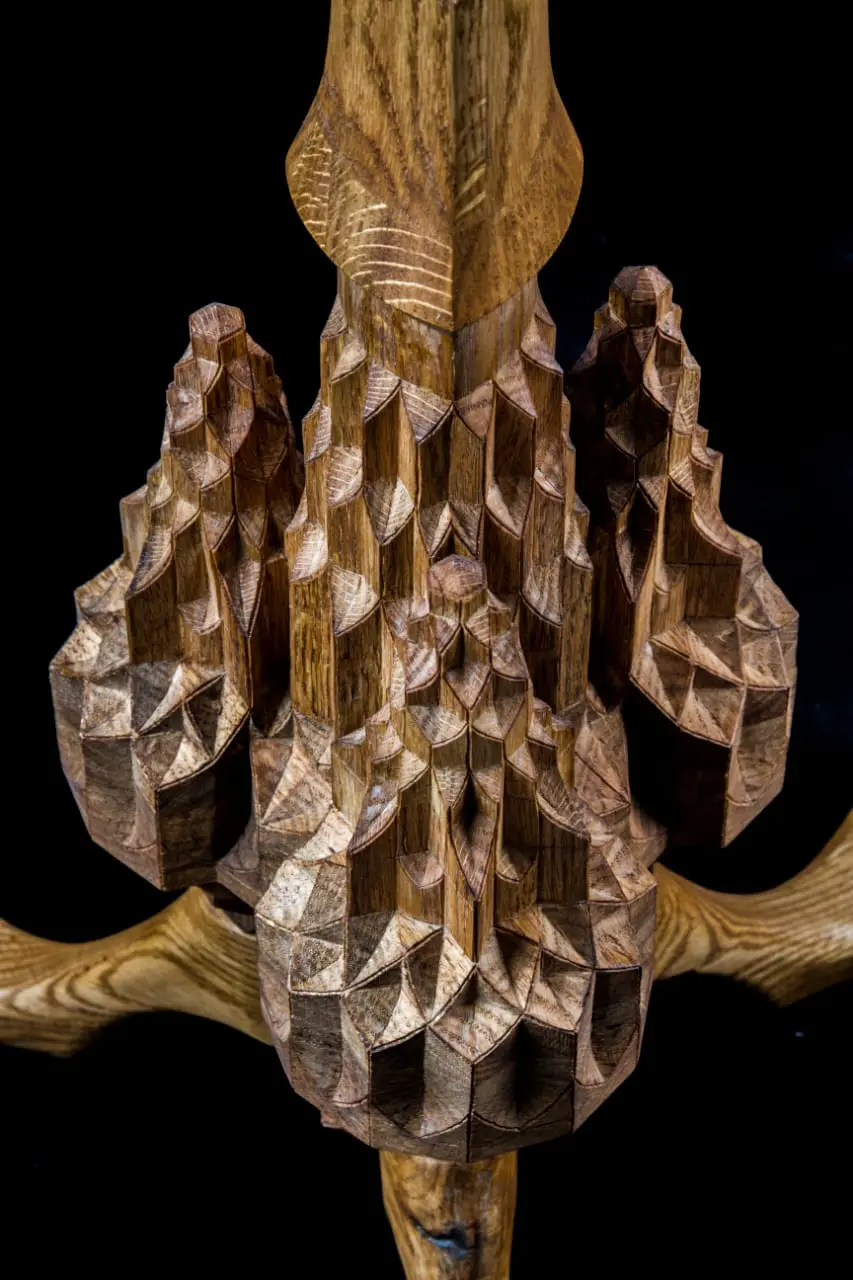
The significance of this work lies in the connection between historical understanding and contemporary application—a relationship that can help traditional arts remain relevant in design and production.
_From Gol-e Farang Motifs to New Methods of Design and Construction
The third major area of Mohamadali Vadood’s work is the reinterpretation of the geometry underlying the drawing and construction of Gol-e Farang motifs, with a view to their application in contemporary furniture design and interior architecture.
This project focuses on understanding the geometric logic of these motifs and examining their potential for developing new design and construction methods. From this perspective, a traditional motif is more than a decorative pattern; it is a visual structure whose geometric relationships and practical applications can be studied and adapted to new contexts.
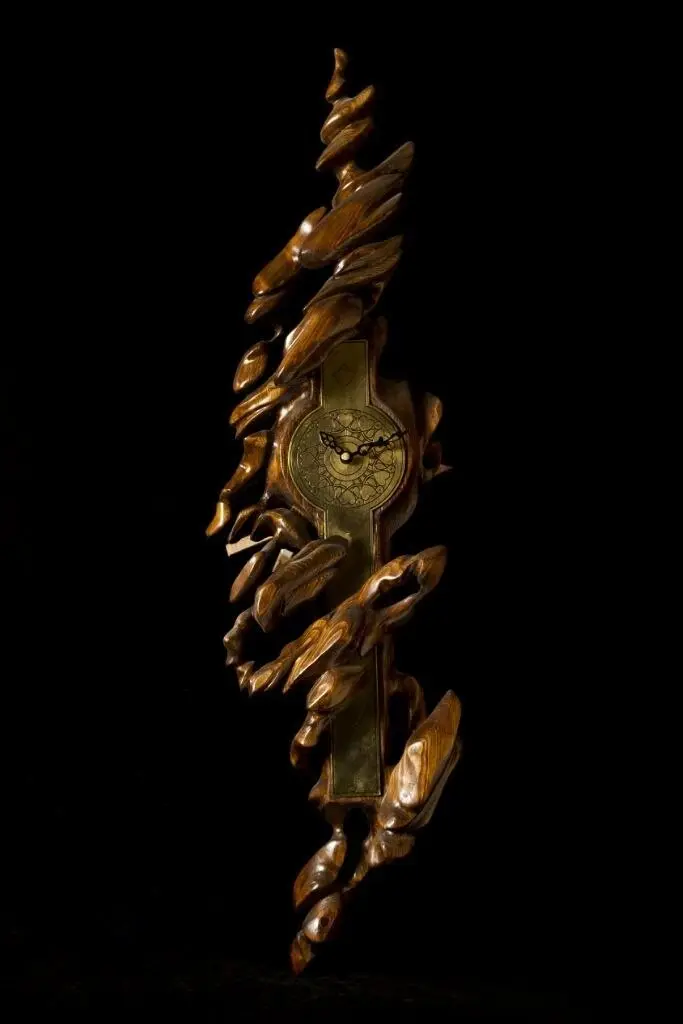
While Wood All Wood emphasizes the creative use of materials and wooden muqarnas focuses on reinterpreting structural and decorative heritage, research into Gol-e Farang motifs represents another dimension of the same approach: transforming the accumulated knowledge of traditional arts into resources for contemporary design.
What unites these three areas is an effort to keep heritage alive through understanding, experimentation, and application—not merely by preserving its outward appearance.
_ Mohamadali Vadood’s Artistic Vision: From Nature’s Memory to Visual Language
A deeper understanding of Mohamadali Vadood’s work requires attention to his artistic vision.
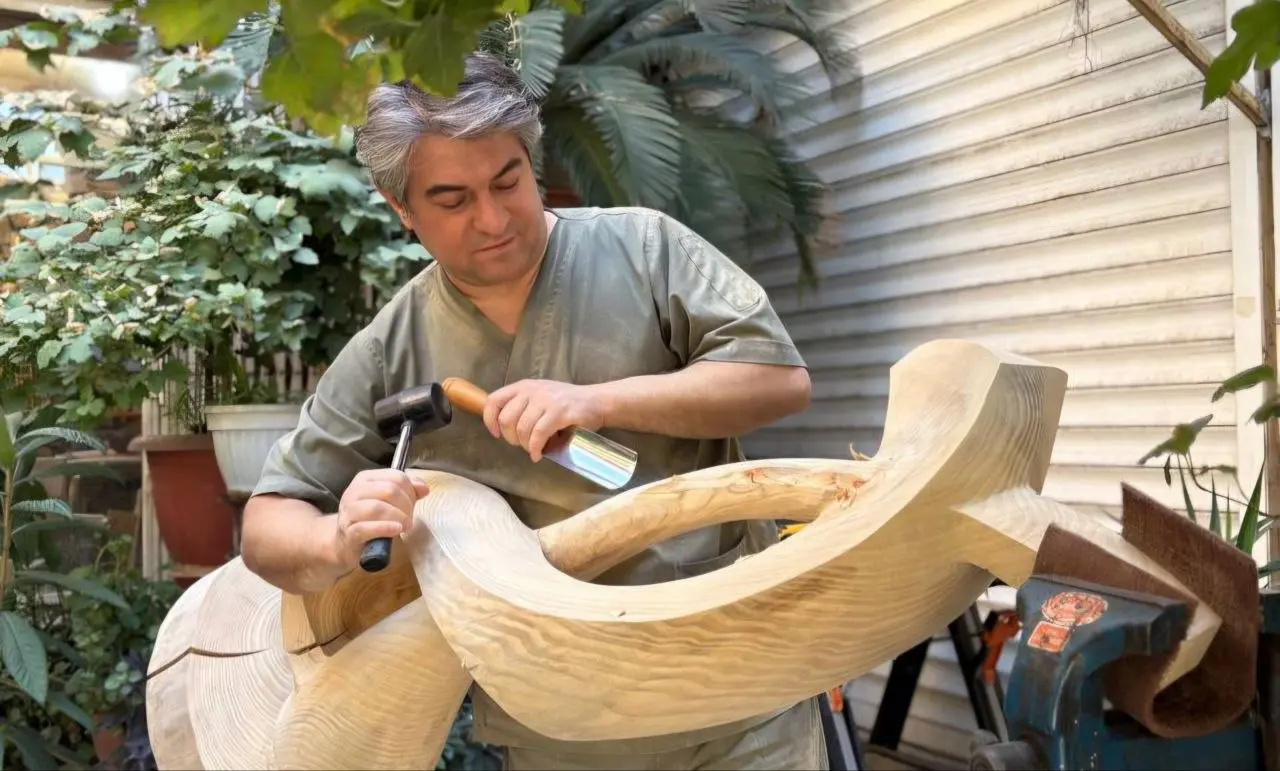
In his work, wood is not simply a material used to execute a predetermined design. Its colors, textures, growth lines, and structural irregularities can all influence the development of an idea and the final direction of an artwork.
This perspective establishes a close relationship between an understanding of materials and artistic expression. When working with wood, the artist encounters a material with its own natural history, structure, and distinctive characteristics. Attending to these qualities can shift the creative process away from imposing a form entirely upon the material and toward discovering its inherent possibilities.
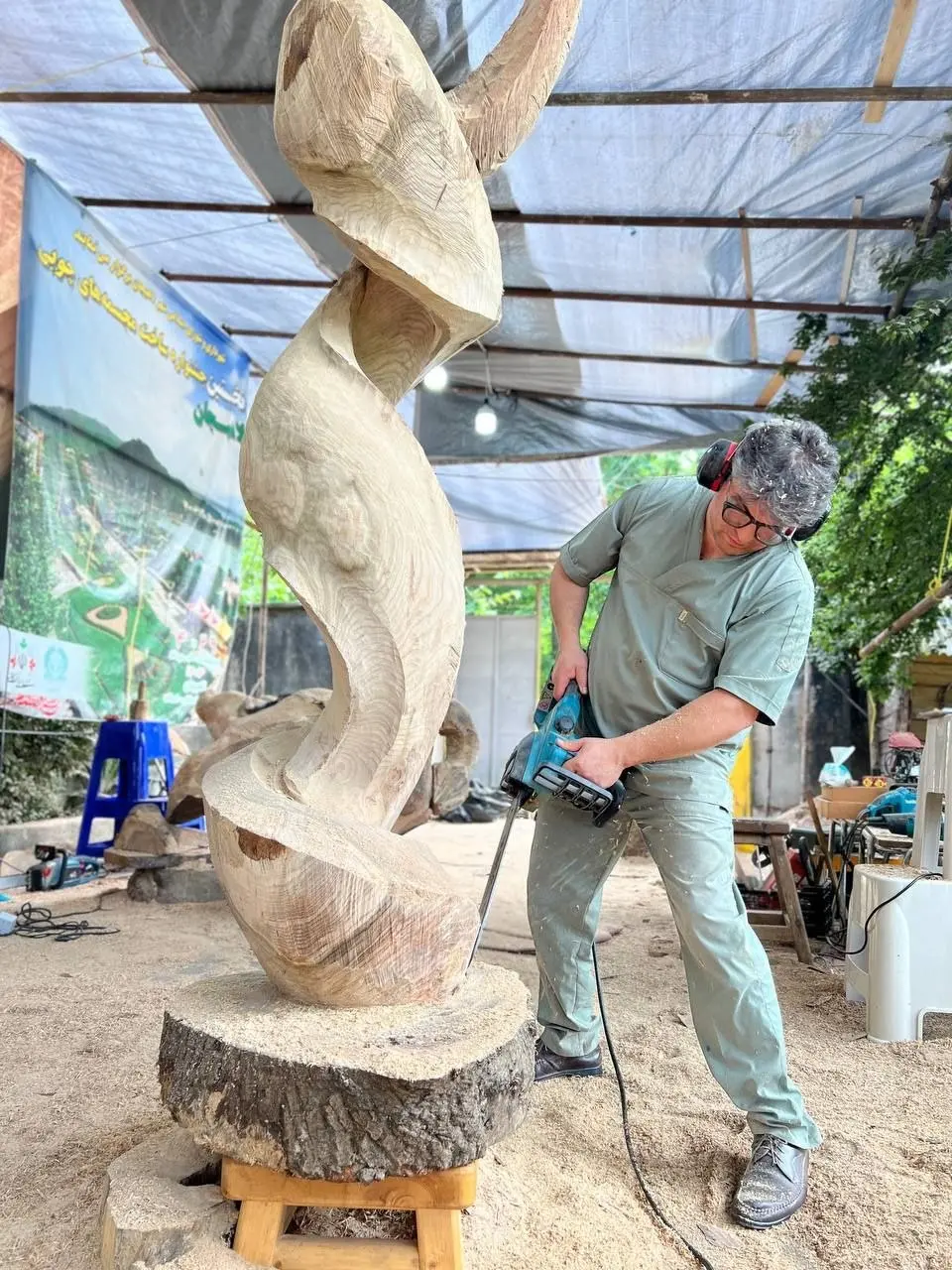
In the project Forever Tree, the use of trunks from dried and felled trees becomes an effort to restore the presence of trees to human life. Something that once formed part of a living organism finds a renewed presence through sculpture—one that carries aesthetic value while reminding viewers of humanity’s relationship with nature.
In Vadood’s Naqshbandi approach, the natural characteristics of wood also become part of the artwork’s visual language. The material’s grain and patterns can participate in shaping the image, revealing their inherent possibilities rather than being entirely subordinated to an imposed design.
From this perspective, an artwork is not merely a representation of a subject; it is an invitation to discover the less visible layers of nature. Through the form and beauty of the work, viewers encounter new possibilities for reflecting on nature’s memory and the relationship between human beings and materials.
_Industrial Design: When Creativity Becomes a Tool
Another distinctive aspect of Mohamadali Vadood’s career is his development of specialized artistic tools and industrial design concepts, a field in which artistic creativity is connected to practical problem-solving.
His achievements include the design of the Unisex Chisel set, featuring ergonomic adaptability, and the Bermuda Compass. The chisel set was developed with practical requirements and the relationship between the tool and its user in mind—an important consideration in precise, specialized woodworking.
The Bermuda Compass is another example of his efforts to develop design tools. In this field, the value of an idea is not limited to the product’s appearance; usability, design logic, and the potential to improve working processes are equally important.
According to information provided about the artist’s achievements, one of these innovations received a Silver Award in the Industrial Design category at the Kioskedia Awards 2024. Alongside his artistic practice, this recognition demonstrates how Vadood’s professional activities have expanded from creating artworks to designing tools and developing practical solutions.
This dimension of his work is relevant to understanding the title he received. In the contemporary world, the advancement of wood arts depends not only on the quality of finished works but also on design knowledge, ergonomics, tool development, and the relationship between art and industry.
_Mohamadali Vadood’s International Awards: From Design to Craftsmanship
Mohamadali Vadood’s international record also encompasses design and fine arts.
His works received recognition at Italy’s A’ Design Award between 2019 and 2021. Among them, Heart of the Forest received the Iron Award in 2020, while One Thousand and One Nights received the Bronze Award in 2021.
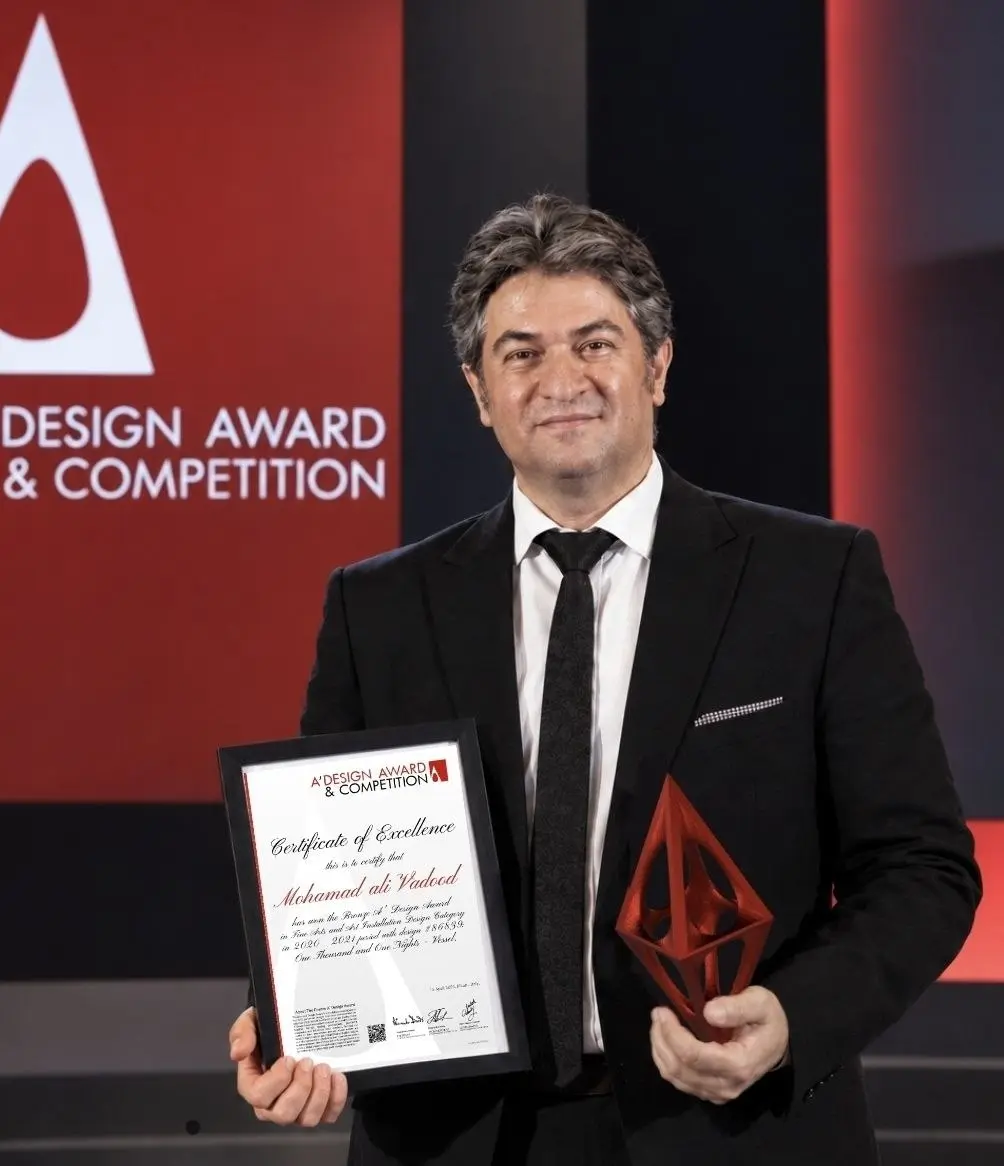
These distinctions have introduced his work beyond national boundaries, creating opportunities for it to be encountered within the international fields of art and design.
In 2022, Vadood also received the title of “Man of the Year in Crafts” at an event held in India, with participants from member countries, under the World Crafts Council (WCC). This recognition, alongside his other international achievements, highlights his activities in wood arts and traditional crafts.
The sixth edition of the International Crafts Award, held in India in 2022, represents another significant achievement in his career. The annual event is held internationally under the auspices of, and in collaboration with, the World Crafts Council (WCC).
Taken together, these experiences show that Vadood’s professional practice is not confined to a single discipline or artistic format. Design, making, research, and the exploration of art’s practical potential are interconnected dimensions of his work.
Each award, however, has its own criteria and scope of evaluation. The significance of these achievements is best understood by examining each within the context of its respective competition and discipline, rather than treating all distinctions as equivalent.
_From Creating Artworks to Advancing Traditional and Applied Arts
Another dimension of Mohamadali Vadood’s work is his involvement in the institutional and professional development of traditional and applied arts.
His participation in establishing and working with a technology development working group in the handicrafts sector, aimed at strengthening connections between traditional arts and emerging technologies, forms part of this trajectory. His membership in the Art Council of Iran’s National Elites Foundation and the Committee for Traditional and Applied Arts at the Iranian Academy of Arts also reflects his involvement in specialized artistic activities and discussions concerning cultural development and policy.
These activities reveal another dimension of professional responsibility: beyond creating artworks, an artist can contribute to structures that strengthen knowledge transfer, education, research, and connections between art and technology.
Such connections are particularly important in the handicrafts sector. Traditional skills may struggle to endure without opportunities for education, innovation in production methods, and engagement with contemporary needs. At the same time, technological development can support artistic heritage only when a thorough understanding of materials, practical skills, and aesthetic principles is preserved.
From this perspective, Vadood’s institutional activities can be understood as an extension of his broader commitment to connecting tradition, technology, and society.
_ Why Does Mohamadali Vadood’s Selection Matter Beyond an Individual Award?
The significance of Mohamadali Vadood’s selection also lies in the opportunity it creates to introduce the potential of Iranian wood art at a regional level.
Iran’s wood arts encompass a broad heritage, from construction and decorative techniques to the geometric knowledge and aesthetic principles of traditional art. Yet an effective international presence cannot be achieved through historical recognition alone. This heritage becomes a living resource when it can engage with contemporary design, technology, markets, and social concerns.
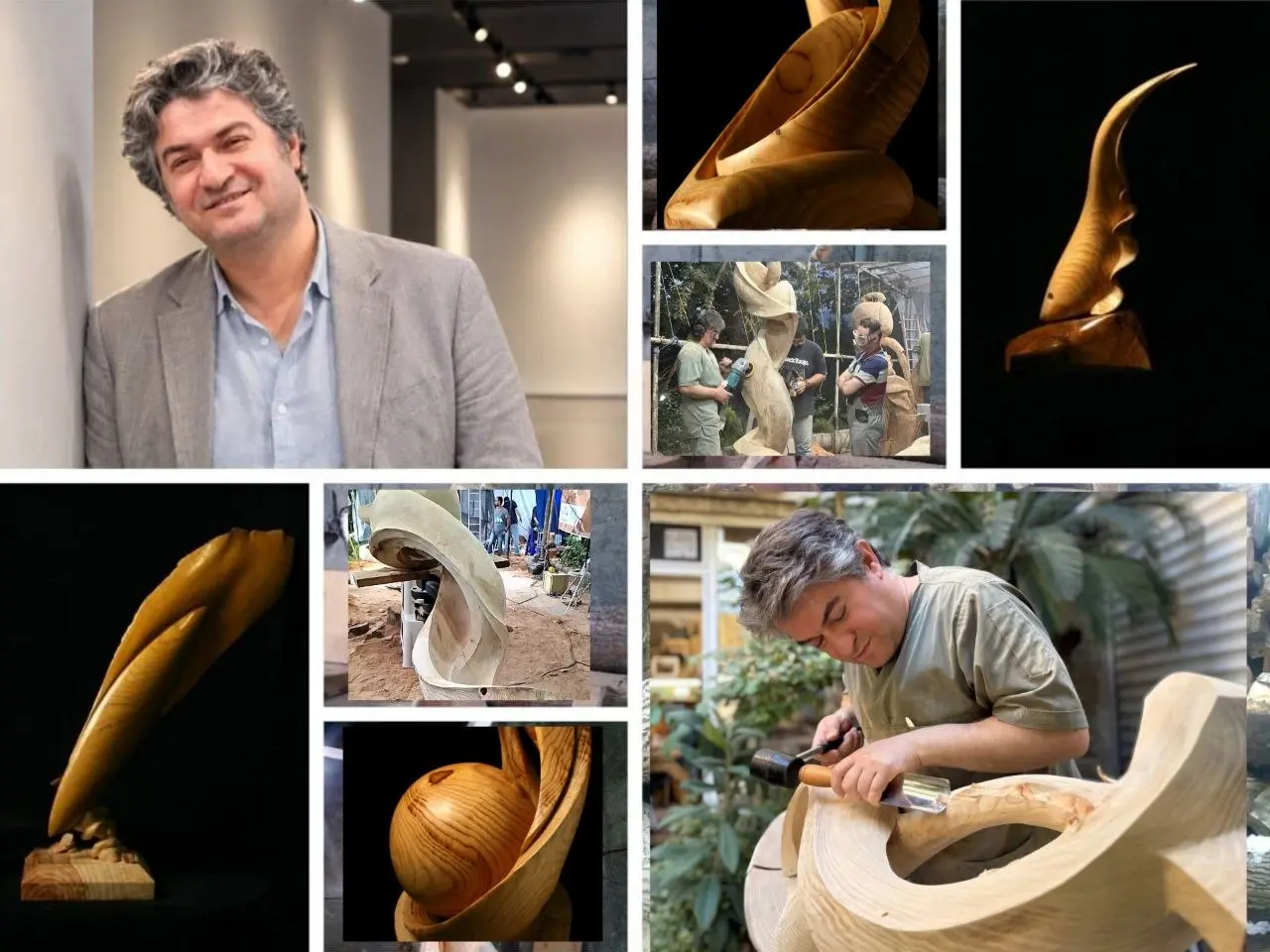
Vadood’s trajectory—from sculpting tree trunks to reinterpreting muqarnas and traditional motifs, and from designing specialized tools to advancing technology in handicrafts—is built around a central idea: wood can simultaneously carry cultural memory, inspire innovation, and serve as a medium for environmental responsibility.
In his artworks and projects, local identity is not positioned in opposition to the contemporary world. Instead, it can enter into dialogue with the language of design and the shared concerns of people today. This dialogue becomes even more meaningful when an individual artist’s experience contributes to knowledge transfer, professional cooperation, and new opportunities for others working in the field.
From this perspective, the title “Outstanding Master of Wood Arts of Asia and the Pacific” is not the end of a journey, but an opportunity to expand professional connections and introduce the capabilities of Iranian wood arts to a wider audience.
_Mohamadali Vadood: Connecting Heritage, Innovation, and the Future
The answer to why Mohamadali Vadood was selected as the distinguished “Outstanding Master of Wood Arts of Asia and the Pacific” at the international CAPFA 2025 event cannot be reduced to a single factor.
His range of activities—from innovative material use and the reinterpretation of artistic heritage to industrial design, tool development, and institutional engagement—presents the profile of an artist who approaches wood arts as an interdisciplinary field.
This approach extends the potential of wood arts beyond practical craftsmanship, transforming them into a field that connects art, design, technology, culture, and the environment.
Perhaps one of the most significant aspects of this experience is the ability to translate a worldview rooted in Iranian culture into a language that can engage with the contemporary world—a language in which natural materials, cultural memory, and innovation coexist.
The significance of such recognition is greatest when it extends beyond individual achievement and becomes an opportunity to introduce other artists, transfer experience, advance research, and strengthen the position of Iranian handicrafts within regional and international networks.
From this perspective, Vadood’s achievement offers an opportunity to reconsider the future of Iranian wood arts: a future in which heritage is not merely a remnant of the past, but a living source of creativity, sustainable development, and cultural dialogue with the world.
_Mohamadali Vadood’s Art Market: Prices, Collections, and Professional Recognition
Over the years, Mohamadali Vadood has developed a growing audience and market for wood art through a distinctive and recognizable artistic language. Today, indications of this trajectory can be found in private collections as well as auction results.
At Kavian Auction 2026, a 30 × 60 cm work created using the Naqshbandi technique, which was selected in the Fine Arts category of Italy’s A’ Design Award, achieved a hammer price of US$8,800.
Meanwhile, the wooden sculpture The Bird of Heaven, from the series The Thirty and That One Bird, created in collaboration with Shadi Habib and associated with the Bronze Medal for Best Designs in Italy in 2019, sold for IRR 1.65 billion—approximately US$9,700—at the 25th Tehran Auction in 2026.
These figures, alongside Vadood’s international Handicraft Award recognition, his 2022 Man of the Year in Crafts title at the International Crafts Award in India, his title of Outstanding Master of Wood Arts of Asia and the Pacific in 2026, multiple awards and selections at the A’ Design Award in Italy and the Kioskedia Awards, lifetime membership in the Global Designers Consortium, membership in the Art Council of Iran’s National Elites Foundation and the specialist group for traditional arts at the Iranian Academy of Arts, as well as his First-Degree Artistic Medal, form part of the symbolic capital of the artistic brand he has built over the years.
Another dimension of this artistic brand can be seen in the destinations of his works after their creation. His works are represented in the digital collection of MOOD Museum in Italy, the museum of the National Arts Research Institute under Iran’s Ministry of Cultural Heritage, Tourism and Handicrafts, and the Tabriz University of Art Museum.
His works are also held in private collections associated with Professor Giv Sharifi, Engineer Abbasi and Abbasi Gallery, Engineer Hassan Golchinpour and Mesnegar Gallery, Engineer Esmail Ghods, Dr. Farshid Bozorgi, Engineer Meysam Moradi-Manesh, and others.
Together, these auction results, institutional affiliations, awards, and collection placements offer several ways to examine the development of Vadood’s artistic profile and market presence. They also illustrate how an artist’s professional reputation can be shaped over time through the interaction of artistic practice, international recognition, institutional engagement, and the circulation of works in the art market.
LEAVE A RELPY