
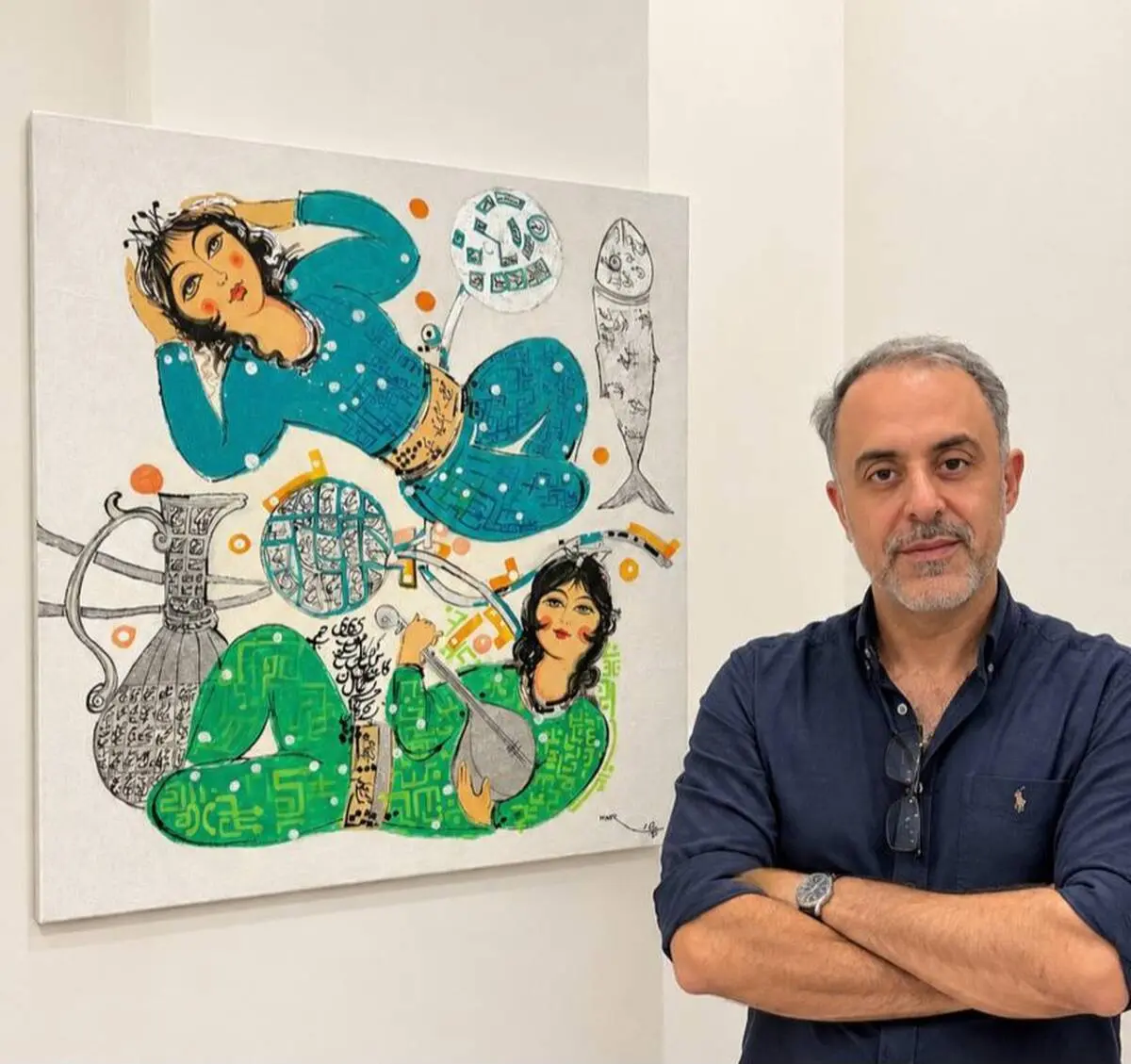
Mehrdad Fallah: An Aesthetic Re-reading of Painting, from Figuration and Line to Cultural Memory
Mehrdad Fallah: An Aesthetic Re-reading of Painting, from Figuration and Line to Cultural Memory
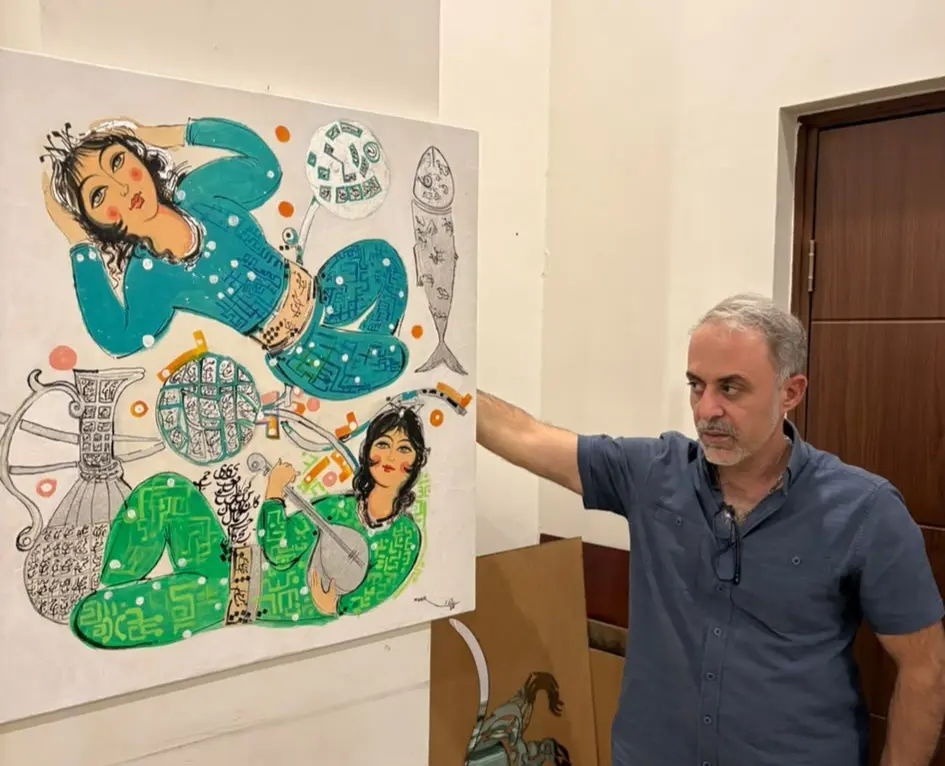
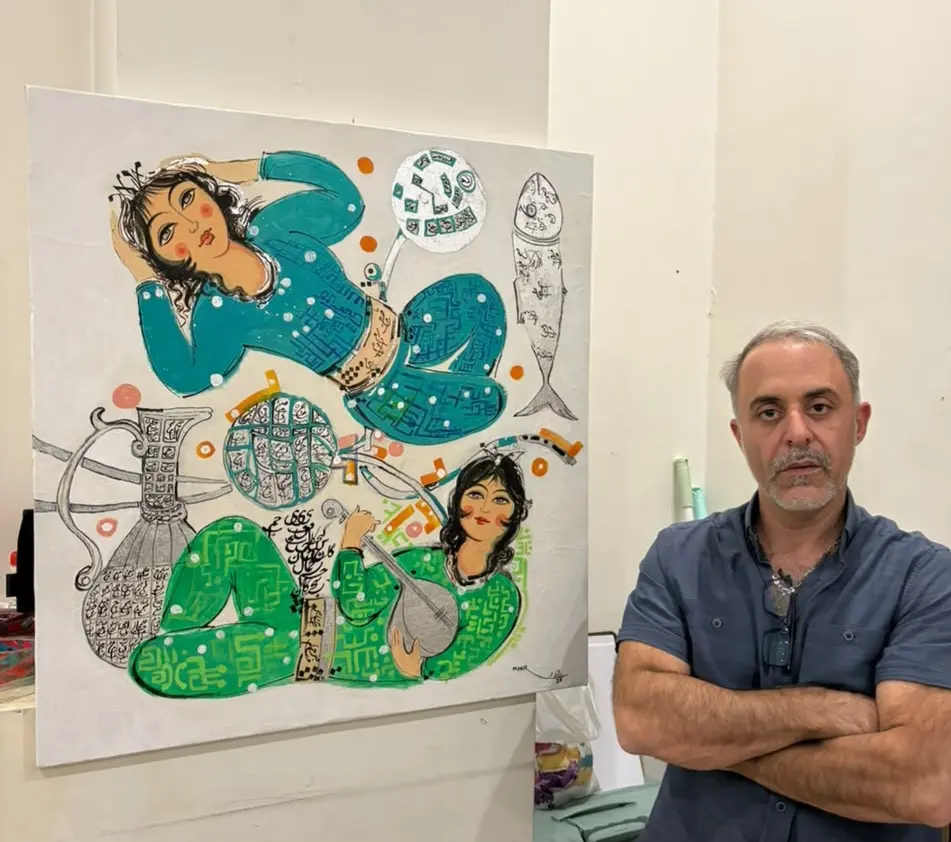
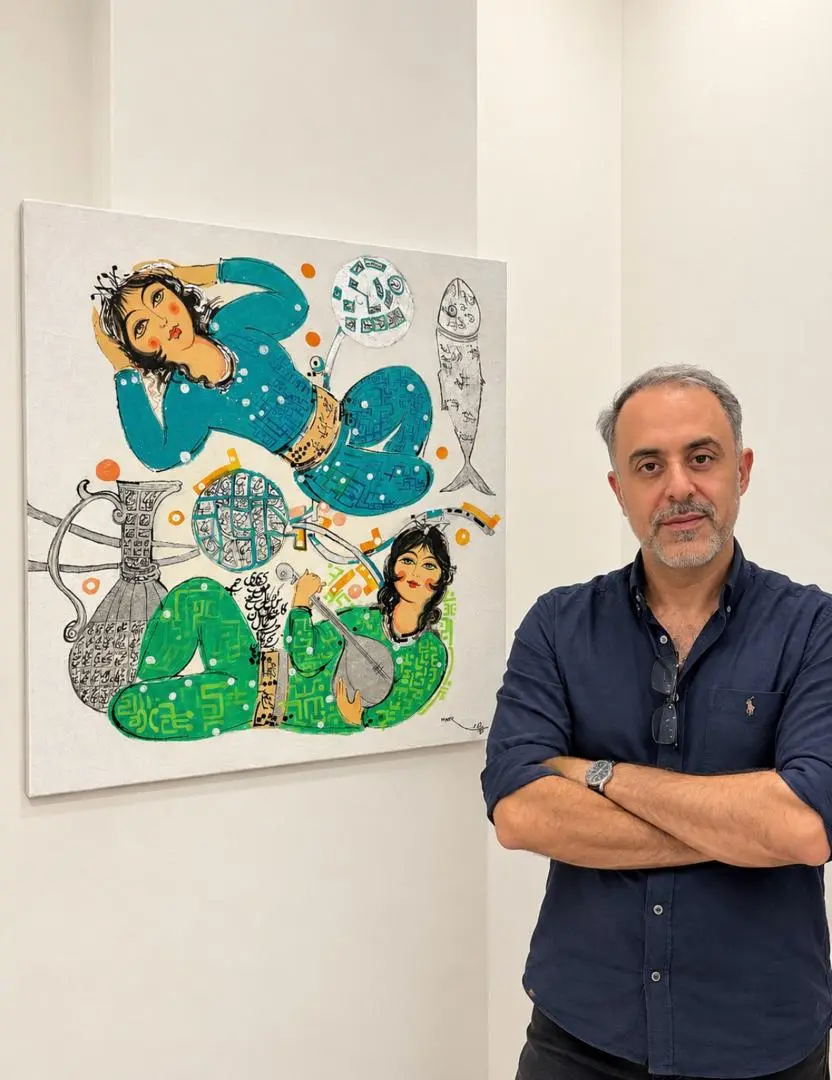
ArtDayMe : We examine a painting by Mehrdad Fallah, a well-known Iranian painter, belonging to one of his renowned series.
Executed in mixed media on a 86 × 82 cm surface, this work was created in 2020.
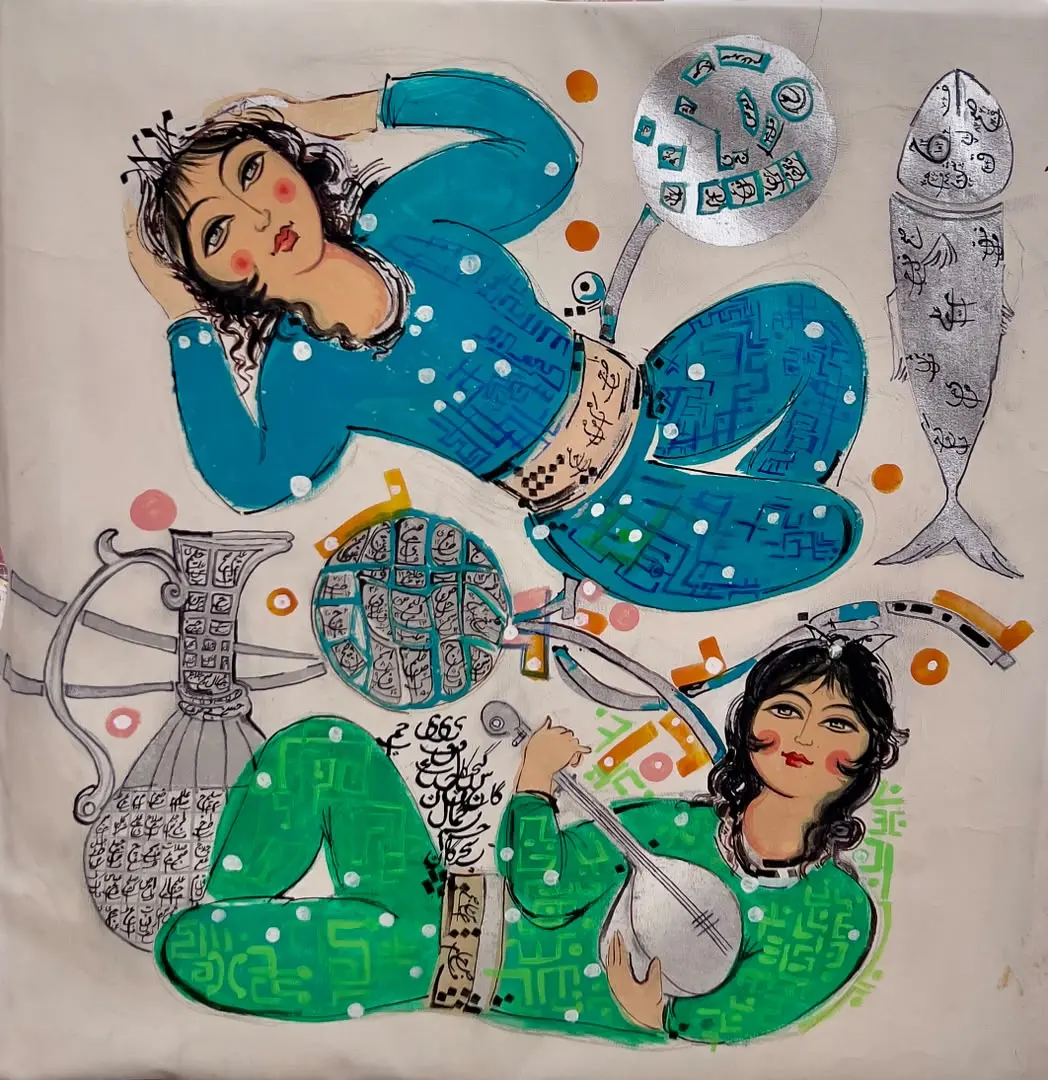
This painting by Mehrdad Fallah can be interpreted at the intersection of figurative painting, contemporary visual experimentation, and the renewal and reinterpretation of the written and visual heritage of Iranian culture. The human body, calligraphic marks, musical instruments, and decorative elements coexist within a shared visual field.
At first glance, two female figures dressed in turquoise and green draw the viewer's attention. Yet, upon closer examination, it becomes clear that the work is not simply concerned with depicting two human figures or creating a colorful composition. Rather, the artist transforms the pictorial world into a space where different visual languages intersect: the language of the body, the language of calligraphy, the language of ornament, and the language of color.
One of the painting's defining characteristics is that none of these languages dominates the composition entirely. Instead, the image moves between narrative and sign, figure and surface, cultural memory and contemporary visual experience.
1. Composition: Balance Within Dispersion
The structure of the painting is organized around two diagonally positioned figures. The upper woman, dressed in turquoise, extends along a diagonal running from left to right, while the lower figure, wearing green, creates an almost opposing movement. This arrangement prevents the composition from becoming static, guiding the eye along a continuous path between the two bodies, musical instruments, circles, and scattered visual signs.
Although the figures occupy a substantial portion of the pictorial surface, they do not dissolve into their surroundings. Their boundaries are defined by distinct black outlines. By contrast, the surrounding textual elements and objects sometimes approach these boundaries and at other points overlap or cross them. The relationship between figure and background is therefore not based on complete separation, but rather on proximity, interference, and visual interaction.
The orange and pink circles appear like brief rhythmic beats across the neutral background. These spots interrupt the viewer's sustained focus on the two figures and help maintain compositional balance against the visual weight of the turquoise and green.
2. Color: Turquoise and Green as Two Visual Forces
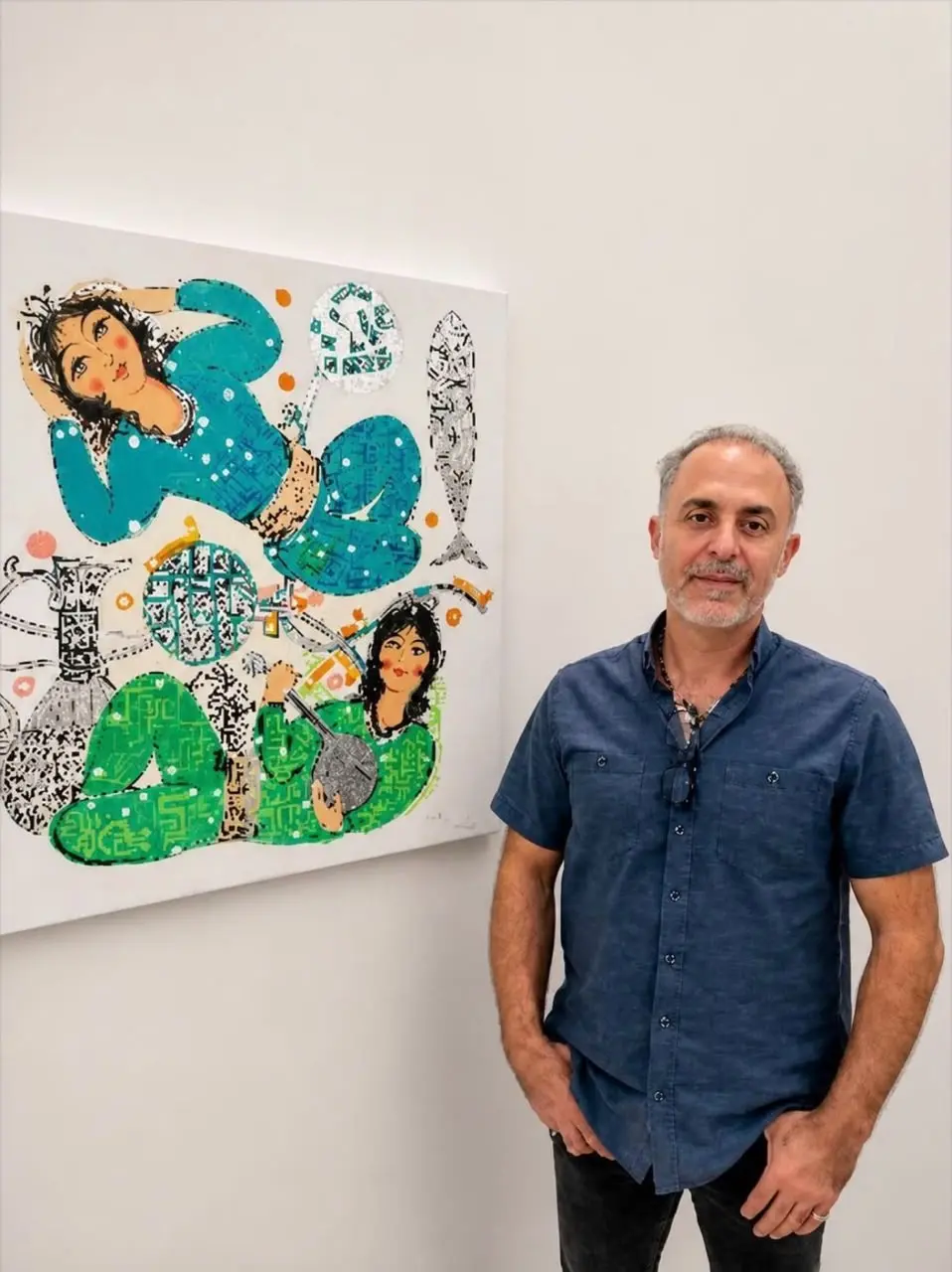
In this painting by Mehrdad Fallah, color is not merely an aesthetic component; it is a means of organizing the entire image. The turquoise of the upper figure has a cool, luminous, and energetic presence. The green of the lower figure, with its relative warmth and inner radiance, produces a different sensation. Together, these two colors establish a kind of visual counterpoint.
The presence of geometric and calligraphic motifs within the colored surfaces is particularly significant. These marks prevent color from becoming a uniform decorative field. Instead, the surfaces of the garments become another arena for the movement of lines and shapes. Scattered white marks, meanwhile, create moments of pause and luminosity against the saturated colors.
The relatively neutral cream-colored background plays a decisive role. It reduces the intensity of competition between the colors, allowing the black, grey, and colored elements to retain a degree of visual independence without overwhelming the composition. The scattered orange accents also function as complementary and emphatic notes, adding energy to the overall arrangement.
3. Line and Drawing: Between the Freedom of the Hand and the Discipline of Signs
The black outlines surrounding the faces, hair, bodies, and objects are among the work's most important expressive elements. In many areas, these lines appear spontaneous, variable, and seemingly rapid. Yet they perform clear functions: defining form, reinforcing movement, and establishing rhythm.
In the hair of both figures, line moves beyond the precise representation of individual strands and becomes an independent expressive element. Its curves and undulations establish connections with the contours of the bodies and the shapes of the instruments. By contrast, the lines within the garments and textual elements are more angular and geometric. The interplay between these two types of line—the organic line of the body and the geometric line of ornament—is one of the principal mechanisms behind the painting's visual diversity.
The work moves between freehand drawing and carefully considered organization. This quality prevents the image from becoming dependent on academic representation while also keeping it from descending into uncontrolled visual disorder.
4. Calligraphic Signs: When Reading Becomes Seeing
One of the painting's most significant layers is the extensive presence of signs that evoke Persian calligraphy and traditional Iranian writing systems. These marks are scattered across the garments, musical instruments, circles, and the space between the two figures. In certain areas, individual letterforms and calligraphic combinations are more recognizable, while elsewhere, writing becomes a collection of compact, geometric, and repetitive forms.
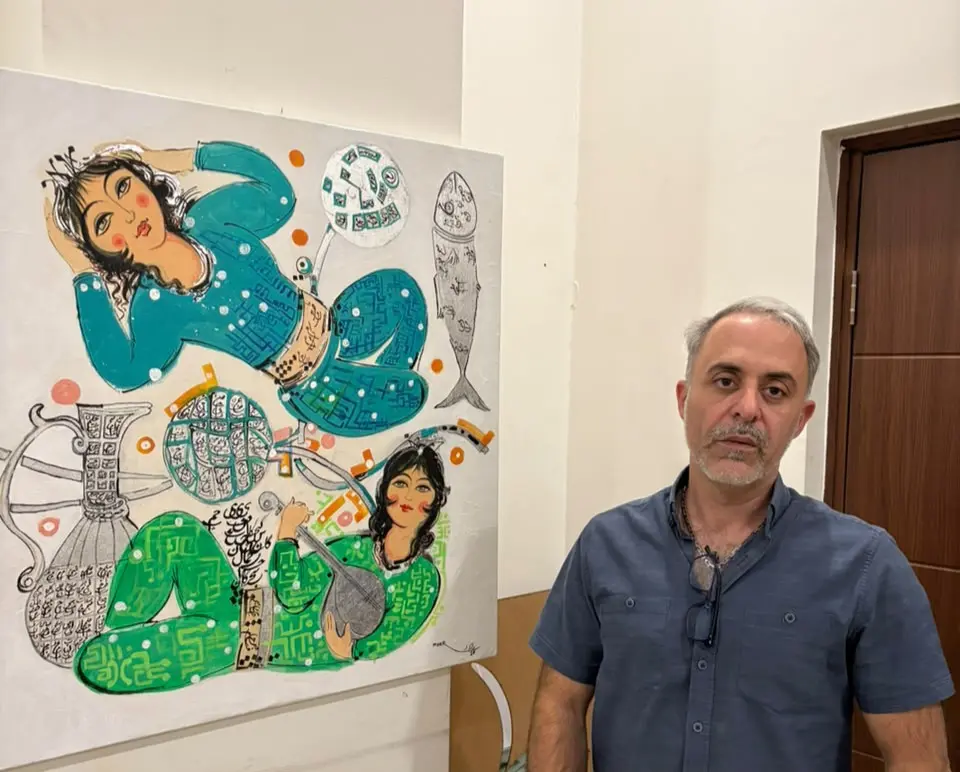
Here, we encounter two different functions of writing: calligraphy as a carrier of meaning and calligraphy as a visual element. When the inscriptions merge into colored surfaces, the act of reading their meaning gives way to observing rhythm, density, direction, and form. Letters move away from their conventional textual context and become active participants in the organization of the image.
This approach can be examined within the broader trajectory of contemporary Iranian painting, in which the heritage of calligraphy, popular motifs, and religious or cultural signs are removed from their original contexts and redefined within a new visual language. In Mehrdad Fallah's work, the connection with the Saqqakhaneh movement, particularly its combination of traditional signs and contemporary expression, provides an important framework for understanding this characteristic.
5. Figuration: The Body as a Surface of Expression
In terms of their pictorial construction, the two women are less concerned with realistic anatomical representation than with simplification and an emphasis on essential contours. The proportions of their bodies, elongated limbs, curved forms, and the positioning of their figures create a deliberately expressive visual language.
The faces follow the same principle. Large, elongated eyes, clearly defined eyebrows and eyelashes, small lips, and rosy cheeks lend the figures an idealized and somewhat narrative quality. These faces are neither realistic psychological studies nor entirely abstract forms. Rather, they occupy a space between individual characterization and visual typification.
The differences between the two figures are equally important. The upper woman, with her bent arm and elongated body, conveys a relaxed and contemplative mood. The lower woman, holding a musical instrument in her arms, establishes a more direct relationship with an object. This difference in gesture prevents the two figures from becoming mere repetitions of a single visual model.
6. Pictorial Space: Rejecting Classical Depth in Favor of the Surface
In this work, linear perspective and the realistic representation of three-dimensional space do not play a central role. The figures and objects are distributed across the picture plane, with each element retaining a considerable degree of visual independence. The light background does not become the interior of a room or a natural landscape; instead, it functions primarily as a surface upon which the elements are arranged.
This characteristic can be compared with certain features of Iranian miniature painting, including an emphasis on the picture plane, the coexistence of elements within a non-naturalistic space, and the relative independence of individual components. Nevertheless, the painting should not be regarded simply as a continuation of miniature traditions. Its spontaneous outlines, luminous colors, distinctive figuration, and use of calligraphic signs bring it closer to the artist's own contemporary visual language.
Negative space is also important. The cream-colored background, particularly around the figures and instruments, creates intervals between the elements and prevents the entire surface from turning into a single, uninterrupted texture.
7. Musical Instruments and Surrounding Objects: From Representation to Cultural Association
The presence of stringed instruments and elongated and circular objects expands the painting's range of meaning. At the bottom of the composition, one figure holds an instrument in her arms. On the left, an object resembling a musical instrument or decorative stand can be seen, while another elongated, symmetrical element appears on the right.
It is not possible to identify the precise nature of every object from the image alone. However, their compositional function is clear: they are not included merely to create a realistic setting around the figures. Instead, they become part of the painting's symbolic vocabulary.
The circles containing inscriptions also establish formal connections with the shapes of the instruments. The repetition of circular forms, curves, and elongated lines creates a visual relationship between the body, the object, and the written sign.
From this perspective, music emerges as one possible association of the painting. This does not necessarily imply a literal depiction of a musical performance, but rather suggests a mental space in which visual rhythm is accompanied by the imagination of sound. The repetition of lines, marks, and signs reinforces this interpretation.
8. Texture, Material, and Technical Execution
Visually, the surface moves between relatively flat areas and sections marked by brushwork and variations in line. Although the garments initially appear to contain uniform fields of color, their internal motifs, white marks, and dark outlines prevent them from becoming monotonous. In the faces, too, variations in color and surrounding lines contribute to a sense of volume without relying on conventional chiaroscuro.
The contrast between large areas of color and minute calligraphic details activates different scales of viewing. From a distance, the viewer perceives the overall color arrangement and the movement of the two figures. At closer range, a network of lines, signs, and intricate details gradually emerges. This shift in visual experience gives the painting the capacity to reward repeated viewing.
From a technical standpoint, it is important to distinguish between what can be directly observed in the image and what requires documented information. Without further details concerning the materials and execution process, no definitive conclusions can be drawn about the precise type of paint, layering technique, or support.
9. Conceptual Reading: A Dialogue Between Tradition and Contemporaneity
The central conceptual question raised by the painting is how elements belonging to cultural memory can be incorporated into contemporary imagery without reducing them to purely decorative signs.
Calligraphy, patterned garments, musical instruments, and the arrangement of the figures all evoke familiar visual traditions. Yet their coexistence within this colorful and spontaneous structure produces a different meaning.
Tradition is not presented here as an untouched model, but rather as a collection of visual possibilities—possibilities that can be rearranged, detached from their original contexts, and employed within a new composition. This is precisely where the painting moves beyond the reconstruction of the past and approaches its reinterpretation.
At the same time, the image establishes a balance between order and disorder. The lines and inscriptions follow recognizable visual principles, while the overall composition retains a sense of freedom and playfulness. This quality prevents the work from becoming either purely nostalgic or overly formal.
10. Painting as a Field of Intersecting Languages
Through the combination of expressive figuration, saturated colors, spontaneous lines, calligraphic signs, and evocative objects,
Mehrdad Fallah's painting creates a world in which no single element possesses the entirety of meaning. The work's strength lies in the relationships between its components: turquoise against green, organic lines against geometric motifs, the body against the object, and writing against imagery.
From an aesthetic perspective, the painting's most significant achievement lies in transforming familiar cultural elements into a new visual organization. It neither remains confined to straightforward representation nor uses cultural signs merely as decorative devices. Instead, it moves productively between these two possibilities.
Perhaps the most rewarding way to approach this painting is to consider the relationships between its elements before attempting to decipher each individual sign. The meaning of the work does not reside exclusively in its inscriptions, faces, or musical instruments. It emerges in the intervals between them, in their repetitions, in the contrasts of color, and in the movement of the viewer's eye across the picture plane. It is here that the painting transcends a collection of scattered elements and becomes a unified, multilayered, and contemplative visual experience.
-Mehrdad Fallah's Art Market and Auction Record
Mehrdad Fallah was born in Tehran in 1975. He grew up in a traditional family, but this was no ordinary household. It was also the home of one of the most important pioneers of modern Iranian painting: Sadegh Tabrizi.
The late Sadegh Tabrizi was Mehrdad Fallah's maternal uncle, and Fallah became one of his particularly distinguished students.
To date, Mehrdad Fallah's works have appeared at four different auction houses, and all have achieved prices above their initial estimates. These include the 21st Tehran Auction in October 2024, where one of his works sold for 187 million tomans; the Second National Auction in 2015; Goharan Auction; and a charity auction in Los Angeles.
Mehrdad Fallah's works have been exhibited on numerous occasions in the United Kingdom, Switzerland, Italy, Belarus, Cyprus, Turkey, the United States (Los Angeles), Dubai, and, of course, Iran.
Among these presentations was the exhibition Persian Whispers, held at Aryan Gallery in the Pars Place complex in Virginia, USA, in November 2025, where ten works were sold.
Another significant presentation was Fallah's painting exhibition Nostalgia, held in October 2025 at the Otto-Mauer-Zentrum in Vienna, Austria, where seven works were sold.
Fallah's professional entry into the art world dates back to 1998, when, at the age of 23, he presented an exhibition of reverse-glass paintings at Gallery 66—a pioneering gallery founded by Sadegh Tabrizi.
He subsequently held six solo exhibitions, among which The Lion with Calligraphy, presented at Art Center Gallery in 2015, was perhaps the most significant in terms of its wide-ranging reception.
Over the years, Mehrdad Fallah has created numerous works combining painting with Iranian symbolism, gradually establishing a distinctive artistic signature. He belongs to a generation of painters who draw upon the traditions of Iranian painting to create modern and contemporary works. Among his best-known series are The Lions, The Roosters, and, notably, The Wonders of Creation (Aja'ib al-Makhluqat), which have brought him considerable recognition.
A number of art critics and specialists regard Mehrdad Fallah as one of the contemporary artists continuing and revitalizing the Saqqakhaneh School, reinterpreting its visual heritage within the context of contemporary art.
LEAVE A RELPY