
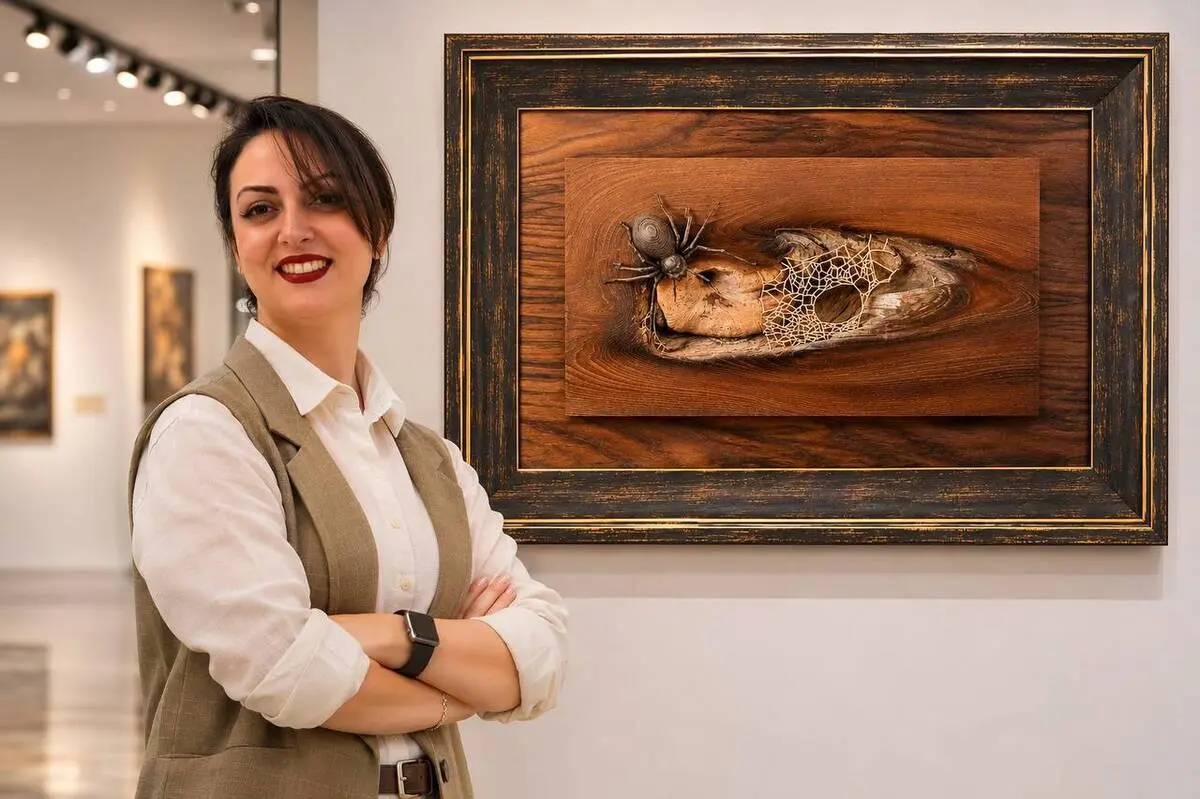
Shadi Habib and “The Geometry of Survival”
Shadi Habib’s The Geometry of Survival brings together the natural characteristics of wood—its cavities, fractures, and variations in texture—to create a composition in which the boundary between natural form and artistic intervention is intriguingly blurred. Rather than relying on the representation of nature, the work draws upon the inherent potential of the material to construct an entirely new visual structure.
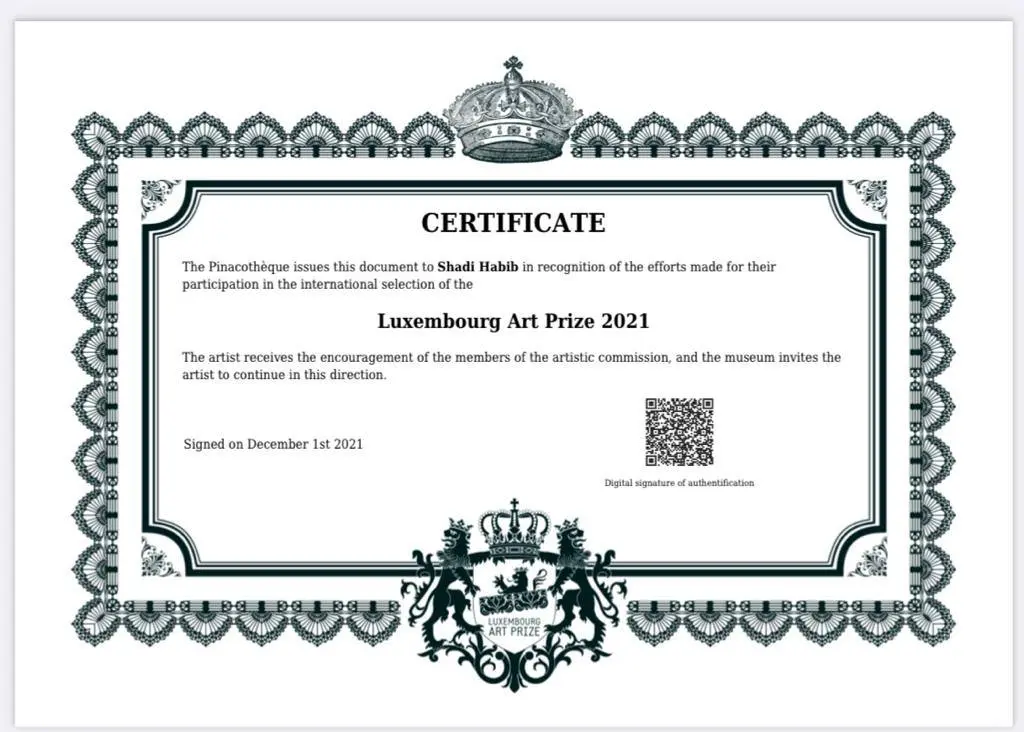
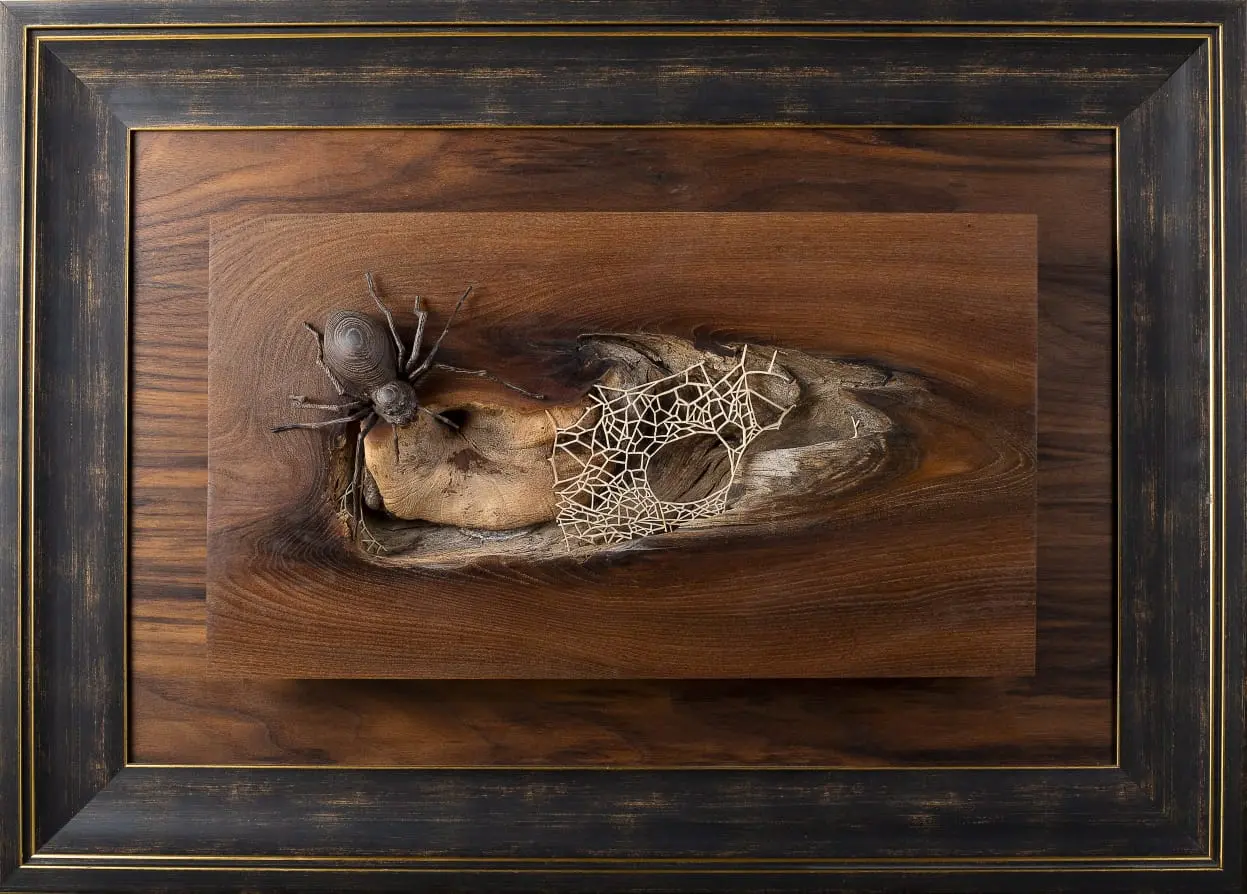
ArtDayMe: We examine The Geometry of Survival, a picture-sculpture by Shadi Habib, which received an Honorable Mention at the Luxembourg Art Prize in 2021.
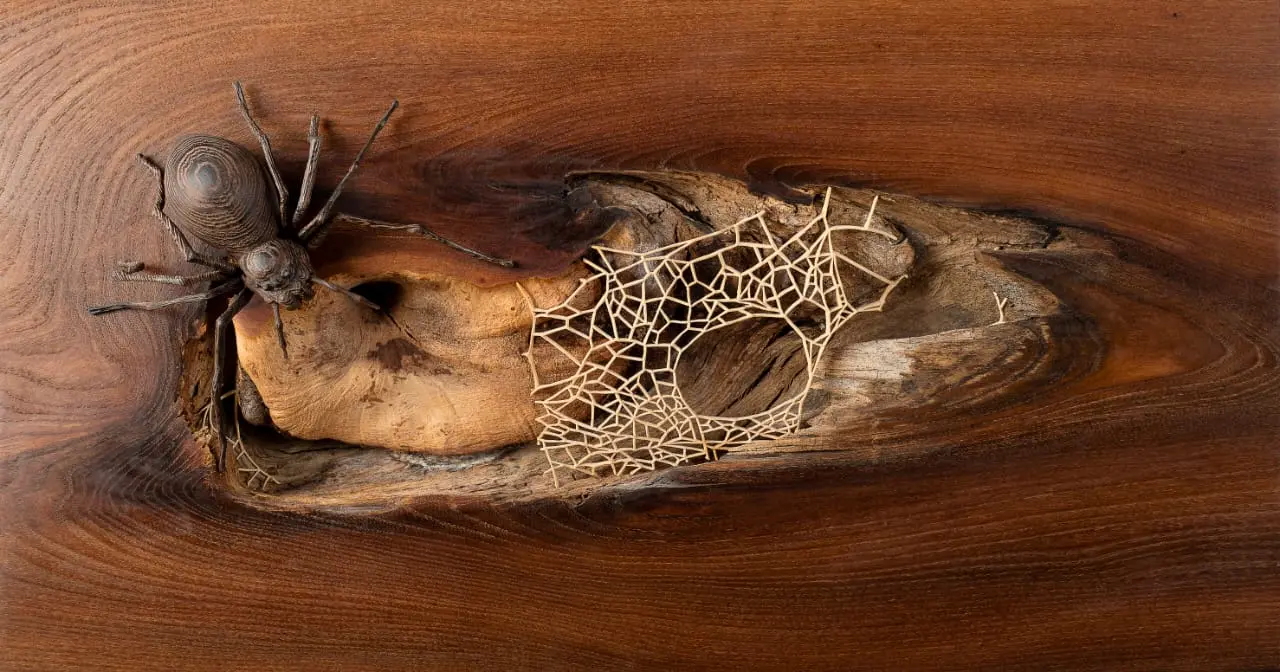
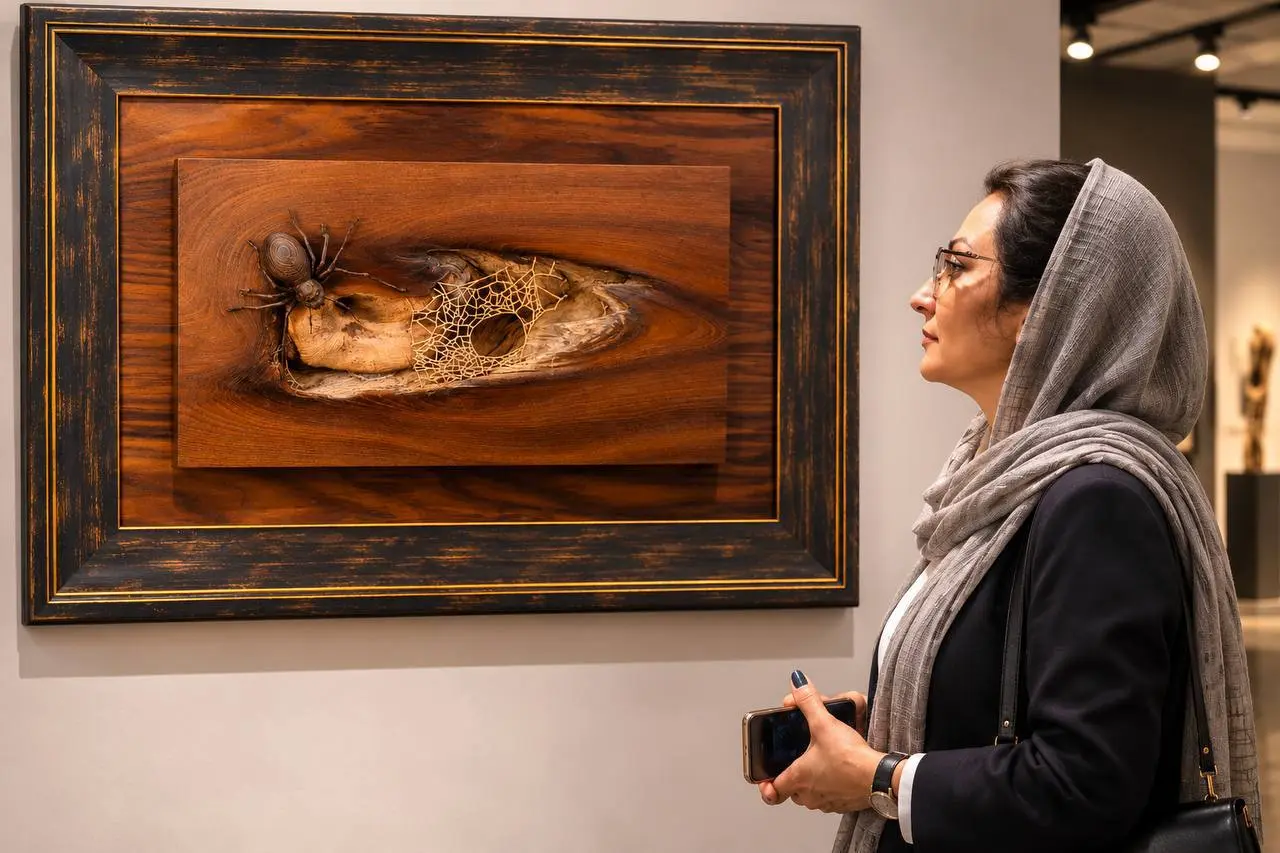
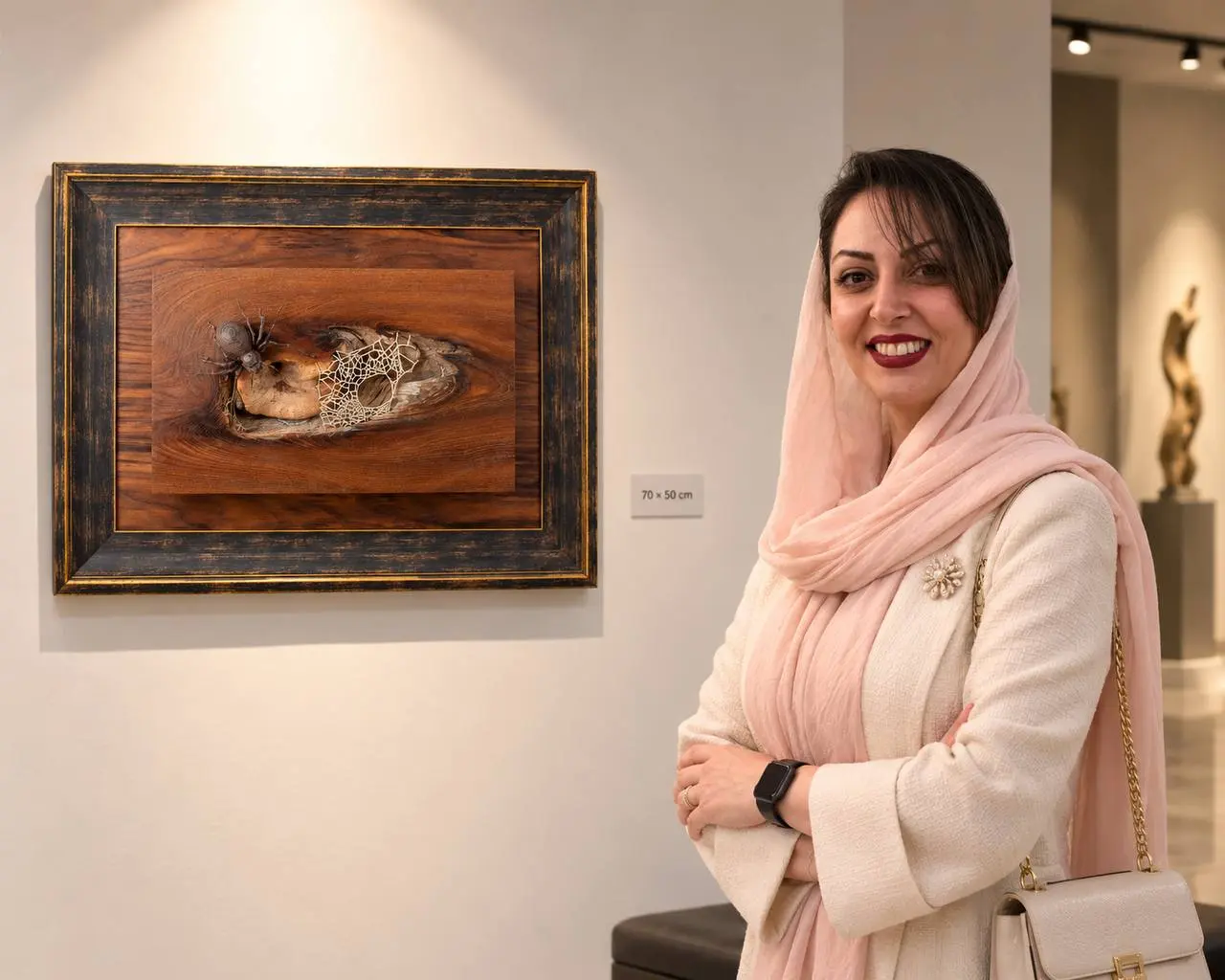
The overall dimensions of the work are 50 × 70 cm. The spider measures 9 × 12 cm, while the spider web measures 10 × 13 cm.
Technically, the work combines volume modeling, openwork wood carving, and relief inlay carving.
Interestingly, Shadi Habib has selected three different types of wood in keeping with the subject of the work: elm for the main support, boxwood for the spider web, and wenge for the spider itself.
- Shadi Habib’s Artist Statement on The Geometry of Survival
Sometimes, what is created for survival becomes a means of restoration.
The Geometry of Survival emerges from the encounter between two structures: a piece of wood with a cavity in its body, and a spider weaving its web to sustain its life.
In response to the needs of a living creature, the web gradually extends across an empty space and, alongside the wood’s natural structure, creates a new architecture. Beyond its original function, this structure becomes a metaphor for the healing of wounds.
In this work, restoration does not mean erasing damage or returning something to its original state. The cavity remains part of the wood’s identity; however, the presence of a newly formed network transforms its relationship with the surrounding space. What was previously perceived as a flaw or rupture becomes the ground for the emergence of a different order.
The spider does not weave with the intention of repairing; it weaves in order to survive. Nevertheless, its action produces consequences that extend beyond its initial need: a structure formed for survival opens up a new interpretation of restoration. In this encounter, survival is not merely a defensive force; it is the capacity to create, connect, and open a new path within an existing condition.
Wood and web, governed by two different principles, come together within a shared structure. One carries the traces of time, erosion, and transformation, while the other embodies delicacy, connection, and an ongoing effort to sustain life. From their encounter emerges a geometry based not on the elimination of a wound, but on the possibility of living with it.
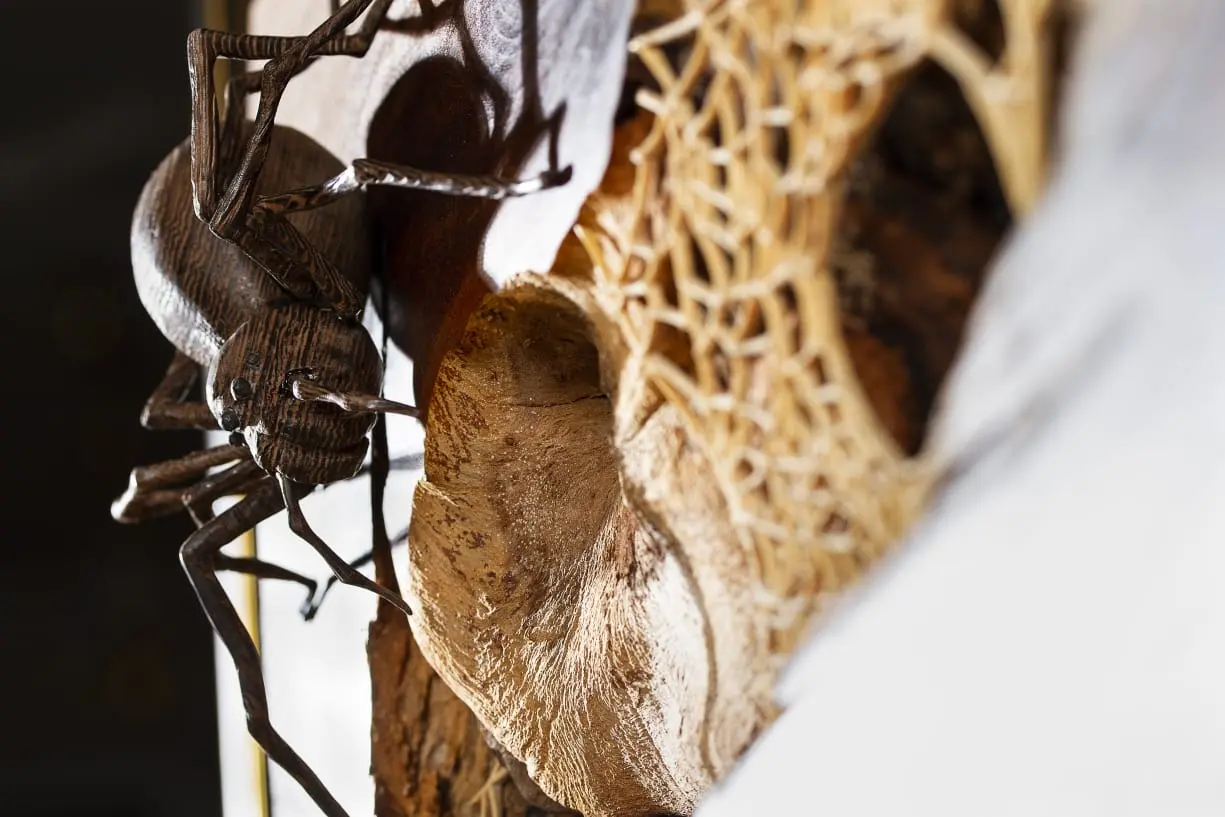
The Geometry of Survival is a meditation on the moment when damage does not signify the end of meaning; a moment when what we create in order to endure can also open a path toward restoration. Sometimes healing does not mean returning to who we once were, but rather creating a new order around what we have experienced.
- An Aesthetic Analysis of Shadi Habib’s The Geometry of Survival
The Geometry of Survival: The Aesthetics of the Relationship Between Nature, Material, and Structure
In Shadi Habib’s The Geometry of Survival, wood transcends its role as the material of the artwork and becomes an integral part of its narrative and aesthetic system.
Through the use of the wood’s natural characteristics, cavities, fractures, and variations in texture, Shadi Habib creates a composition in which the boundary between natural form and artistic intervention is intriguingly blurred. The result is a work that draws less on the representation of nature than on the inherent potential of the material to generate a new visual structure.
1. Composition: Balancing Mass, Cavity, and Network
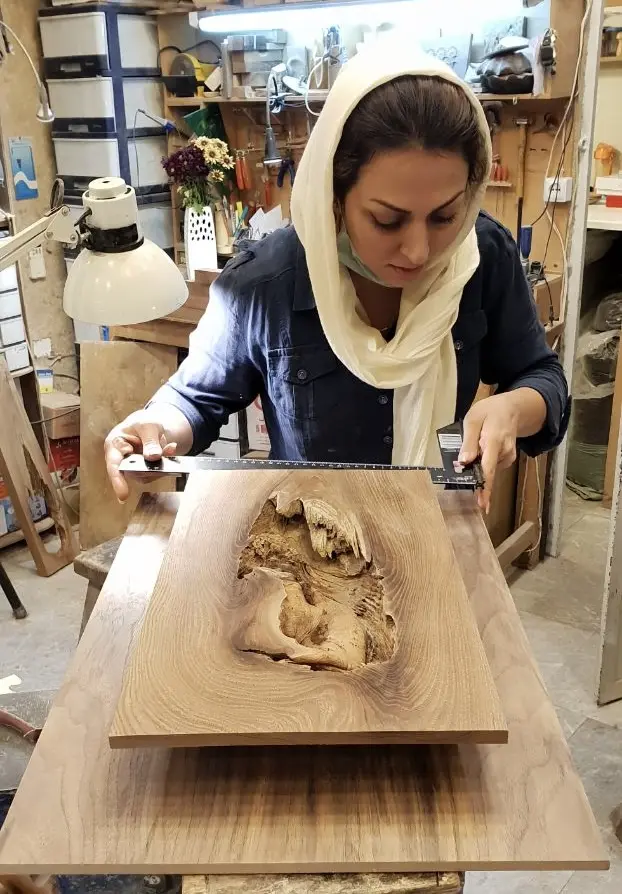
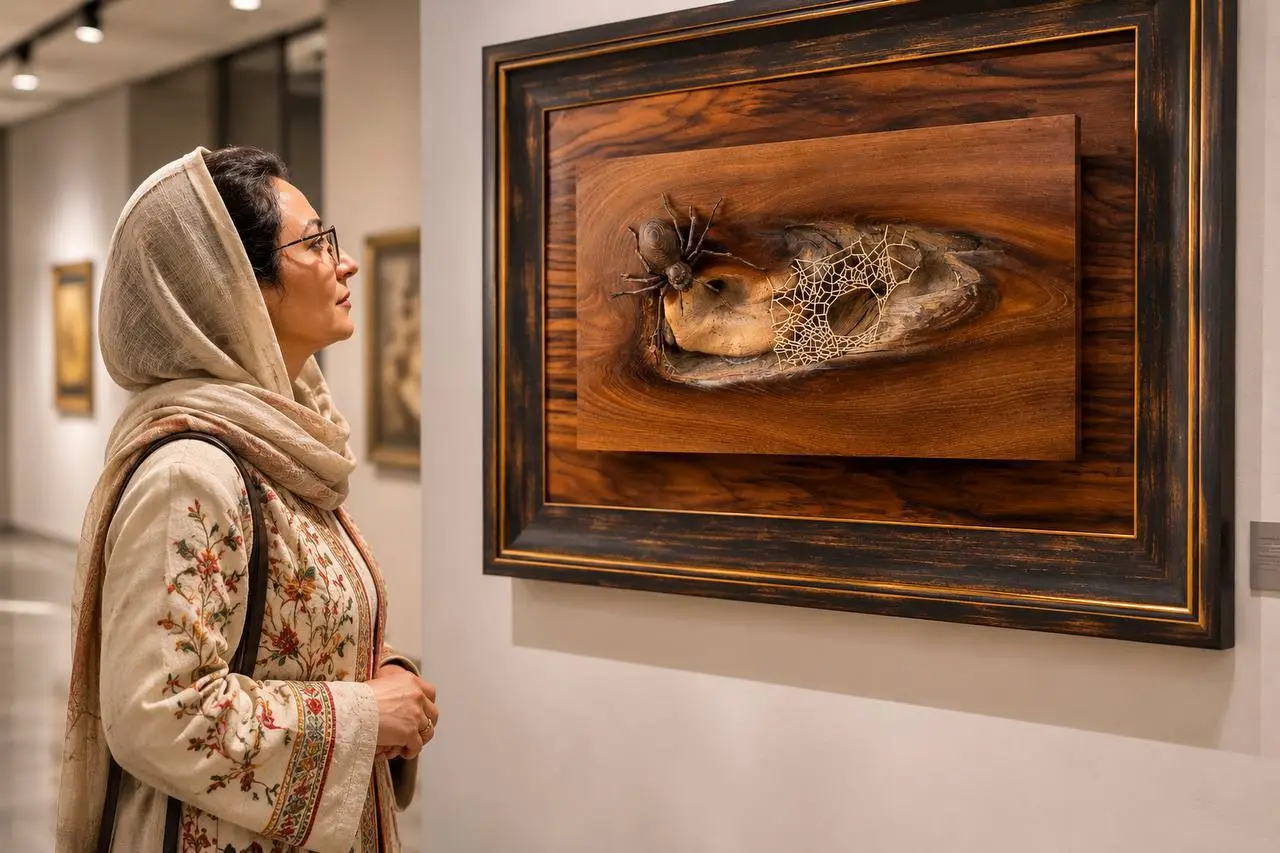
The composition is based on a horizontal structure. The elongated form of the elm wood guides the viewer’s eye across the work, while the irregular central cavity establishes its primary visual focal point. Three principal elements—the mass of the wood, the spider, and its web—form relationships that extend beyond mere juxtaposition.
The spider occupies the left side of the composition, while the wooden web extends across the center and right. This spatial arrangement establishes a visual movement from the living creature toward the constructed structure. The eye first encounters the spider’s dark, relatively dense volume, then follows the intricate, lighter lines of the web, before moving into the depth of the cavity and the varied textures of the wood.
An important achievement here is the balance maintained among these three elements. None independently dominates the entire visual field, allowing the composition to retain its overall coherence.
2. The Aesthetics of Material: Shadi Habib’s Thoughtful Selection of Three Woods and Three Visual Qualities
The selection of three different wood species is one of Habib’s significant decisions in establishing the work’s visual language. The main support is made of elm, the spider of wenge, and the web of boxwood.
With its warm color, flowing grain, and natural texture, elm provides a rich ground for the other elements. The continuous lines and organic patterns of the wood, particularly around the cavity, create a sense of natural movement that both contrasts with and relates to the geometric structure of the web.
By contrast, the dark color and dense appearance of wenge make the spider a prominent and clearly distinguishable element. This chromatic contrast establishes an effective visual separation between the spider’s body and its background.
Boxwood, with its lighter color and workability, makes it possible to construct the delicate, intricate web. Consequently, the three types of wood are not merely different materials; they fulfill three distinct aesthetic functions: background, volume, and line.
3. The Contrast of Textures: From Natural Surface to Geometric Order
One of the most compelling features of Shadi Habib’s work is the contrast between irregular textures and ordered structures.
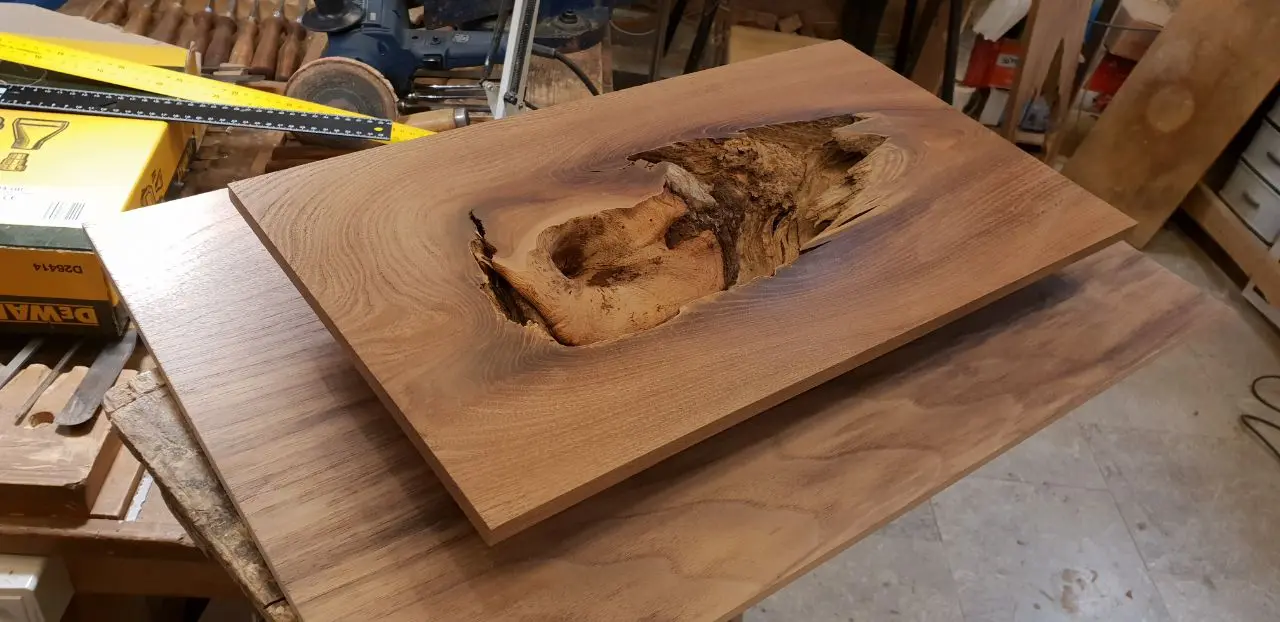
The wooden support, with its grain, fractures, uneven surfaces, and natural cavity, possesses an entirely organic quality. In contrast, the spider web introduces a geometric, network-like order through its delicate lines and multiple connections.
This contrast represents one of the work’s most significant aesthetic strengths. Rather than concealing or correcting the wood’s irregularities, Habib preserves them within the final composition and places them alongside the web’s carefully articulated lines. The work’s beauty, therefore, does not arise from uniformity or polished surfaces, but from the coexistence of two contrasting qualities: natural irregularity and constructed order.
4. Line and Network: Geometry in Contrast with Organic Form
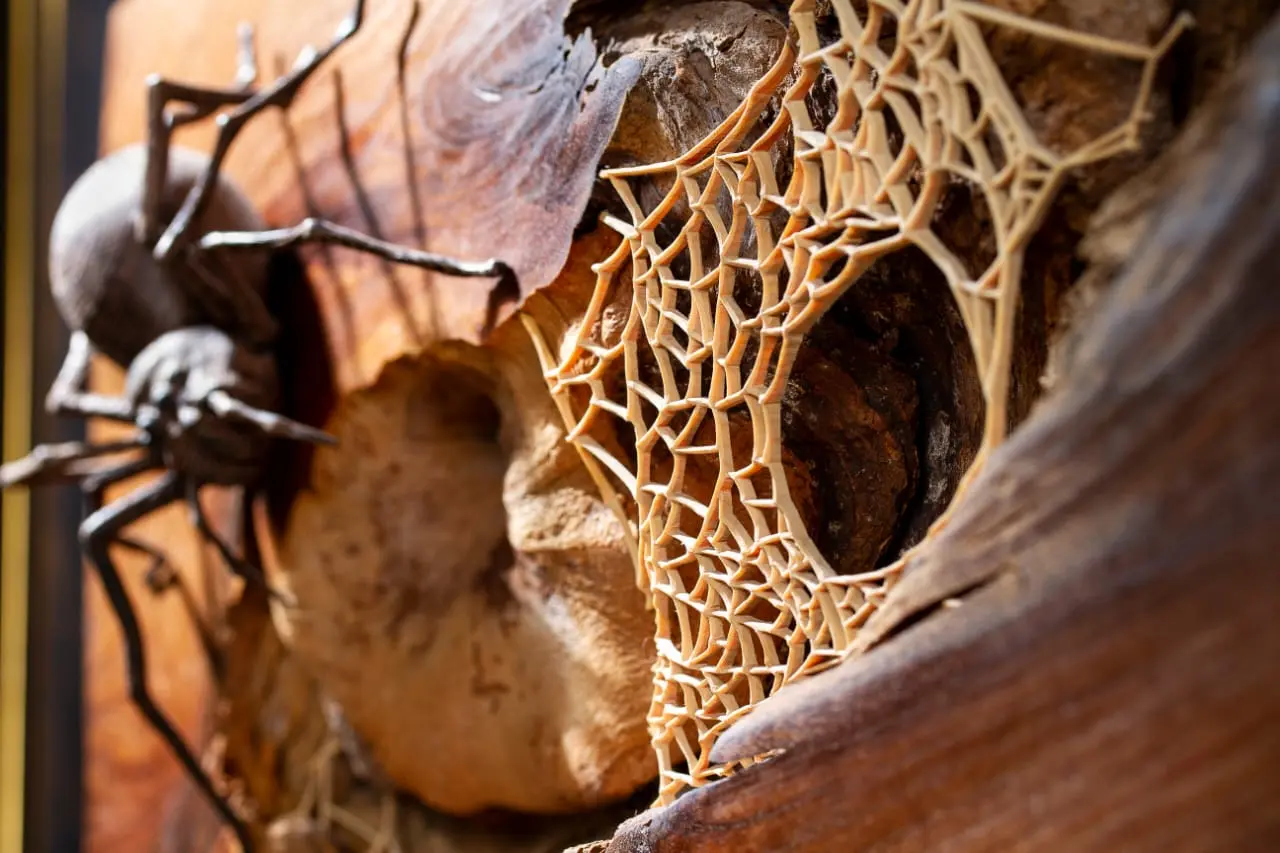
The spider web is the work’s principal linear and structural element. It consists of a network of fine, angular lines whose multiple connections create an asymmetrical, polygonal structure. Unlike the familiar image of a spider web, which generally follows a relatively regular radial pattern, this wooden network expands through space with greater freedom.
Here, line transcends its function as a drawing element and becomes material and volume. The intervals between the lines, the openings within the network, and the changing directions of its connections establish a distinct visual rhythm. Rather than producing disorder, this network introduces a secondary order into the composition through its relationship with the wood’s irregular forms.
5. Volume and Relief: Moving Beyond the Two-Dimensional Surface
Shadi Habib’s The Geometry of Survival cannot be regarded merely as a wooden image. Differences in the height of its elements, the raised form of the spider, the depth of the cavity, and the positioning of the web within the empty space bring the work closer to the realms of relief art and assemblage.
The central cavity functions as negative space: unlike an empty area in a painting, it possesses actual depth and material presence. The spider and the web, raised above the background surface, also cast shadows that enhance the work’s three-dimensional perception.
This relationship between positive and negative space is one of the work’s structural strengths. Empty space is not treated as an absence, but as an active component in the organization of form.
6. Color and Light: The Harmony of Natural Tones
The color palette of Shadi Habib’s The Geometry of Survival is largely confined to shades of brown, ochre, honey, gray, and black. This restrained palette allows greater attention to be directed toward variations in texture and structure.
The light color of the boxwood contrasts with the darkness of the wenge and the varied brown tones of the elm, creating a controlled chromatic tension. Light also plays an important role in distinguishing the different visual layers by revealing raised and recessed surfaces. Particularly within the cavity, variations in light and shadow help convey the depth and complexity of the wood’s natural texture.
7. Scale and Detail: The Importance of Delicacy Within the Overall Structure
Measuring 50 × 70 cm, the work occupies a relatively compact scale. Nevertheless, the proportions among its elements demonstrate Shadi Habib’s careful attention to internal relationships.
The spider, measuring 9 × 12 cm, and the web, measuring 10 × 13 cm, are proportioned so that neither overwhelms the overall composition nor becomes lost within the larger wooden support.
These proportions allow Habib to preserve the delicate details of the web and the spider’s structure alongside the expansive texture of the wood. In effect, the work operates through two different scales: the macro scale of the wooden support and the micro scale of its handcrafted details.
8. From Found Nature to Artistic Creation
One of the notable characteristics of Shadi Habib’s approach is her use of the material’s pre-existing potential. By selecting a piece of wood that already possesses its own distinctive cavity and natural structure, the artist begins with a form that has been partly shaped by nature itself. She then introduces additional wooden elements, establishing new relationships among the existing components.
In this process, the artist is neither entirely governed by the material nor does she bring it completely under the control of her own will. Instead, she establishes a balance between the wood’s natural characteristics and deliberate artistic intervention. This interaction gives the work a distinctive quality that lies between sculpture, assemblage, and nature-based art.
From this perspective, The Geometry of Survival exemplifies an aesthetic approach grounded in the discovery of the material’s hidden potential. The wood grain, cavity, relief, line, and network each become independent elements within a coherent visual language. Habib’s artistic achievement lies precisely in this ability to transform the material’s natural differences into a unified and meaningful structure without compromising the wood’s original identity and qualities.
- The Art Market and Prices of Shadi Habib’s Works
Shadi Habib (born 1986, Tehran) is an artist with an academic background whose professional practice has developed at the intersection of graphic design, handicrafts, and wood art.
She graduated in Graphic Design from Shariaty Technical and Vocational College, earned a bachelor’s degree in Handicrafts from Alzahra University, and received her master’s degree in Handicrafts from the University of Art in Isfahan. She also works as a university lecturer.
From an art-market perspective, Shadi Habib’s wooden works have been attracting growing interest. Their presence in museum and private collections, as well as their entry into auction markets, provides an increasingly visible record of her professional trajectory.
One of the most significant milestones in this development was her participation in the 25th Tehran Auction in 2026 with the wooden sculpture The Bird of Heaven, created in collaboration with Mohammadali Vadood. The work achieved a hammer price of 1.65 billion Iranian tomans, approximately $9,700. The piece had previously received recognition in the prestigious Italian A' Design Award competition in 2017.
The Abbasi Museum Gallery in the city of Arak also acquired one of Habib’s works in 2023 (1402 in the Iranian calendar) and subsequently put it on display.
Beyond these sales and acquisitions, Habib’s works are held in several collections, including the digital collection of an Italian museum, the Museum of the Research Institute of National Arts under Iran’s Ministry of Cultural Heritage, the Museum of Tabriz University of Art, and various private collections.
In recent years, Shadi Habib has received international titles and awards at art events in the United States and Italy.
In 2022, her work Centaur received the Best in Show award in the international ALL Figurative/Portrait competition, organized by Contemporary Art Gallery Online in the United States.
In January 2025, her work BIRDS’ BATTLEFIELD won Third Place in the 3 Dimensional category at the 14th All Women Art Exhibition, organized by Light Space & Time Online Art Gallery in the United States.
Her third-place achievements in two consecutive years, 2018 and 2019, at Italy’s international A' Design Award competition further underscore the international recognition of her artistic practice.
Shadi Habib holds a First-Grade Artistic Certificate in Sculpture and is a member of the Policy Council of Iran’s National Handicrafts Olympiad. She has also received first place and the First-Grade Medal in Wood Arts at Iran’s Shamseh Festival.
LEAVE A RELPY