
Roshanak Sattari and the UAE’s 54th Anniversary
Roshanak Sattari’s painting Awakened Time positions itself, both conceptually and structurally, in a dialogue between Modernism and Postmodernism—where the city is no longer a purely physical landscape but a geography of memory and collective consciousness. The symbolism of the clock and the watchful eyes continues the historical tradition of using emblems of power, time, and surveillance. Meanwhile, the modern architecture and nocturnal execution align the work with contemporary urban painting, while the use of artificial light and atmospheric reflections connects it to the light-based art of the past century.
ArtDayMe : On the occasion of the 54th National Day of the United Arab Emirates, Roshanak Sattari presents a symbolic and contemplative work—a visual narrative of a city that not only races forward but also sees.
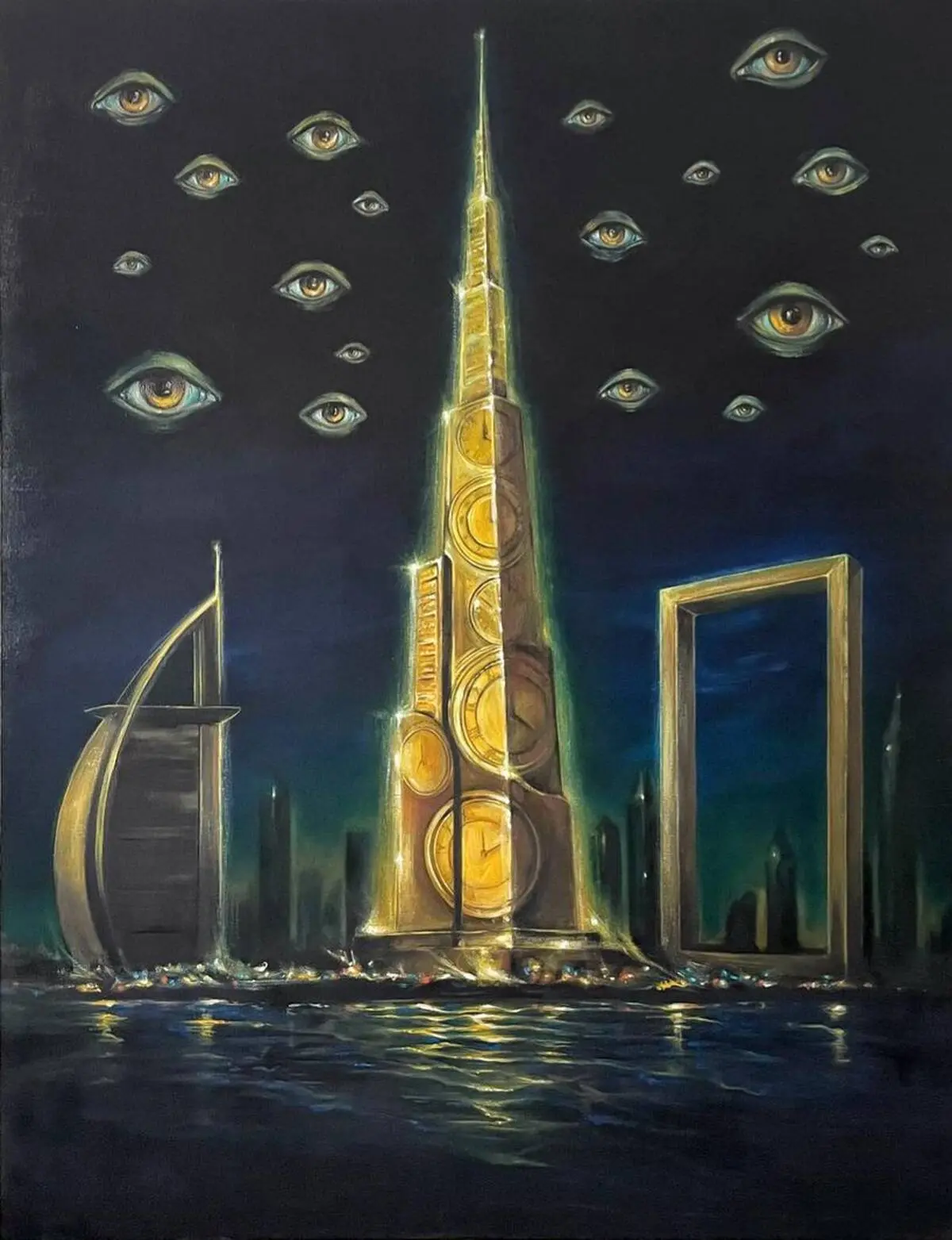
Titled Awakened Time, this 100 × 130 cm oil painting orchestrates an artistic dialogue among architecture, time, collective memory, and urban consciousness within a nocturnal world shimmering with awe.
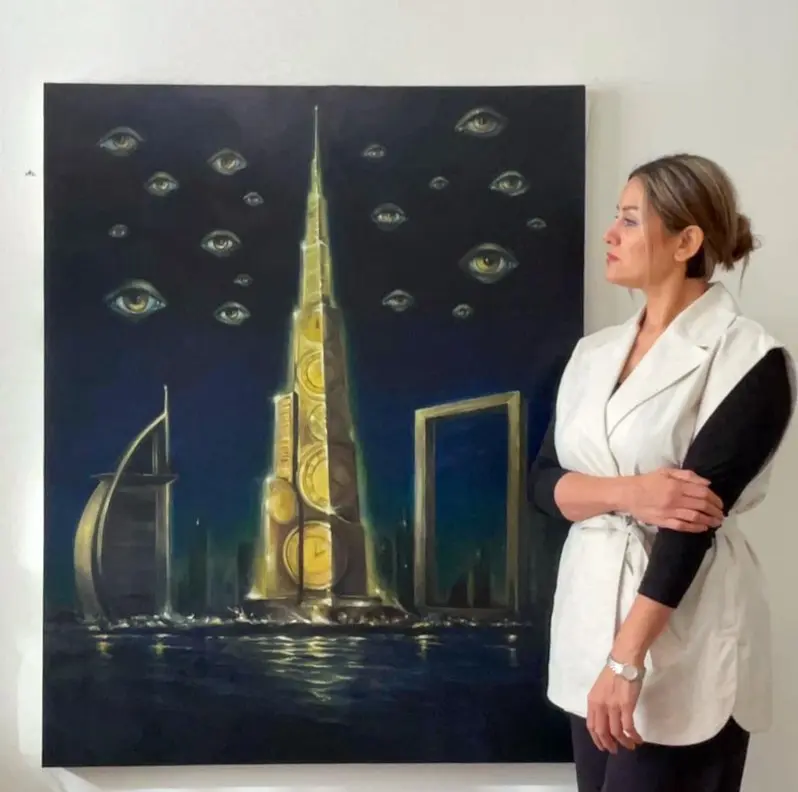
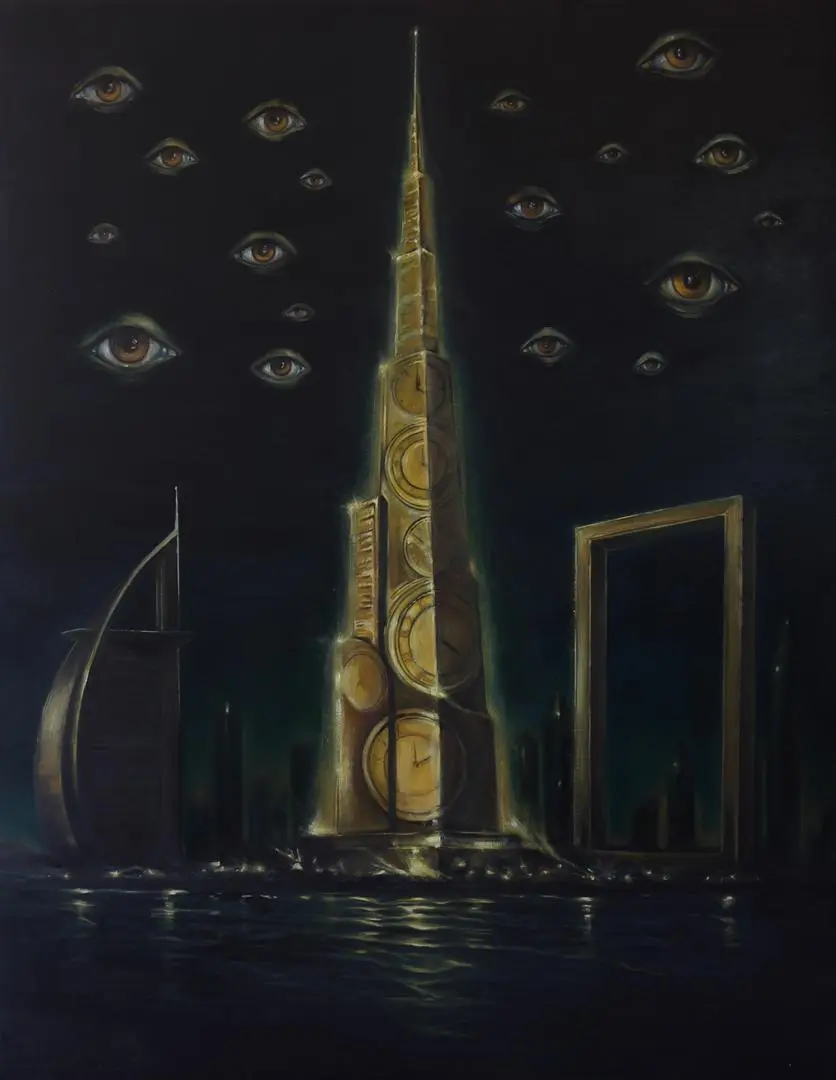
At the heart of the composition lies a modern city—familiar yet surreal—unfolding before the viewer’s eyes. Rather than merely representing technological advancement, the city is portrayed as a living, sentient organism. Focusing on the themes of time, power, and collective memory, Sattari depicts Dubai as an entity for which night does not signify rest but the moment of awakening and watchfulness. The monumental central tower—shaped like a clock—becomes the focal point to which everything ultimately returns. It is not merely an architectural structure but a symbol of authority, endurance, and the omnipresent gaze of time itself. Here, time does not merely pass; it observes.
The painting’s palette is dominated by shades of blue, silver, and cool tonalities—luminous colors that fuse technology, nighttime stillness, and artificial light. These hues give the work a reflective, fluid quality, as though the city were built from light itself. Soft, flowing reflections on the water narrate the passage of time like a gentle wave, guiding the viewer back toward the clock tower and its “suspended eyes.”
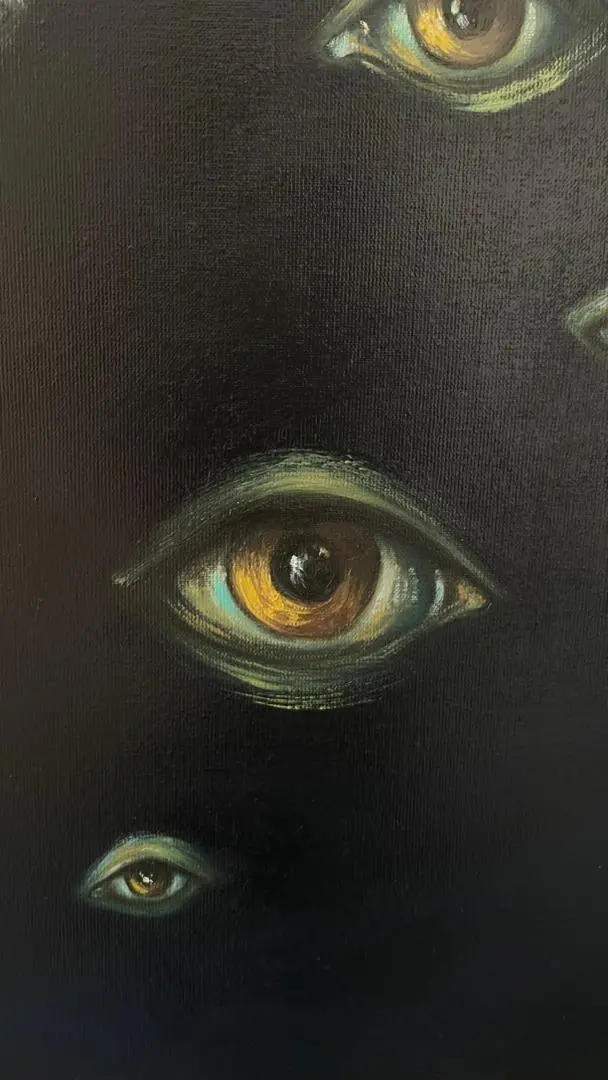
One of the work’s most striking features is these hovering eyes in the sky—symbols that introduce a conceptual and even mythic dimension to the painting. They may signify collective awareness, evoke the perpetual surveillance of modern life, or serve as metaphors for an urban memory that never sleeps. Their pervasive presence transforms the city from a physical environment into a symbolic habitat—where “wakefulness” becomes a defining law.
The clock tower at the center functions as the visual and conceptual axis. The disciplined, geometric lines of the buildings—rendered with fine, controlled brushwork—evoke the rhythm of a contemporary metropolis. Meanwhile, the lights and reflections create a fluid visual cadence, suspending the viewer between architectural solidity and the motion of time. The water’s surface adds yet another dimension: the city reflecting upon itself becomes a secondary narrative, a visual conversation with time.
The choice of oil painting is particularly astute. Through precise, layered application, Sattari allows light to breathe across the canvas with a vivid, shimmering presence. The gloss, clarity, and atmospheric depth are achieved through expert layering and tonal control. The reflections are executed with exceptional precision, strengthening the dreamlike-yet-real urban atmosphere. This technique not only enhances the work’s visual richness but also reinforces the concept of “awakening” as a visual identity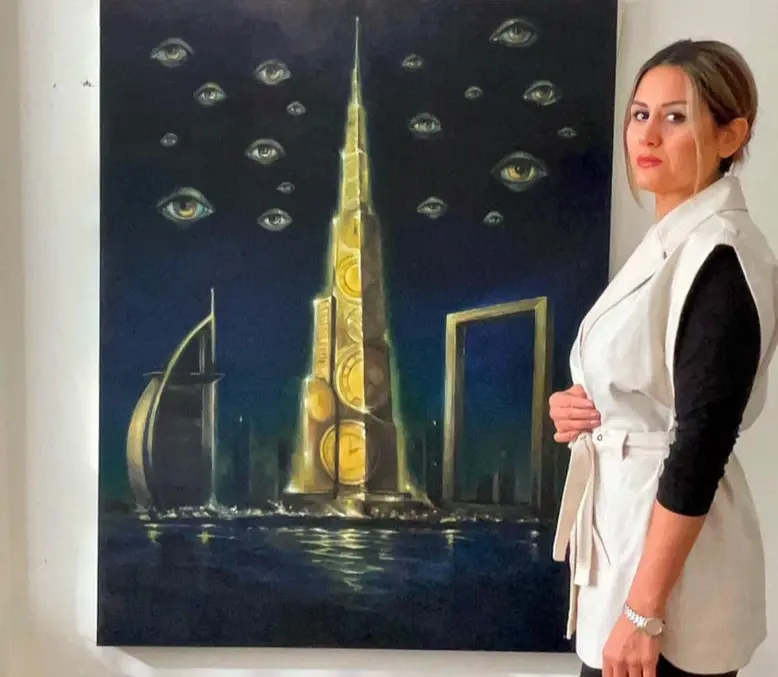
Awakened Time, both conceptually and structurally, engages in a dialogue between Modernism and Postmodernism—where the city is no longer a mere physical site but a landscape shaped by thought and collective memory. Its symbolic use of clocks and eyes ties it to historical iconography of time, power, and vigilance; its modern architecture and nocturnal setting situate it within the current of contemporary urban painting; and its use of artificial illumination places it in conversation with light-based art of the last century.
Ultimately, Roshanak Sattari’s Awakened Time is more than an urban painting—it is a mirror that reinterprets Dubai as a forward-looking metropolis, imagined as a watchful, wakeful being. Here, time becomes corporeal, eyes become memory, and architecture becomes narrative. This artwork is not only significant within the framework of the UAE’s 54th National Day but also valuable for understanding the aesthetics and psychology of modern cities.
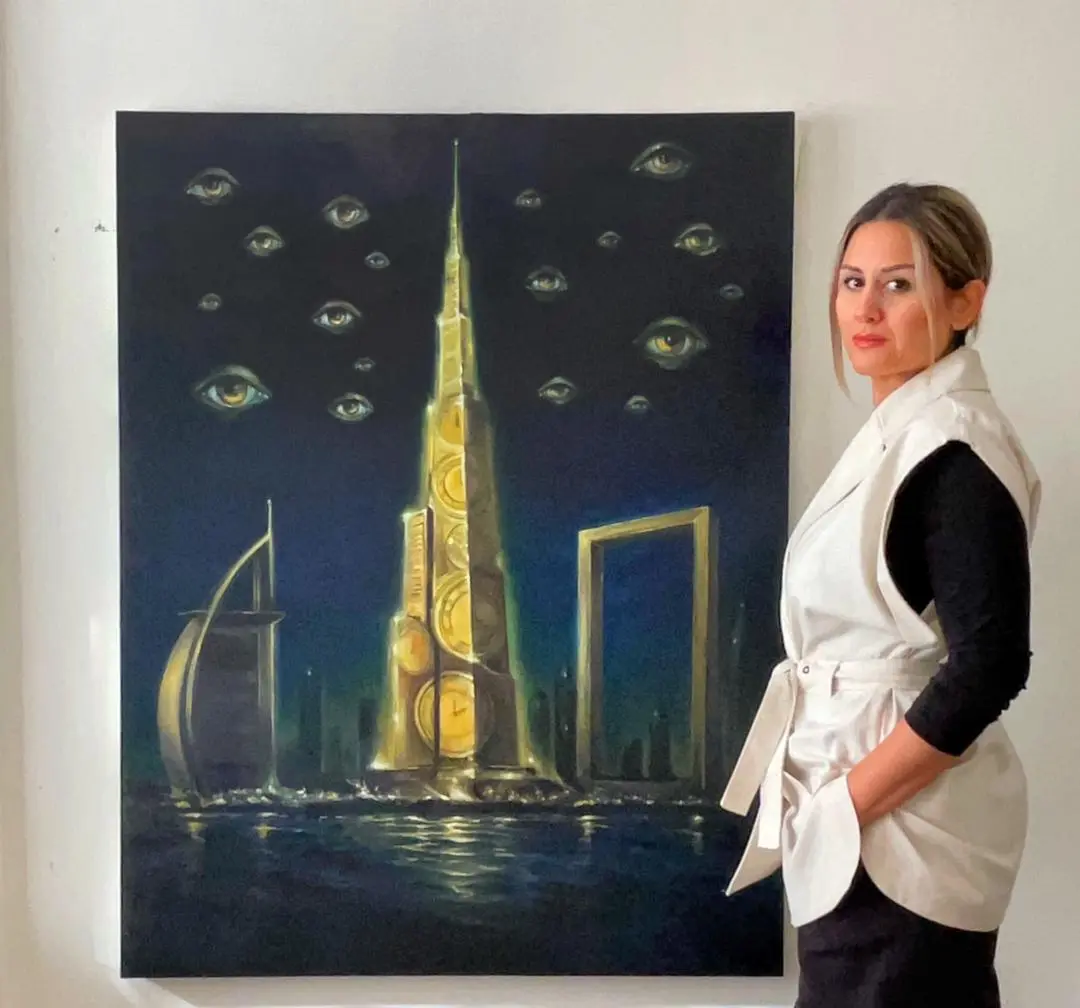
Artist Biography — Roshanak Sattari
Born in Tehran in 1979, Roshanak Sattari has been working professionally as a painter for more than two decades. She completed her academic studies in Graphic Design and has benefited from the guidance of several prominent masters of painting and drawing.
Throughout her artistic career, Sattari has participated in numerous group exhibitions both in Iran and internationally, including shows at Atashzad Gallery, Shirazi Gallery, and various exhibitions across East Asia.
She has also taught drawing and painting in Iran and abroad, taking part in multiple domestic and international workshops—particularly in Thailand. In her works, she often incorporates Iranian lines, motifs, and visual elements alongside figurative forms, consistently seeking innovative connections between tradition and modernity.
LEAVE A RELPY