
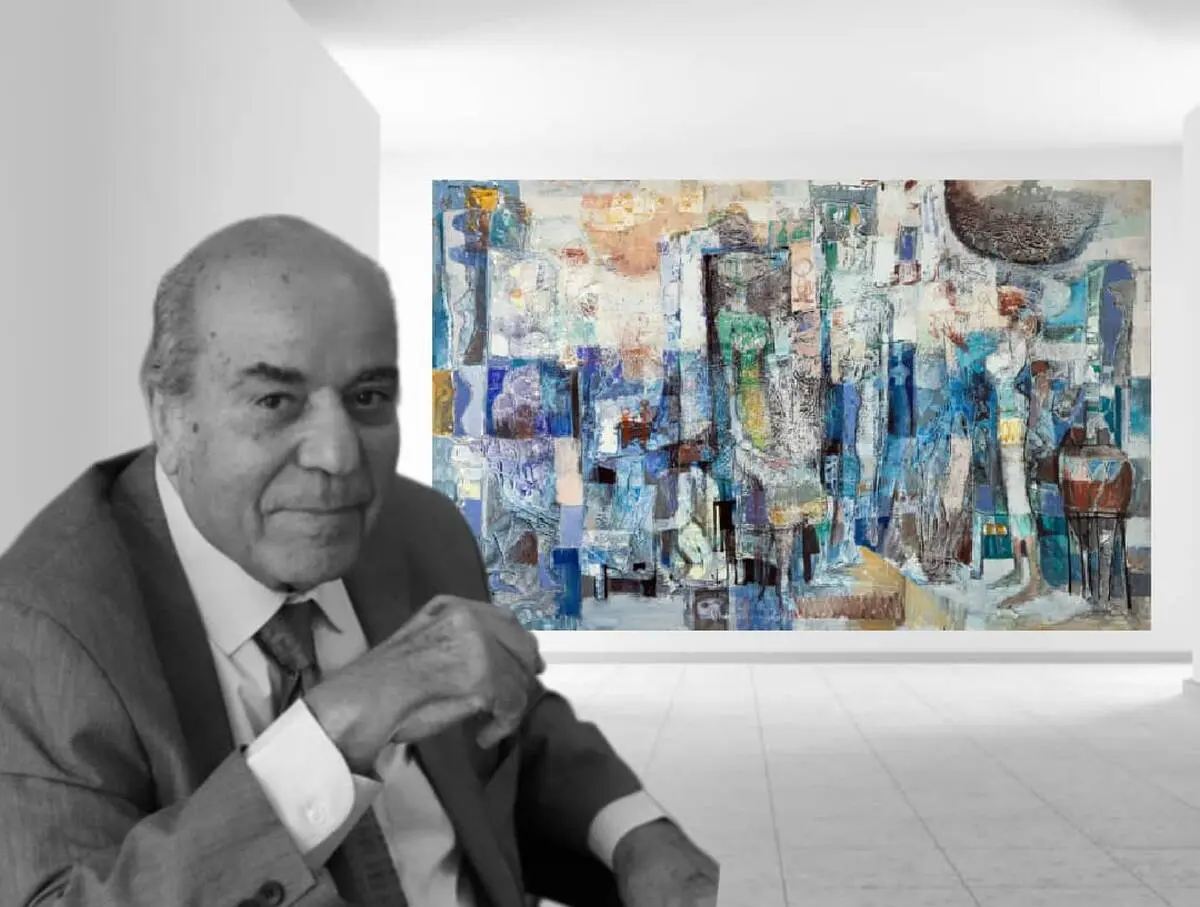
Omar El-Nagdi and La Pharaonne in the Raha Gallery Collection
Omar El-Nagdi’s painting La Pharaonne forms a bridge between Pharaonic mythology, contemporary reality, and the shared global concerns of humanity. One of the most compelling ironies in this master painter’s approach is his deliberate choice of the title La Pharaonne—“The Pharaoh’s Lady”—instead of the Pharaoh himself. This choice offers a subtle yet pointed critique of the patriarchal narratives of official history, while foregrounding the fundamental role of women in the continuity of civilization and identity.
ArtDayME: For more than two decades, the Raha Gallery Collection has maintained a sustained cultural presence with a focus on elevating art from the region, preserving a diverse range of modernist and contemporary masterpieces by Iranian and Arab artists.
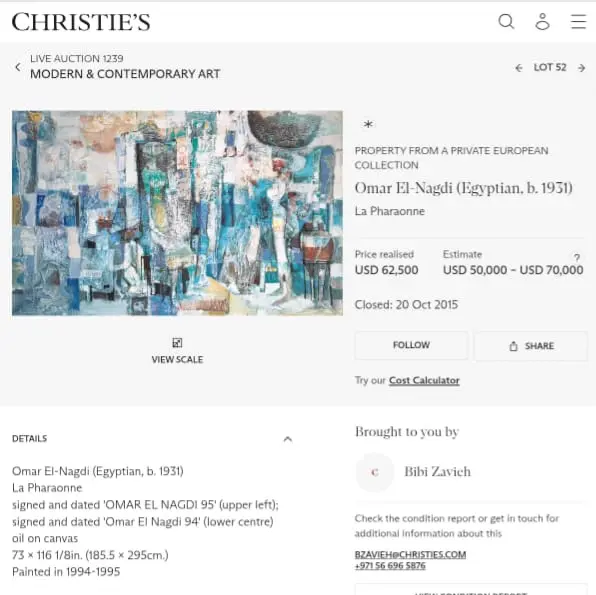
One of the key works in this collection is La Pharaonne by Omar El-Nagdi (1931–2019), the renowned Egyptian artist. Created in 1995 in oil on canvas, the painting measures an impressive 295 × 185 cm and was sold at Christie’s in 2015. This work not only represents El-Nagdi’s distinctive visual language, but also offers a profound reflection on the relationship between humanity, history, and collective memory within modern Egyptian and Middle Eastern art.
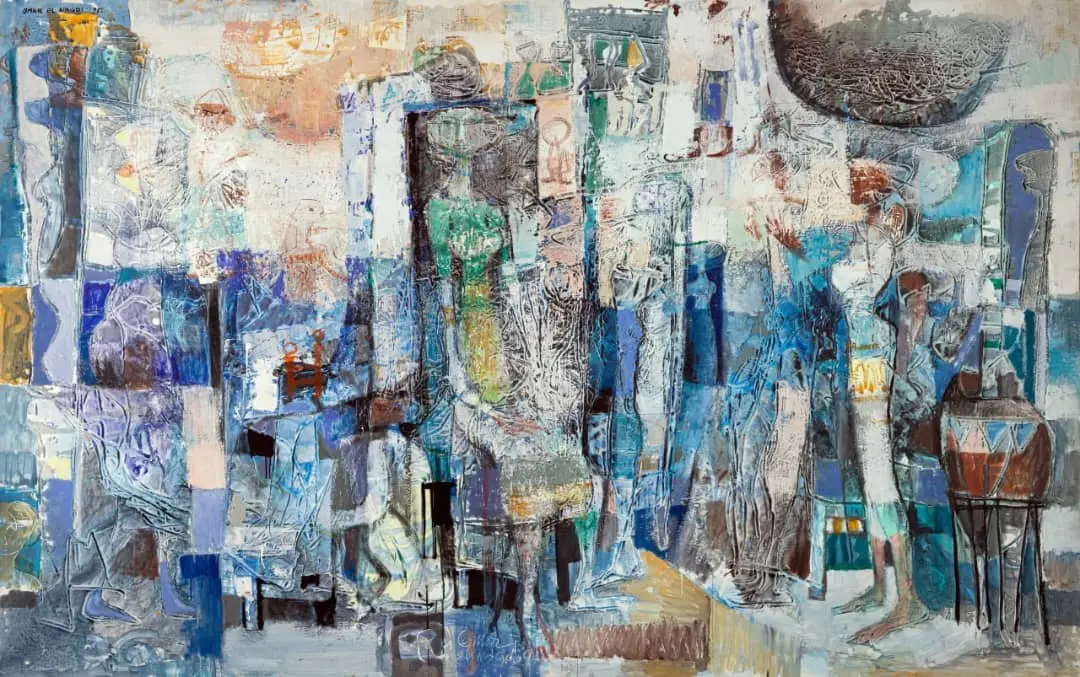
At first glance, the composition unfolds through a vertical, rhythmic structure: standing columns that evoke human figures, ritual processions, or signs of collective presence. These vertical forms, alongside fractured horizontal planes and dense layers of paint, create a space suspended between stillness and movement.
Omar El-Nagdi avoids the direct depiction of faces or bodies, reducing figures to human signs—faceless and indistinct presences that convey a collective experience rather than individual identity.
The color palette is grounded in cool tones of blue, turquoise, and gray, punctuated by areas of brown, ochre, and broken white. This chromatic range conveys a sense of ancient endurance, historical melancholy, and the passage of time. Here, color is not decorative but semantic; each layer of paint settles onto the canvas like a stratum of memory, experience, and history. Rough textures, scratches, erasures, and raised surfaces transform the painting into a physical field in which time and the artist’s gesture are visibly inscribed.
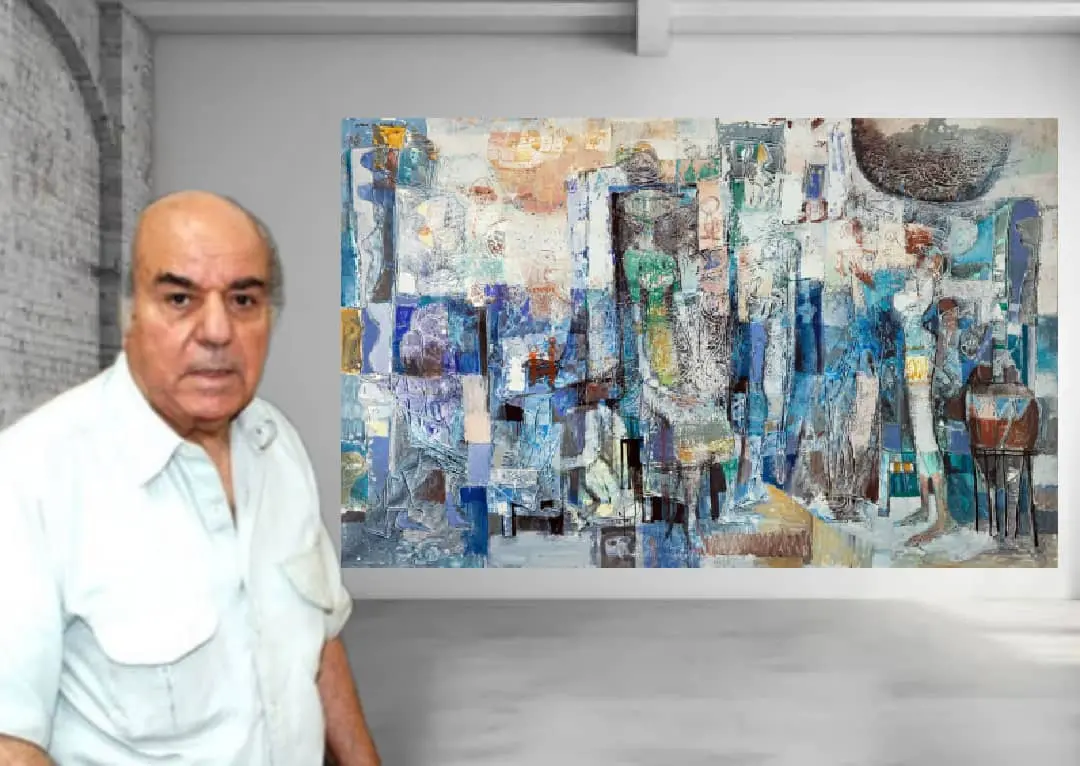
Yet it is the title La Pharaonne that adds a decisive layer to the reading of the work, pushing its meaning beyond pure abstraction. Through this title, the painting directly engages with the civilizational legacy of ancient Egypt and the concept of woman as a bearer of power, history, and continuity.
The “Pharaoh’s Lady” is not a single figure, but an allegory of Egypt itself—a land that, like a historical mother, has safeguarded memory, authority, and civilizational identity for centuries.
Within this interpretation, the upright, ritualistic forms recall the static postures of Pharaonic statues and reliefs—bodies in which time appears frozen, yet meaning continues to flow. The intentionally weathered textures and dense layers of paint align with this reading, functioning as metaphors for temple walls, inscriptions, and ancient monuments: surfaces eroded by time but still charged with power and memory.
El-Nagdi’s conscious choice of La Pharaonne rather than the Pharaoh himself also articulates a critical stance toward patriarchal historical narratives, highlighting the concealed yet essential role of women in sustaining civilization and identity.
This perspective is fully consistent with Omar El-Nagdi’s historical position. He is regarded as one of the central figures of modern Egyptian art—an artist who moved beyond social realism toward an abstract, sign-based, and texture-driven language, bringing Egyptian painting into dialogue with global modernism. El-Nagdi’s works consistently operate at the intersection of humanity, history, and social structures, offering not direct narratives but poetic and philosophical reflections on the condition of contemporary human beings.
In the art market, Omar El-Nagdi’s name holds a firmly established position. Over the past two decades, his works have appeared regularly in international auctions, particularly at Christie’s. His large-scale paintings from the 1980s and 1990s have attracted the greatest attention from collectors and are widely regarded as having museum-level quality. La Pharaonne, held in the Raha Gallery Collection, can thus be understood as a multilayered and contemplative work—one in which abstraction becomes a language of history, and the human figure transforms into a sign of collective memory.
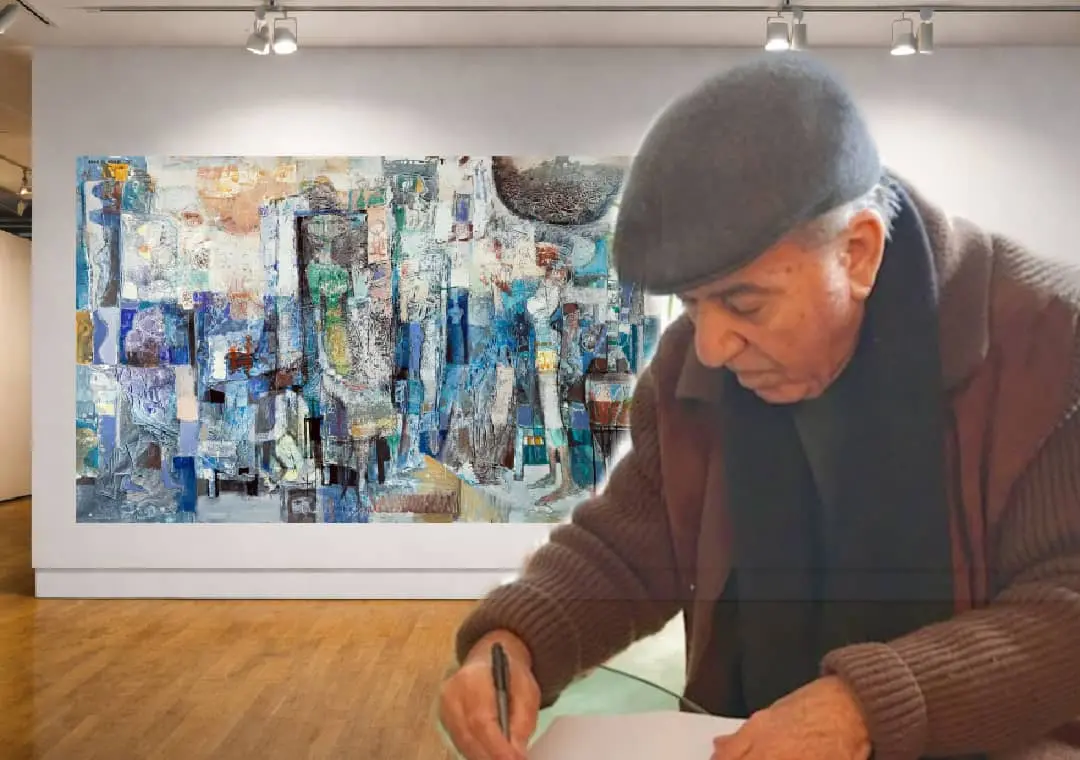
This painting stands as a bridge between Pharaonic myth, contemporary reality, and the universal concerns of humanity—a bridge that firmly establishes Omar El-Nagdi’s position as one of the key figures of modern art in Egypt and the Middle East.
The work belongs to the Middle Eastern collection of Raha Gallery.
LEAVE A RELPY