
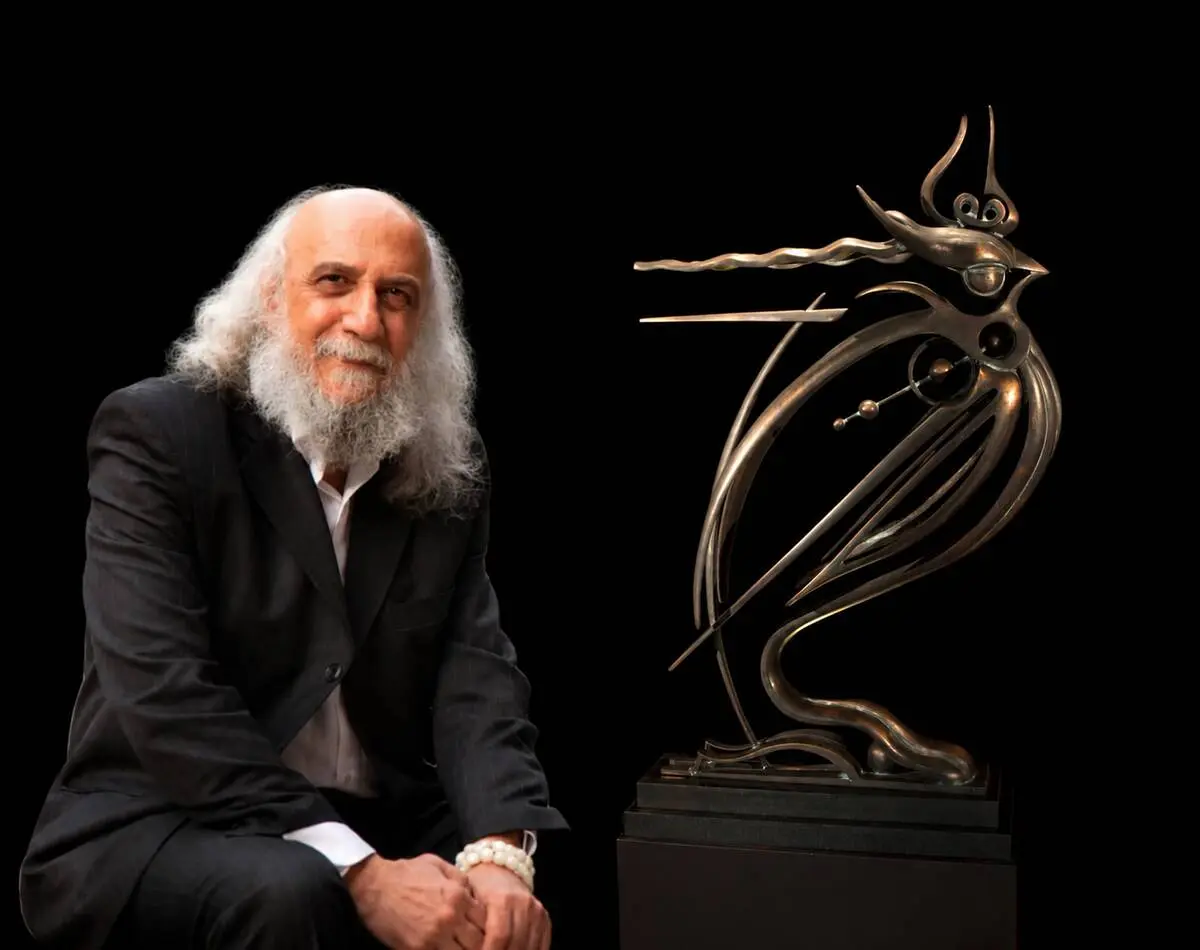
Taha Behbahani’s Work in the Raha Gallery Collection_ A Meaning-Driven Sculpture with a Musical Rhythm
Taha Behbahani’s works invite viewers to contemplate concepts such as creation, spiritual journey, the mystery of existence, and the relationship between human beings, themselves, and the world. Through floating lines, carefully measured negative spaces, and a musical rhythm, his sculptures embody not only physical form, but also energy and movement. Taha’s work has succeeded in connecting the mystical vision and aesthetic traditions of Iran with a contemporary, universal language.
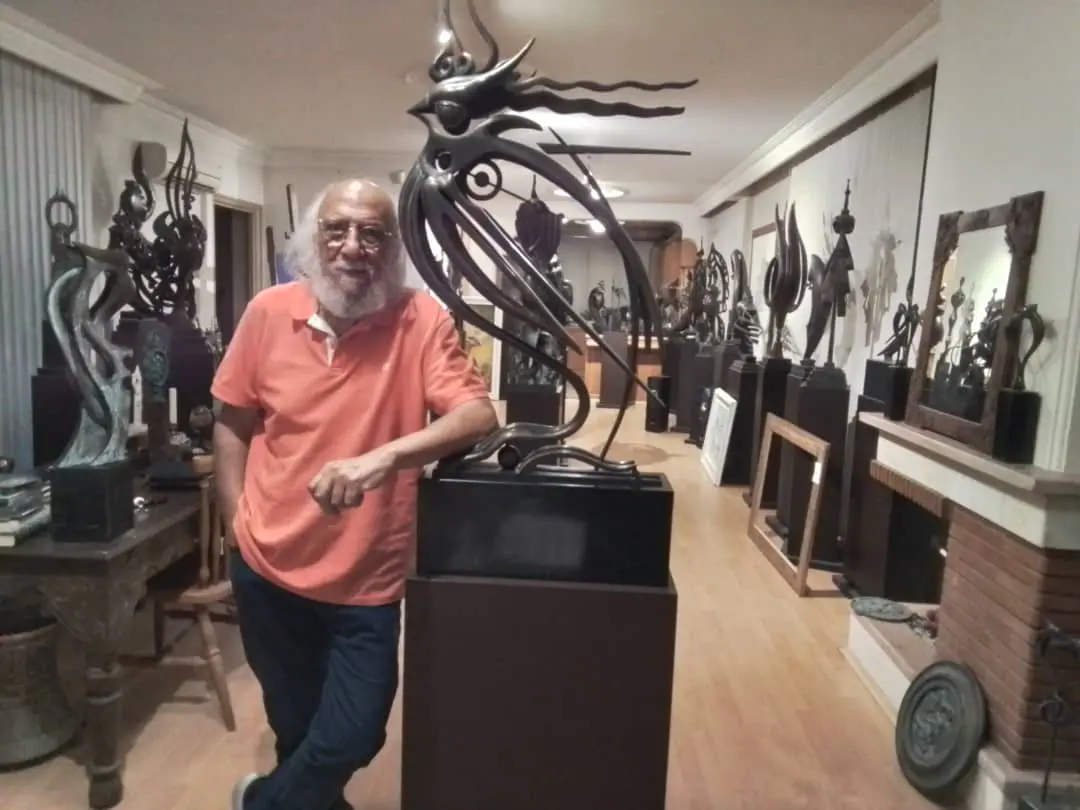
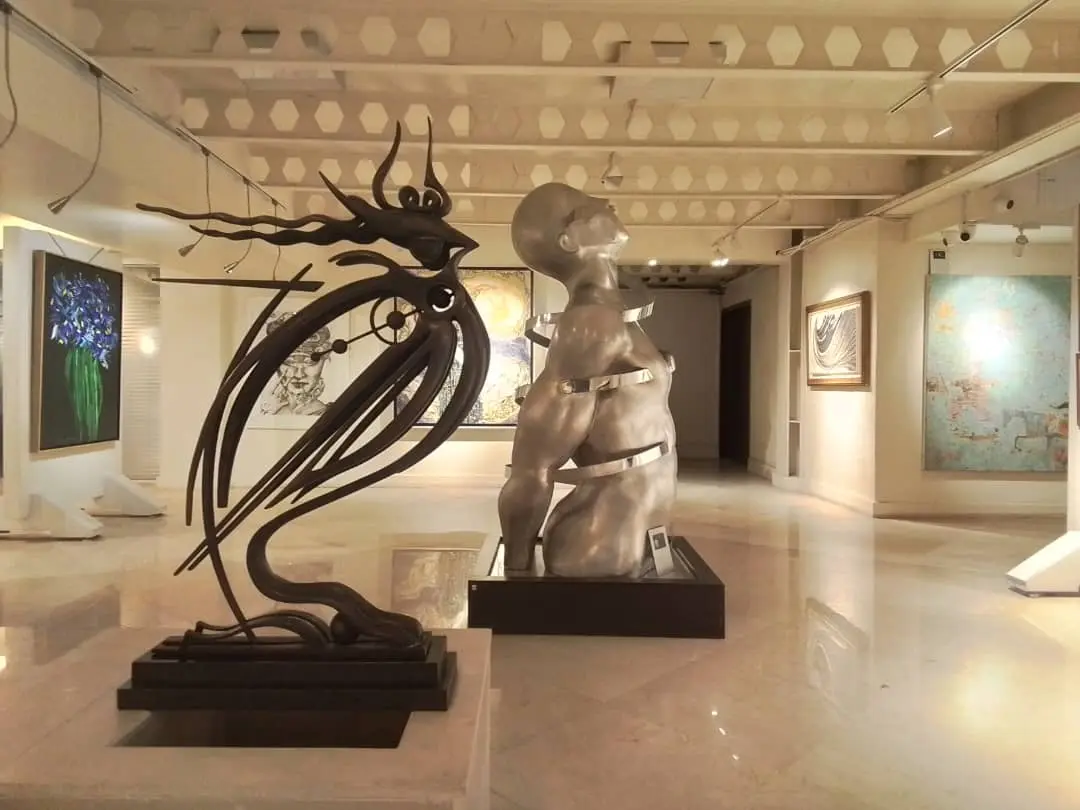
ArtDayMe : Founded and managed by engineer Mohammadreza Ghaemmaghami, the Raha Gallery Collection has maintained continuous cultural activity for more than two decades, with a focus on advancing the arts of the region. The collection preserves a diverse range of modernist and contemporary masterpieces by Iranian and Arab artists.
Among these works is a beautiful and enduring sculpture by master artist
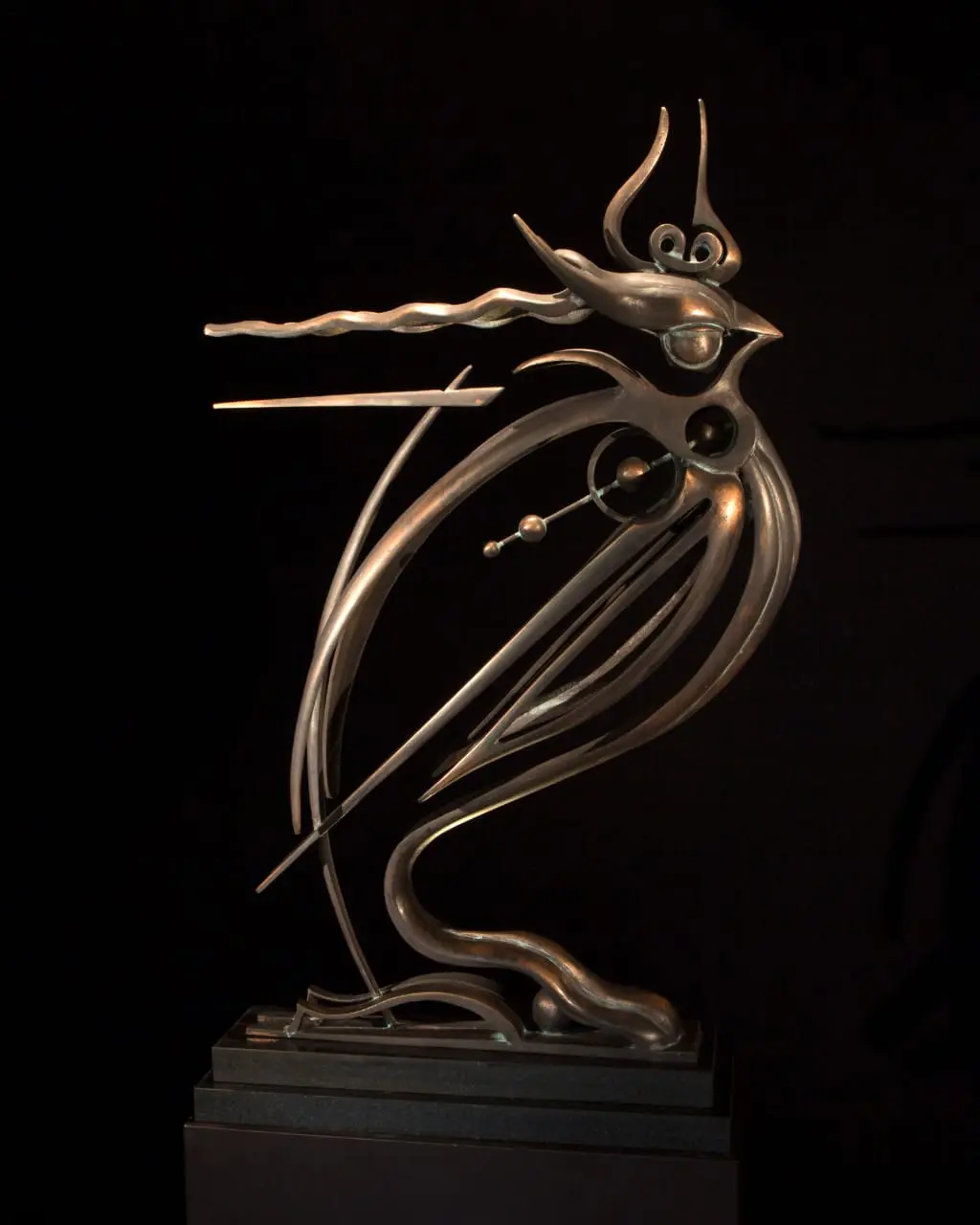
Taha Behbahani, titled “My Crown Is from ‘Hoo’; I Am the Confidant of His Secrets.” Created in 2016 using the bronze technique, the sculpture measures 57 × 96 × 17 cm.
Born in Tehran in 1947, Taha Behbahani is one of the prominent figures of contemporary Iranian art. Over several decades of sustained activity, he has made significant contributions to painting, sculpture, filmmaking, research, and writing.
Rather than simply representing the visible world, his works search for the unseen layers of existence, mythology, mysticism, the cultural memory of Iran, and the broader heritage of human civilization.
Drawing on elements of calligraphy, ancient Iranian symbols, and an abstract visual language, Behbahani creates a world in which the boundaries between human beings, nature, the cosmos, and the sacred are dissolved. In his sculptures, the line is lifted from the surface of paper and transformed into a living, dynamic volume charged with meaning.
In Taha Behbahani’s artistic language, form is never merely an aesthetic structure; it carries meaning and embodies an intuitive experience. His works invite viewers to contemplate such concepts as creation, spiritual journey, mystery, time, and humanity’s relationship with existence. Through floating lines, carefully considered negative spaces, and a musical rhythm, his sculptures embody not only the physical body, but also energy and movement.
For this reason, Behbahani occupies a distinctive position in contemporary Iranian sculpture: he is an artist who has succeeded in connecting Iran’s mystical vision and aesthetic traditions with a universal and contemporary language. This is also why, alongside the reception his works have received at auction houses, his works are preserved in the collections of at least 45 prominent collectors in Iran, France, Germany, the Netherlands, Japan, the United Kingdom, New Zealand, the United States, Switzerland, Belgium, the United Arab Emirates, and elsewhere.
_A Different Reading of Art
The sculpture “My Crown Is from ‘Hoo’; I Am the Confidant of His Secrets,” preserved in the Raha Gallery Collection in the Middle East, can be regarded as one of the most compelling expressions of Taha Behbahani’s distinctive worldview. It is a work that transforms metal into poetry, line into volume, and stillness into perpetual movement—a sculpture that, rather than simply being seen, must be experienced through silence, contemplation, and intuition. It is for this reason that art theorists have acknowledged Behbahani’s achievement in developing a distinct personal artistic language.
It is a language focused not on representing the external world, but on depicting the inner world, mystical intuition, and the metaphysical dimension of the human being.
The title of the work is itself the first key to entering its semantic universe.
The word “Hoo” here refers to the mystical invocation of God in the Iranian Sufi tradition. Accordingly, the most appropriate Persian rendering of the title is:
“My Crown Is from Hoo; I Am the Confidant of His Secrets.”
The title is not merely the name of the work; it is a condensed expression of the artist’s worldview.
_A Being Between Boundaries
At first encounter, the sculpture is neither human nor bird, nor a mythological creature in any conventional sense. Rather, it moves along the boundary between all of these forms. It is as though the artist has created a mythological being with a mystical spirit: a presence that simultaneously contains human, avian, and cosmic qualities, and belongs to a world beyond objective reality.
This quality brings the work close to the realms of metaphysical and Surrealist art—the very style identified on the work’s certificate of authenticity as “Surrealistic Metaphysic.”
_The Artist’s Account of “Hoo”
In a media interview, Taha Behbahani spoke about his interpretation of “Hoo,” a motif that appears prominently in numerous works:
“The sounds that emerge from the human throat under particular circumstances and in specific moments reveal unforeseen emotions—such as a sigh or an exclamation. ‘Hoo,’ too, is an exhalation that rises from within at moments of supplication, need, gratitude, or thanksgiving.
‘Hoo’ is the sign of the ever-present third person.
‘Hoo’ is the sign of Him.
He who is the source of all creativity; He who endures and remains.”
_Form as a Catalyst
Form is not an end in itself in Taha’s work. Yet he consciously creates distinctive forms in order to attract the viewer’s gaze and guide the viewer toward the meaning he seeks to evoke. It is from this perspective that the greatest achievement of this sculpture lies in its form.
Rather than defining volume through heavy masses, Taha Behbahani creates volume through the movement of lines. There is no enclosed, solid mass in the work. What the viewer encounters is a network of fluid, flowing lines moving through space and shaping volume through that movement.
In essence, this is less a sculpture of mass than a sculpture of flow.
_ Line and Connection
Line is the most important visual element in the work. The entire structure of the sculpture is built from lines, and these lines do not merely function as boundaries between objects; they become the very body of the work.
The soft curves, elongated gestures, and continuity of the forms recall the movement of the pen in Iranian calligraphy, particularly Nastaʿlīq. It is as though the artist has lifted calligraphy from the surface of paper and written it in three-dimensional space.
This quality is one of the most distinctive signatures of Taha Behbahani’s artistic language.
At the same time, a viewer familiar with Iranian literature, seeing Taha’s persistent emphasis on the presence of line in his works, might be reminded of the ancient Persian expression “khat-o-rabt”—a phrase that evokes human identity and nature.
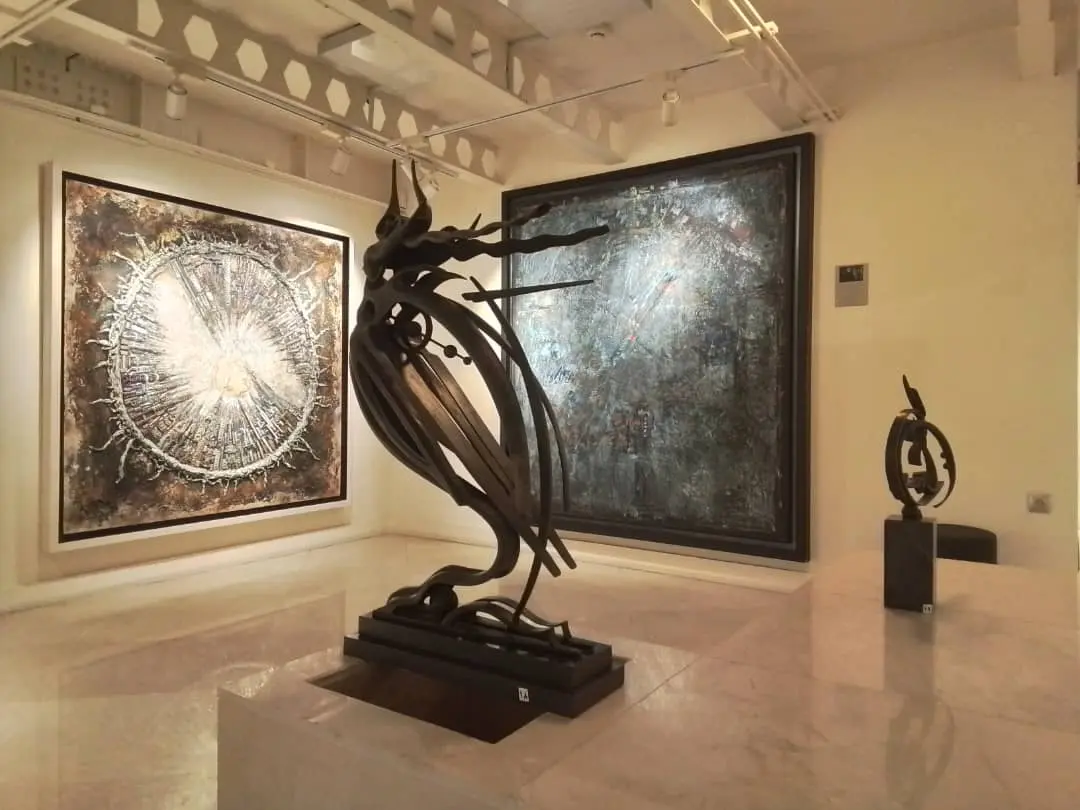
_The Air Is Here, Too
In this sculpture, empty space is as important as the figure itself. Air exists between the lines, and this negative space becomes a fundamental component of the form.
In effect, the artist has sculpted not only metal, but air as well.
This approach represents one of the major achievements of modern sculpture, in which emptiness becomes part of the body of the work rather than merely the space between its components.
The balance of the sculpture is equally carefully conceived. Although the work initially appears light and almost suspended, its principal weight is concentrated in the base. The elongated and curved lines create both visual and structural equilibrium, conveying a sense of stability to the viewer.
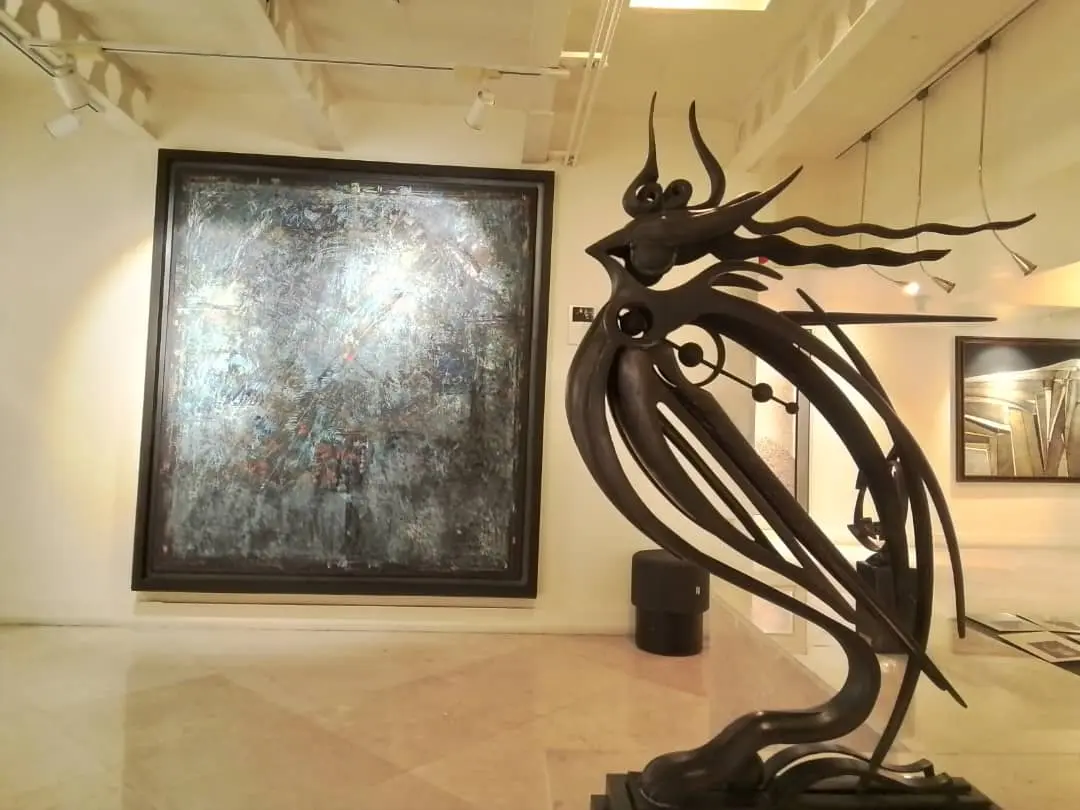
_The Sculpture’s Musical Rhythm
Rhythm is another fundamental element of the sculpture “My Crown Is from ‘Hoo’; I Am the Confidant of His Secrets,” preserved in the Raha Gallery Collection in the Middle East. No line is entirely still.
Every line—even the most direct—contains a degree of vibration and movement. This continuous rhythm gives the sculpture a musical quality and guides the viewer’s gaze throughout the work.
As a result, the sculpture never appears entirely static. It is as though a being is moving through the wind—or passing from one world into another.
Light and Shadow
Light plays a fundamental role in experiencing this work. The shadows cast by the lines onto the surrounding surfaces are almost as important as the sculpture itself.
Behbahani has not designed only the metallic form; he has also transformed its shadow into part of the work. On one level, this quality places his work in dialogue with important currents in modern sculpture; on another, it points toward the realm of meaning and the intellectual concerns that lie at the heart of his artistic practice.
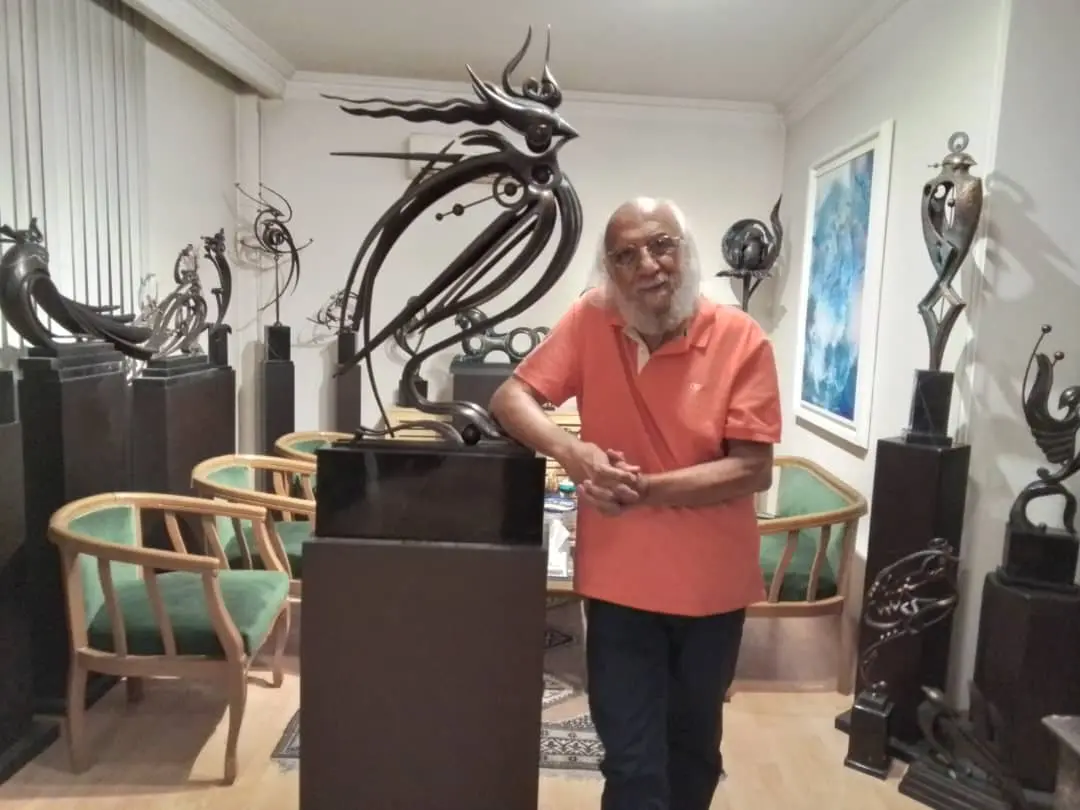
_Mystical References
From a symbolic perspective, the sculpture is rich in mystical references.
The “crown” here is not a symbol of worldly power, but an emblem of knowledge and illumination.
The upward-reaching forms may evoke flames, the letter “alef,” or an ascending movement toward the sacred.
The large eye suggests intuition and inner vision, while the orbital and spherical elements at the center of the figure evoke an image of the cosmos and the concept of the human being as the “microcosm”—ʿālam al-saghīr.
Even the continuous horizontal line running through the middle of the work may be understood as a boundary between the material and spiritual worlds.
The proportions of the figure have also consciously departed from nature. Its elongated and exaggerated body, rather than adhering to human anatomy, expresses transcendence, ascent, and liberation from earthly gravity.
What is particularly fascinating is that, despite the sharp and elongated lines, the overall expression of the work remains calm, poetic, and filled with delicacy—as though energy is flowing through it.
From a technical perspective, the execution of such a work requires considerable skill. The construction of slender lines, the preservation of structural strength, the creation of balance, and the precise joining of the elements in bronze all demonstrate the artist’s mastery of the possibilities of the material.
The choice of bronze is equally considered: a metal that provides the necessary strength for this delicate structure while also enhancing the poetic quality of the work through its soft reflection of light.
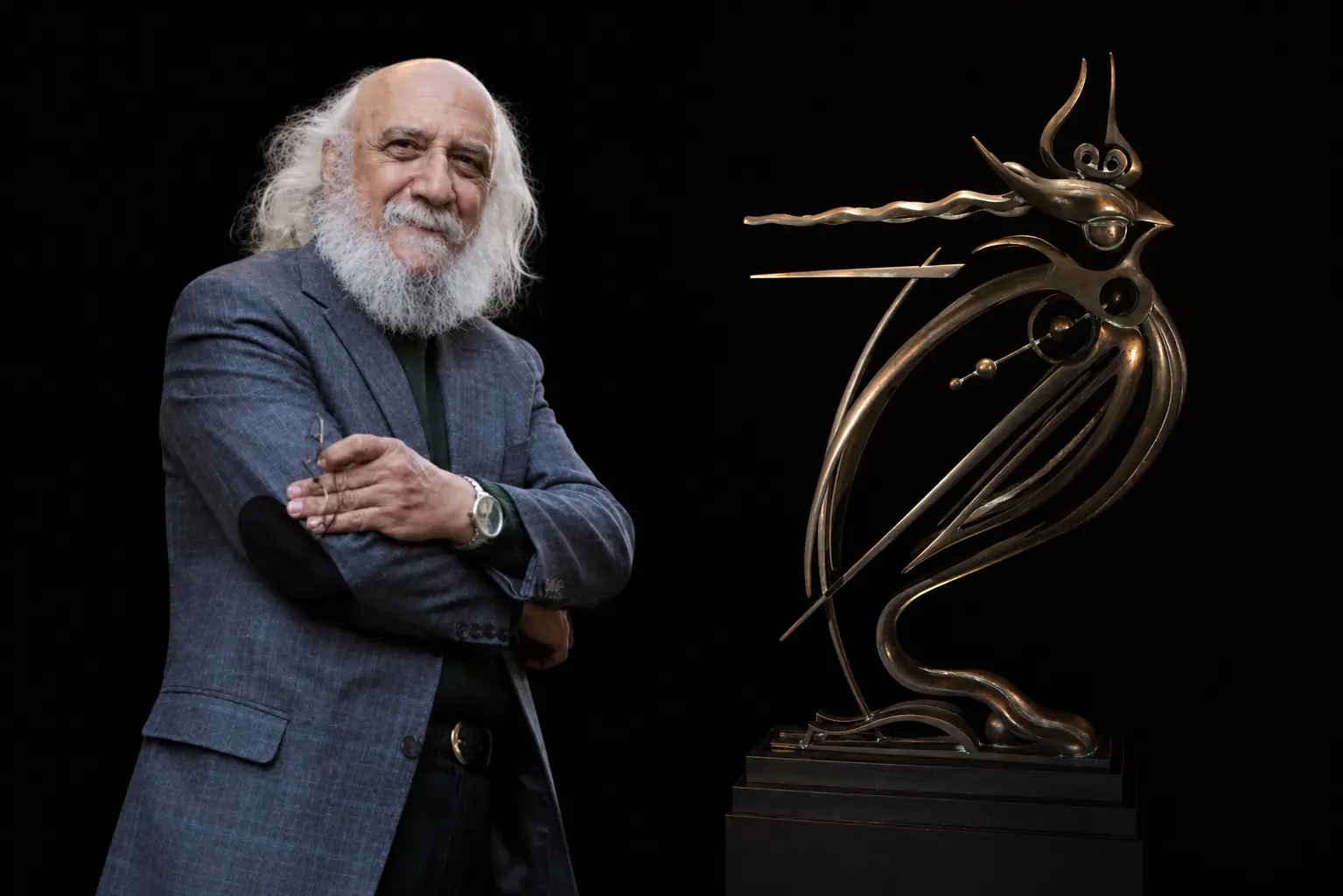
_Taha and an Independent Artistic Language
The sculpture “My Crown Is from ‘Hoo’; I Am the Confidant of His Secrets,” preserved in the Raha Gallery Collection in the Middle East, brings together many of the principal elements of Taha Behbahani’s artistic language: from three-dimensional calligraphy and mythological beings to Iranian mysticism, the metaphysical realm, fluid movement, the elimination of heavy masses, and the connection between the human being, the bird, and the cosmos.
These qualities make the work identifiable with the artist even without his signature—a clear indication of the formation of a distinct and independent visual language.
LEAVE A RELPY