
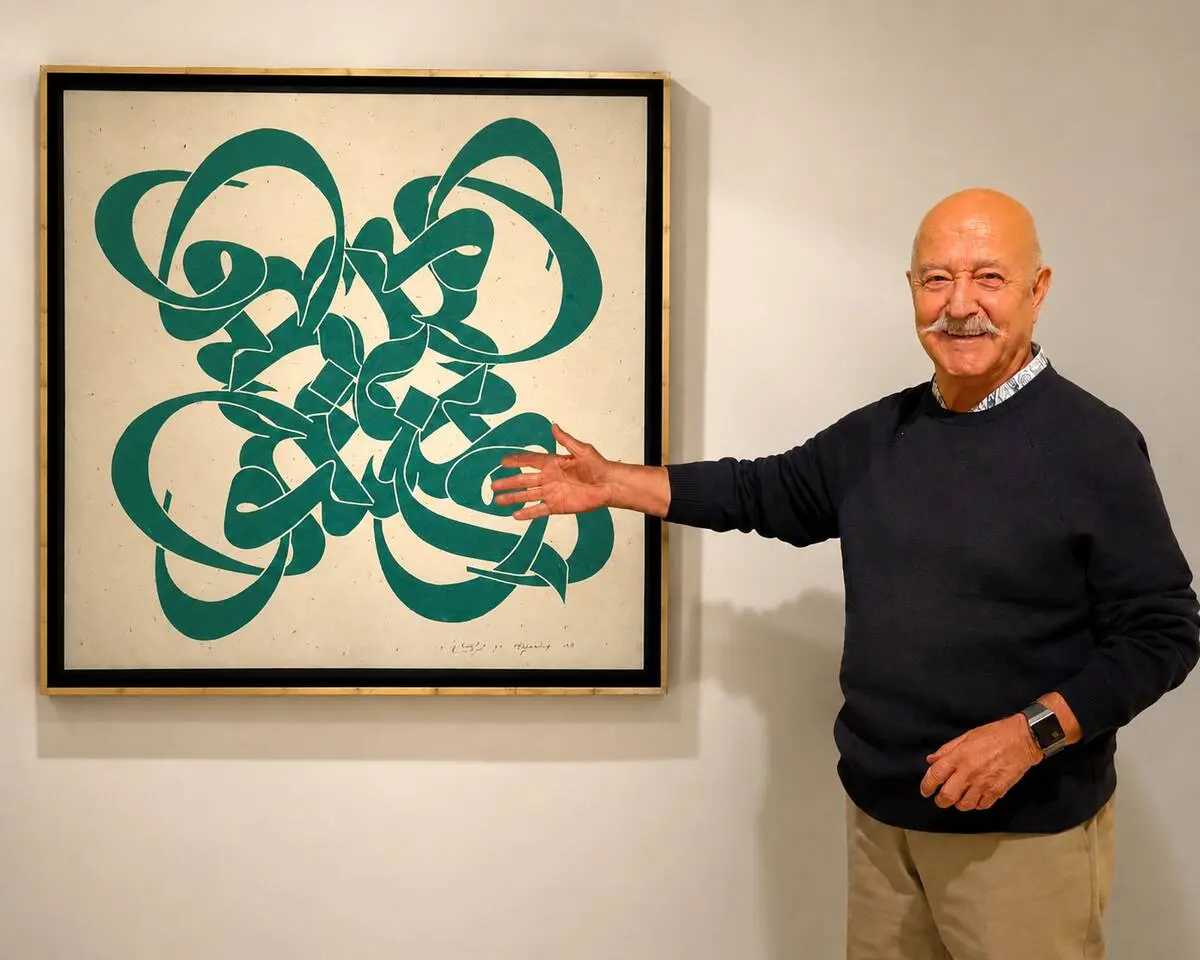
Mohammad Ehsai’s “Eshgh” (Love) in the Raha Gallery Collection/ A Fusion of Persian Shamsa Motifs, Islamic Geometry, and Mandala-Like Eastern Structures
In this work, Mohammad Ehsai simultaneously evokes Islamic architecture, Persian geometry, Eastern mysticism, and modern abstract art. Love appears as an all-encompassing force, and its rotation in four directions may allude to the four cardinal points of the world, the four elements of nature, the four seasons, or even the omnipresence of love throughout existence.
ArtDayMe : The Raha Gallery Collection, founded and directed by Mohammadreza Ghaemmaghami, has been engaged in sustained cultural activities for more than two decades with a focus on promoting the art of the region. The collection preserves a diverse range of modernist and contemporary masterpieces by Iranian and Arab artists.
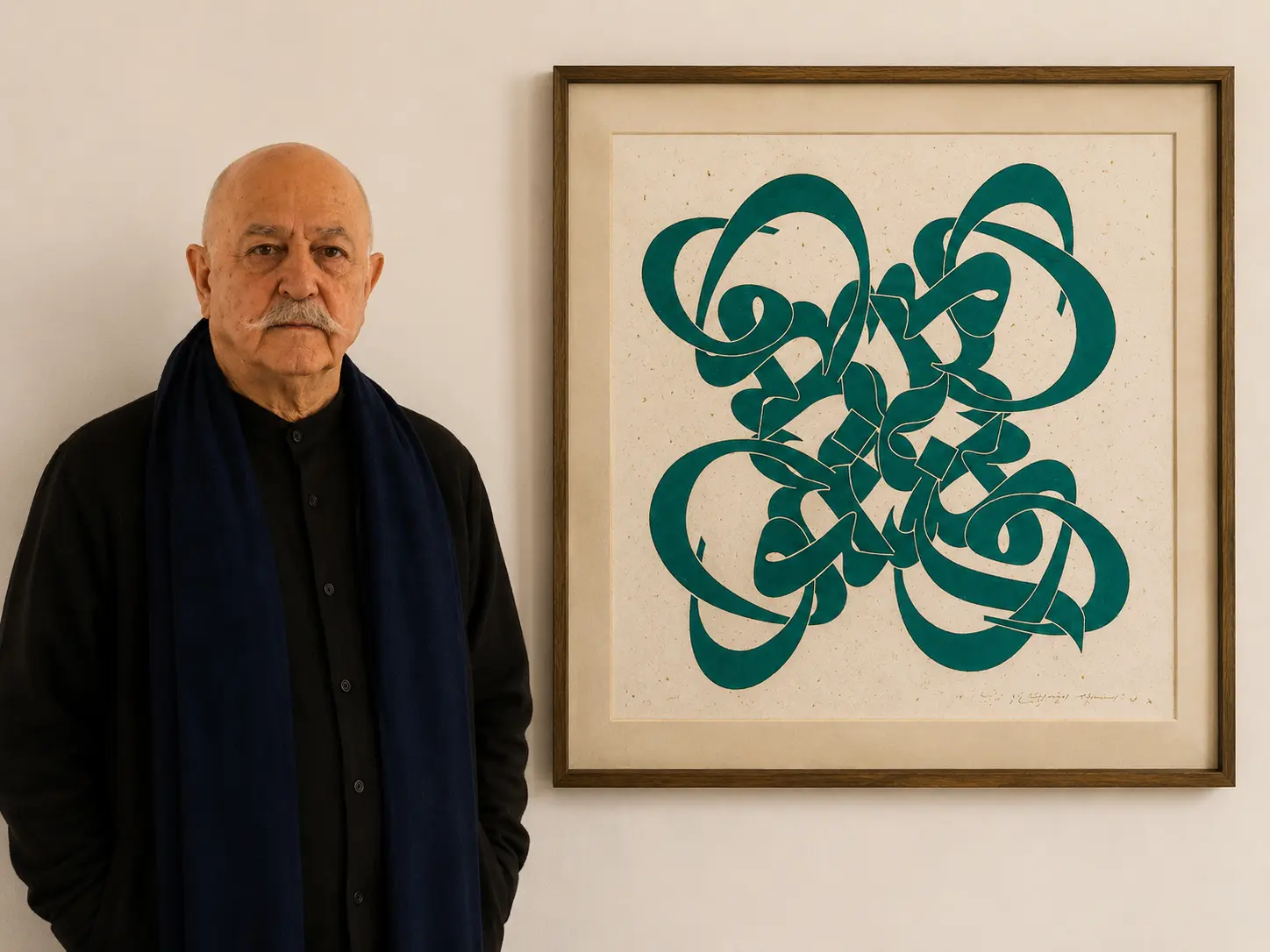
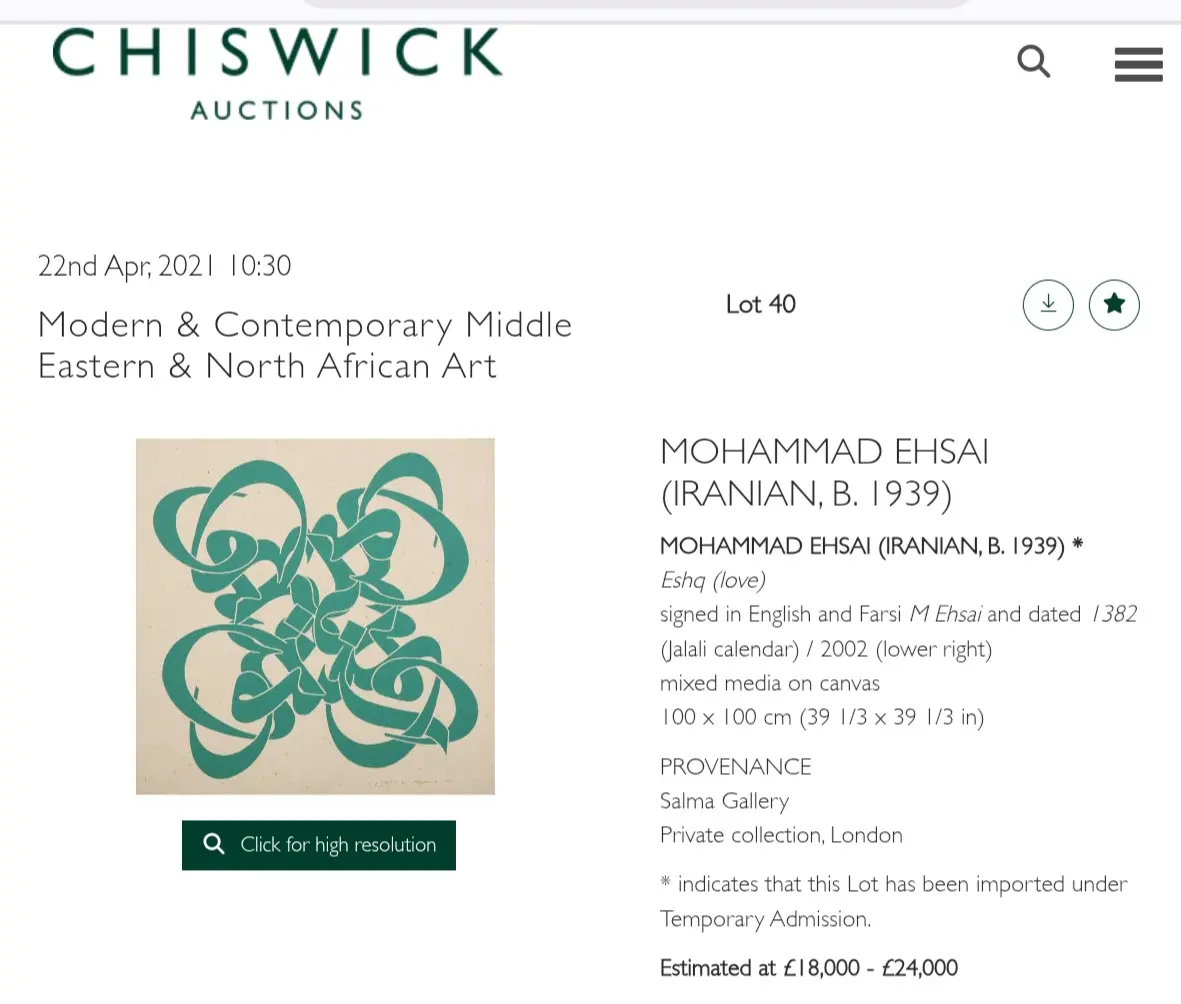
Among its holdings is a significant work by Master Mohammad Ehsai from his celebrated Knots and Love series. Measuring 100 × 100 cm, the piece was created in 2002 and was presented at Chiswick Auctions in London in May 2021.
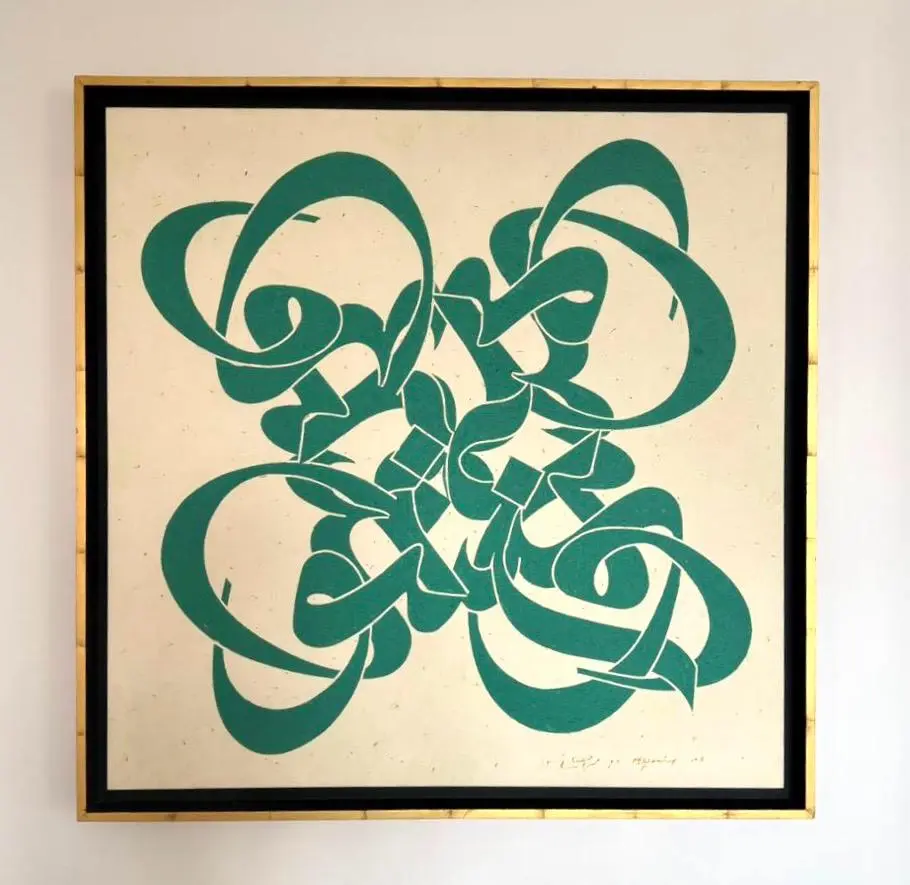
Born in 1939 in Qazvin, Mohammad Ehsai is one of the most distinguished figures in Persian calligraphy and calligraphic painting in Iran and the Middle East. His works are housed in major institutions such as the Metropolitan Museum of Art in New York and the British Museum, while his auction records include landmark sales exceeding one million dollars at Christie’s.
This work, now displayed in the Raha Gallery Collection, may be regarded as one of the most successful examples of transforming a “word” into an entire visual universe.
At first glance, the viewer does not encounter a word but rather a field of visual energy. Yet as the eye navigates the curves, rotations, and interwoven forms, a familiar word gradually emerges from within abstraction: Eshgh (Love).
It is precisely at this point that Ehsai’s art begins—where calligraphy ceases to function merely as a vehicle for reading and instead becomes a medium for seeing, feeling, and experiencing. Throughout his oeuvre, Ehsai has brought traditional Persian calligraphy into the realm of modern and abstract art.
_Formal Analysis: The Architecture of the Sublime Word “Love”
The composition is constructed around the repetition and rotation of the word Eshgh.
Ehsai rotates the word four times in different directions and interlocks the forms at the center of the canvas. The result is a composition that simultaneously recalls Persian shamsa motifs, Islamic geometric patterns, and mandala-like structures found in Eastern visual traditions.
The center of the work is its most concentrated area, where letters intertwine and generate a powerful visual explosion. As the eye moves toward the edges, the forms become increasingly open and liberated. This movement from density toward expansion creates a rhythmic sense of breathing within the composition.
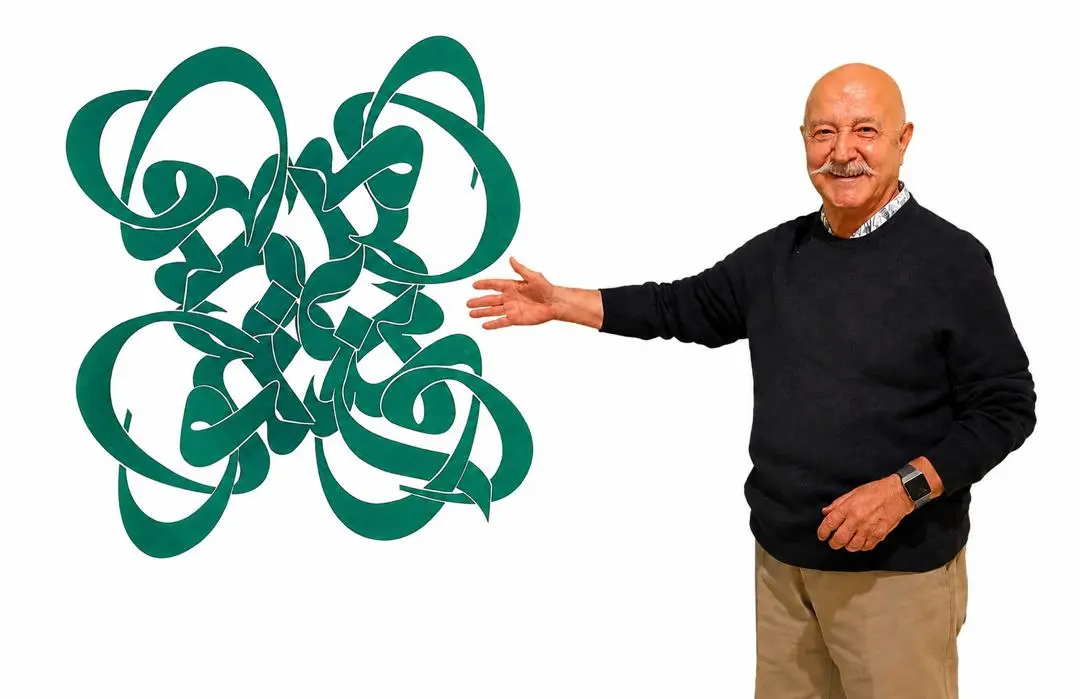
The viewer’s gaze is unconsciously drawn into a circular movement around the center, as though the work invites a visual act of circumambulation.
_Calligraphic Analysis: From Legibility to Abstraction
One of the most important characteristics of this work is its departure from the traditional function of script.
Ehsai pushes the word to the threshold of illegibility, yet never completely destroys it. The viewer can still recognize the components of the letters; the forms corresponding to the Persian letters Ayn, Shin, and Qaf remain present within the swirling composition, though they no longer obey conventional rules of reading.
Meaning is therefore not transmitted through reading but through visual experience.
This is precisely the quality frequently highlighted by scholars and critics of Ehsai’s work: the moment at which Persian script becomes detached from textual function and transforms into an autonomous visual entity.
_Color Analysis: The Silence of Green
The choice of a turquoise-green palette for this work, preserved in the Raha Gallery Middle East Collection, is highly deliberate.
Within Persian and Islamic cultural traditions, green carries a rich spectrum of meanings:
Life and growth
Serenity and balance
Spirituality and sanctity
Hope and continuity
In contrast, the luminous background creates an expansive and seemingly boundless space in which the forms can breathe, allowing the work to convey profound tranquility despite its dynamic movement.
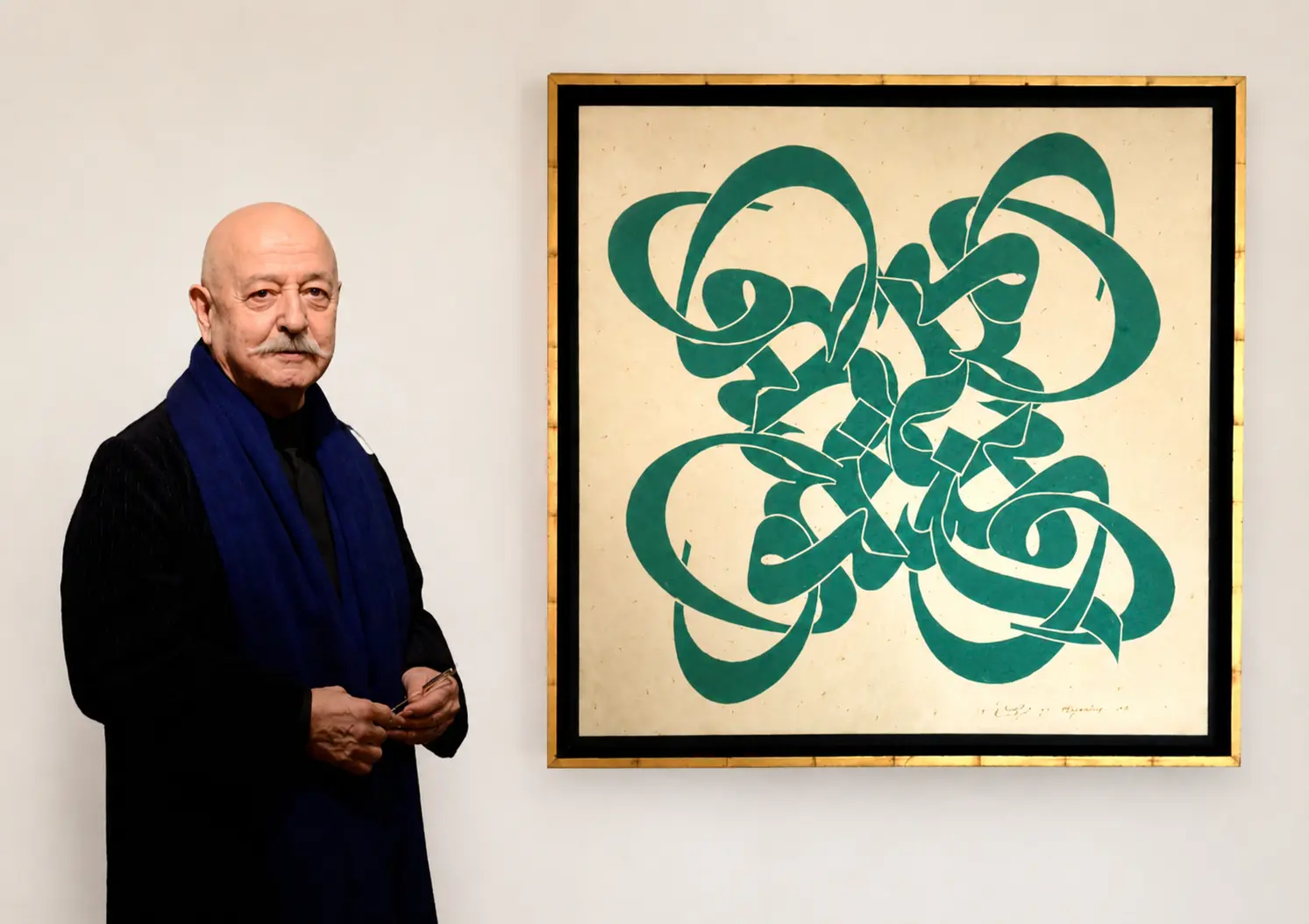
_ Symbolic Analysis: Love as a Cosmic Order
In this composition, love is not merely a word; it is a cosmological system.
The fourfold rotation of the forms may symbolize:
The four cardinal directions
The four elements of nature
The four seasons
Or the all-encompassing presence of love throughout existence
The word occupies the center, yet it possesses neither beginning nor end.
There is no fixed path through which the work can be read. This absence of beginning and ending functions as a metaphor for love itself—a concept that Persian mystical literature has consistently defined as transcending both time and space.
Perhaps this is why other examples from this celebrated series can be found in some of the most important art collections across the Middle East.
_ Psychological Analysis: Between Order and Chaos
From a psychological perspective, the work is built upon a compelling tension.
On one hand, the composition is highly symmetrical, structured through geometric principles, and imbued with a sense of order.
On the other hand, the curves remain free, the lines fluid, and the forms appear to be in constant motion.
As a result, the viewer experiences two seemingly contradictory sensations simultaneously. It is precisely this dynamic balance between order and movement that keeps the work alive and visually engaging.
This artwork belongs to the Raha Gallery Collection of the Middle East.
LEAVE A RELPY