
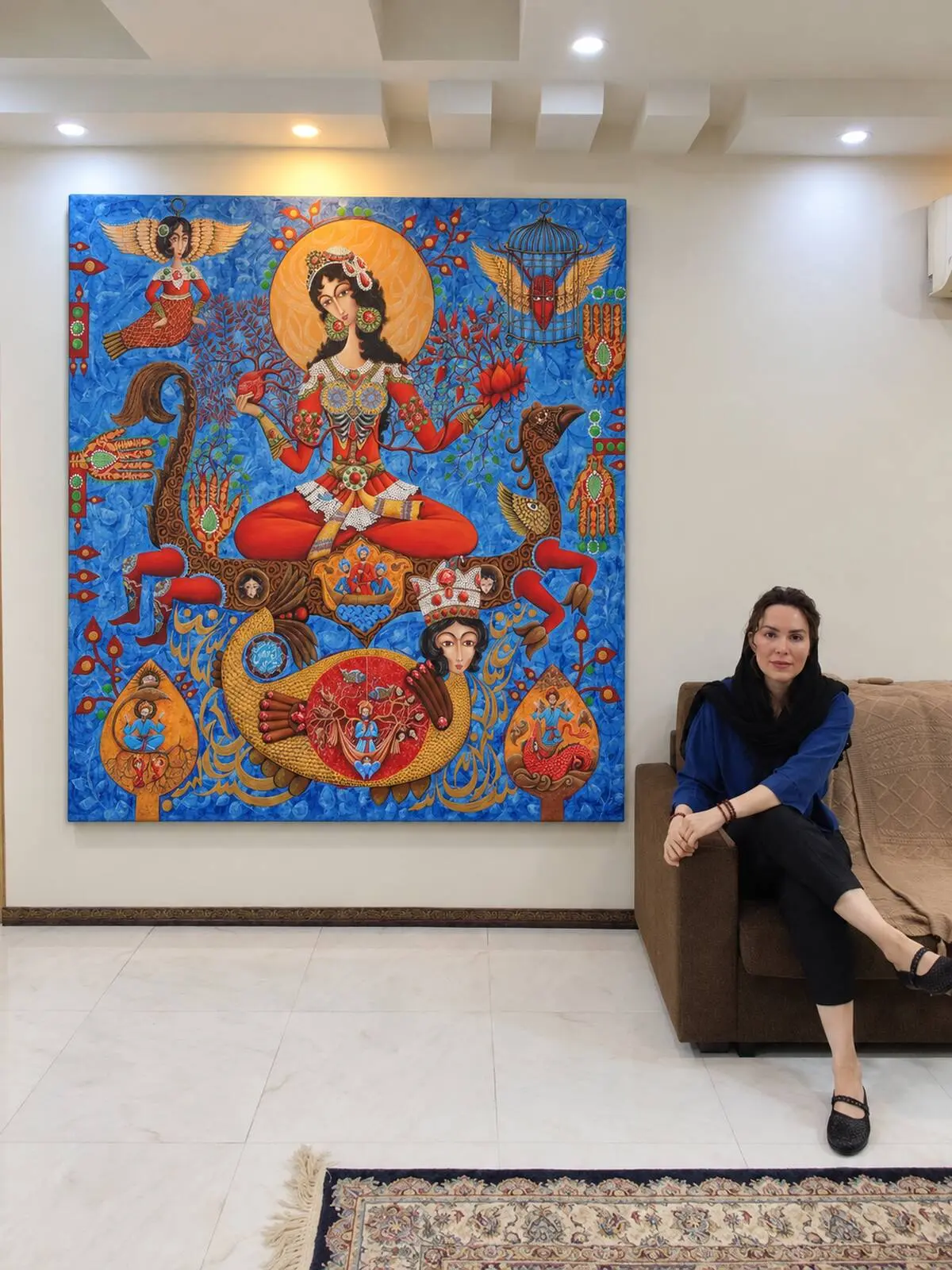
Fatemeh Ahmadian and Prophet Jonah: A Painting Acquired by a Jamaican Art Collector Based in Dubai
The significance of Fatemeh Ahmadian’s Prophet Jonah lies in its ability to convey the spiritual dimension not merely through narrative, but through colour, motifs, the arrangement of figures, symbolic imagery, and a confident command of visual symbolism. Together, these elements open up broader possibilities for interpretation.
ArtDayMe : In this article, we examine " Prophet Jonah ", a painting by Fatemeh Ahmadian (born in 1982 in Khansar, Iran).
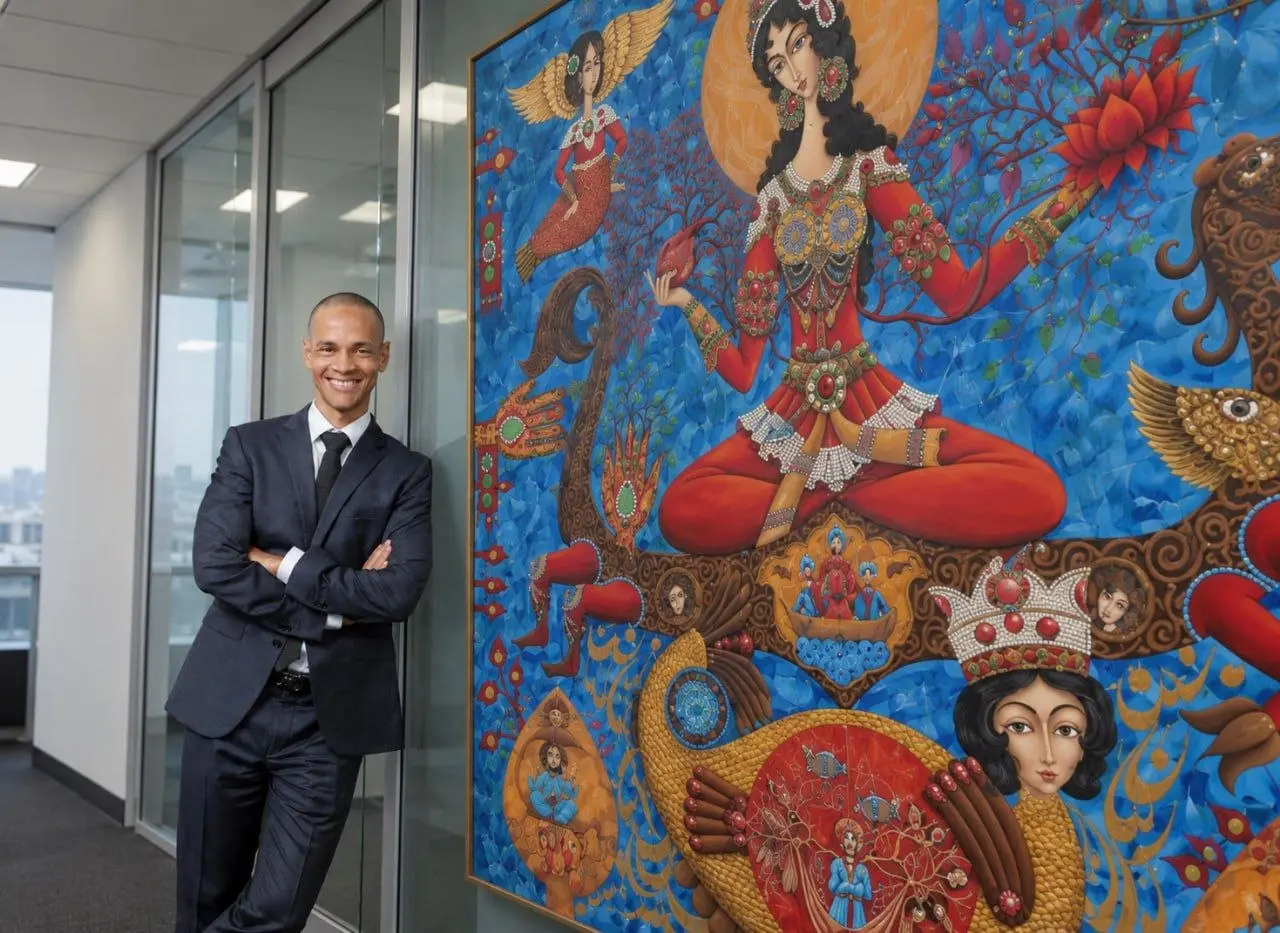
Created in 2022, the work measures 160 × 200 cm and is executed in oil on canvas. It was acquired by Jason Carey, a Jamaican art collector based in Dubai, and is now part of his collection.
_The Narrative Behind the Painting
The story of Prophet Jonah and the people of Nineveh is a narrative about impatience, error, descent, repentance, the possibility of return, and divine mercy.
_ An Aesthetic Analysis
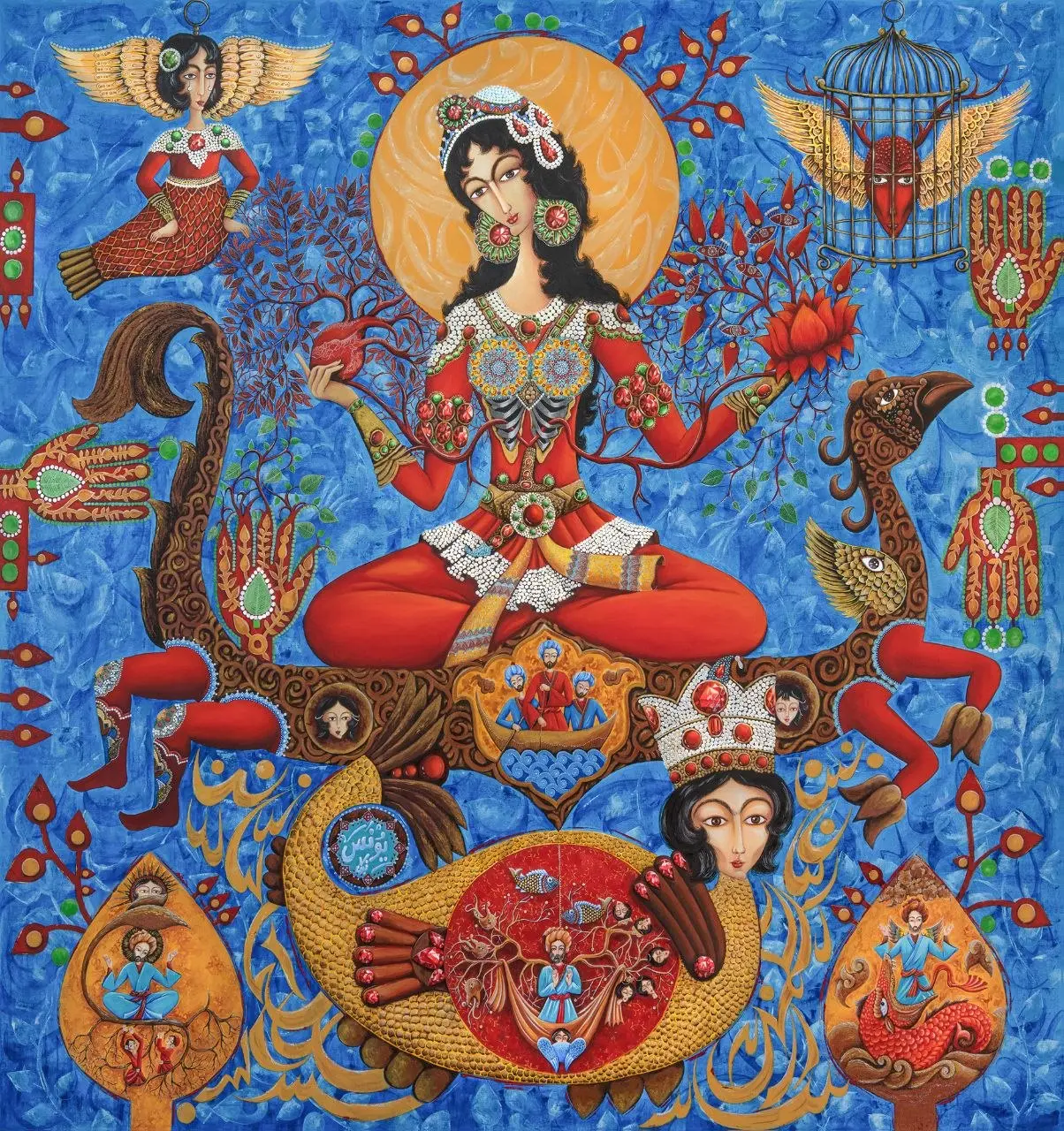
Fatemeh Ahmadian’s Prophet Jonah is a visual narrative rooted in a mythic and spiritual world, where religious storytelling intersects with symbolic imagination and the visual ornamentation of Iranian art. Rather than offering a direct, naturalistic depiction of the story of Prophet Jonah, the artist constructs a multilayered world in which human, animal, and botanical forms coexist with supernatural signs. The central figure, dressed in red, adorned with intricate ornaments, and framed by a golden halo, serves as the painting’s visual focal point. Its prominence is established through scale, colour, and composition. The figure’s symmetrical seated posture, outstretched arms, and the tree-like forms extending around and across the body establish it as the axis connecting the painting’s diverse elements. Meanwhile, the expansive blue background, marked by varied textures and visible brushstrokes, creates a fluid, otherworldly atmosphere. Its contrast with the red garment and the orange tones of the halo produces a powerful chromatic tension that draws the viewer’s gaze towards the centre.
One of the most distinctive aesthetic features of Ahmadian’s painting is its synthesis of Iranian miniature painting, popular and folk painting traditions, traditional ornamentation, and contemporary imagination. Birds with outstretched wings, symbolic hands, miniature figures, botanical motifs, and fantastical creatures are not merely decorative additions; they form a network of signs that elevates the work beyond the level of straightforward narrative illustration. The intricate rendering of jewellery, feathers, the textures of animal bodies, and the patterns on the garments, together with sinuous lines and recurring forms, lends the composition a richly detailed, narrative-driven character.
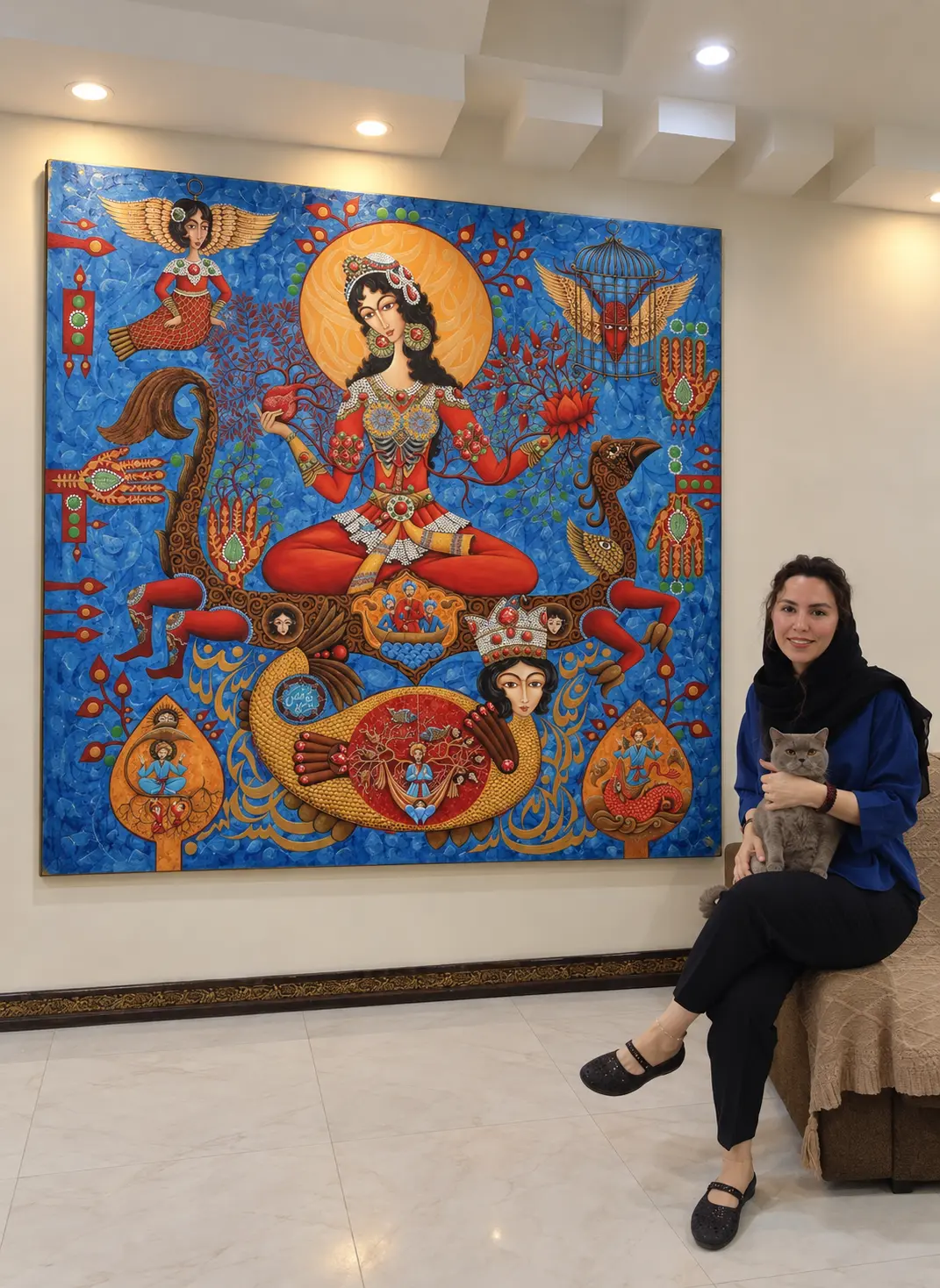
In the lower part of the composition, smaller figures and scenes unfold like stories within the principal narrative, introducing additional layers of meaning. This approach recalls the visual logic of Iranian miniature painting, in which space does not necessarily conform to linear perspective or naturalistic representation. Instead, it is organised according to the symbolic significance of individual elements, the coexistence of multiple narratives, and the relationships established between different visual planes.
By combining relative symmetry at the centre with a carefully balanced distribution of elements around it, Fatemeh Ahmadian establishes an equilibrium between order and movement. The recurrence of curved forms in branches, birds’ tails, and surrounding ornamentation creates a continuous visual rhythm, guiding the eye across the canvas. The result is an image whose intricate details reward repeated viewing and sustained attention.
The significance of Prophet Jonah lies in the way Ahmadian transforms a religious subject into an imaginative visual experience. Here, spirituality emerges not simply through storytelling, but through colour, the arrangement of figures, symbolic signs, and the accumulation of detail. The title directs the viewer towards the story of Prophet Jonah and its associated themes of trial, deliverance, return, and humanity’s relationship with a power beyond the material world. Yet the painting’s symbolic language allows for a broader range of interpretations. The fish-like imagery and animal forms, alongside trees and smaller figures, evoke the connections between life, nature, and ancient narratives, although a precise interpretation of individual symbols would depend on their visual sources and the artist’s intentions.
From an aesthetic perspective, Fatemeh Ahmadian does not rely on visual restraint or the elimination of detail. Instead, she draws on an abundance of motifs and a dense interplay of colours to construct an autonomous visual world. Within this world, red conveys emotional intensity and human presence; gold evokes grandeur and the sacred; and blue establishes a sense of expansiveness and mystery.
The result is a painting that connects religious narrative, the visual memory of Iranian art, and the artist’s personal imagination. It invites viewers to read the image as a visual text in which meaning emerges not only from the central figure, but also from the relationships between its constituent elements, the rhythm of its lines, its chromatic contrasts, and the scattered details that animate the entire canvas.
_ Artistic Approach and Technique
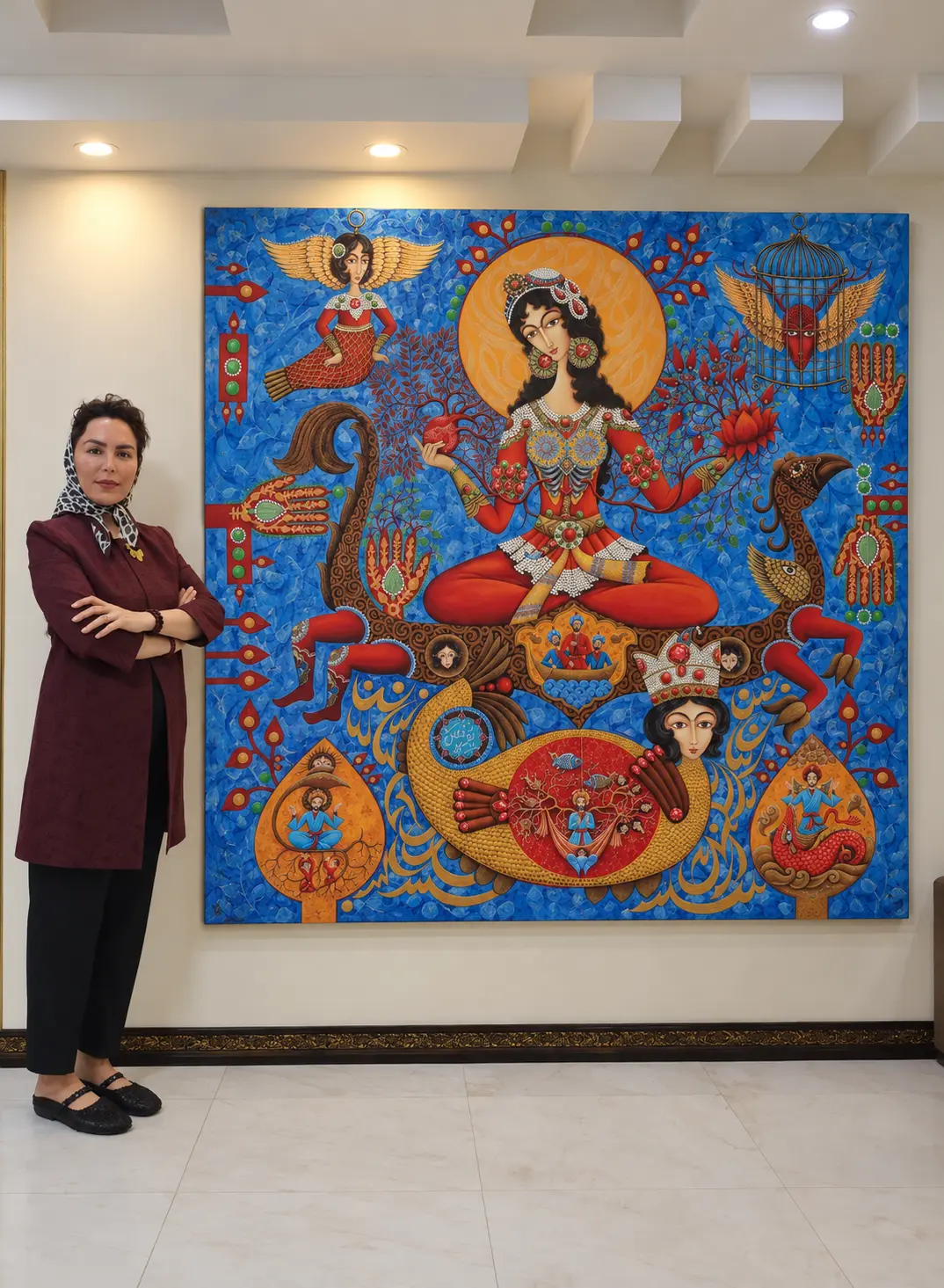
In this work, Fatemeh Ahmadian draws on the narrative structure of Iranian coffeehouse painting, the ornamental vocabulary and characterisation associated with Qajar painting, and symbolic elements reminiscent of the Saqqakhaneh art movement.
For the artist, the narrative unfolds not through figures alone. Symbols, too, recount parts of the story on a different level, contributing an additional dimension to the visual narrative.
_ Visual Characteristics
Fatemeh Ahmadian establishes the painting’s overall atmosphere through the colour blue, while signs of growth, vitality, and movement appear throughout the composition. Its structure is built around the relationships between above and below, ascension and descent, confinement and liberation. The central figure, the crowned fish, the caged bird, the free bird, the heart, the lotus, and Saqqakhaneh-inspired elements each play a role in conveying the narrative.
_ Conceptual Interpretation
The story of Jonah is more than the account of a prophet inside a fish. It is also the story of a fallible human being who may succumb to pride, impatience, disobedience, and hasty judgement, only to fall, recognise his error, and discover the possibility of returning. In this sense, the painting emphasises a cycle of descent and downfall, repentance, mercy, and redemption.
_ Fatemeh Ahmadian on Prophet Jonah
The artist explains the symbolism and conceptual foundations of the painting in her own words:
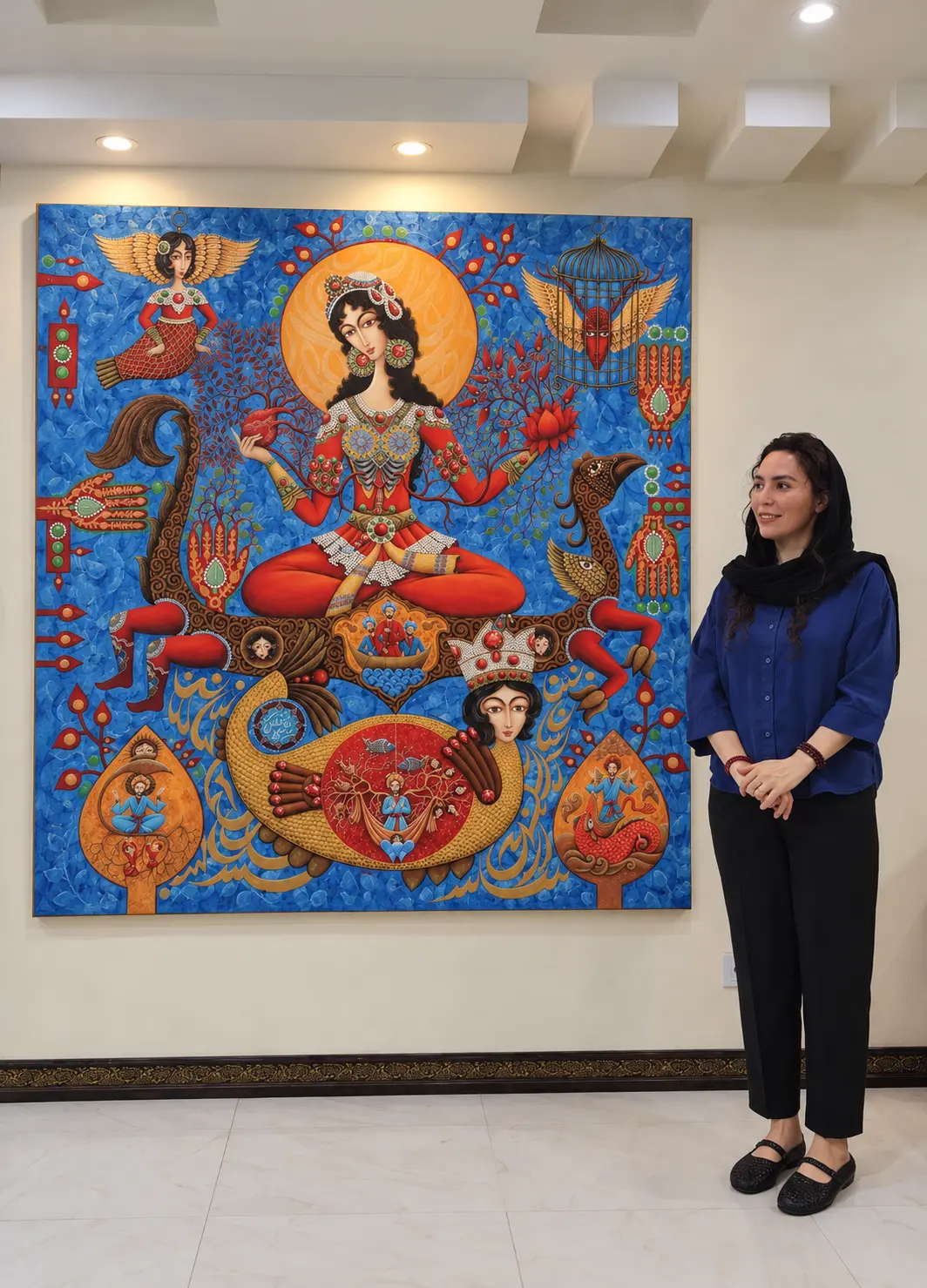
“The large central figure in this work is a symbolic embodiment of the divine. Although its outward appearance is feminine, my intention is not to assign a gender to God. In my work, the female figure often transcends gender and becomes a vehicle for broader, more universal concepts. In this painting, the figure’s feminine aspect is associated, for me, primarily with love, compassion, creativity, and forgiveness.
“The heart held in the figure’s hand symbolises divine mercy, while I have used the lotus flower as a sign of redemption following repentance.
“The crowned fish is one of the painting’s most important symbols. I deliberately placed a crown on the fish’s head to suggest a reversal of hierarchy: the human position is neither absolute nor permanent. When divine will determines that a person should descend, a creature that appears inferior may gain power over them. Jonah, despite being a prophet, finds himself in a situation in which his salvation depends on the very fish that has swallowed him.
“The caged bird symbolises humanity’s captivity within a collection of traits, including pride, disobedience, and entrapment by the ego. By contrast, the free bird points towards return and liberation. The scattered leaves against the blue background represent growth and life. Even amid descent and crisis, the possibility of life and a new beginning does not disappear.
“For me, Prophet Jonah is less about punishment than about the possibility of return. Human beings may fall, but a fall does not necessarily mark the end of the journey. Awareness of one’s mistakes, repentance, and mercy can bring a person back to the right path.” The Painting’s Acquisition and Collection History
Prophet Jonah was acquired by Jason Carey, a Jamaican art collector based in Dubai, and is currently held in his private collection.
_ Fatemeh Ahmadian’s Artwork Prices and Market Presence
Fatemeh Ahmadian, born in 1982 in Khansar, Iran, holds a bachelor’s degree in Islamic Arts, specialising in ceramics and sculpture, from Isfahan University of Art.
In 2021, her painting Prophet Jonah, measuring 160 × 200 cm, was reportedly sold in a private transaction for US$4,500 to an art collector based in Dubai.
Another major work by Ahmadian, The Fourth Trial of Rostam: Rostam’s Battle with the Magician, was created in 2021 in oil on canvas and measures 160 × 200 cm. The painting was acquired by Shahdad Fazeli and is now held at the Fazel Museum Library in Khansar, Isfahan Province, Iran.
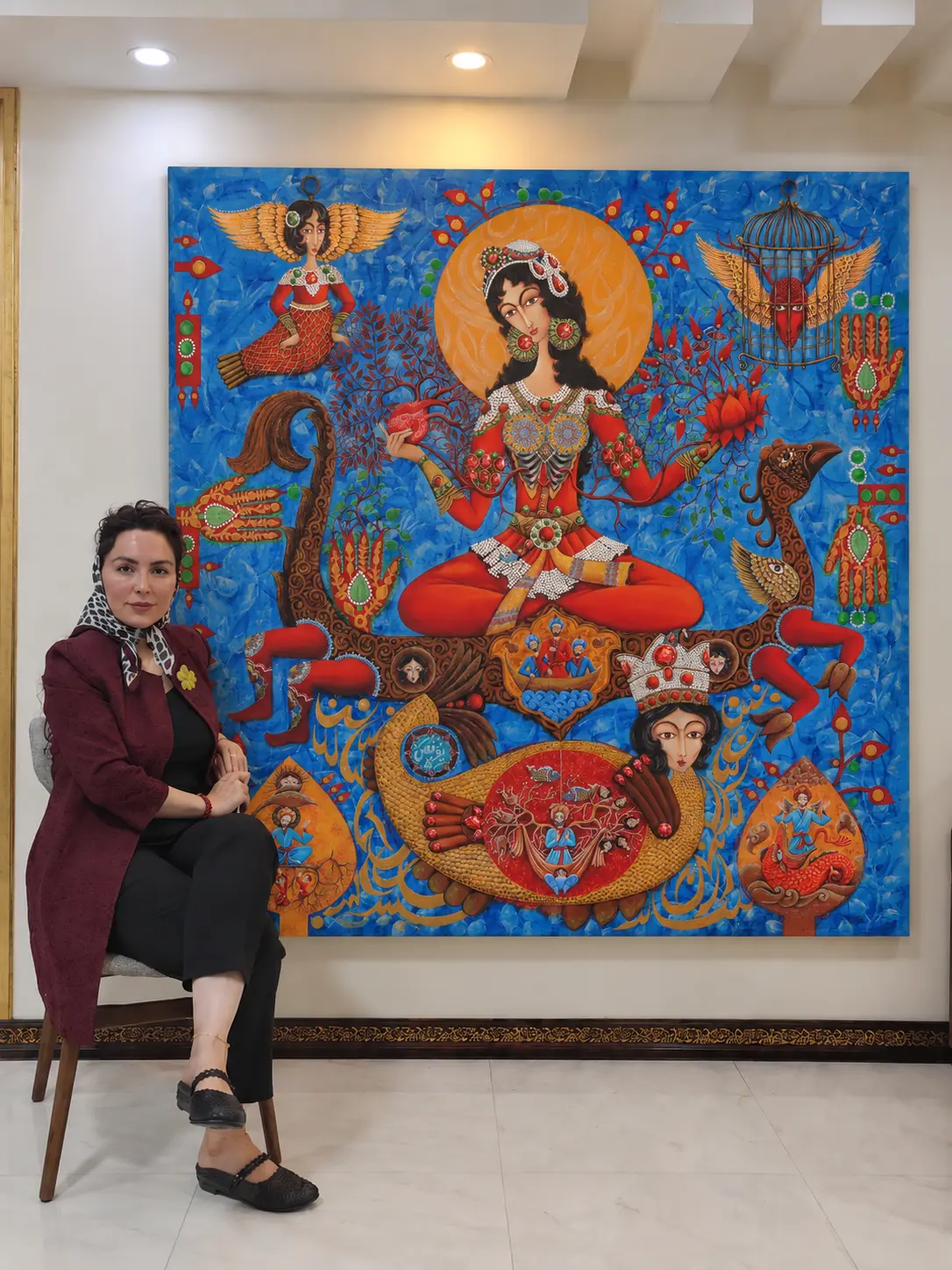
Ahmadian’s work has attracted attention within the art community and the art market for its distinctive worldview and recurring thematic concerns. At first glance, her paintings may appear classical and traditional; after a more sustained encounter, however, their contemporary dimensions become increasingly apparent. This interplay between historical visual languages and contemporary conceptual possibilities, combined with the strength of her draughtsmanship, has contributed to growing interest in her work.
LEAVE A RELPY