
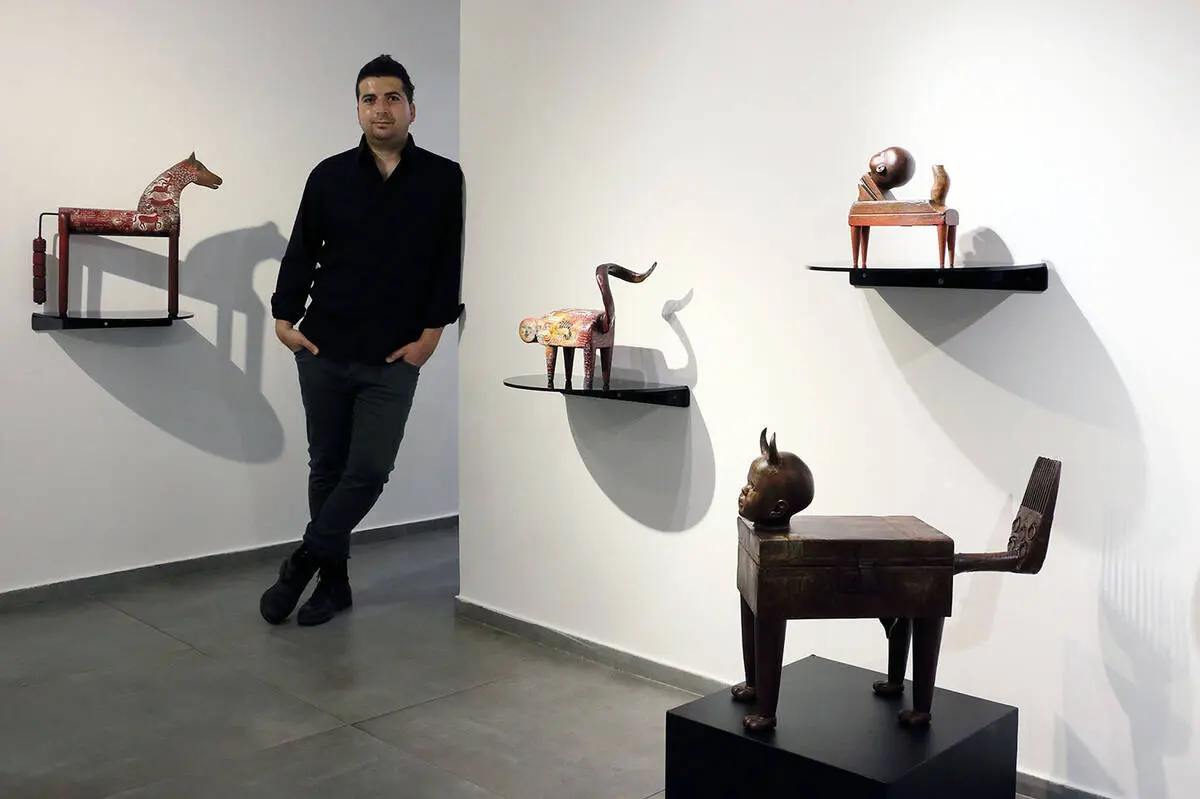
Ahad Ghadiri at Mojdeh Gallery: Sculptures Moving Between Myth, Everyday Life, and the Language of Painting / An Environmental Reading
Ahad Ghadiri’s Khokhan at Mojdeh Gallery offers an intriguing environmental dimension alongside its artistic interpretations and explorations of hybrid creatures—a dimension that has received comparatively little attention.
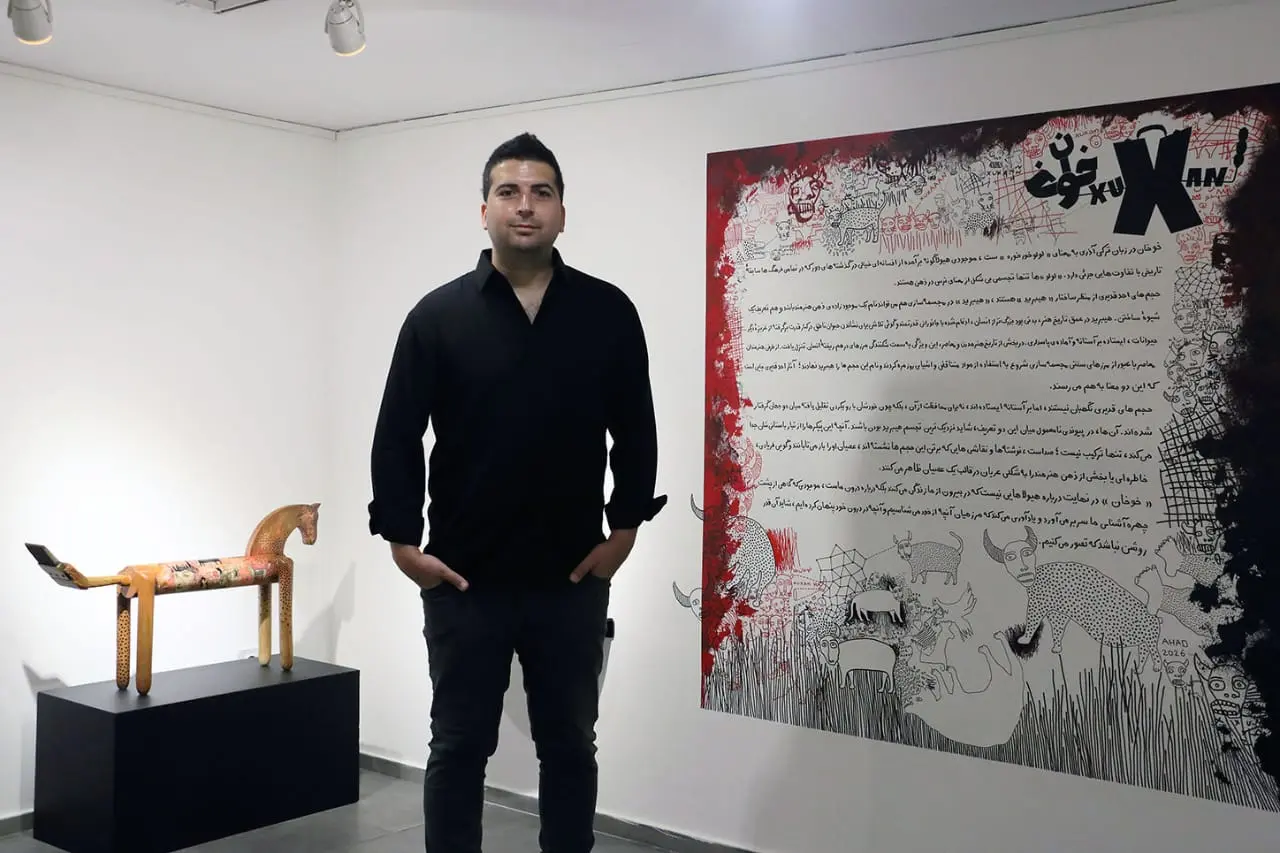
ArtDayMe | Azadeh Jafarian : Mojdeh Gallery is hosting a selection of distinctive sculptures by Ahad Ghadiri through 30 October. Titled Khokhan, the exhibition presents hybrid creatures—mythological beings that move between human and animal forms—in fantastical and endearing shapes.
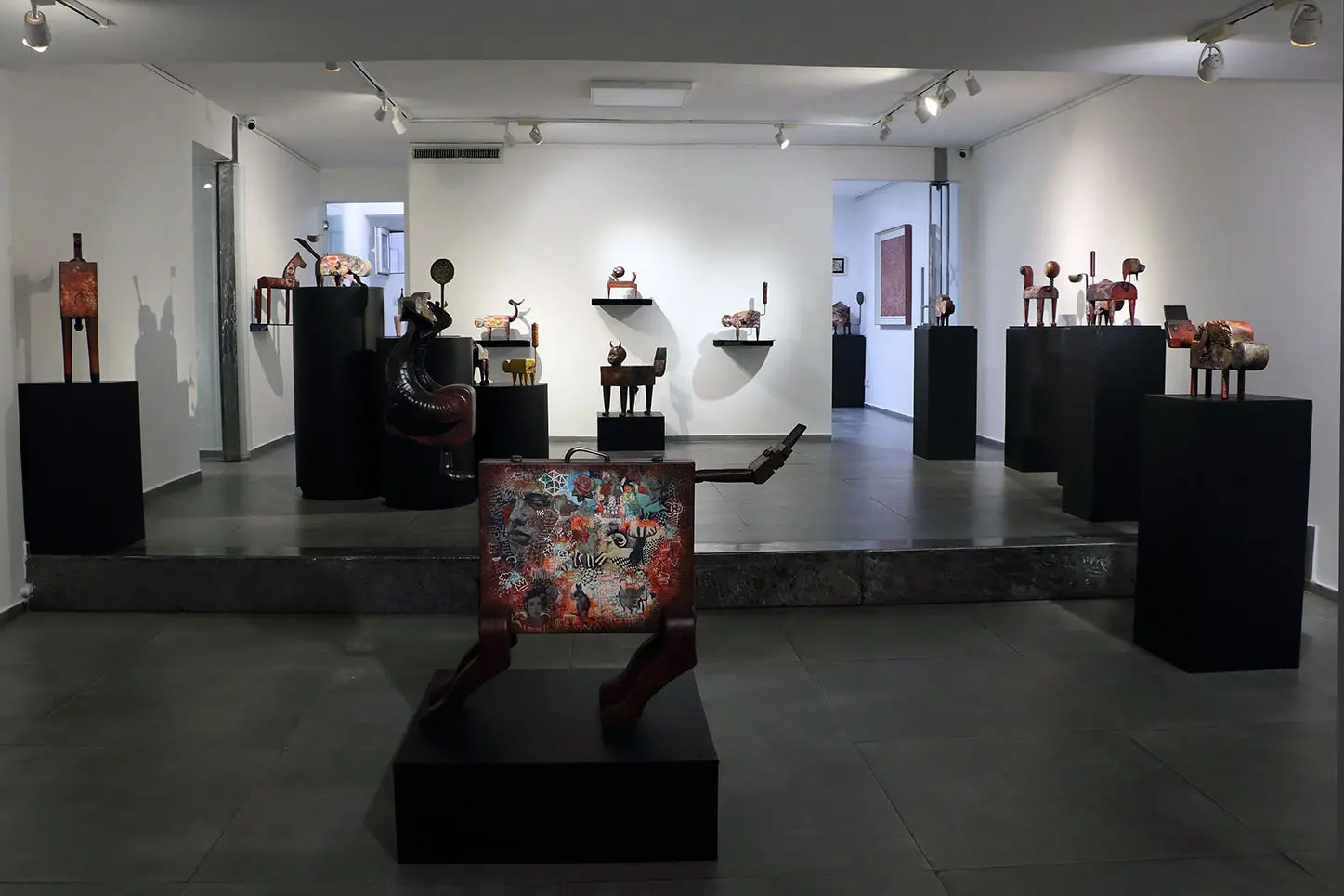
The thoughtful exhibition design and the appropriately proportioned pedestals on which the sculptures are displayed further enhance their visual presence.
Ahad Ghadiri (born 1987, Tabriz) was first associated with Mojdeh Gallery in October 2022, when the gallery presented his works at WOPART, the international art fair in Lugano, Switzerland. The works received a notable response and achieved encouraging sales in the Swiss market.
1.
Ahad Ghadiri’s sculptures can be understood as an exploration of the possibility of transforming the identity of matter and images. Objects move away from their original functions, animals transcend natural patterns, and painting shifts from a two-dimensional surface to become part of a sculpture’s body. In this world, a monster is not necessarily a creature existing beyond everyday life; it may be made from the very things we encounter every day but rarely consider in terms of their hidden possibilities. The strength of these works lies in their ability to compel viewers to look again at familiar objects, bodies, and even their own familiar shadows.
2.
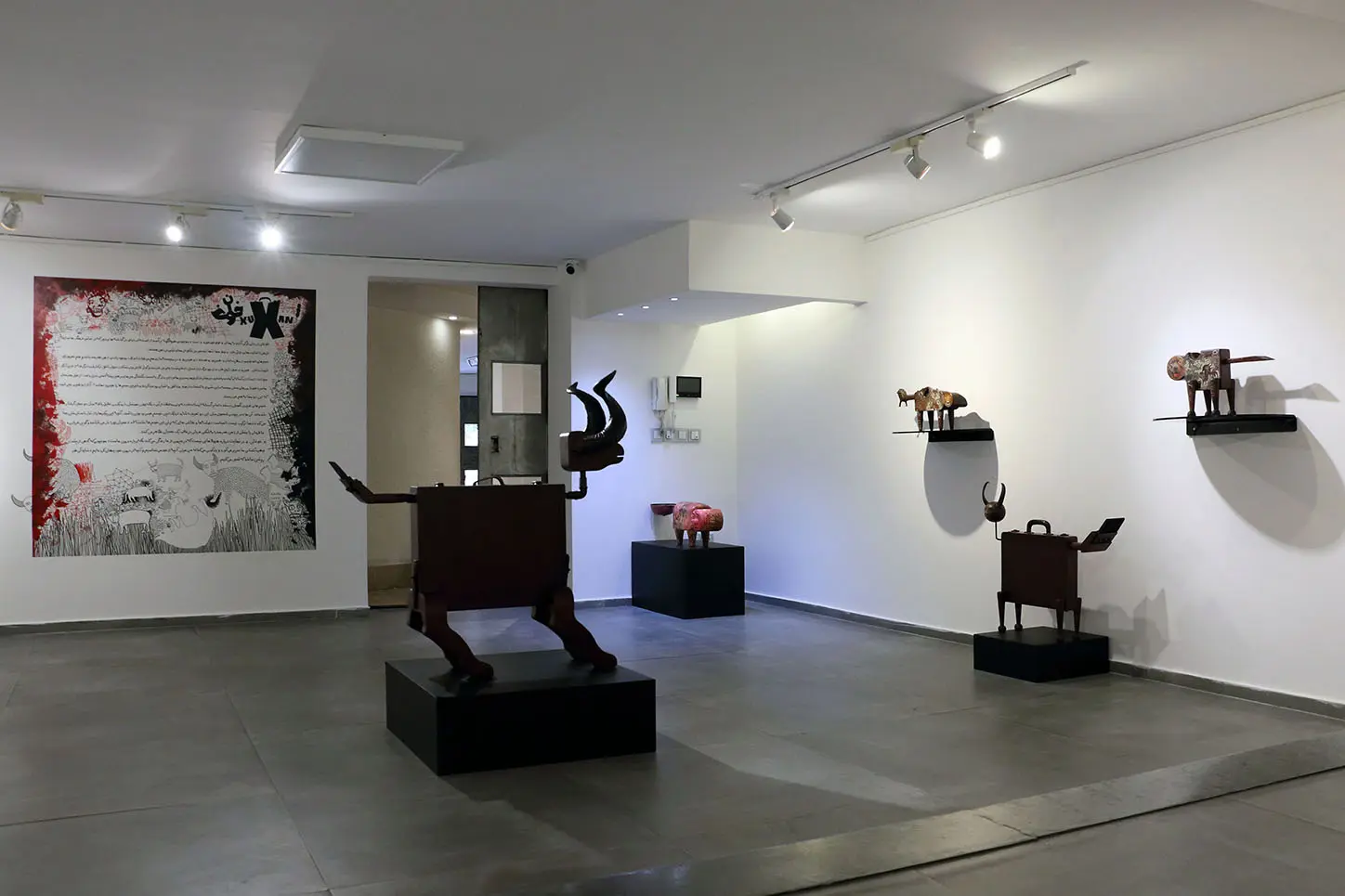
In the world of Ahad Ghadiri’s sculptures, currently on view at Mojdeh Gallery, animals do not emerge from nature; they arise from fragments of the human-made world.
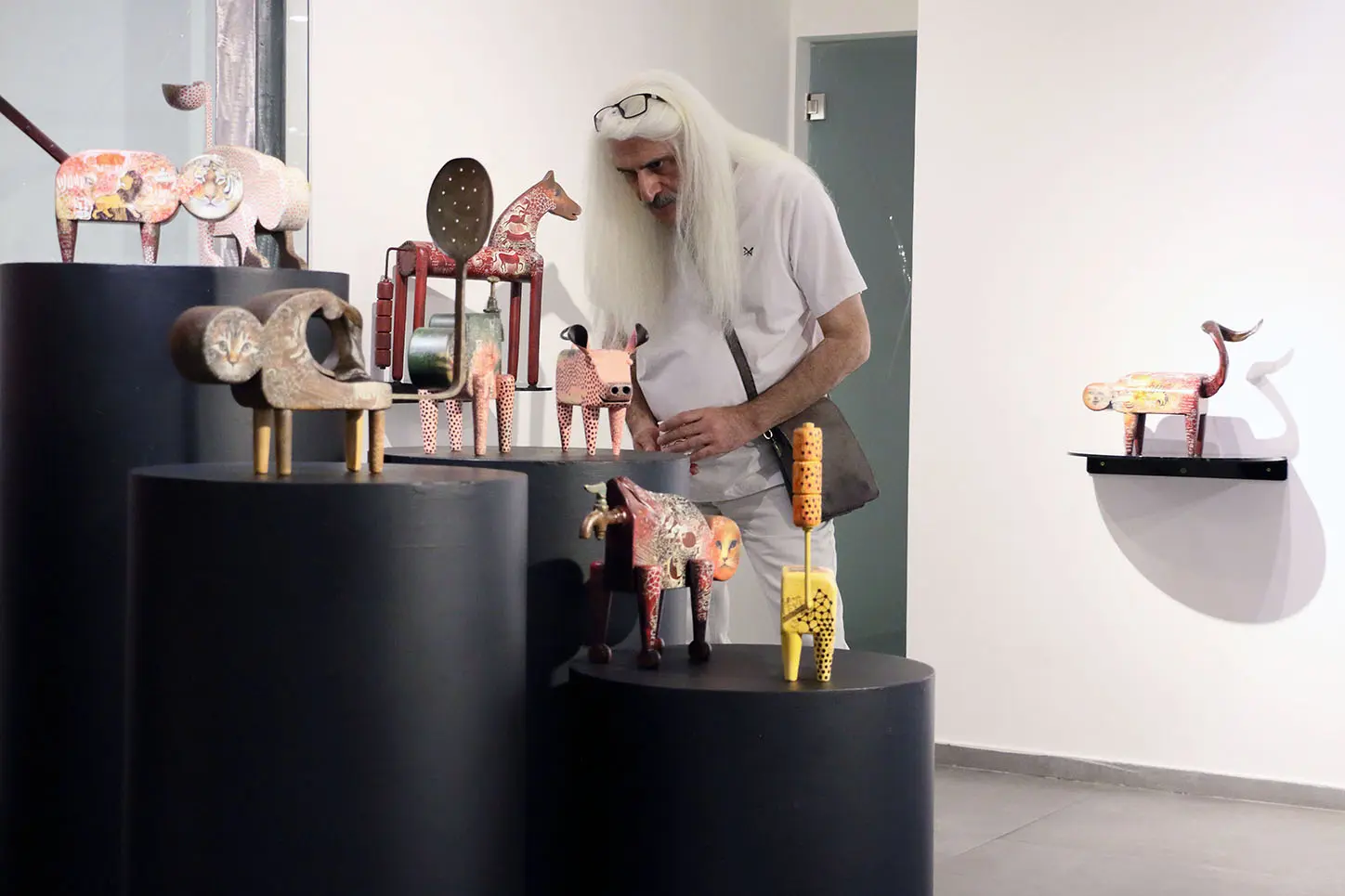
A figure with a suitcase-like body, an animal with a metal neck, a horse with wooden legs, and a creature with a human-like face all appear in a realm where the boundaries between animal, human, and object are constantly shifting.
The exhibition Khokhan at Mojdeh Gallery, through these material and visual transformations, invites an interpretation that goes beyond the creatures’ surface-level strangeness. In Azerbaijani Turkish, Khokhan means a bogeyman—a creature whose identity depends less on a fixed form than on collective imagination and fear.
But a crucial question arises: when a creature intended to inspire fear has a wooden body, a painted face, and limbs resembling everyday tools, what happens to the very concept of the monster?
Are we witnessing a representation of fear, or a world in which the distinction between ordinary and extraordinary beings itself becomes uncertain?
3.
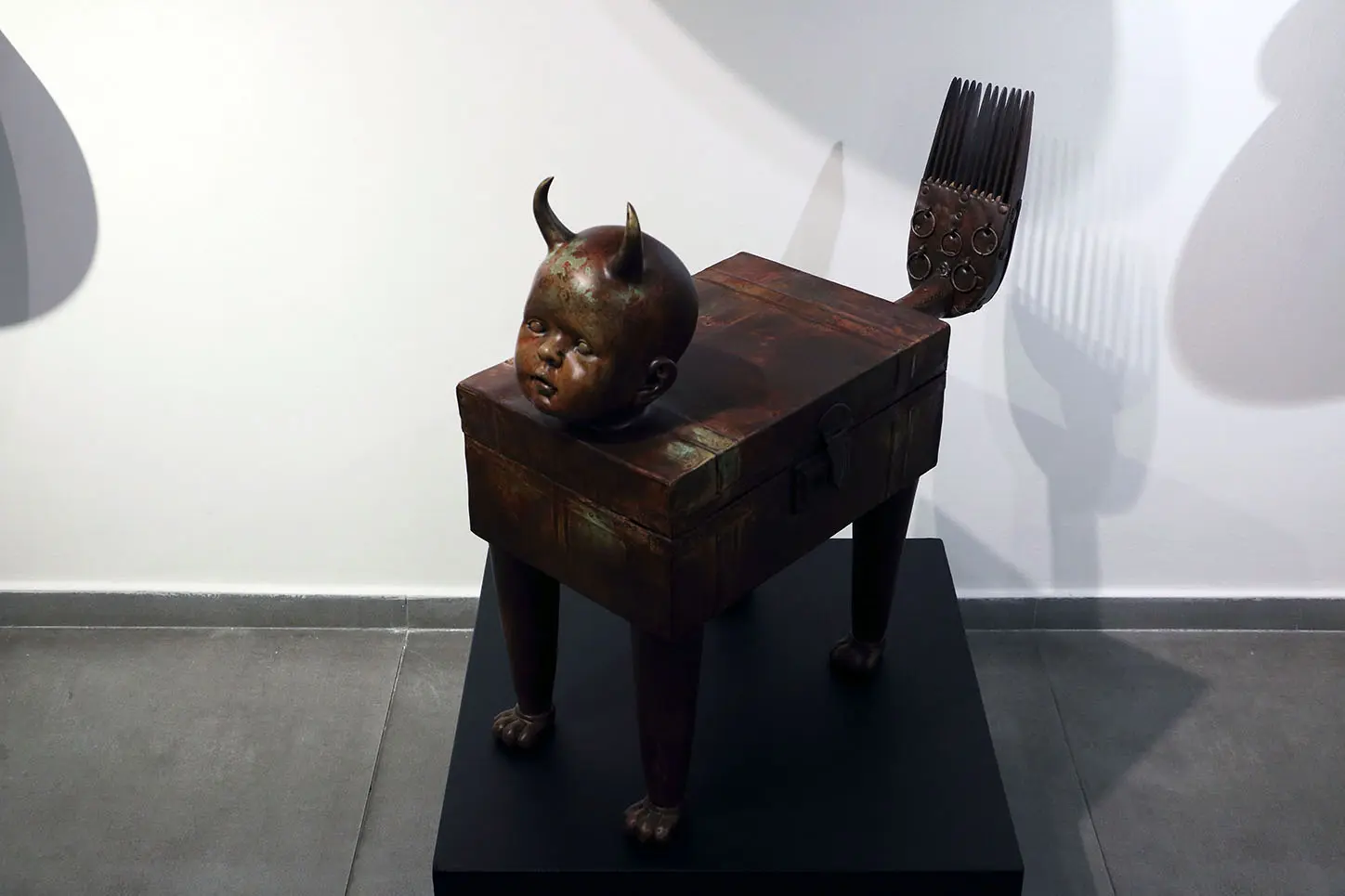
One of the most striking features of Ahad Ghadiri’s works is his use of structures associated with familiar objects. In some sculptures, a rectangular torso recalls a table or chest; in others, handles, rods, and metal fittings become limbs that seem to protrude from the body of an unknown creature. This choice is more than simply a means of producing unusual sculptures. The artist draws on objects that once occupied clearly defined positions and served specific functions in everyday life, then introduces them into an order for which no familiar set of instructions exists.
In this process, an object does not entirely lose its past. A suitcase retains memories of travel and movement; a metal tap still evokes the mechanism through which water flows; wooden supports bring furniture structures to mind. Yet these elements no longer serve their original purposes. Instead, they become limbs that make the emergence of a new creature possible.
This process can be understood as a form of imaginary zoology: rather than classifying natural species, it constructs a new realm by recombining remnants of the human-made world. Here, every object has the potential to become something else, and no material is confined to its original identity.
The artist defamiliarises objects that exist all around us, encouraging viewers to look again at the things they encounter in their everyday surroundings.
4.
Among the works are figures in which human faces are placed upon animal bodies or geometric structures. This combination establishes an ambivalent relationship between the viewer and the sculpture. The human-like face makes emotional engagement possible, but the unconventional body prevents that engagement from developing into a secure sense of recognition.
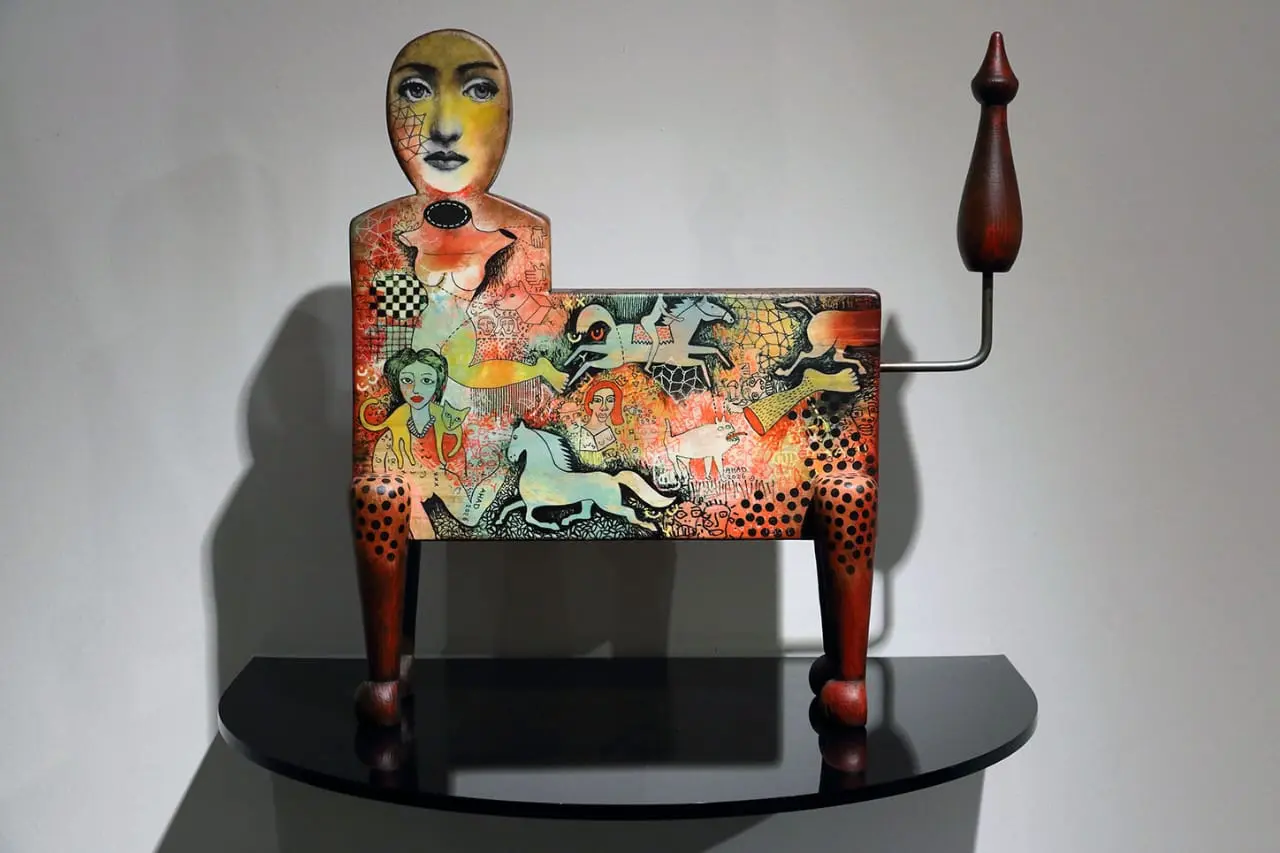
In one sculpture, a human head sits atop a rectangular torso covered with small images, lines, and a variety of colours. The legs resemble simple, almost mechanical structures, while an elongated appendage extends from the side of the body. The result is neither a human transformed into an animal nor a machine given a human face. It is a creature whose identity emerges from the coexistence of these two realms.
This condition can also be examined through the experience of contemporary humanity.
In today’s world, identity is often constructed from a combination of roles, memories, tools, and images. Nevertheless, this should be regarded as one possible interpretation rather than a definitive meaning that can be attributed to the artist’s intentions without further evidence. The value of these figures lies in their ability to raise such questions without imposing a final answer.
5.
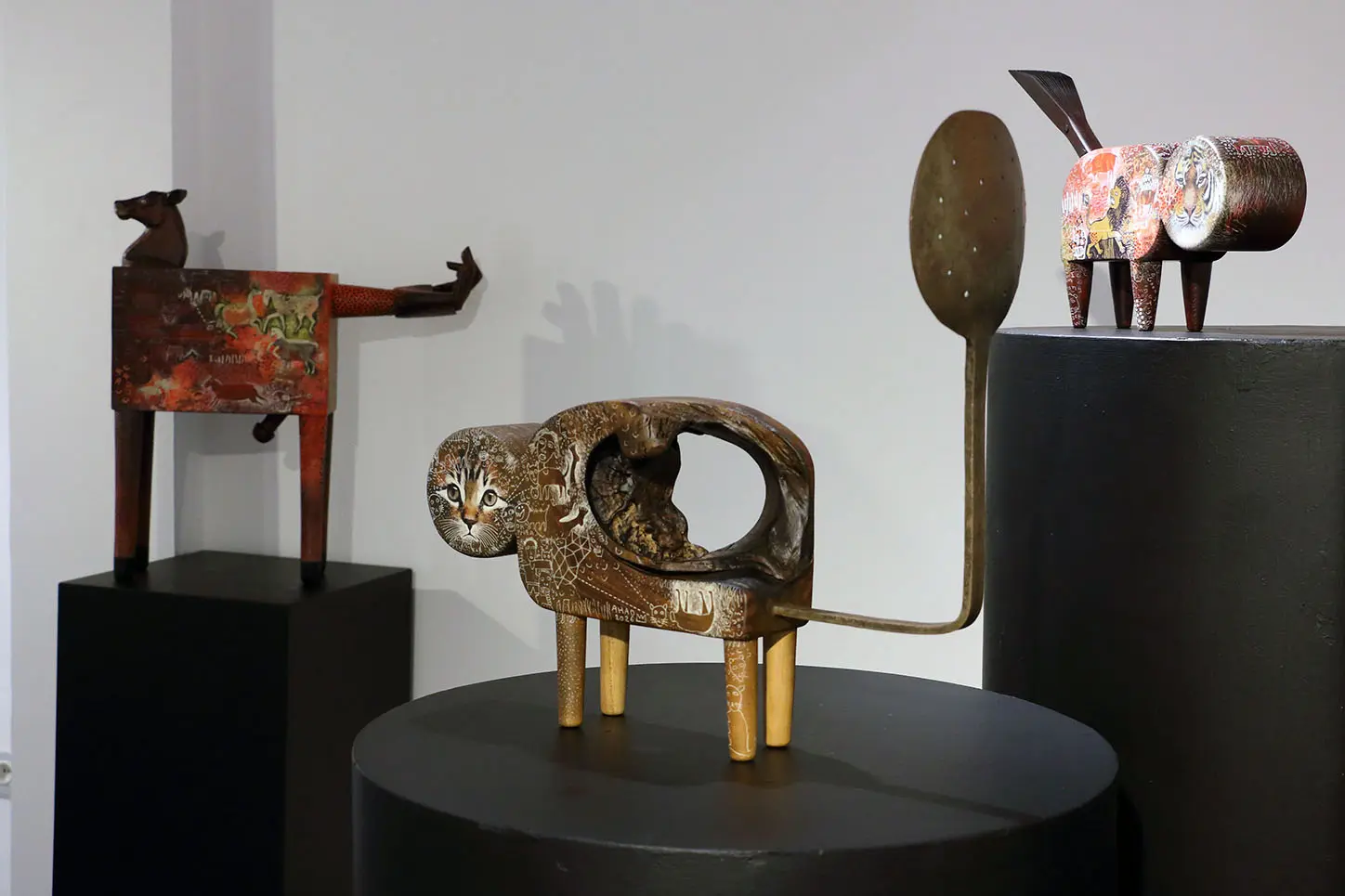
The painted surfaces of Ahad Ghadiri’s sculptures at Mojdeh Gallery represent an inventive approach to expanding the scope of meaning in each work. Beyond their decorative function and their contribution to the sculptures’ visual appeal, these patterns transform the creatures’ bodies into spaces where multiple narratives coexist. Small faces, animals, grid-like lines, dots, inscriptions, and geometric signs appear alongside one another, as though each part of a figure carries a fragment of a dispersed memory.
In some works, animal images move along the torso and merge with other lines and symbols. The viewer’s gaze shifts between these elements without arriving at a clearly defined narrative centre. Unlike a painting that organises its elements to guide the viewer towards a principal subject, these surfaces embrace multiplicity and simultaneity.
An important distinction emerges between painting on a flat surface and painting on a three-dimensional form. On canvas, an image generally remains contained within a defined area. On a sculpture’s body, however, lines must negotiate curves, edges, supports, and changes in the direction of its surfaces. An image may disappear around a corner, continue from one plane to another, or acquire a new meaning through its encounter with the three-dimensional structure. Painting, therefore, is no longer an independent covering; it enters into a reciprocal relationship with the sculpture’s architecture.
Colour also plays a significant role in this relationship. Shades of red, brown, and pink, alongside black, white, and green, establish a balance between the warmth of the material and the visual complexity of the imagery. In some sculptures, the density of the patterns animates the surface; in others, dark wood and more restrained lines emphasise the work’s physical presence.
6.
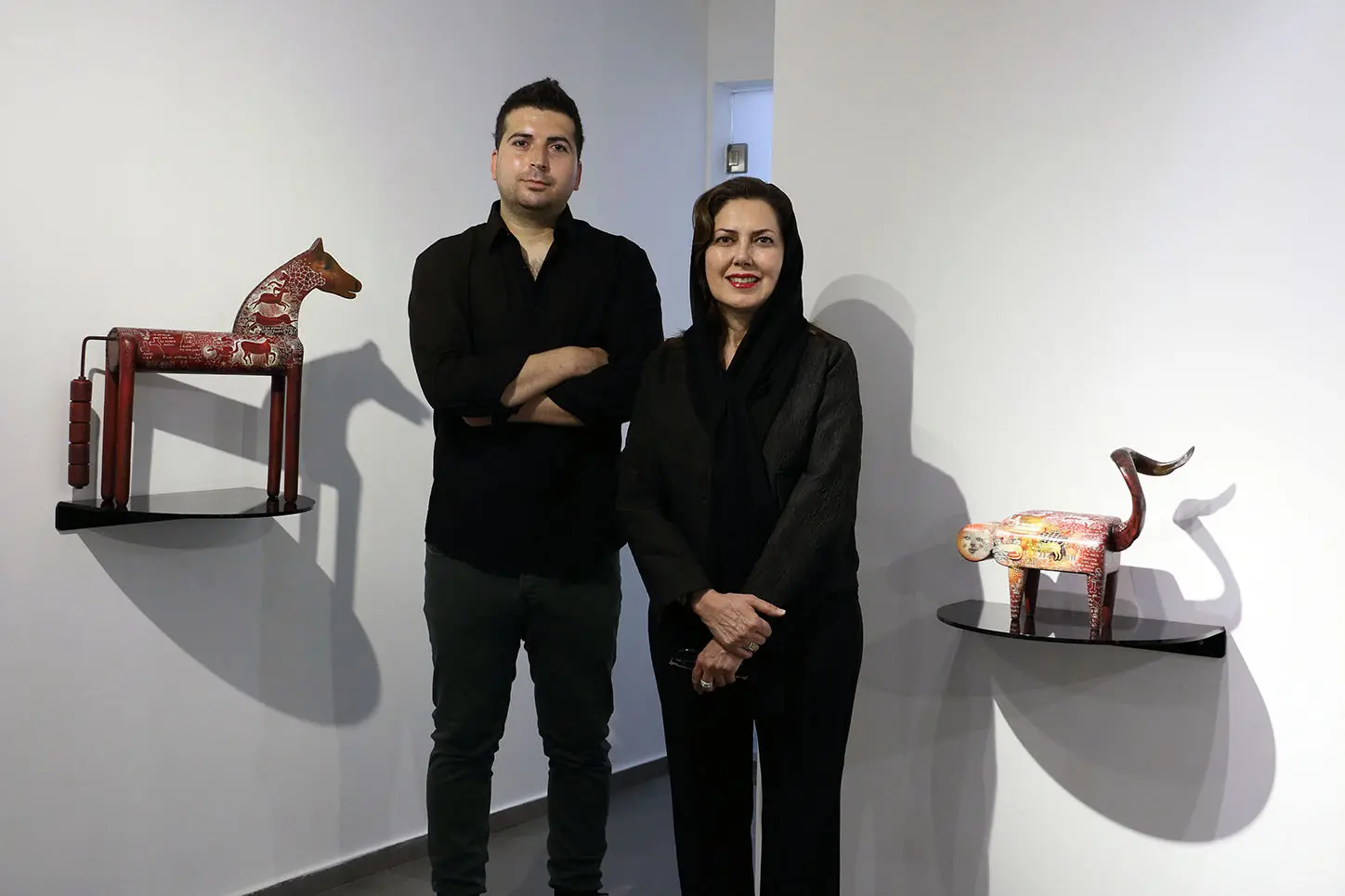
One notable element of the exhibition’s atmosphere is the shadows cast by the lighting onto the walls. The elongated shadows of certain sculptures, particularly those with horns, rods, or extended limbs, create a different image of the sculptures themselves. At times, this second image appears larger and more threatening than the original figure.
Here, shadow can visually extend the meaning of the exhibition’s title. A creature made of wood and metal, with limited physical dimensions, becomes a much larger presence through its shadow. This contrast recalls the distance between what actually stands before us and what the mind constructs from it.
The placement of the works on black pedestals, separated from the walls, also allows each sculpture to become an independent presence within the gallery space. The exhibition, in this sense, is more than a collection of objects; it is an environment that organises the relationship between physical form, light, distance, and the viewer’s gaze.
7.
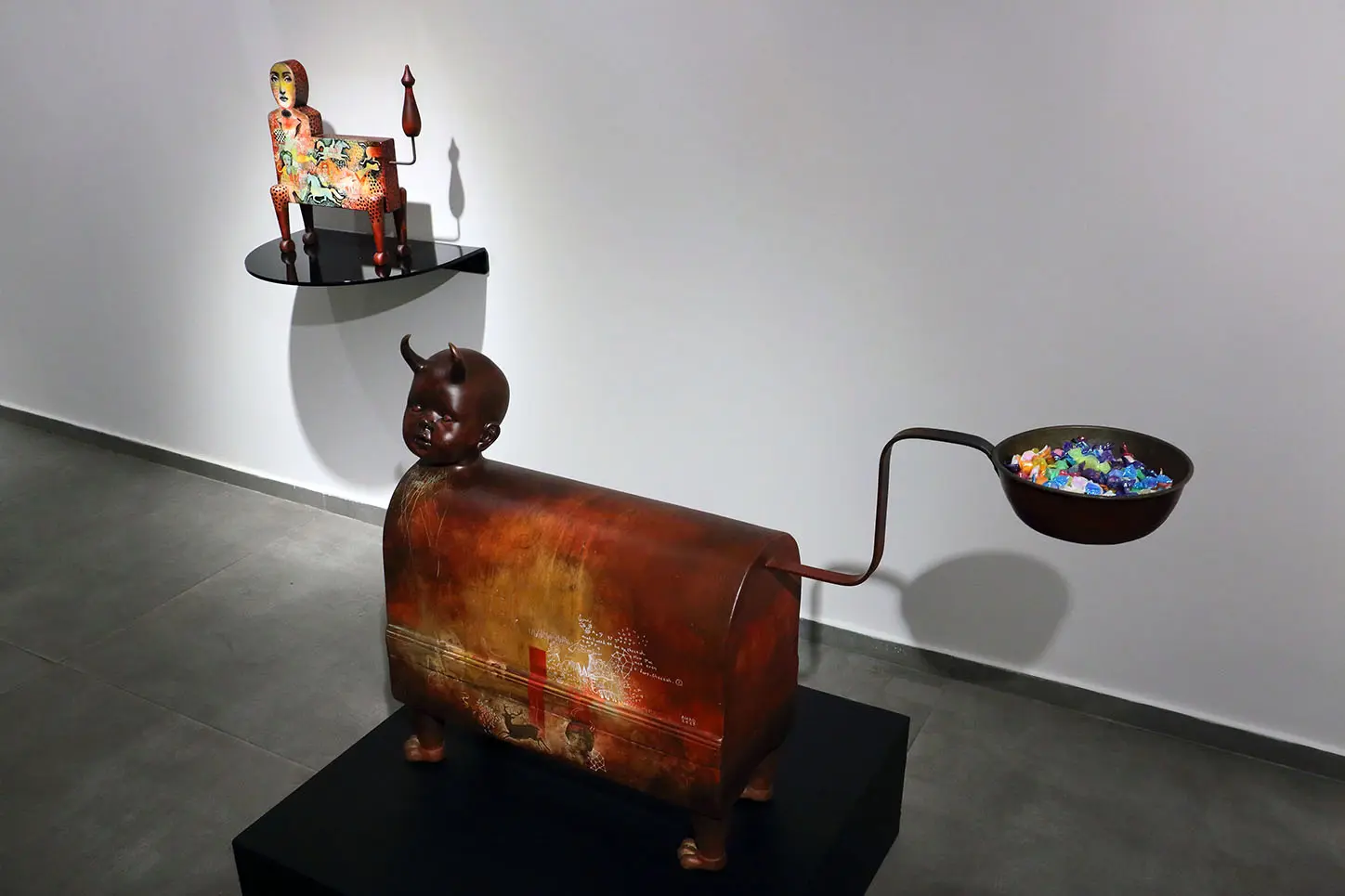
If Khokhan is understood as a figure from oral culture that has traditionally helped shape children’s fears, Ahad Ghadiri’s works offer an indirect reimagining of this mechanism. Fear is not generated through explicit or threatening imagery; instead, it arises from uncertain identities, mismatched limbs, and the inability to classify the creatures.
Yet the playfulness of the colours and the simplicity of certain faces temper this unease. At one moment, viewers may feel alienated by a creature’s strangeness; the next, its eyes or the patterns on its body may draw them closer. This oscillation between fear and empathy is a defining feature of Ghadiri’s artistic world.
8.
One of the most commendable aspects of Ahad Ghadiri’s creativity in the Khokhan series is his use of discarded objects as tails, legs, and other bodily elements of these hybrid creatures. Such assemblages are increasingly open to environmental interpretations, drawing attention to sustainability and the responsible reconsideration of materials within the wider ecosystem.
By giving discarded objects a new purpose and incorporating them into the bodies of imaginary beings, Ghadiri invites viewers to reconsider the potential of materials that might otherwise be thrown away. The objects are not merely reused; they acquire new identities and become integral to the creation of an alternative visual world.
From this perspective, Khokhan at Mojdeh Gallery is also a thought-provoking exploration of environmental concerns, demonstrating how artistic imagination can transform the remnants of everyday life into forms that encourage a renewed awareness of our relationship with materials, consumption, and the environment.
LEAVE A RELPY