
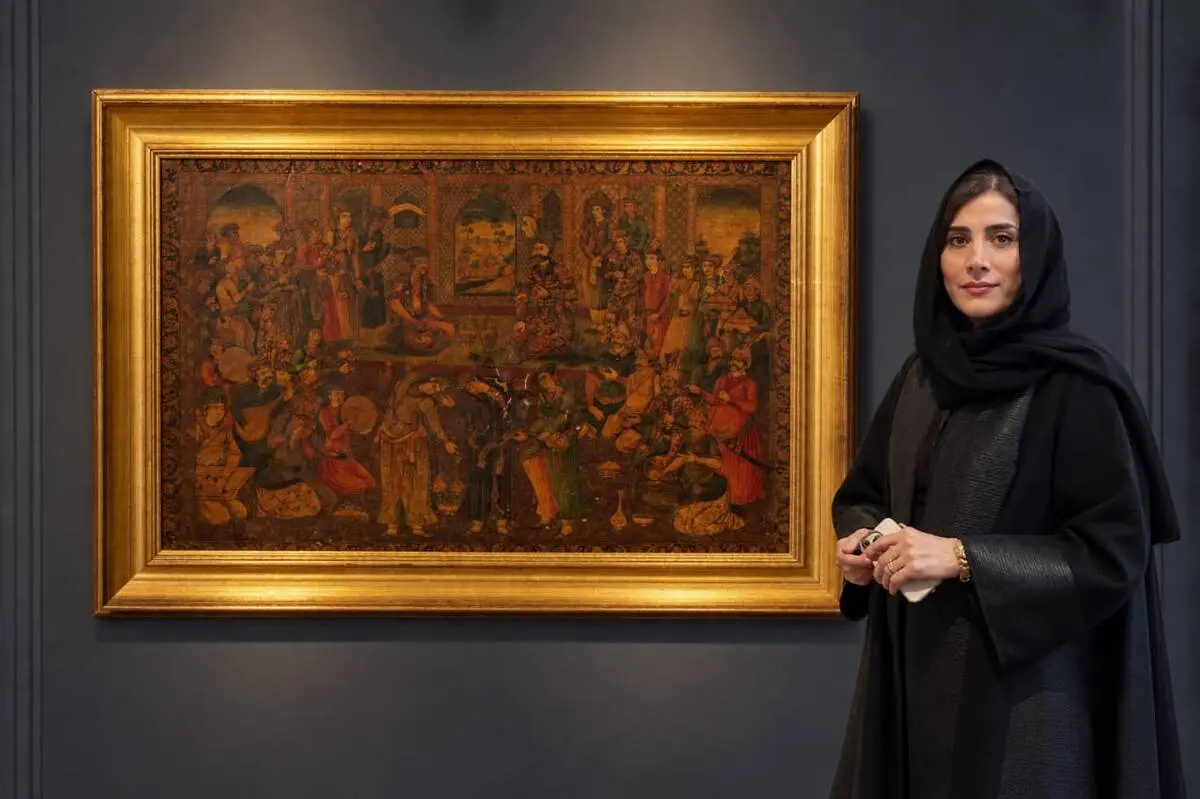
Mahboubeh Kazemi and Agha Najaf Naqqash-Bashi’s 200-Year-Old Masterpiece: From Safavid Courtly Festivities to the Refinement of Qajar Lacquer Painting
This unique painting belongs to a distinguished, documented family in the history of Iranian art: Agha Najaf Naqqash-Bashi. A museum-quality work, it serves not only as an example of traditional visual aesthetics but also as a valuable resource for cultural and social studies.
IranArt : Mahboubeh Kazemi, founder and director of Baran Auction, a specialist auction house dedicated to calligraphy, Iranian art, and Islamic art, introduces and analyses a unique and exceptionally rare painting by Mohammad Ali, son of Agha Najaf Naqqash-Bashi, which is expected to be offered to collectors at the fifth edition of Baran Auction.
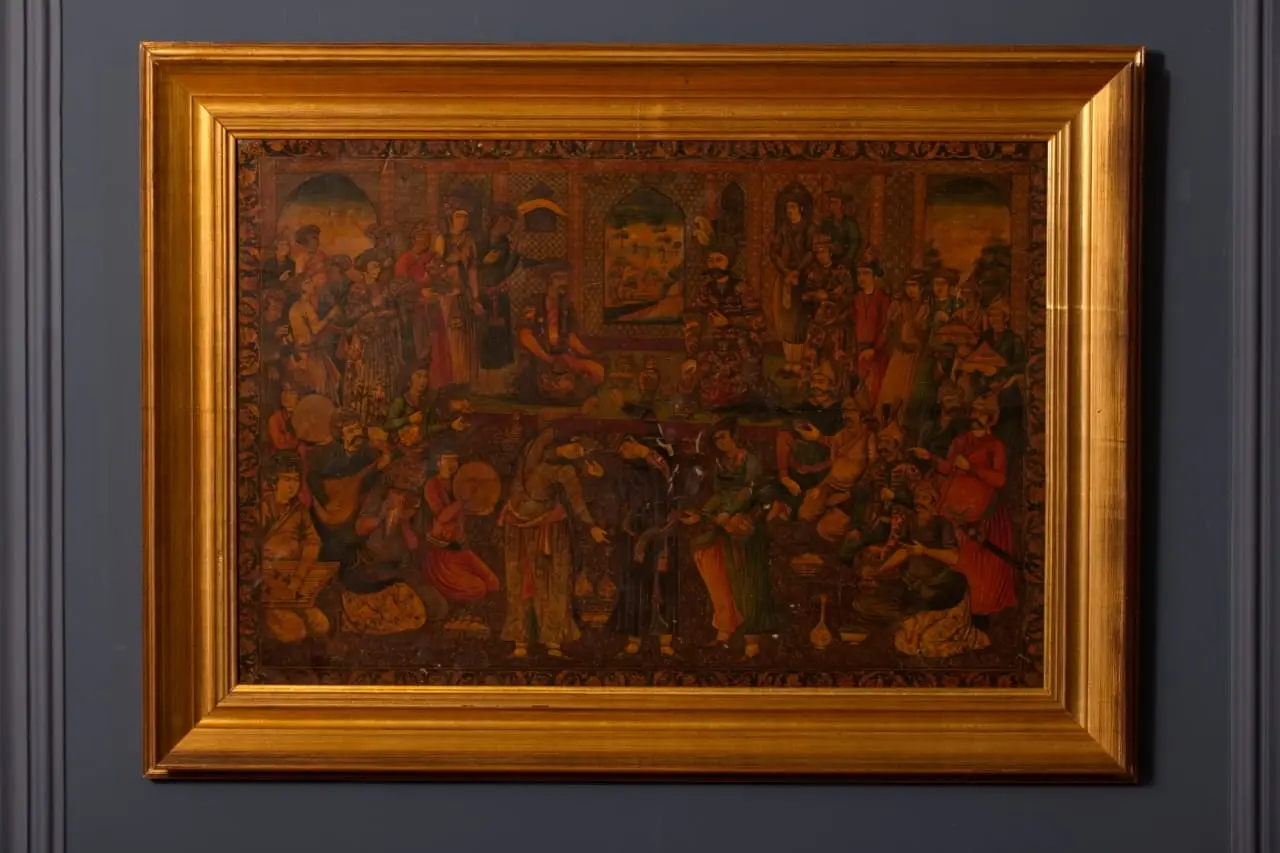
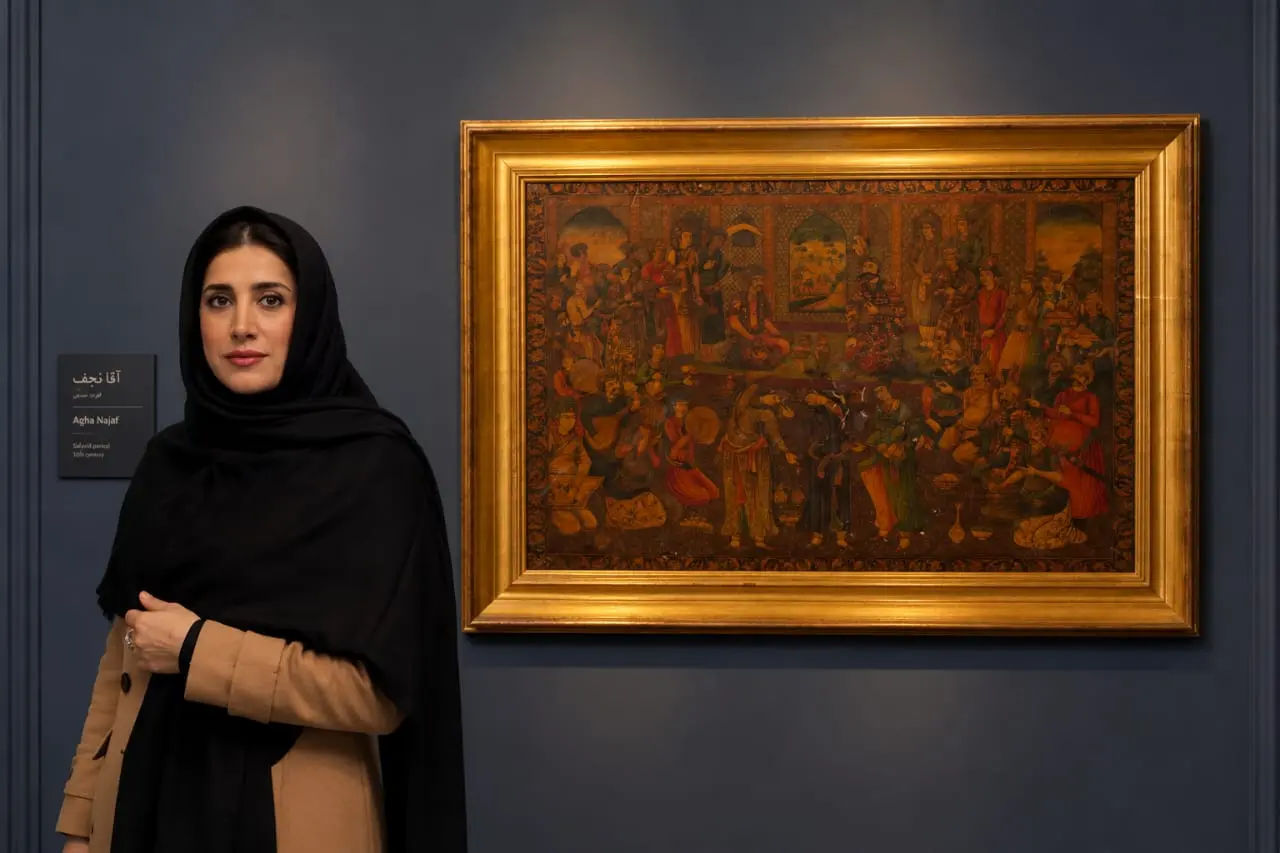
Mahboubeh Kazemi says: “This lacquer painting by Mohammad Ali, son of Agha Najaf Naqqash-Bashi, measuring 70 × 50 centimetres, presents a visual narrative of a royal feast during the reign of Shah Abbas of the Safavid dynasty, interpreted through the artistic language of Qajar-period lacquer painting. History, royal ceremony, music, and the refinement of Iranian painting converge in a richly detailed composition. Beyond its historical subject, the work possesses distinctive qualities in its composition, colour palette, figure design, and surface treatment that make its examination an experience extending far beyond the mere viewing of a courtly gathering.”
The founder and director of Baran Auction notes:
“The considerable dimensions of the work, combined with the density of its figures and ornamentation, draw attention to the technical expertise required to execute such an image on a papier-mâché surface. This technique, based on layers of compressed paper bound together with adhesive materials, was widely employed in Iranian art, particularly in the making of pen boxes, mirror cases, and other finely crafted objects. Executing a multi-figure scene with this degree of detail on a surface measuring 70 × 50 centimetres requires precision in preparing the ground, designing the composition, and completing the final surface.
“In this painting, the lacquered surface provides a setting in which figures, garments, vessels, musical instruments, and architectural ornamentation are depicted simultaneously. The work’s significance lies not merely in its dimensions but in the harmony among its numerous elements and the preservation of the image’s overall coherence. This quality demonstrates the painter’s skill in managing an extensive narrative composition.”
Mahboubeh Kazemi points out:
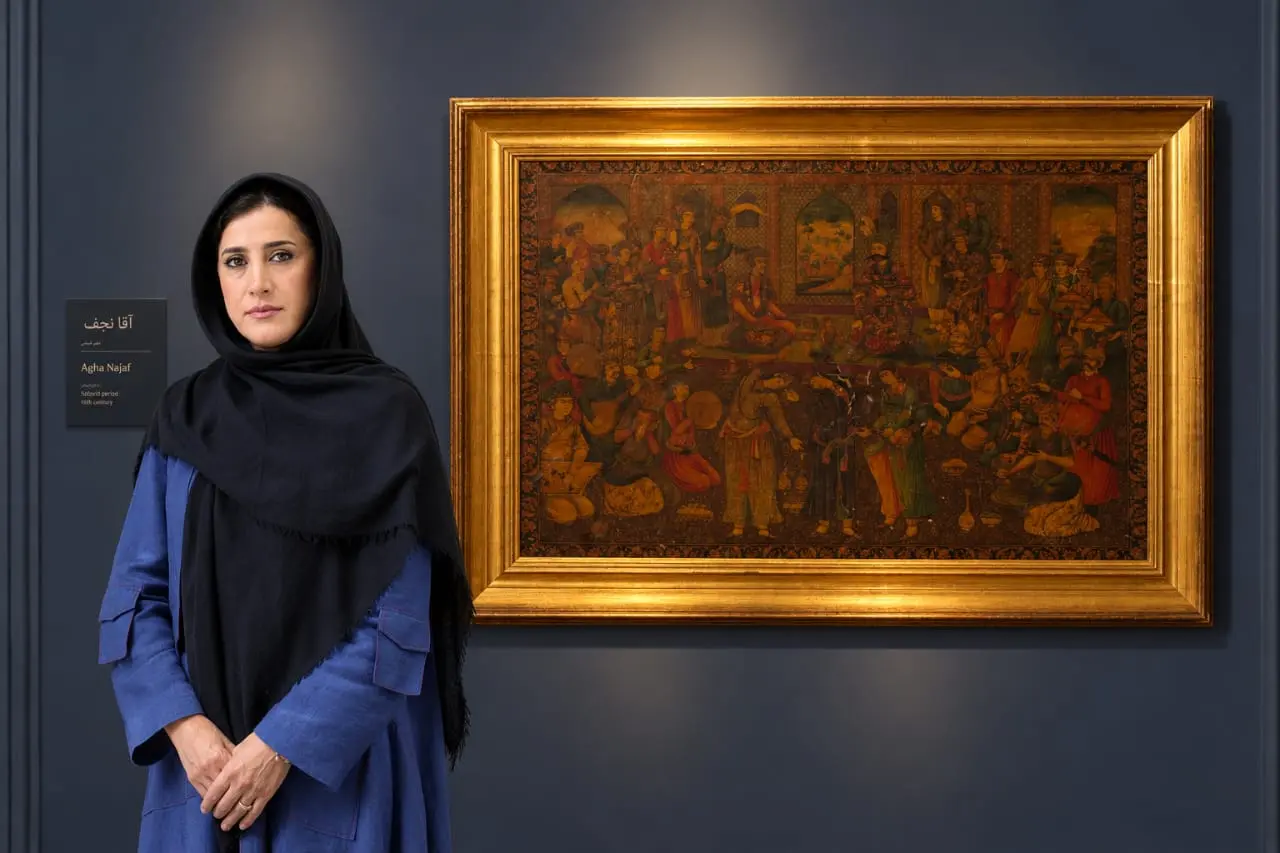
“According to established conventions of Iranian painting, Shah Abbas is seated on an elevated platform in the upper-central section of the composition. His distinctive attire, headgear, and prominent moustache distinguish him from the other figures. His placement at the centre of the composition directs the viewer’s gaze towards the principal focus of the narrative. Groups of attendants and courtiers appear on either side of the ruler, their standing, seated, and turning figures collectively shaping the atmosphere of the gathering.
“In the lower section of the painting, musicians and dancers introduce movement through their varied bodily poses. The extension of arms, the curves of the figures, and the differences in the directions of their gazes create a visual movement that guides the eye from one character to another. The composition is thus organised into two complementary registers: the upper section, centred on the ruler and royal ceremony, and the lower section, emphasising music and entertainment.”
Mahboubeh Kazemi, founder and director of Baran, a specialist auction house for calligraphy, Iranian art, and Islamic art, identifies the colour palette of this painting by Mohammad Ali, son of Agha Najaf Naqqash-Bashi, as one of its most striking features. She explains:
“The palette is dominated by warm, earthy colours, ranging from browns and ochres to deep reds and golden yellows. These hues are integrated with the painting’s relatively dark ground, allowing garments, faces, and decorative details to stand out from the overall surface. Red garments worn by certain figures, alongside the yellows and golds found in clothing and objects, create accents that help distribute visual weight throughout the composition.
“By contrast, the dark background and sections of the architecture reinforce the depth and unity of the scene. Colour is not used here merely to represent objects. Its repetition and contrast across different groups generate a visual rhythm that prevents the viewer’s gaze from becoming dispersed among the numerous figures. The brilliance of the golden elements, set against more muted colours, also lends a ceremonial quality to the garments and ornamentation.”
Mahboubeh Kazemi identifies another distinguishing feature of Mohammad Ali, son of Agha Najaf Naqqash-Bashi’s painting in the cultural and social insights it offers into its historical period. She says:
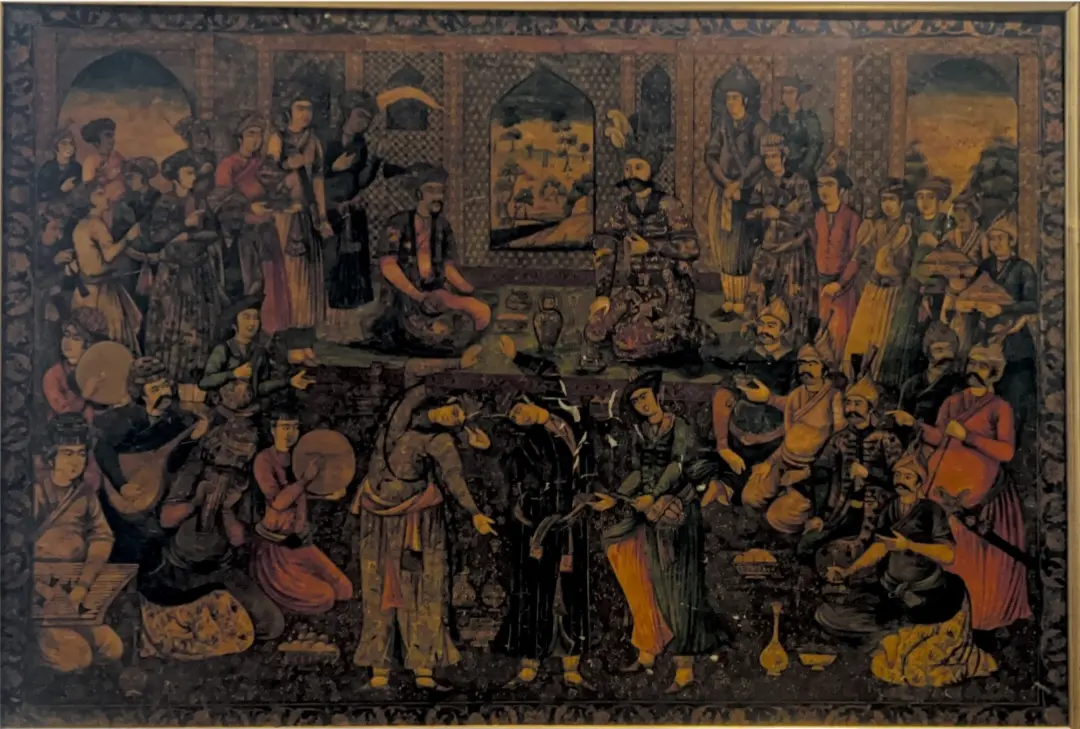
“The arches and architectural frames in the background transform the scene into a defined and carefully organised space. Landscapes visible through some of these frames, together with geometric patterns and wall decorations, introduce variety across the pictorial surface. Nevertheless, the suggestion of depth remains subordinate to the overall narrative, while the decorative principles of Iranian miniature painting continue to govern the image, allowing its individual details to retain their visual significance.
“In the lower section of the painting, musicians playing instruments such as frame drums and stringed instruments contribute to the musical atmosphere of the gathering. The dancers, positioned at the centre of this section, enhance the scene’s dynamism through their varied arm and body movements. Vessels, fruit, and other elements associated with hospitality offer a glimpse into the culture of feasting and courtly ceremony. These details elevate the scene beyond a formal royal portrait, bringing the social and cultural dimensions of court life into view.”
The director of Baran Auction identifies the meticulous treatment of details, including the carefully executed decorative border, as another distinctive characteristic of the painting. She emphasises:
“The dark border and the vegetal ornamentation surrounding the painting establish a boundary between the animated world within the image and the space beyond it. This ornamental frame underscores the work’s autonomy while remaining consistent with the decorative traditions of Iranian lacquer art. The treatment of the faces, variations in clothing, and details of the hands and musical instruments further demonstrate that the painter’s attention was not limited to depicting the gathering as a whole. The representation of even the smallest elements played an important role in the structure of the work.”
In conclusion, Mahboubeh Kazemi, founder of Baran Auction, considers the painting attributed to Ali, son of Agha Najaf Naqqash-Bashi, historically significant and worthy of a place in a museum collection for at least three additional reasons.
“The first and foremost point is the significance of the name Ali, son of Agha Najaf Naqqash-Bashi. He was the son of Agha Najaf, an artist belonging to a distinguished family in Iran’s lacquer-painting tradition, and himself attained the rank of Naqqash-Bashi. In the Qajar court, the title ‘Naqqash-Bashi’ was not merely ceremonial. It denoted an artistic and courtly office associated with the leadership and supervision of court painters and the royal workshop. From this perspective, the title identifies more than an individual artist; it also indicates his position within the formal structure of court art.
“The second point lies in the painting’s particular significance as a synthesis of a subject drawn from the splendour of the Safavid era and the visual language of Qajar lacquer art. Through colour, ornamentation, figure painting, and details of courtly life, the work recreates a historical scene while demonstrating the exceptional capacity of lacquer art to convey elaborate narratives on a large scale, beyond the confines of small, functional objects.
“The third point is the work’s distinctive scale. Within the tradition of Iranian lacquered papier-mâché art, large dimensions combined with such a dense arrangement of figures, ornamentation, and narrative details set this painting apart from more conventional examples. Its scale, together with the quality of its execution and its attribution to Ali, son of Agha Najaf Naqqash-Bashi, reinforces its standing as a museum-quality work and an exceptionally rare masterpiece.
This painting is not simply a precious object or a decorative example of lacquer art. It brings together history, visual tradition, courtly art, technical mastery, and the social culture of Iran within a single pictorial composition.
The presentation of this work at the fifth Baran Auction offers an opportunity to renew attention to Iran’s lacquer-painting heritage and to the value of unique, museum-quality works that can serve as a link between art history, cultural memory, and Iran’s professional art market. Their significance extends beyond aesthetics; they also have the potential to be studied and preserved in distinguished collections as part of Iran’s visual heritage.”
LEAVE A RELPY