
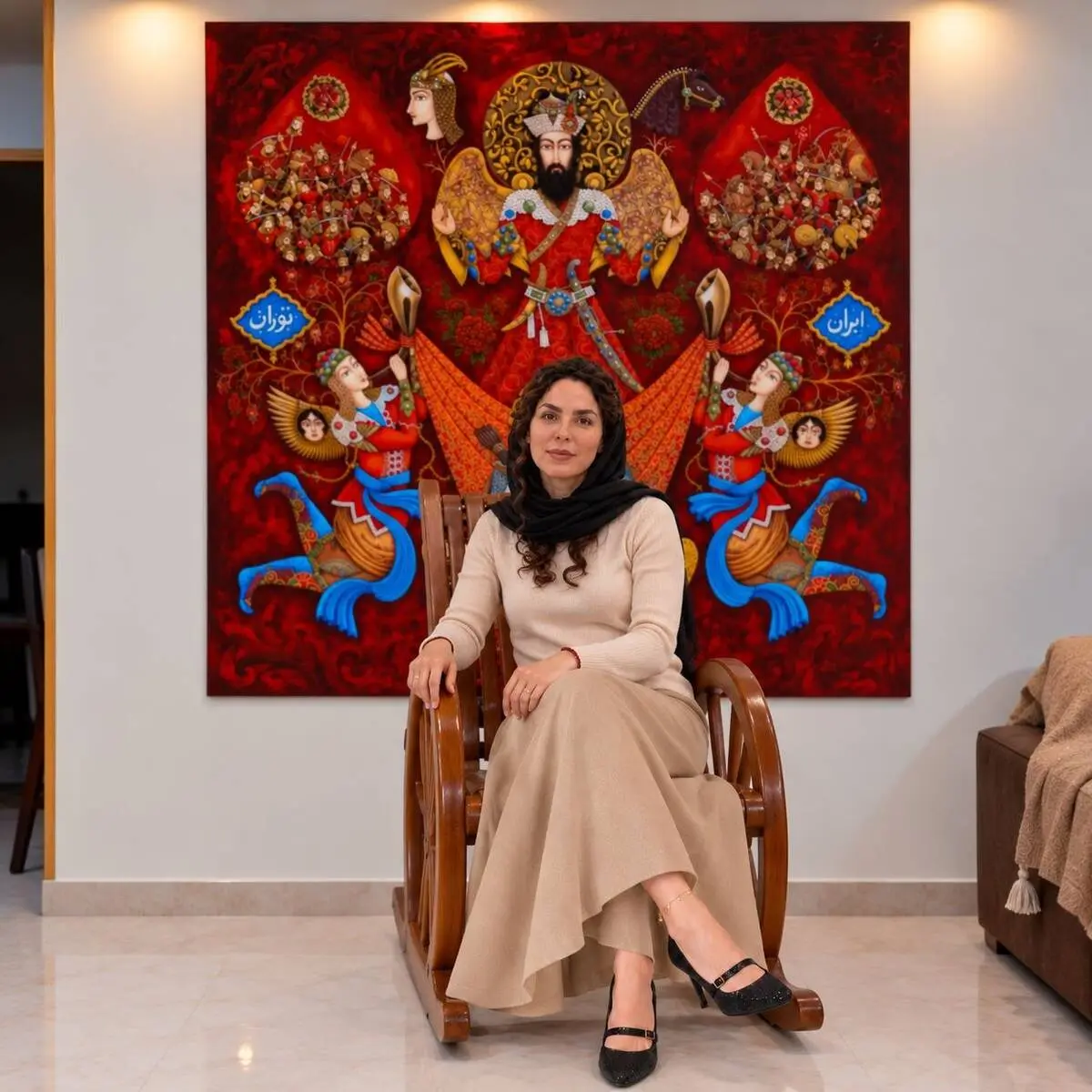
Fatemeh Ahmadian and Her Painting Arash the Archer / A Reinterpretation of Myth
Fatemeh Ahmadian and Her Painting Arash the Archer / A Reinterpretation of Myth
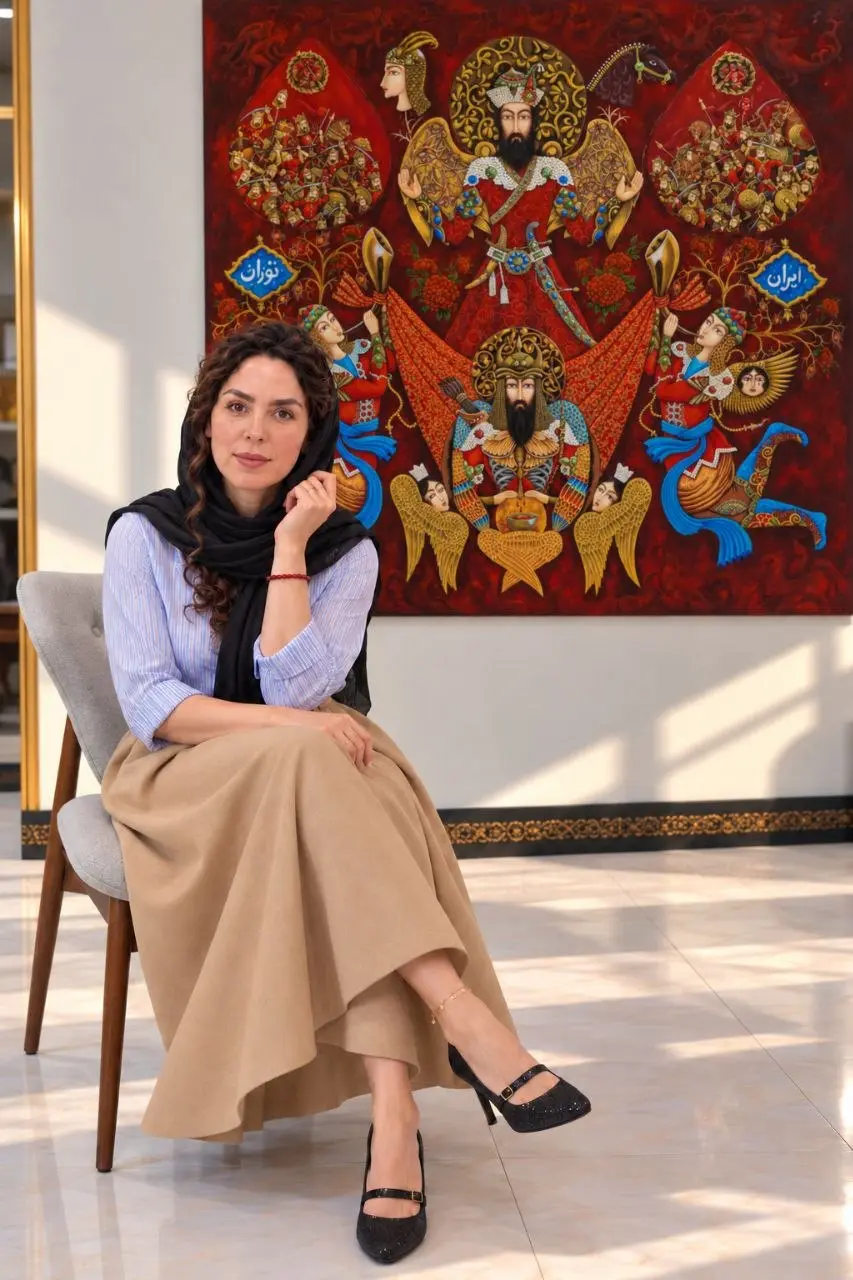
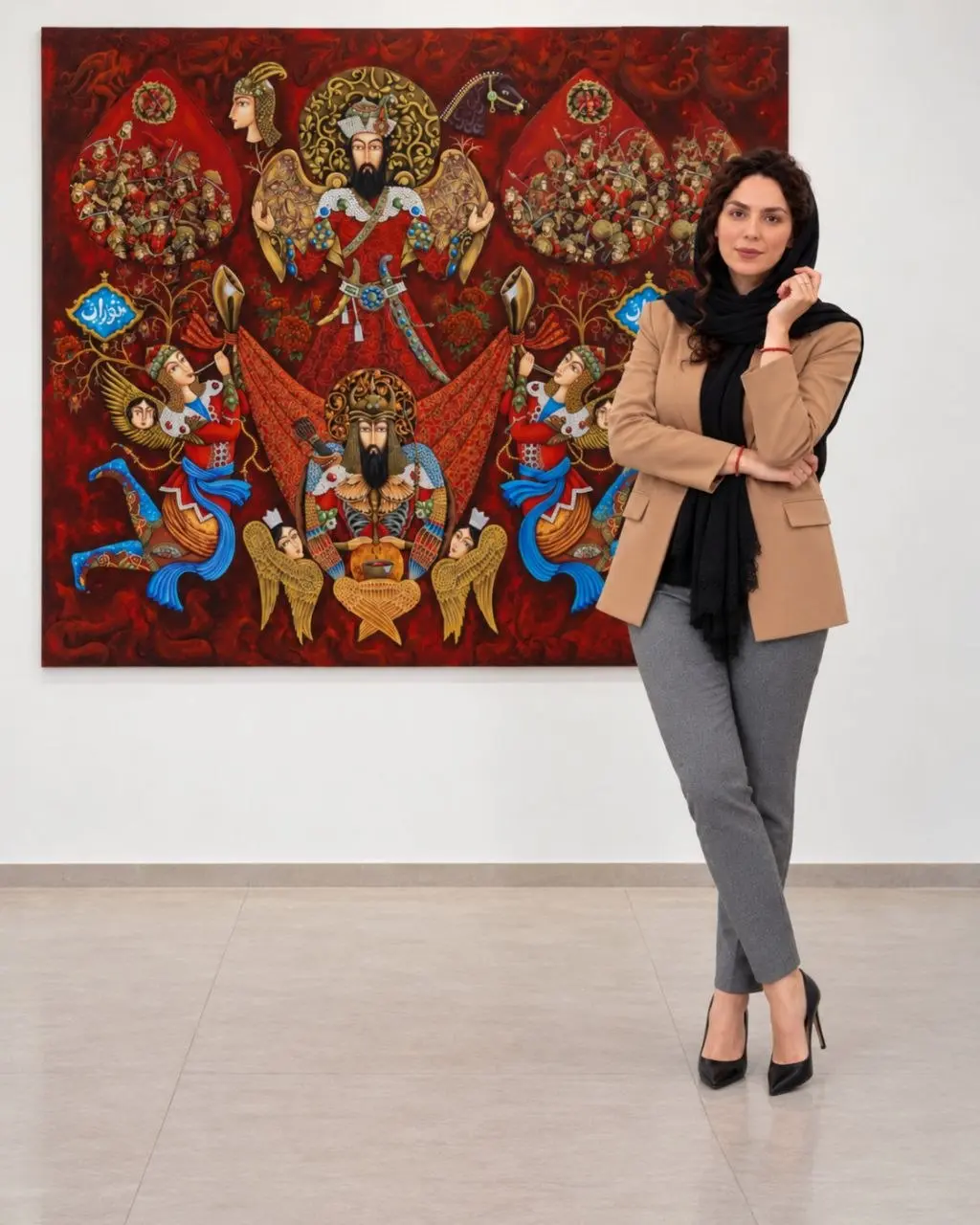
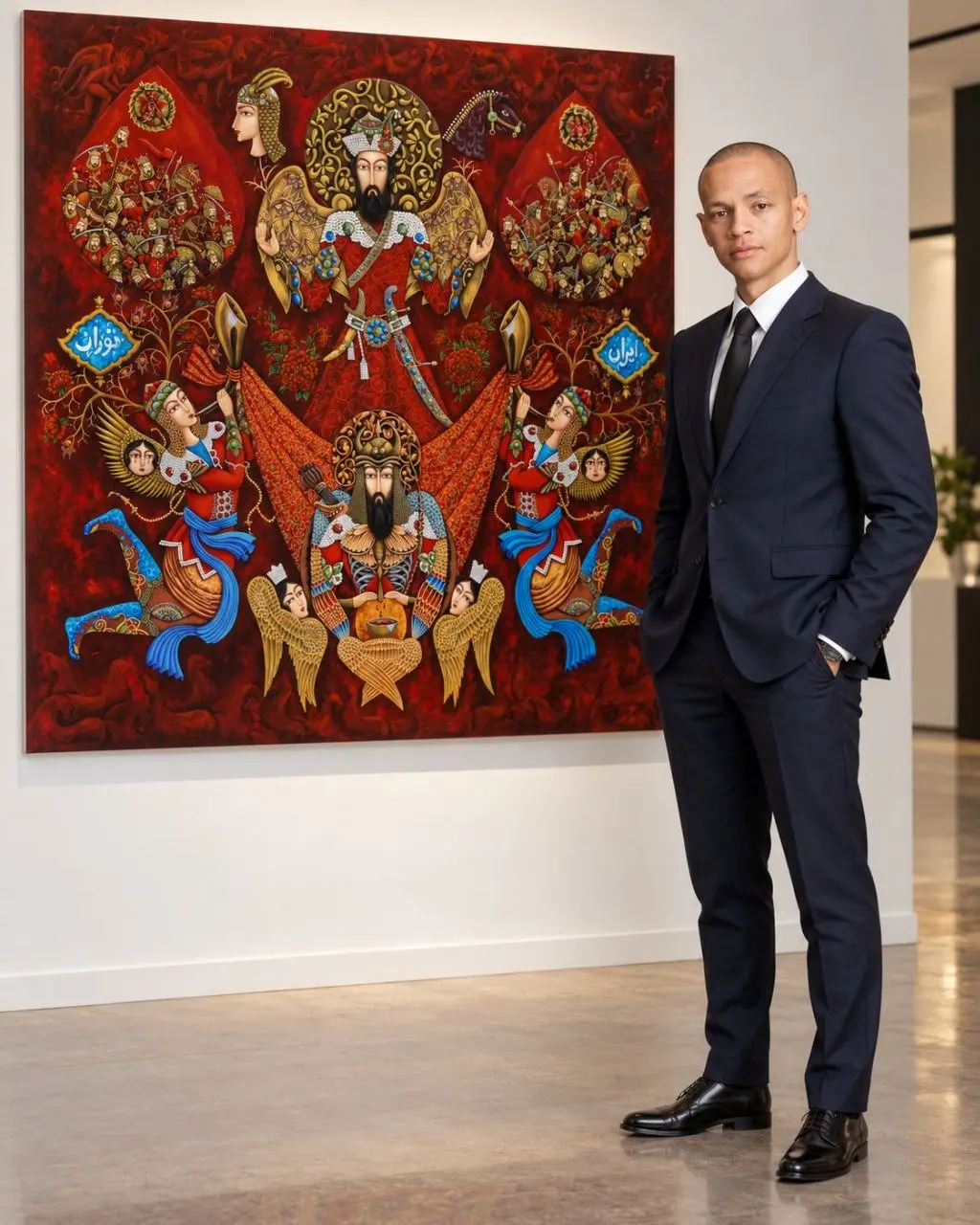
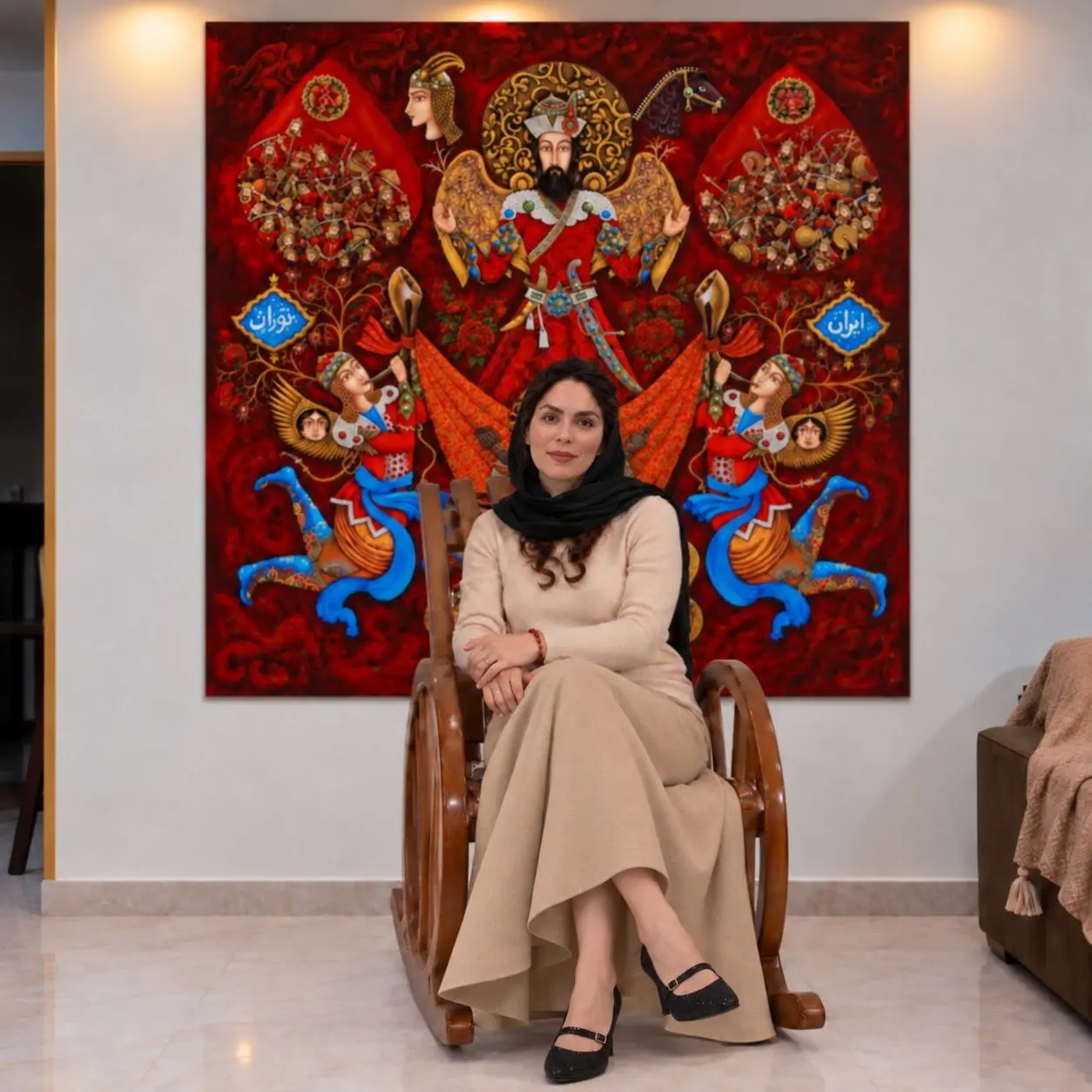
ArtDayMe : We examine Arash the Archer, a painting by Fatemeh Ahmadian, created in 2022 using oil on canvas. Measuring 160 × 160 cm, the work was acquired by Jason Carey, a Jamaican art collector based in Dubai.
- Fatemeh Ahmadian’s Artist Statement on Arash the Archer
“Arash the Archer is not merely the story of a mythological hero for me. More than anything, it is about war, power, misguided decisions, and the people who pay for those decisions with their lives.
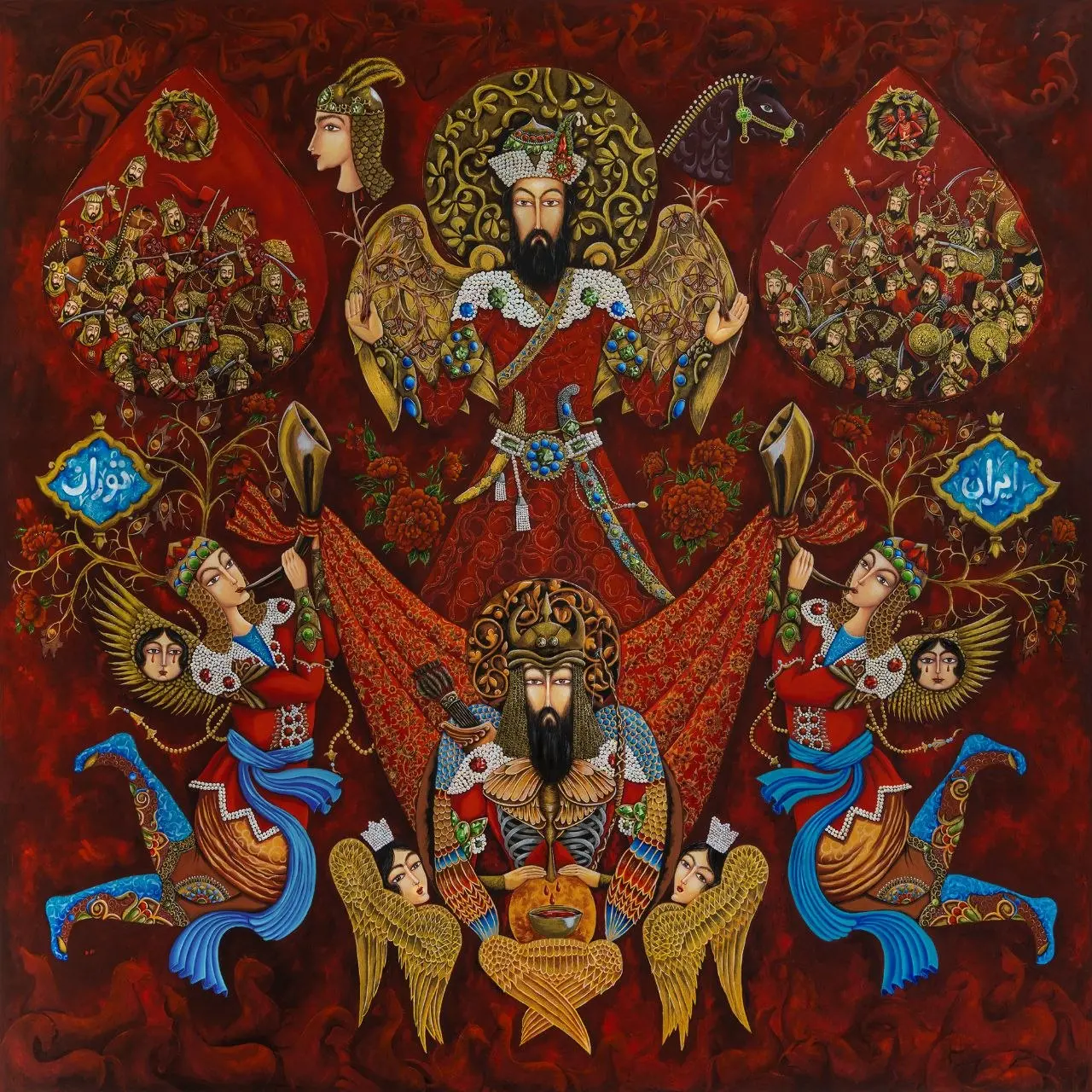
At the top of the painting, I have depicted Manuchehr, the king caught up in the conflict between Iran and Turan. He remains standing in his place with dignity and grandeur, while signs of war surround him: armies, a severed head, a horse, and people who have fallen victim to this conflict. This section of the painting is particularly important to me because, in every war, there are those who make the decisions and others who bear the cost of those decisions.
At the bottom of the painting, I have placed Arash the Archer. For me, Arash is not simply someone who released an arrow; he is someone who sacrifices himself to bring an end to a conflict. That is why I wanted his position in the painting to convey a sacred and enduring presence. Two angels support him from below, while the angels on either side seem to be carrying him upwards.
The branches extending from around the angels symbolize taking root. They suggest that some people do not come to an end with their death. What they do remains alive in society, in history, and in people's minds. Many people are killed in wars and eventually forgotten, but Arash remains alive because of what he did, and his name endures.
In the background, I have once again depicted the conflict between an angel and a demon: the eternal struggle between good and evil, humanity and violence, self-sacrifice and the pursuit of power.
Red is the dominant colour of the painting because its subject is connected to war, blood, and tension. However, I did not want the painting to appear violent or disturbing. For this reason, I used luminous colours, ornamentation, and an abundance of details, so that the viewer would first encounter the beauty of the image and gradually discover the bitterness of its subject.
It was important to me that the painting should be beautiful in its outward appearance, but that, upon looking at it more closely, the viewer would gradually realize that behind this beauty lies a tragic narrative of war and the sacrifice of human lives.
If I were to summarize the entire painting in one sentence, I would say: Those who possess power may remain where they are, but those who sacrifice themselves for others become immortal in history.”
- An Aesthetic Analysis of Fatemeh Ahmadian’s Arash the Archer
Through an aesthetic reading of Fatemeh Ahmadian’s Arash the Archer, one might describe the painting as “a point where epic narrative, Persian miniature painting, and contemporary imagination converge.”
Fatemeh Ahmadian’s painterly approach to revisiting one of the most enduring myths of Iranian culture adopts an ancient and classical visual appearance while speaking in a contemporary artistic language.
In this work, Fatemeh Ahmadian goes beyond the straightforward representation of an epic narrative. She constructs a visual world in which myth, history, cultural symbols, imagination, and decorative elements are interconnected within a multilayered structure. The result is an image that resembles an allegorical and mythological tableau more than a conventional narrative scene.
1. Composition: The Symmetrical Architecture of an Epic Narrative
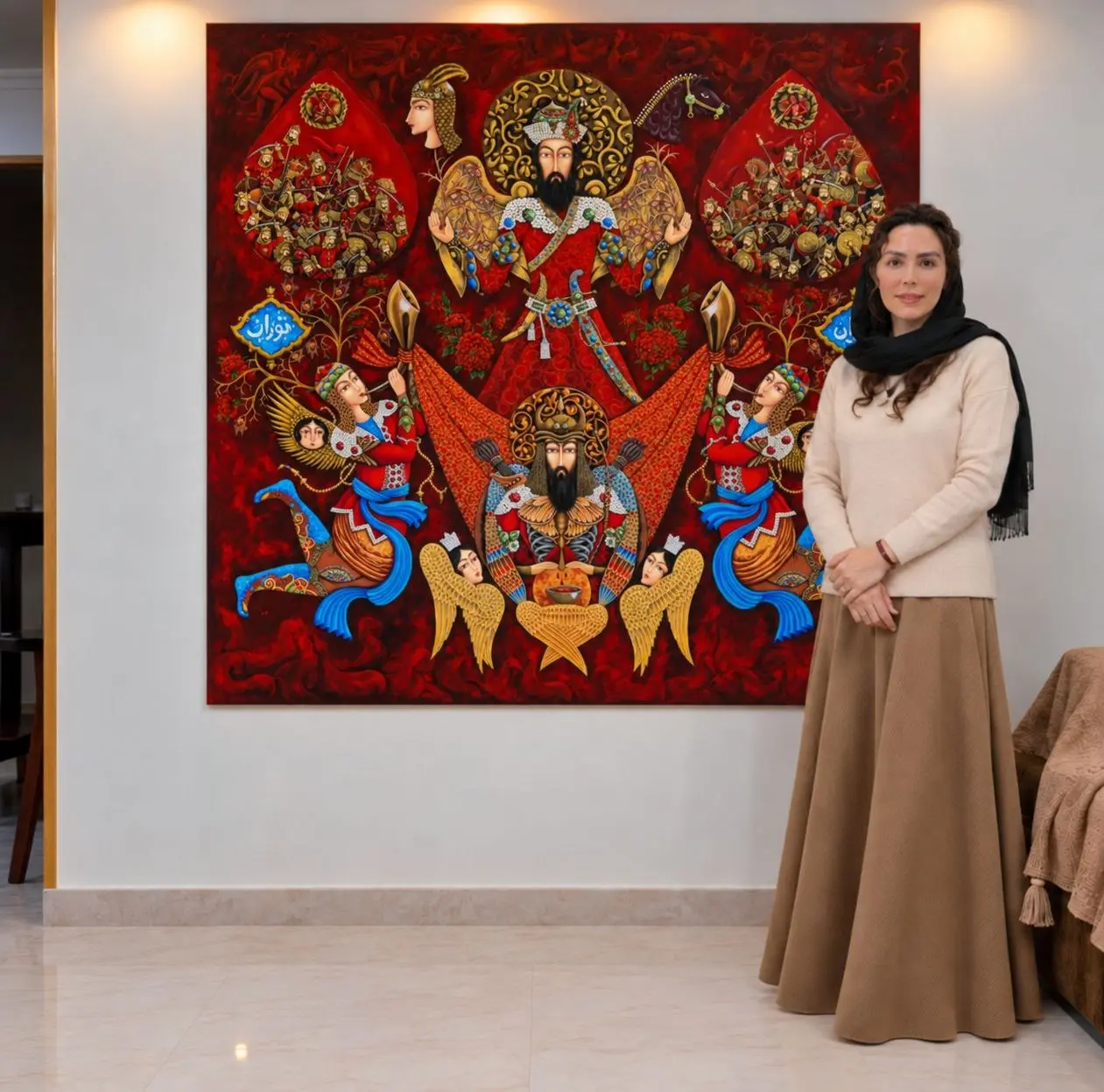
The first striking characteristic of Fatemeh Ahmadian’s work is its geometric organization and relatively strong symmetry. By positioning the principal figures along a vertical axis and placing corresponding elements on either side of the composition, the artist establishes a form of ceremonial balance. This symmetry is not merely a device for organizing the image; it also lends the painting's mythological world a ceremonial and timeless quality.
The central figure in the upper section, surrounded by an expansive decorative halo, constitutes the most important point of visual focus. Continuing along the vertical axis, another figure, dressed in battle attire and adorned with elaborate ornaments, appears surrounded by two angels and a collection of symbolic elements. This arrangement guides the viewer's eye from the centre towards the surrounding areas and subsequently downwards through the composition.
In effect, the composition moves away from the logic of linear storytelling towards a simultaneous, multicentred structure, as though the past, the present, and mythological memory have come together within a single frame.
2. Colour: The Red of Epic Struggle and the Radiance of the Sacred
Fatemeh Ahmadian’s colour palette in Arash the Archer is one of the painting’s most important instruments of conceptual expression. The dominance of red, burgundy, crimson, and dark brown creates an atmosphere charged with passion, tension, and epic intensity. Here, red is not merely the colour of blood and battle; it can simultaneously evoke grandeur, authority, fire, and the force of life.
Against this warm and densely layered background, the luminous blues of the garments worn by the flanking figures and the inscriptions on either side of the painting function as points of visual relief. This chromatic contrast prevents the pictorial surface from becoming monotonous or visually exhausting through the accumulation of red tones.
Gold also plays a decisive role. In the central halo, wings, armour, crowns, and botanical ornaments, gold becomes a means of emphasizing grandeur and mythological significance. The interplay of luminous blue, gold, and white against red establishes a chromatic hierarchy in which the viewer's gaze continually moves between power, sanctity, and emotional intensity.
3. Line and Ornament: The Legacy of Persian Miniature Painting in a Contemporary Visual Language
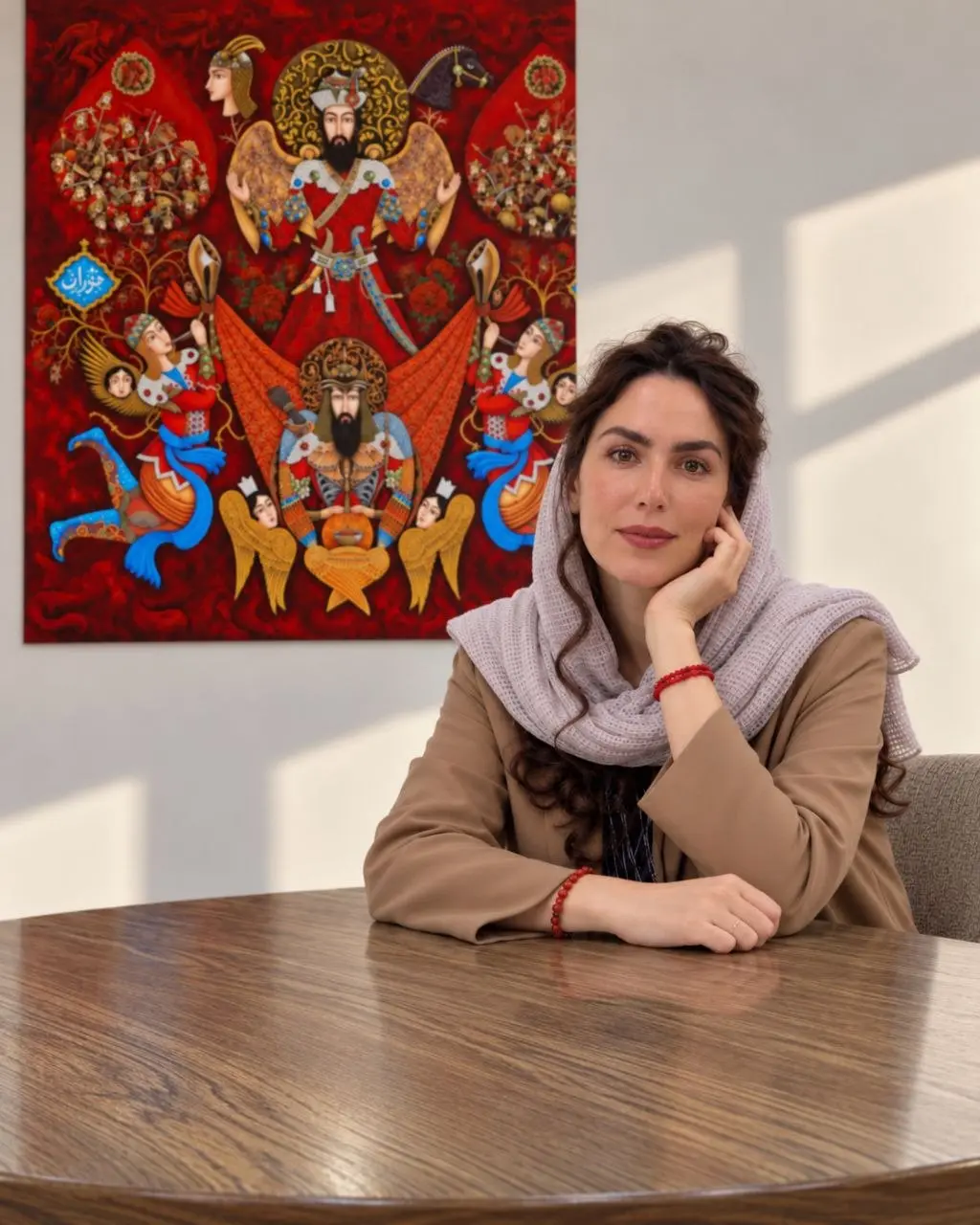
One of the notable aspects of Fatemeh Ahmadian’s work is the importance of line in organizing its forms. Figures, garments, armour, plants, and even decorative structures are defined through precise and continuous lines. This characteristic brings the painting close to the tradition of Persian miniature painting and narrative art, in which line is not merely a boundary separating objects but an independent element of the work's aesthetic language.
Ahmadian draws visibly upon this heritage without simply reproducing it. Through her use of oil paint, chromatic modelling, restrained chiaroscuro, and meticulous detailing, she gives the forms a distinctive character. In this way, the painting moves between the narrative tradition of Iranian painting and the personal expression associated with contemporary art.
4. Texture and Detail: The Aesthetics of Accumulation
In this painting, Fatemeh Ahmadian transforms the canvas into a space for the display of intricate details. Coloured stones on garments, botanical motifs, armour, feathers, crowns, and the ornamental decoration of horses all contribute to the creation of a densely textured visual surface.
This density generates a particular kind of visual pleasure, rooted in the discovery of details. With each viewing, the audience can identify a new element in another corner of the composition. At the same time, this characteristic introduces an aesthetic challenge: how can the richness of ornamentation be balanced with the overall legibility of the work?
By maintaining a central axis and repeating symmetrical structures, Ahmadian largely manages to control this risk. Nevertheless, the abundance of details occasionally diverts attention from the principal narrative action, allowing ornamentation itself to become an independent subject of contemplation.
5. Figuration: Between Human, Hero, and Symbol
The direct gazes, relatively composed faces, idealized proportions, and ceremonial poses transform the characters into mythological signs rather than individuals with distinct personalities and emotional complexities.
This choice is consistent with the visual logic of mythological painting. In such a world, the hero is not simply an individual; he embodies a meaning that extends beyond his personal existence.
The two flanking figures, with their military attire and similar gestures, do more than establish symmetry. They also lend the pictorial space a sense of protection and ritual presence. The angels in the lower section, with their expansive wings and symmetrical arrangement, connect the epic atmosphere to the realm of allegory and the supernatural.
6. Space and Depth: A World Between Reality and Imagination
Fatemeh Ahmadian moves away from conventional perspective and the realistic representation of three-dimensional space. Elements of varying scales are positioned alongside one another on different visual planes. The figures, emblems, horse, and battle scenes are governed less by the laws of natural space than by their narrative and symbolic significance.
This characteristic recalls the visual logic of Persian miniature painting, where time and place can coexist simultaneously on a single surface.
The red and dark background, rather than creating geographical depth, establishes a kind of psychological and theatrical space: a world in which all the elements seem to unfold within the collective memory of a nation.
7. Symbolism: From Iran and Turan to Historical Memory
Another deliberate painterly intervention by Fatemeh Ahmadian is the creation of two blue inscriptions, “Turan” and “Iran”, on either side of the composition. These symbols direct the interpretation of the painting towards the mythological confrontation between the two territories. The battle scenes in the upper sections further reinforce this opposition.
In the myth of Arash the Archer, the central issue is not simply military victory. It concerns the determination of a territorial boundary and the collective salvation of a people through the sacrifice of a hero. Arash, therefore, becomes a symbol of the connection between the individual and the destiny of an entire land.
An important aspect of Fatemeh Ahmadian’s painting is the transformation of this concept into a multilayered visual structure. The presence of military symbols, mythological figures, decorative elements, and ceremonial arrangements elevates the epic beyond a historical event and transfers it into the realm of cultural memory.
8. Arash as an Image of Identity
Arash the Archer can be regarded as an example of an attempt to restore the visual potential of Iranian mythology within the language of contemporary painting.
Rather than adopting a minimalist approach or a realistic mode of representation, Fatemeh Ahmadian has created a dense, colourful, and richly ornamented world in which the aesthetics of Persian miniature painting, narrative art, symbolism, and personal imagination converge.
One of the work's principal strengths lies in the female artist's ability to construct a coherent visual system from numerous elements, a system in which colour, line, texture, and symmetry play complementary roles. Although the abundance of details occasionally reduces the narrative focus, it also creates opportunities for multiple interpretations and the continuous discovery of new visual elements.
The value of this painting should not be sought solely in its representation of a mythological hero. The central question is how an ancient narrative can be transformed into a visual experience in the contemporary era. On this canvas, Arash is no longer merely an archer who releases an arrow to determine a territorial boundary. He becomes a symbol of sacrifice, belonging, identity, and the connection between individual destiny and collective fate.
This is precisely the point at which the painting moves beyond retelling a myth and arrives at the reinvention of its meaning.
It is worth noting that Fatemeh Ahmadian’s mythological painting Arash the Archer was acquired by Jason Carey, a Jamaican art collector based in Dubai, and is now held in his private art collection.
- The Art Market and the Prices of Fatemeh Ahmadian’s Works
Fatemeh Ahmadian (born 1982, Khansar) holds a bachelor's degree in Islamic Arts, specializing in Ceramics and Sculpture, from Isfahan University of Art.
In 2021, her painting Prophet Jonah (Younes Nabi), measuring 160 × 200 cm, was acquired in a private transaction for US$4,500 by Jason Carey, a Jamaican art collector based in Dubai. The work is now held in his private art collection.
Another painting by Fatemeh Ahmadian, titled Rostam's Fourth Trial: Rostam's Battle with the Sorceress, was created in 2021 using oil on canvas and measures 160 × 200 cm. The work was purchased by Shahdad Fazeli and is currently housed in the Fazel Museum Library in Khansar, Isfahan Province.
Fatemeh Ahmadian’s works have attracted the attention of the art community and the art market because of their distinctive worldview and thematic approach. The concepts underlying her paintings are such that, at first glance, they appear classical and traditional, while their contemporary dimensions gradually become apparent after a few minutes of closer observation.
It is this distinctive conceptual dimension, together with her considerable drawing skills, that has contributed to the growing appreciation of her works.
LEAVE A RELPY