
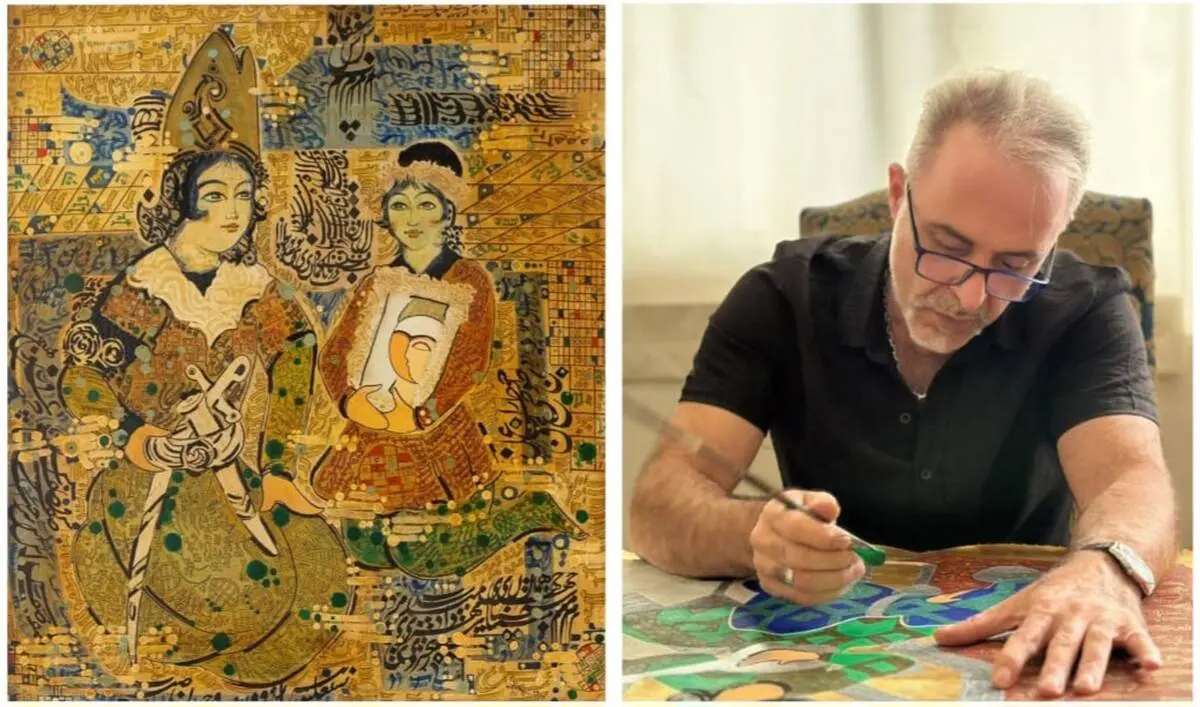
Mehrdad Fallah and Aja'ib al-Makhluqat: A Visual Narrative of Identity, Memory, and Wonder
Reading Mask from the Aja'ib al-Makhluqat Series: The Convergence of Calligraphy, Iranian Motifs, and Reflections on the Human Face.
ArtDayMe : Following the sale of a painting by Mehrdad Fallah at the Second Kavian Auction on November 6, 2026 , we turn our attention to another work by the artist.
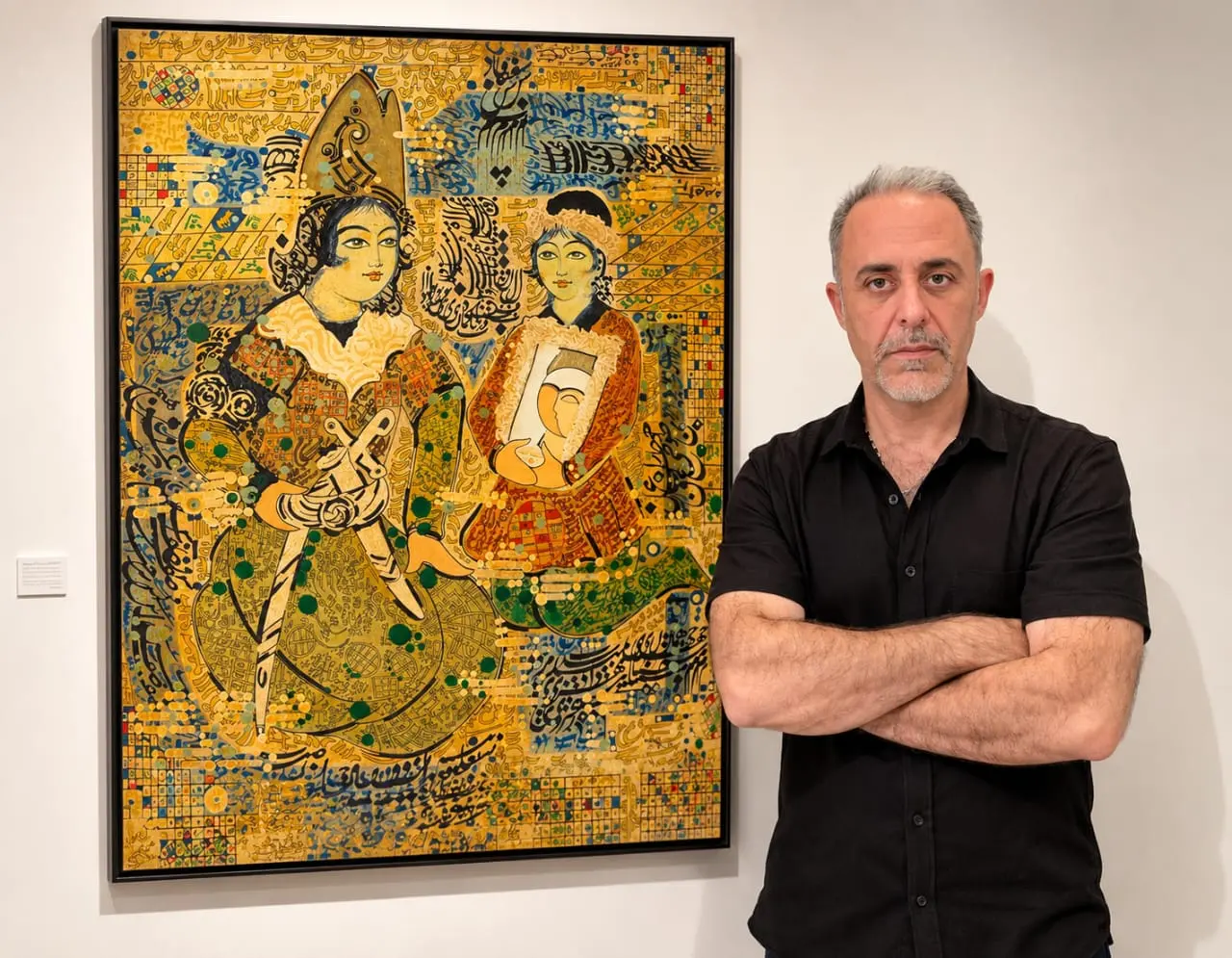
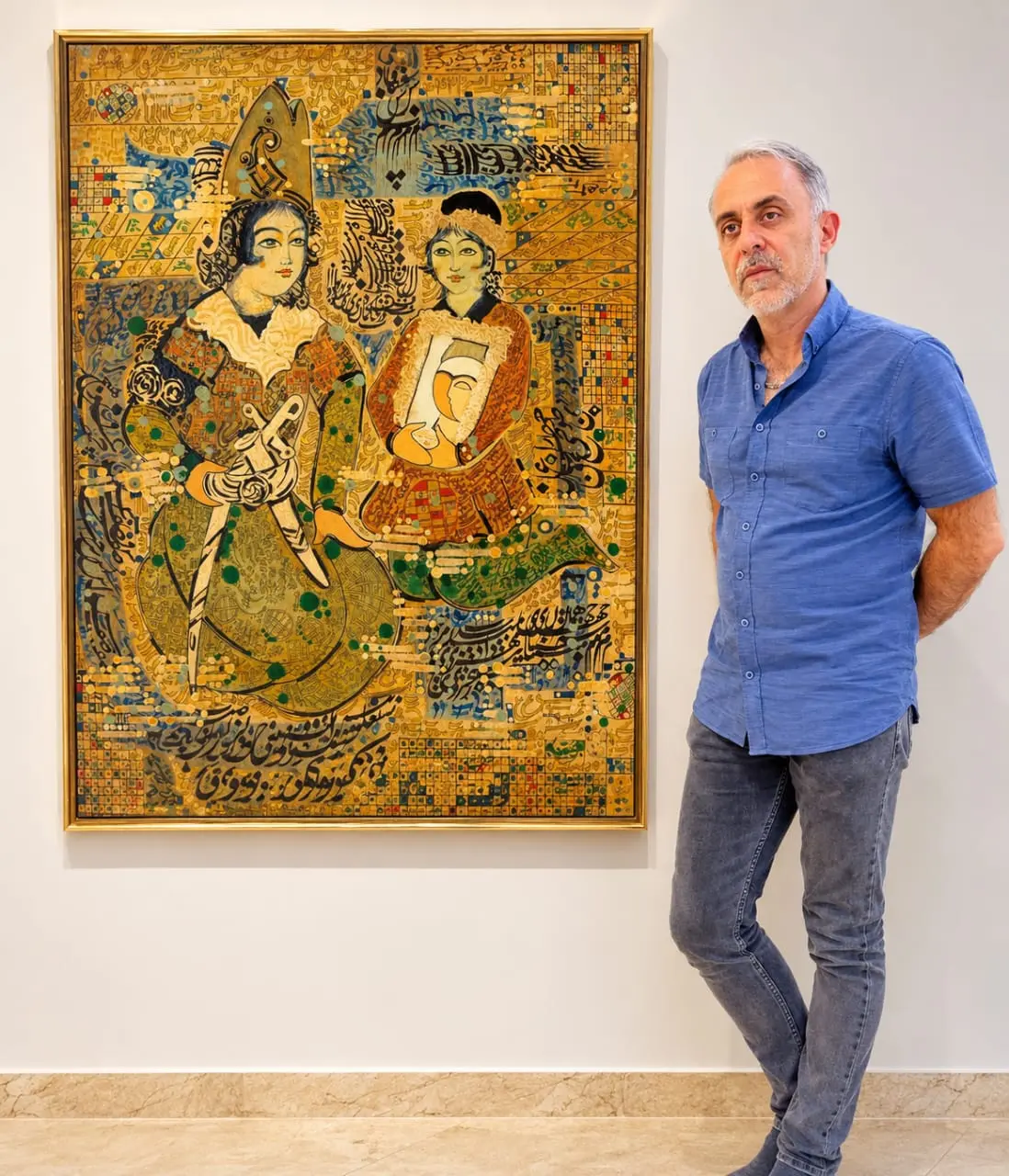
Mask, a mixed-media painting by Mehrdad Fallah from his Aja'ib al-Makhluqat series, was created in 2017 (1396) and measures 82 × 128 cm. The work can be examined through several artistic and conceptual perspectives, opening up a world rich in colour, lines, motifs, and visual signs.
In this painting, Mehrdad Fallah places human figures amid an intricate abundance of calligraphic forms, geometric patterns, and colourful ornamentation. The resulting composition evokes the visual memory of Iranian culture while simultaneously moving towards the artist's own contemporary pictorial language.
The title Mask provides an entry point into the work's deeper layers of meaning. In conjunction with the human faces and the image of a face held by one of the figures, it raises questions about identity, representation, and the distance between outward appearance and inner self—a recurring conceptual signature in Mehrdad Fallah's artistic practice.
_Composition: A World of Signs Surrounding the Human Figure
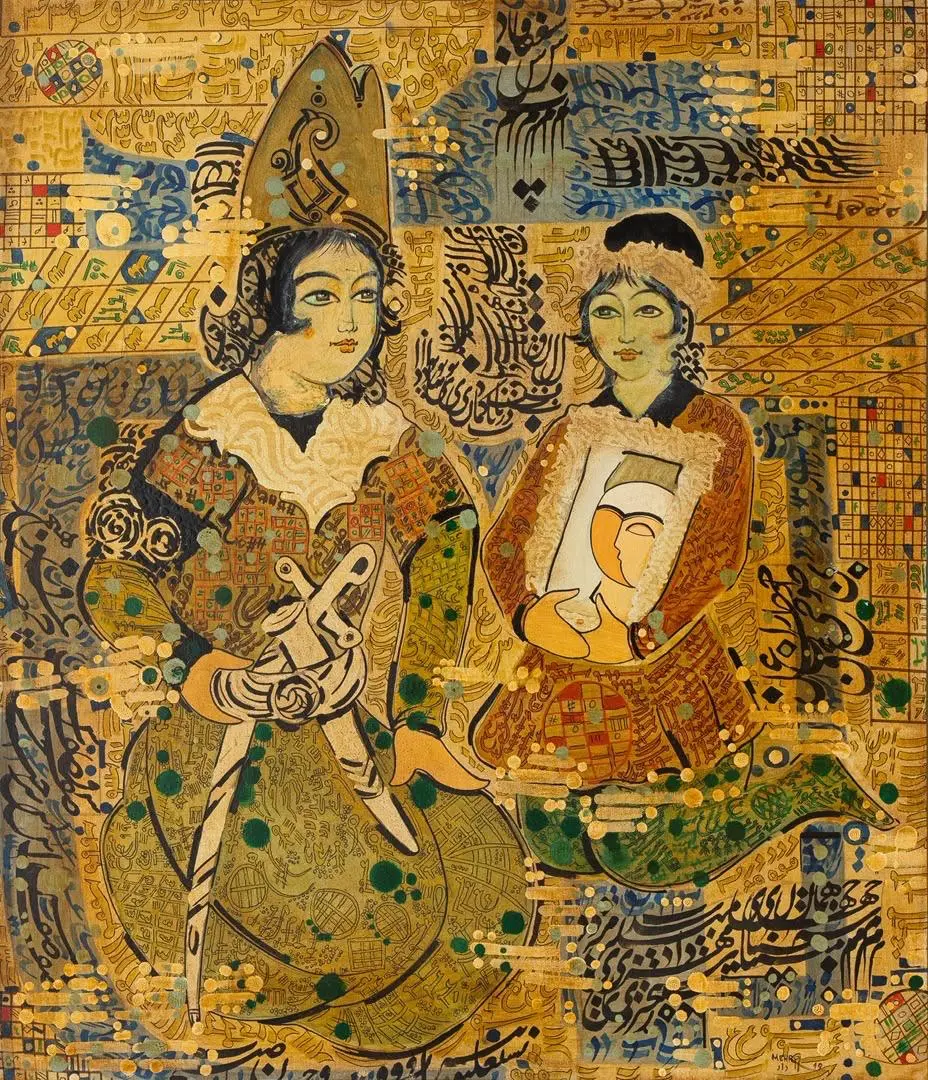
At the centre of Mehrdad Fallah's painting, two human figures appear in elaborately patterned garments.
The figure on the left commands considerable visual weight through its larger scale and the extensive ornamental detail of its clothing. The figure on the right, meanwhile, introduces another point of semantic focus by holding an image of a human face.
The background is constructed from calligraphic lines, geometric networks, patches of colour, and repeating motifs. These elements function as more than a decorative backdrop for the figures; they actively shape the viewer's visual experience and contribute to the painting's conceptual atmosphere. The eye moves between the faces, garments, and surrounding lines, discovering new details with each return to the image.
_Colour: Golden Radiance and Historical Memory
The dominance of gold, yellow, ochre, and brown establishes the painting's overall chromatic atmosphere. By placing warm colours alongside blue, green, and black, Fallah creates a dynamic palette that lends coherence to the figures while preserving the visual diversity of the background.
Gold and ochre evoke illuminated manuscripts, aged papers, and historical artefacts. Blue and green interrupt this predominantly warm spectrum with moments of chromatic contrast, while the assertive black lines reinforce the image's graphic structure.
In this painting, colour is far more than a means of representation. It contributes to the creation of atmosphere, establishes visual rhythm, and activates the viewer's cultural memory.
_Calligraphy: Where Writing Becomes Image
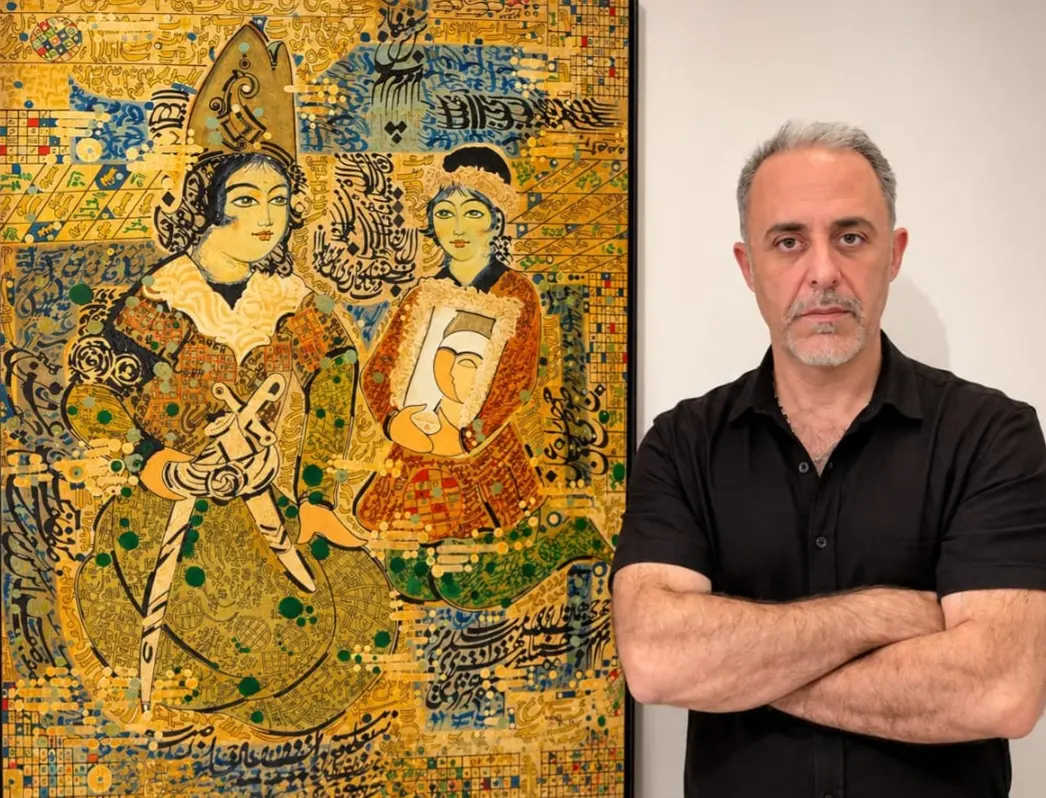
The extensive presence of calligraphic forms is among the most distinctive characteristics of Mask and this series of works by Mehrdad Fallah. Letters and calligraphic compositions are dispersed throughout the background, appearing at times as bold, dark strokes and elsewhere as delicate, densely arranged inscriptions.
Writing serves a dual function here. On one level, it recalls the linguistic and semantic potential of letters; on another, through its shape, curvature, density, and rhythm, it becomes an autonomous visual element within the painting's structure.
This coexistence of calligraphy and imagery establishes a connection with the longstanding tradition of integrating calligraphy, book illumination, and illustration in Iranian and Islamic culture. Fallah reconfigures this heritage within a distinctly contemporary visual framework.
_The Interplay of Geometric Order and Painterly Expression
Mehrdad Fallah's human figures are characterised by simplified facial features, clearly defined contours, and an avoidance of conventional naturalistic modelling. By contrast, the background consists of geometric networks, curved lines, and densely layered motifs. This formal distinction allows the figures to stand out against the abundance of surrounding signs.
The painting's visual texture also emerges from this diversity. Lines, patches of colour, and ornamental details create a multilayered surface that invites close observation and the discovery of intricate details. The mixed-media technique is particularly suited to this composite visual language, in which line, colour, and pattern participate simultaneously in constructing the overall image.
_From the Human Face to the Question of Identity
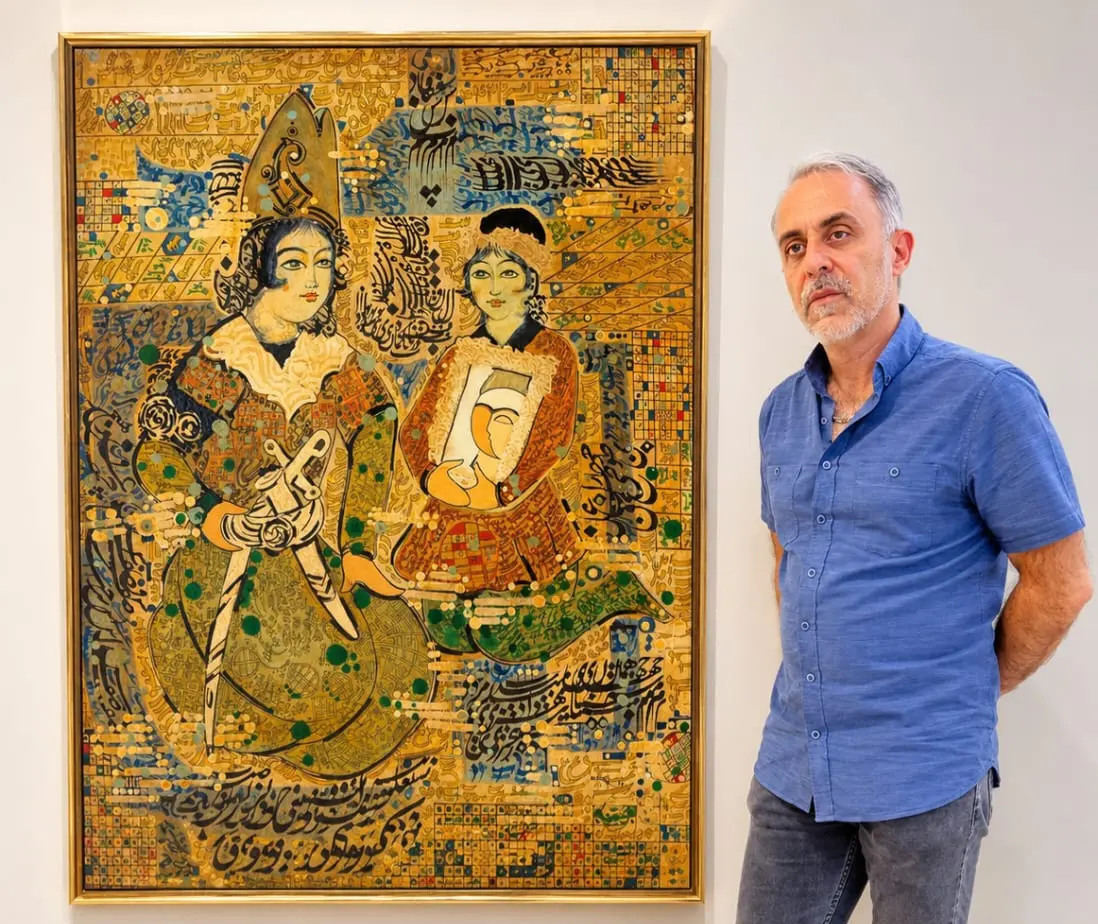
One of the painting's most significant conceptual dimensions lies in the relationship between the human figures and the image held by the figure on the right. Enclosed within a frame, this image itself becomes an object of observation. The painting thus presents not only the human being but also the representation of the human being.
From a semiotic perspective, the face can function as a sign of individual identity. Yet the image of a face introduces the possibility of distancing oneself from immediate identity and entering the realm of representation.
By choosing the title Mask, Mehrdad Fallah extends this relationship and invites viewers to contemplate the distinction between who we are and what we choose to reveal to others.
From psychological and sociological perspectives, the mask can also be interpreted as a metaphor for the different roles individuals assume in social life—roles that reveal particular dimensions of identity in different circumstances. This reading takes the painting beyond the mere depiction of figures, transforming it into a meditation on identity and the ways in which human beings are seen.
Mehrdad Fallah's Aja'ib al-Makhluqat: A Dialogue Between Tradition and Contemporary Art
The title of the series opens up another horizon for interpreting the work. Aja'ib al-Makhluqat, meaning The Wonders of Creation, evokes a world of marvels, diversity, and encounters between familiar and unfamiliar elements.
In Mask, human figures, calligraphic forms, geometric patterns, and the framed image of a face come together to create an environment in which the boundaries between narrative, ornament, and visual sign remain fluid.
The visual references to Iranian artistic traditions are not confined to a straightforward reconstruction of the past. Instead, they are incorporated into a new structure and connected with contemporary concerns surrounding identity and representation. Cultural memory consequently becomes a living component of the painter's visual language.
Painting as a Multilayered Narrative of the Human Condition
Through the integration of figurative representation, calligraphy, geometric motifs, and warm colours, Mehrdad Fallah's Mask establishes a pictorial structure that combines ornamental richness with considerable conceptual depth.
The density of details guides the viewer's gaze across the painted surface, while the juxtaposition of the human figures and the separate image of a face places identity and representation at the centre of the work's interpretation.
In this painting, Iranian visual tradition is not merely a historical reference; it becomes an active component of a living, contemporary artistic language.
Mask invites viewers to reflect on the human face amid patterns, conventions, and cultural memory—a reflection in which what initially appears before the eye is only the beginning of a much broader encounter with meaning.
- Mehrdad Fallah's Artwork Prices and Auction Record
Mehrdad Fallah was born in Tehran in 1975 (1354). He grew up in a traditional family, although his was far from an ordinary household. It was also the family of one of the most important pioneers of modern Iranian painting: Sadegh Tabrizi.
The late Sadegh Tabrizi was Fallah's maternal uncle, and Fallah became one of his particularly distinguished students.
To date, Mehrdad Fallah's works have appeared at five different auction houses, with all of them reportedly selling above their initial estimates.
On November 6, 2026 , a work by Mehrdad Fallah achieved a hammer price of $2,200 [ 594 million Iranian tomans ] at the Second Kavian Private Auction.
In October 2024 , one of his works from the Rooster series sold for approximately $2,970 [ 187 million Iranian tomans ] at the 21st Tehran Auction.
His other auction appearances include the Second National Auction in 2015 (1394), the Gooharan Auction, and a charity auction in Los Angeles.
Mehrdad Fallah's works have been exhibited on numerous occasions in the United Kingdom, Switzerland, Italy, Belarus, Cyprus, Türkiye, the United States (Los Angeles), Dubai, and Iran.
Among these presentations was Persian Whispers, an exhibition held in November 2025 at Aryan Gallery, located within the Pars Place complex in Virginia, USA. Ten of Fallah's works were sold during the exhibition.
Another significant presentation was Nostalgia, his painting exhibition held in October 2025 at the Otto Mauer Zentrum in Vienna, Austria, where seven works were sold.
Fallah's professional entry into the art world dates back to 1998 (1377), when, at the age of 23, he presented an exhibition of reverse glass paintings at Gallery 66, an influential gallery founded by Sadegh Tabrizi.
He subsequently held six solo exhibitions, perhaps the most significant and widely acclaimed of which was Lion with Calligraphy, presented at Art Center Gallery in 2015 (1394).
Over the years, Mehrdad Fallah has created numerous works combining painting with Iranian symbolism, gradually establishing a distinctive artistic signature. He belongs to a generation of painters who draw upon the traditions of Iranian painting to create modern and contemporary works. Among his most celebrated series are Lions, Roosters, and, of course, Aja'ib al-Makhluqat.
Several art critics and specialists consider Mehrdad Fallah among the contemporary artists who have continued and revitalised the Saqqakhaneh School, bringing its visual heritage into the language of contemporary art.
LEAVE A RELPY