
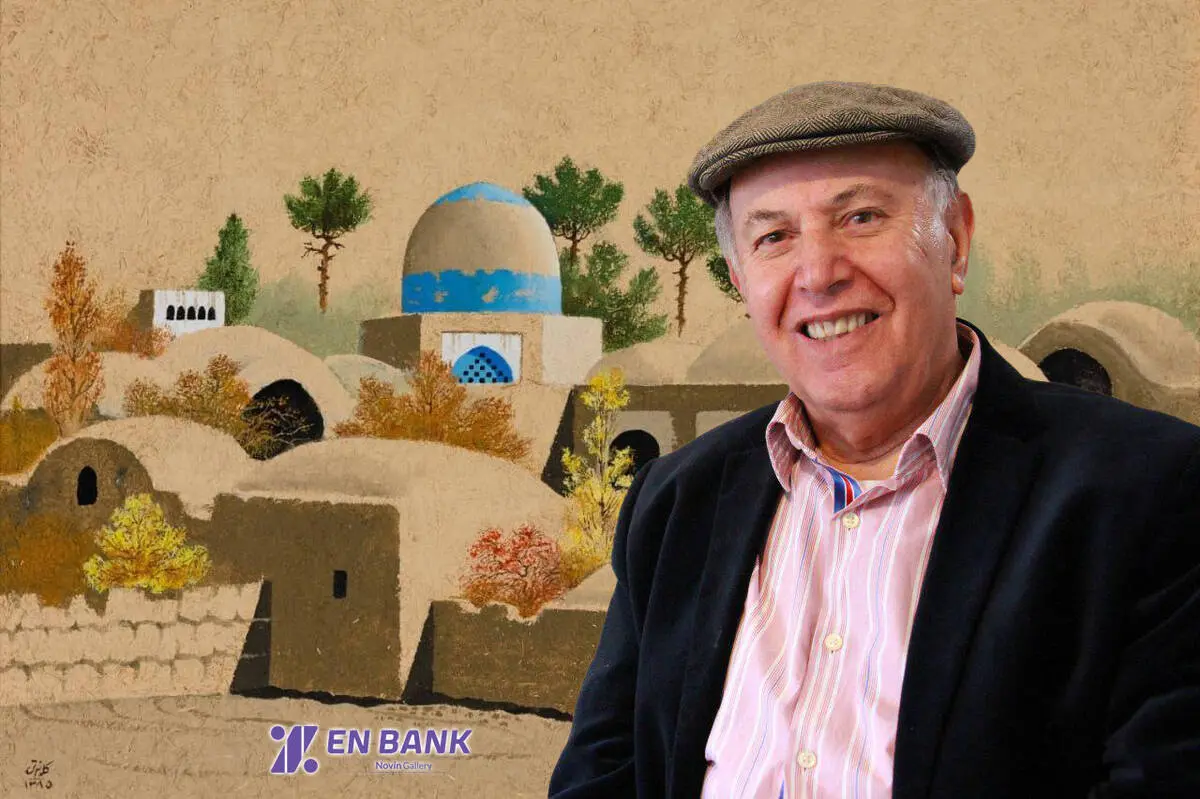
The Utopia of Parviz Kalantari in the Novin Gallery Collection of Eghtesad Novin Bank
Anyone who catches even a distant glimpse of these desert landscapes instantly recognises them as the work of Parviz Kalantari. Within these seemingly quiet settings, the celebrated Iranian painter created an ideal place—a utopia, a promised land imbued with tranquillity, harmony, beauty, and contentment—despite the striking absence of any human figure.
ArtDayMe – Since its establishment as Iran's first private bank, Eghtesad Novin Bank has maintained a significant presence in the country's cultural landscape. Through the creation of an outstanding art collection and the establishment of Novin Gallery, the bank has emerged as a pioneer in presenting and supporting Iran's artistic ecosystem.
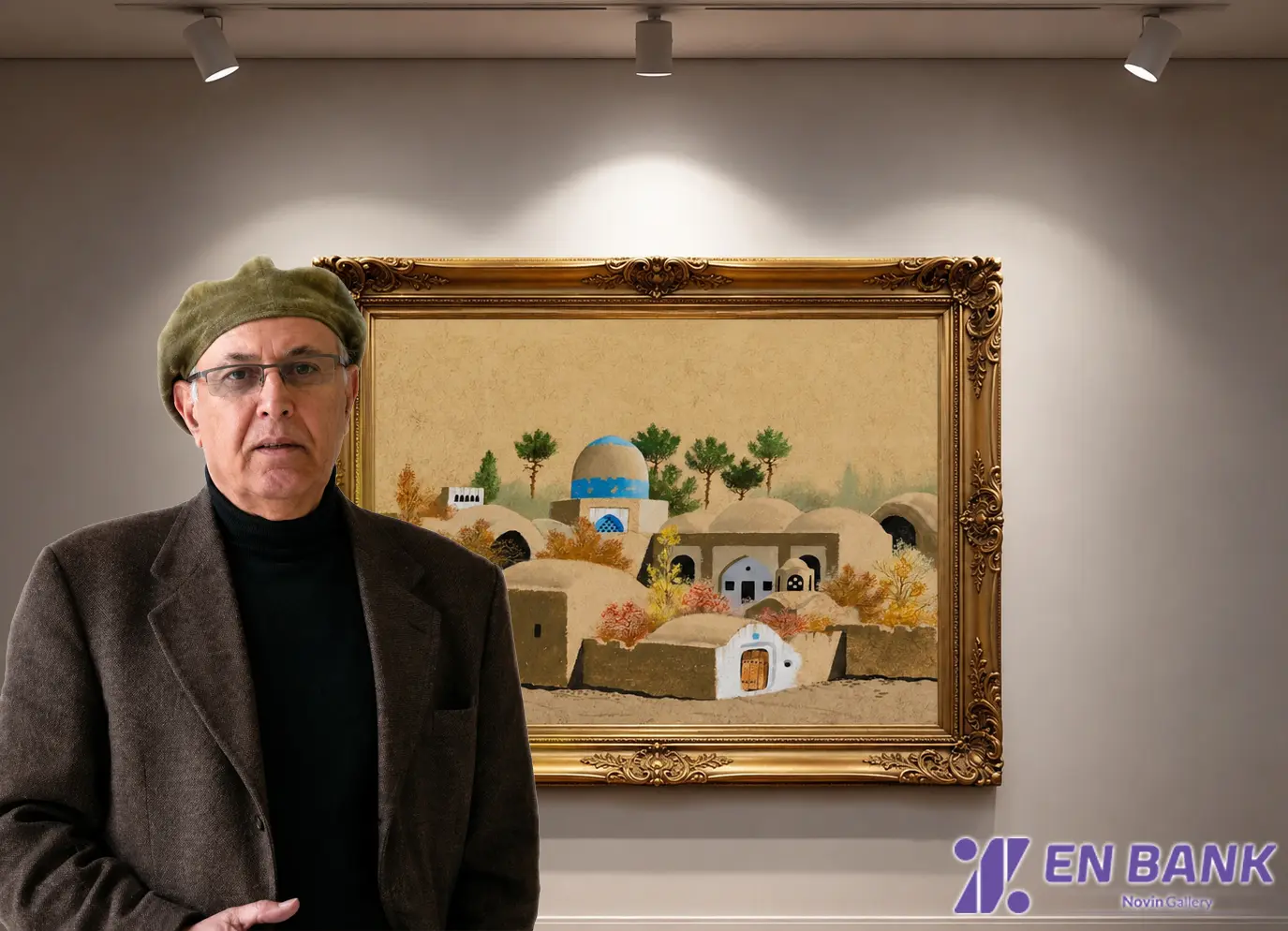
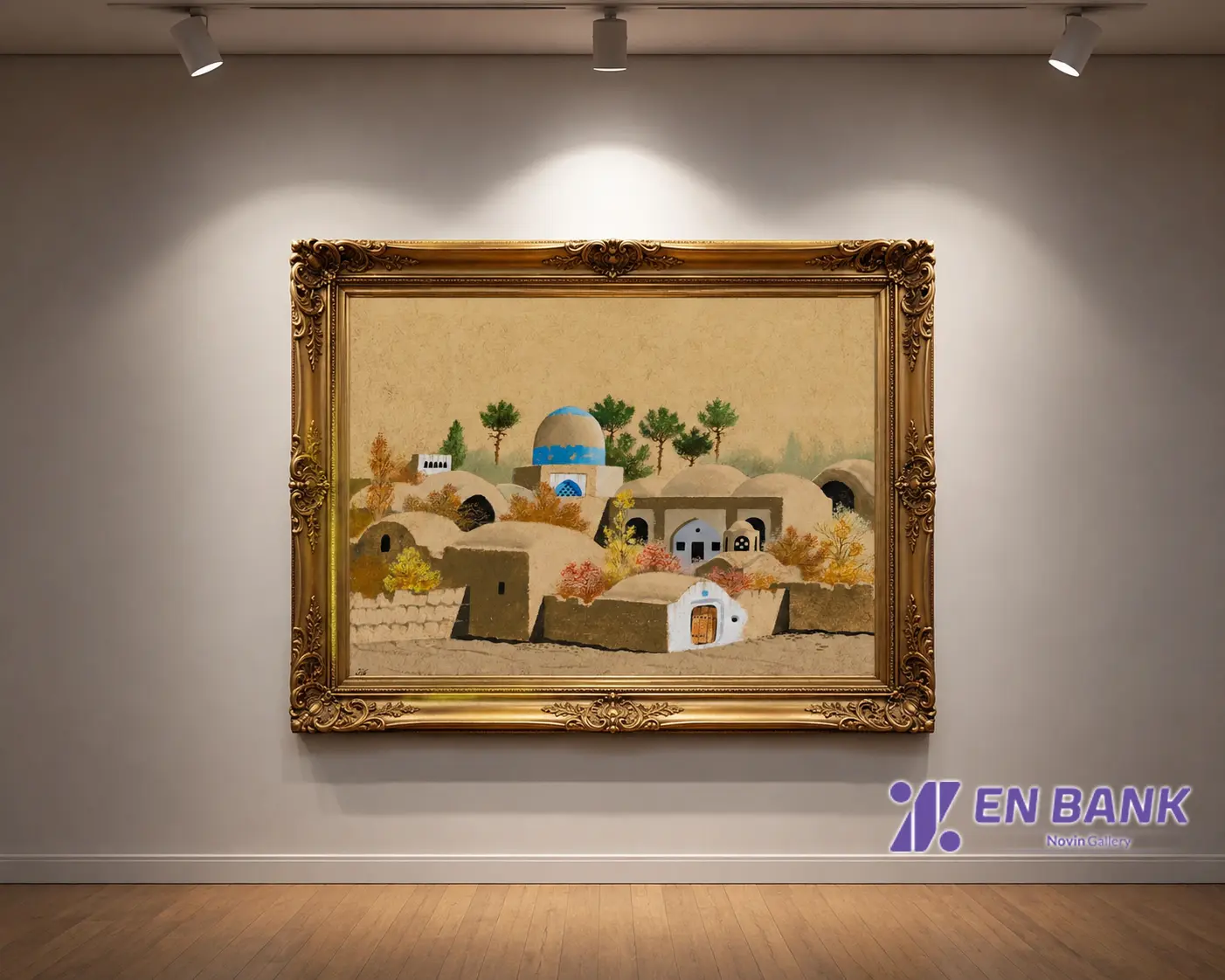
Among the highlights of the bank's permanent collection is an exceptional painting by the late master Parviz Kalantari (March 1931 – May 2016). Executed in mixed media on canvas and measuring 100 × 70 cm, the work belongs to Kalantari's celebrated Mud-Plaster Paintings series, the body of work he began developing in 1974, which would eventually become the defining hallmark of his artistic career.
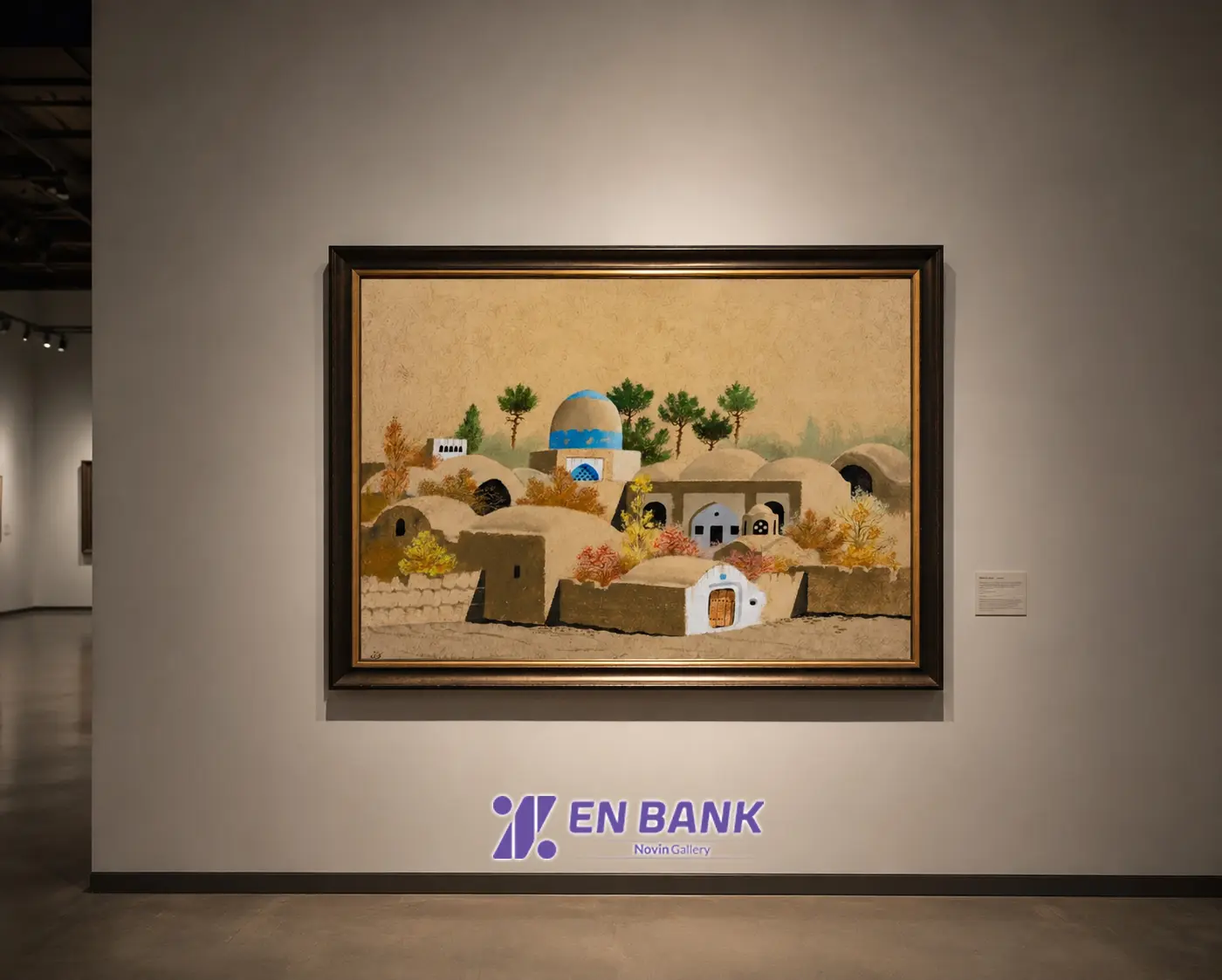
Parviz Kalantari received formal academic training in art, yet his influence extended far beyond the walls of art schools. His name became inseparable from the illustrations of Iranian school textbooks as well as publications produced by the Institute for the Intellectual Development of Children and Young Adults. One of his paintings was selected for the United Nations' commemorative stamp collection, while his celebrated work, An Iranian City Through the Eyes of an Iranian Painter, is housed at the United Nations Office in Nairobi.
Kalantari's mud-plaster paintings gradually evolved into his unmistakable artistic signature. "I am the painter of my country's dust-covered landscapes," he once remarked. Yet these works transcend documentary representations of Iran's arid terrain. Time and again, Kalantari constructed an imagined utopia—a promised land defined by serenity, balance, beauty, and prosperity—even though not a single human figure physically inhabits these scenes.
The painting preserved in the Novin Gallery Collection of Eghtesad Novin Bank is therefore far more than a landscape. It is a window onto the collective memory of a nation, recalling an era when adobe walls, warm sunlight, and the gentle shadows of late afternoon gave profound meaning to everyday life.
Kalantari's paintings extend well beyond representations of traditional architecture. They portray an entire way of life—social relationships, patterns of living, and the cultural fabric of historical Iran. Inward-looking houses, courtyards filled with trees, and narrow alleyways become more than architectural elements; they embody spaces of human interaction and communal life. Through these compositions, the artist not only revives memories of a vanished world but also offers a subtle reflection on contemporary humanity's growing estrangement from its cultural roots and living environment.
Within Kalantari's visual universe, houses are never merely shelters. Adobe walls, domes, wooden doors, and trees each become fragments of a shared cultural memory—a remembrance of a land where architecture, nature, and human existence remained inseparably intertwined.
_ Architecture as the Protagonist
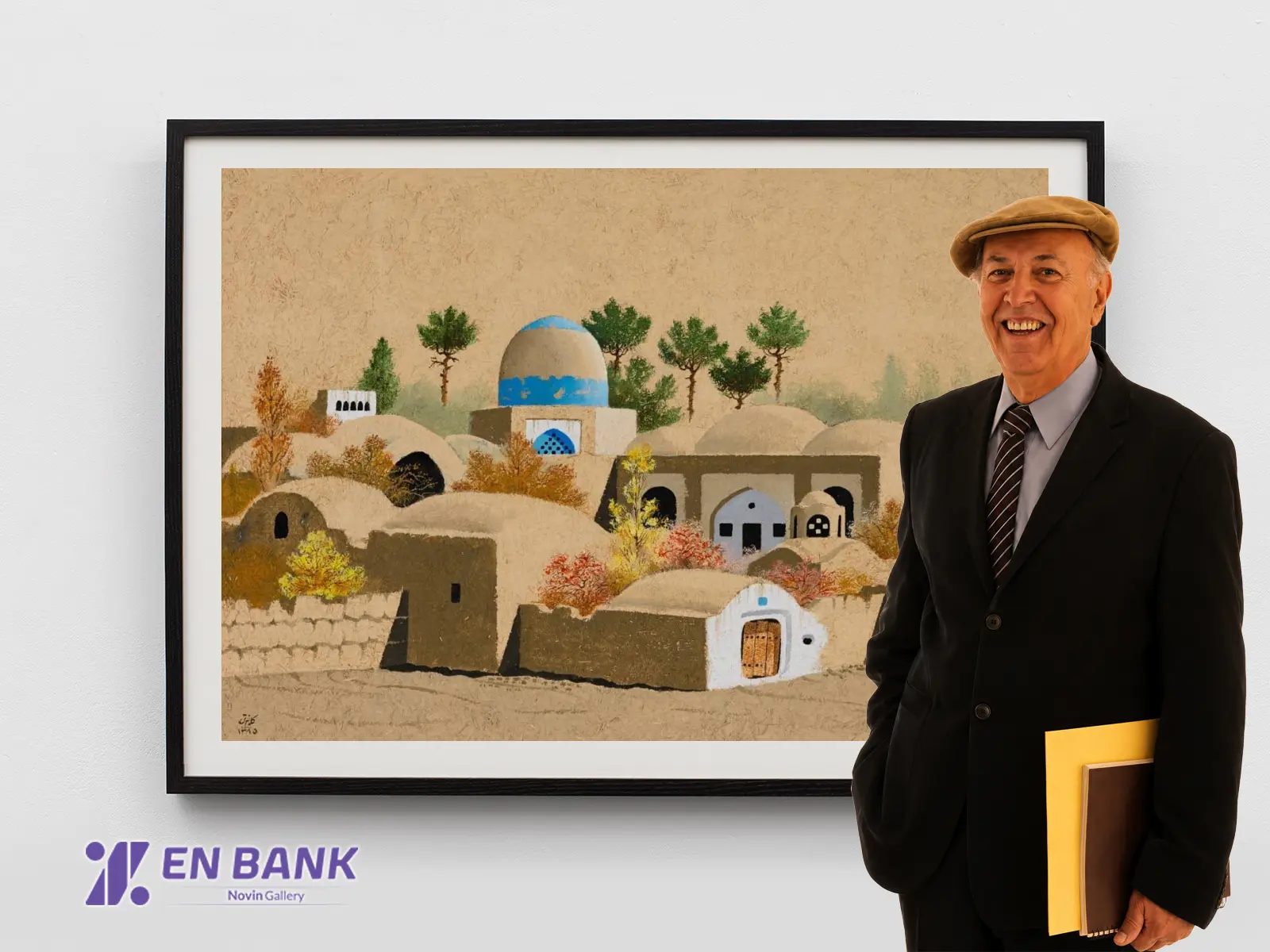
In this 100 × 70 cm painting, preserved in the Novin Gallery Collection of Eghtesad Novin Bank, Kalantari reimagines Iran's vernacular architecture as a landscape suspended between reality and memory, geography and imagination.
At first glance, the viewer encounters a horizontal expanse of adobe houses, domes, and trees stretching across the canvas. Yet with prolonged observation, the painting reveals its hidden order. Domes, arches, walls, and trees establish a quiet visual rhythm—one that unfolds with an almost musical cadence.
The eye moves effortlessly from one form to another until the village ceases to appear as a mere cluster of buildings and instead becomes a unified, living organism.
Here, architecture is not a backdrop; it is the painting's central protagonist. The houses are inseparable from the land on which they stand. Their walls and domes share the same earthen palette as the surrounding terrain, dissolving the boundary between architecture and nature. They seem to have emerged organically from the soil itself, as though the village had grown from the earth rather than been built upon it.
This transformation of seemingly ordinary elements—houses, walls, earth, trees, and village life—into symbols of cultural identity and collective memory is among the defining characteristics of Kalantari's artistic language. Architecture, in his hands, becomes far more than physical form; it becomes the narrative of an entire way of life.
_Domes Between Earth and Sky
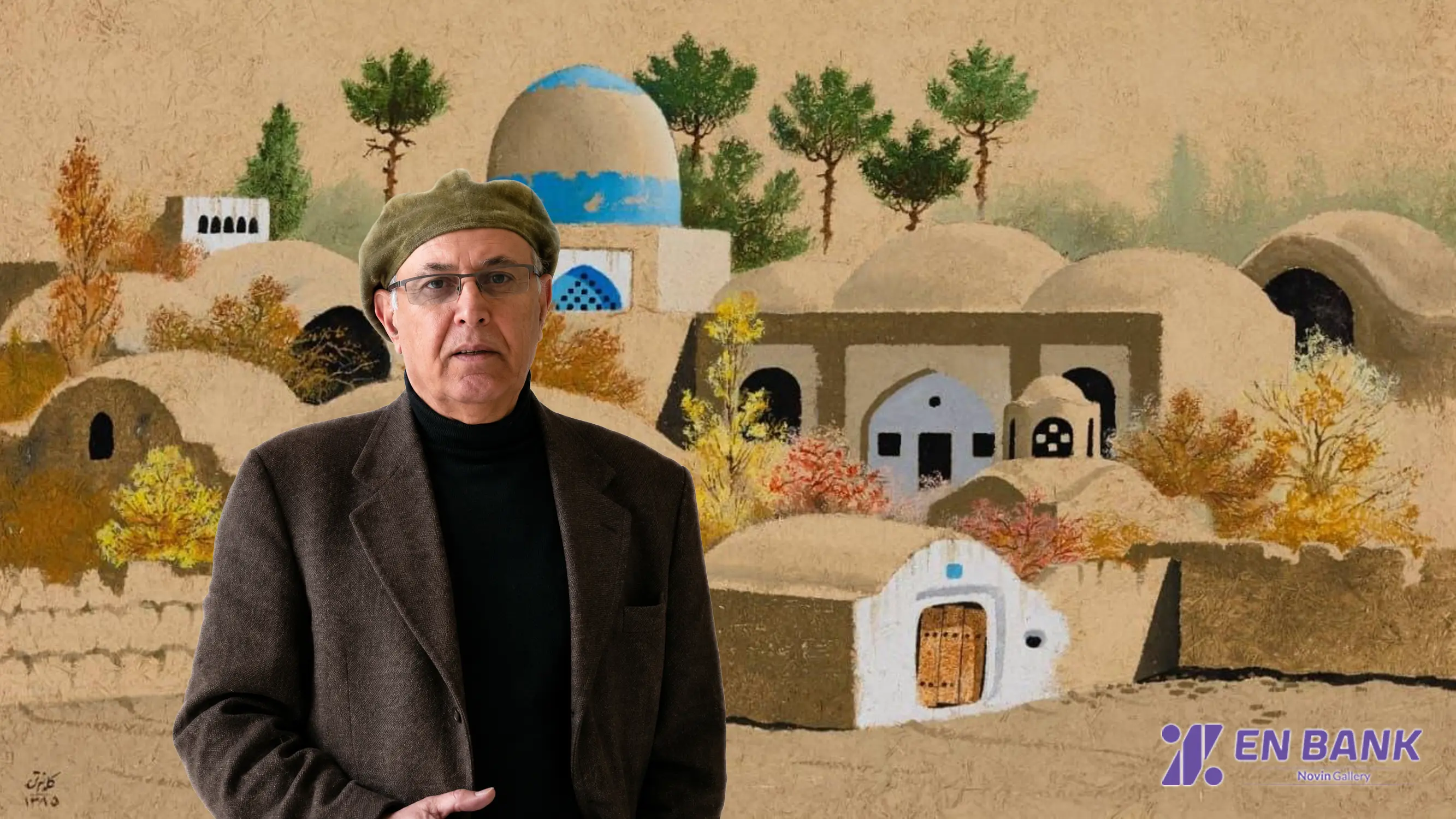
Within the warm ochres and earthy browns of the composition, restrained yet striking touches of blue assume remarkable importance. The central dome, accented by a vivid blue band, immediately becomes one of the painting's principal visual anchors.
Against the earth-bound world of the composition, blue functions as a symbol of sky, water, coolness, and hope. It interrupts the quiet warmth of the landscape, introducing both vitality and spiritual resonance.
The domes themselves transcend their architectural function. Within the composition they generate a subtle upward movement—a visual ascent that begins with the houses rooted in the earth and gradually extends toward the heavens.
_Colours Born of the Landscape
The painting's palette is dominated by muted earth tones—ochres, sandy beiges, warm browns, and subdued greens—perfectly attuned to the climate and architectural character of Iran's desert environment.
Against these restrained hues, small accents of yellow, red, and green emerge like signs of life rising from an arid landscape.
The trees are far more than decorative devices. Set against the earthen walls and adobe buildings, they embody the life force of the landscape itself. If the architecture represents permanence, endurance, and stability, the trees signify growth, renewal, and vitality.
One of the painting's most compelling visual dialogues therefore unfolds between earth and life—between permanence and regeneration, stillness and renewal.
_ Without People, Yet Filled with Human Presence
As in many of Parviz Kalantari's paintings, no human figure appears in the composition. Yet everything within it speaks unmistakably of human presence.
The houses have been built by human hands, as have the walls, wooden doors, winding alleys, and pathways that connect them. Humanity is absent from the picture, yet the traces of its existence permeate every corner of the scene.
It is precisely this absence that lends the painting its poetic quality. Closed doors and shadowed entrances invite the viewer to imagine what lies beyond them. Behind each doorway may exist a family, a memory, or an untold story—narratives the artist deliberately leaves to the imagination of the observer.
In this way, Kalantari transforms the village into a profound image of human presence expressed through physical absence.
Some art critics have also argued that the artist's deliberate omission of people constitutes a subtle protest against humanity's neglect of the very cultural identity and collective nostalgia these villages embody—a forgotten heritage gradually abandoned by modern society.
_ Simplicity Achieved Through Deliberate Reduction
The forms in Kalantari's paintings are strikingly simple. Houses are reduced to elementary geometric volumes, domes are rendered through soft, fluid curves, trees appear in highly condensed silhouettes, and wooden doors are described with only the essential details.
Kalantari eliminates everything unnecessary in order to arrive at the essence of form. A single arch, a wooden doorway, or the curve of a dome is sufficient to evoke an entire architectural world within the viewer's imagination.
This economy of expression is deeply rooted in the artist's long experience as an illustrator, where he learned to communicate the richest narratives through the fewest visual elements.
For this reason, his works occupy a unique position at the intersection of painting and illustration. They possess the autonomy and sophistication of fine art while simultaneously retaining an extraordinary capacity for storytelling.
_A Painting About Earth and Identity
Within Parviz Kalantari's artistic universe, earth is never merely a colour.
It is material, subject, memory, and metaphor all at once.
In his celebrated mud-plaster paintings, the relationship between the physical substance of the artwork and its subject acquires exceptional significance. By incorporating earthy textures and materials into the painting itself, Kalantari narrows the distance between the image of earth and earth as material reality.
Consequently, the viewer is prompted to ask whether the work is simply depicting an adobe settlement, or whether it also seeks to convey the tactile, physical experience of that architecture.
Here, earth becomes a symbol of return: houses emerge from the soil, people inhabit them throughout their lives, and ultimately everything returns to the earth from which it came.
_An Iran Remembered
This painting does not depict a specific geographical location. It offers neither a place name nor an identifiable moment in time. Precisely because of this ambiguity, it transcends documentary landscape painting.
What Kalantari creates is not the portrait of a particular village, but the image of an Iran remembered.
It is an Iran in which homes remain intimately connected to the land, architecture exists in harmony with climate, and nature—even within an arid environment—continues to sustain life.
The painting therefore possesses a deeply nostalgic character. Yet this nostalgia is never imposed through narrative. Instead, memory is awakened through colour, form, earthen walls, weathered wooden doors, and the quiet dignity of vernacular architecture.
_ Documenting a Way of Life
The houses in this painting do not stand in isolation. Their walls extend seamlessly into one another, domes rise side by side, and trees grow naturally within the architectural fabric.
Place, here, is not conceived as a collection of individual dwellings but as a unified communal structure.
This vision evokes a way of life in which the individual and the community, the home and the public realm, architecture and nature were bound together far more intimately than they are today.
In this sense, Kalantari is not simply painting architecture; he is portraying an entire culture of living.
_ One Landscape, One Collective Memory
Ultimately, Parviz Kalantari's painting is less about a specific place than about the enduring relationship between human beings, home, and the earth.
Within this work, soil is transformed into colour, architecture into memory, and domes become visual mediators between earth and sky. The silent houses reveal human existence precisely through its absence.
The power of the painting lies in its apparent simplicity. With only a restrained palette, a handful of essential forms, and a vocabulary of vernacular architecture, Kalantari creates a world that feels both intimately familiar and poignantly out of reach for many Iranian viewers—a world that perhaps survives less in today's geography than in the nation's collective memory.
This is not the image of a particular village. It is the visual embodiment of a shared memory—a homeland where humanity, architecture, and the earth had not yet become separated from one another.
_Novin Gallery of of Eghtesad Novin Bank
As Iran's first private bank, ENBank [ www.enbank.ir ] has, since its founding in August 2001, embraced a vision of development extending well beyond conventional financial practice. From its earliest years, the Bank recognized culture and the arts not as peripheral activities but as essential components of the nation's social and cultural capital.
Over the past quarter century, EN Bank has assembled one of Iran's most distinguished corporate art collections, comprising more than one hundred works by many of the country's leading modern and contemporary artists. More than a corporate collection, it represents a visual narrative of an important chapter in the history of Iranian art.
The establishment of Novin Gallery and the presentation of regular exhibitions from the collection demonstrate that these works were never intended to remain hidden within corporate offices or storage facilities. Instead, the Bank has sought to create opportunities for public engagement and meaningful dialogue around Iranian art.
At a time when many important works of contemporary Iranian art remain inaccessible within private collections, their public presentation contributes significantly to cultural circulation and strengthens society's relationship with its artistic heritage.
Today, major financial institutions around the world are evaluated not solely by economic performance but also by their contributions to cultural development, creativity, and quality of life. International experience has repeatedly shown that art can serve as a bridge between economy, culture, and society—transforming financial capital into cultural and social capital.
As August 2026 marks the twenty-fifth anniversary of EN Bank, the institution stands at an important moment in its history.
The Bank's leadership is preparing to introduce a new vision for the role of financial institutions in the arts—one that extends beyond collecting and exhibiting artworks toward actively supporting Iran's artistic ecosystem, strengthening the creative economy, expanding public access to art, and fostering new forms of collaboration among artists, audiences, and the private sector.
At a time when societies increasingly rely upon cultural resources to nurture hope, encourage dialogue, and reinforce collective identity, the meaningful engagement of economic institutions with the arts can represent far more than philanthropy.
It is, fundamentally, an investment in society's cultural future—a future in which economic development and cultural development advance together.
The twenty-five-year history of EN Bank offers an ideal opportunity for the institution to reaffirm its pioneering role—not only in Iranian private banking, but also in establishing a new model for meaningful collaboration between the financial sector and the cultural life of Iran.
LEAVE A RELPY