

Somayeh Ramezanmahi on Maahyar Charmchi’s Works: The Loss of Individuality
Maahyar Charmchi’s Butcher Machine Symphony confronts viewers with an invisible machine that, throughout history and within the complex dynamics of contemporary society, consumes critical thought and intellectual and cultural differences.
ArtDayMe: An exhibition of works by Maahyar Charmchi attracted considerable attention in November (Aban) at Maad Gallery in Tehran. Butcher Machine Symphony was the compelling title of the exhibition, offering the artist’s interpretation of phenomena such as globalisation, and generating widespread responses.
Somayeh Ramezanmahi, art professor, researcher, and Artistic Director of Maad Gallery, has written an essay on the exhibition. The full text is published below:

Butcher Machine Symphony offers a critical reading of a fundamental and violent process in contemporary social life: a process through which the diverse, discordant, and unruly multiplicity of human existence gradually fades under the constraints of codified norms, rigid traditions, inherited rituals, and institutionalised conventions, eventually dissolving into an imposed order.
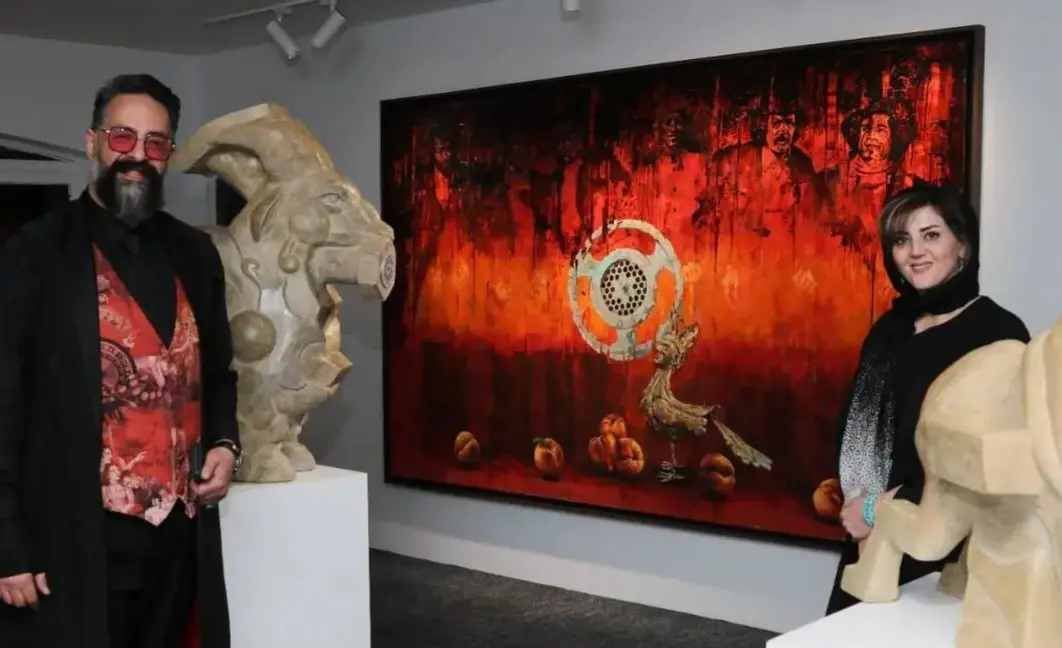
At the heart of the aesthetic language of this series lies the unsettling metaphor of the meat grinder. It is not merely a mechanical device associated with the machinery of everyday life, but rather the tangible embodiment of what Gilles Deleuze describes as an “abstract machine” of totalisation and domination. It is an apparatus of negation whose primary function is to suppress heterogeneity, wear down the angles of individual identity, and erase the fundamental distinctions between human beings. This machine restrains the generative forces of difference and repetition, transforming thinking, self-determined subjects into a homogeneous, diminished, and faceless mass.
In this series, Maahyar Charmchi employs the aesthetic strategy of appropriation, bringing familiar and established icons of contemporary life into a field of visual tension. These figures range from intellectual theorists and political and social activists to prominent personalities from cinema and popular culture.
Confronted with the jagged mechanisms of this coercive assimilation, these subjects relinquish what Jacques Derrida regards as the source of dynamism, endless plurality, and the perpetual deferral of fixed meanings. They are compelled to surrender to an imposed harmony and the repetition of homogenising stereotypes. This is the disturbing symphony perceived by the artist: the loss of unique individual identities at the feet of totalising structures.
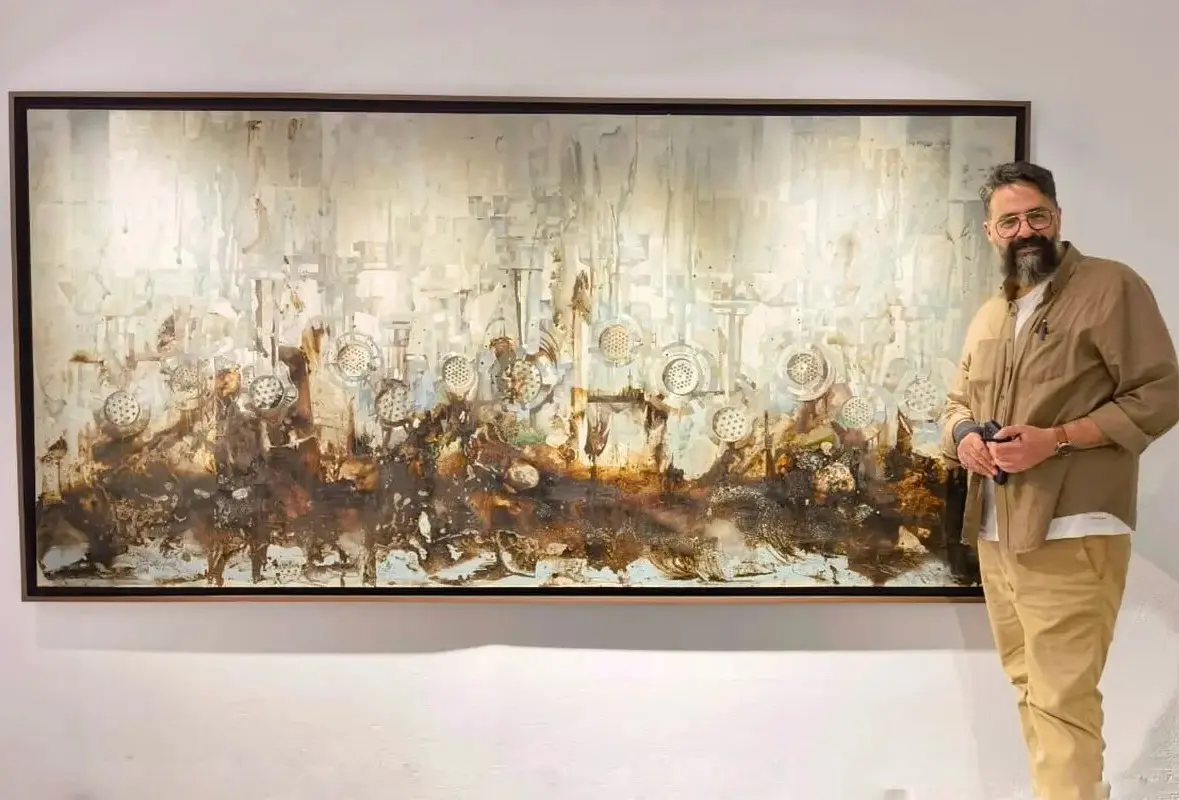
In Charmchi’s paintings, the materiality of the work carries its conceptual significance through the use of bitumen. Here, bitumen transcends its function as a material for creating texture or establishing a visual ground. It becomes a concrete, historically charged signifier, invoking the constrained existence of Iranian society within an oil-based geopolitical order, the paralysing consequences of a mono-product economy, the erosion brought about by years of sanctions, and the suffocating persistence of these conditions in the present.
The dense, opaque, and unyielding blackness of bitumen creates a sedimentary, swamp-like space in which figures are buried or immobilised. The portraits appear to be suffocating beneath the remnants of oil, surrendering their individual characteristics as they dissolve into the darkness of the surface, eventually becoming neutralised, mass-produced entities.

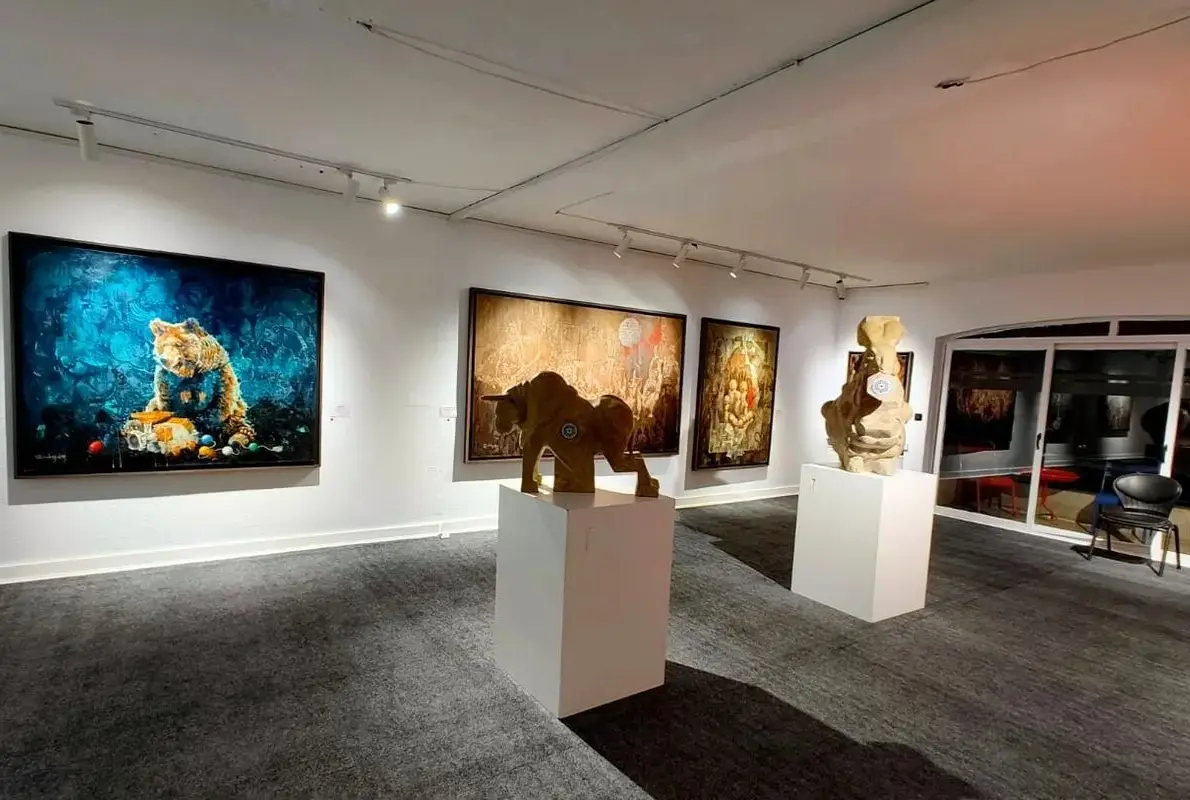
Extending this condition, the sculptures broaden the scope of the artist’s critique, adopting a deconstructive approach that moves from the historical present towards the archetypes and grand visual narratives of civilisational history. The invocation of figures and forms such as the Trojan Horse, the Sphinx, and the Buddha is not simply a formal reference to art history; rather, it constitutes an attempt to deconstruct and expose the multiple layers of meaning embedded in these myths.
In Charmchi’s interpretation, these historical symbols themselves become ancient instruments of the same homogenising mechanism. The Sphinx emerges as a symbol of the terrifying enigma of intimidation and the subjugation of individuals before power. The Trojan Horse represents structural deception and a form of cunning through which submission to the dominant discourse is presented, on the surface, as a historical gift or blessing. Meanwhile, the Buddha’s patient stillness, in this new representation, intersects not with spiritual salvation but with collective passivity, withdrawal from agency, and a conciliatory acceptance of the status quo.
Butcher Machine Symphony confronts viewers with an invisible machine that, throughout history and within the complex dynamics of the contemporary world, consumes critical thought and intellectual and cultural differences. It grinds them down within the digestive system of frozen traditions, hypocritical conventions, and closed political structures, ultimately producing an outcome characterised by nothing beyond a uniform form, a standardised identity, and obedient silence.
In this sense, the exhibition may be read as a visual warning against the absorption of the entirety of human identity into the silent gears of uniformity.
LEAVE A RELPY