
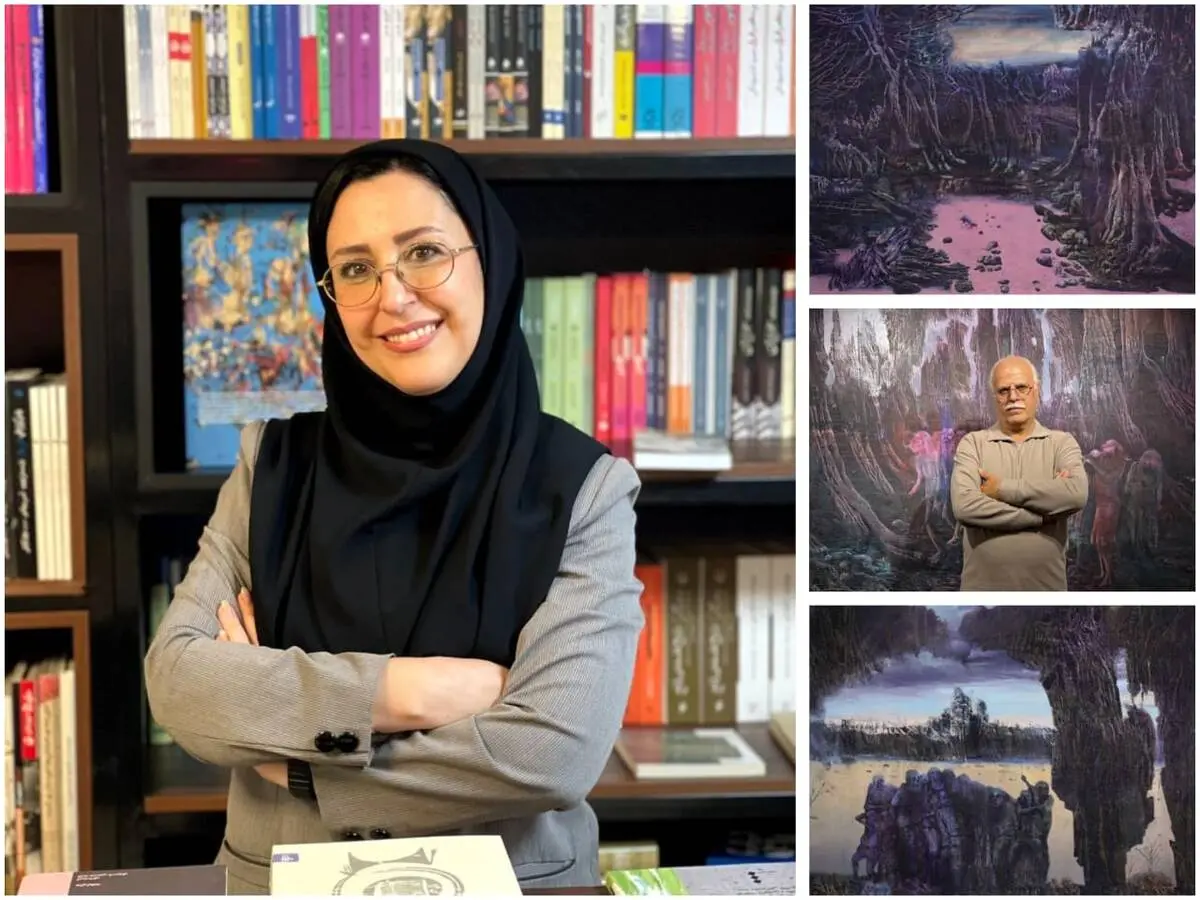
Somayeh Ramezanmahi: Majid Kamerani’s Paintings and the Sublime Grandeur of Nature in Praise of Silence
Kamerani’s creative mind is imbued with a profound reverence for nature. Consequently, the earth and all that emerges from it take on an almost temple-like, sacred quality.
ArtDayMe : Majid Kamerani’s painting exhibition remains on view at Maad Gallery in Tehran until October 16.
In Praise of Silence is the intriguing title of this exhibition.
Somayeh Ramezanmahi, an art professor, researcher, and Art Director of Maad Gallery, has written an essay on the exhibition. The full text is published below :

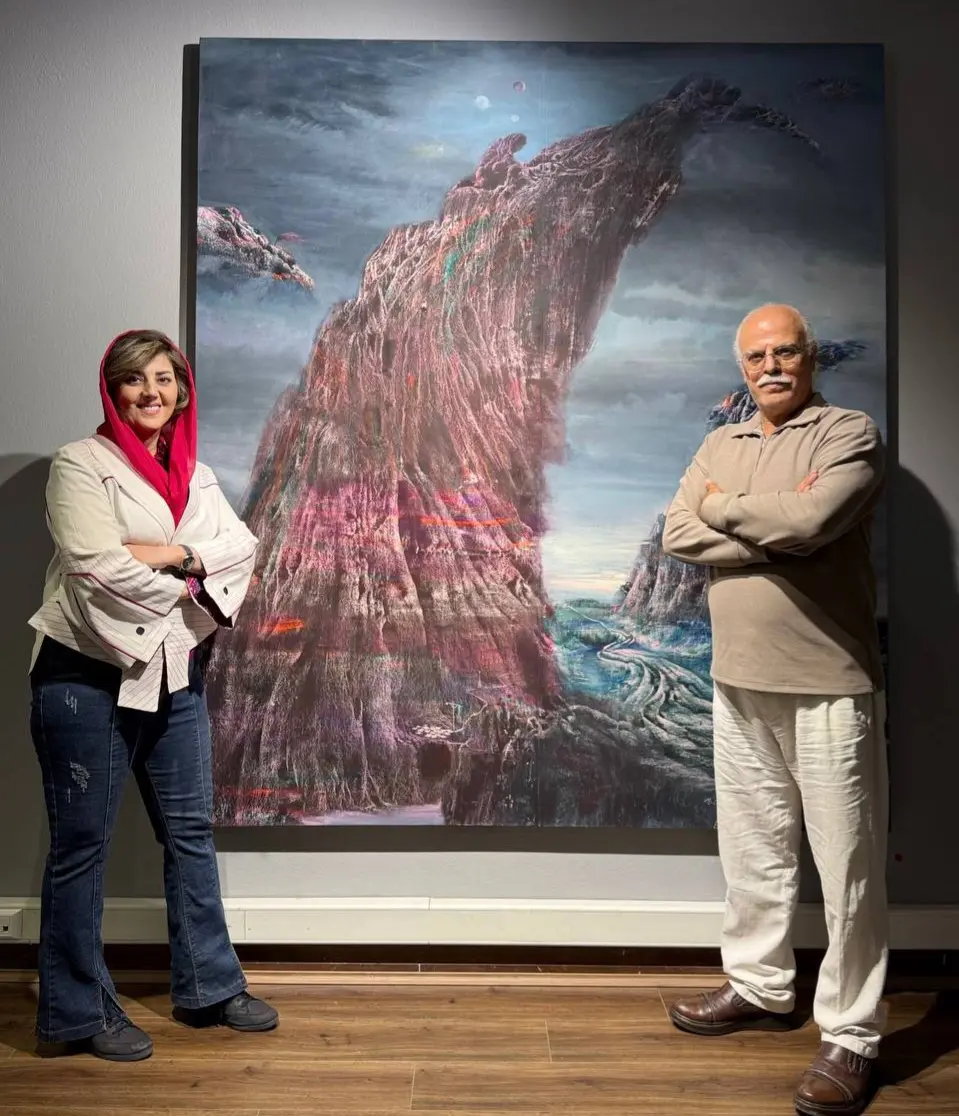
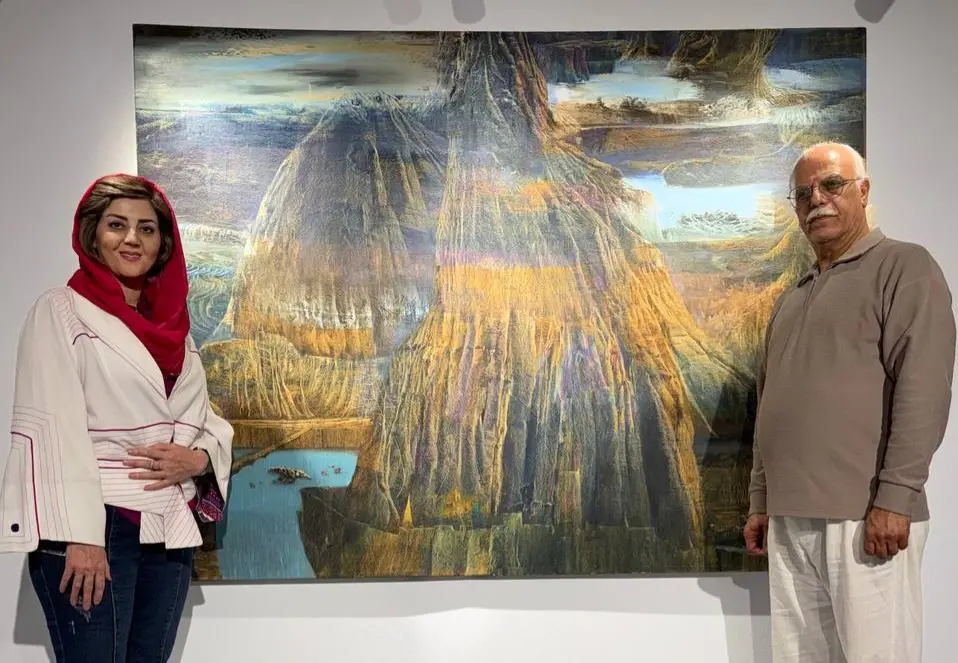
Majid Kamerani’s paintings are mental evocations of the perception of a vast and formidable nature, visualised through massive, weighty rock formations. His interest in depicting nature and combining it with an imaginary world has led him to construct, across large canvases, a realm that appears primordial and ancient, as though immersed in profound silence.
Kamerani’s creative mind is imbued with a profound reverence for nature. Consequently, the earth and all that emerges from it take on an almost temple-like, sacred quality. Amid a multitude of towering, monumental rocks, the presence of a blue sky offers a glimpse of an opening to the outside world. It seems to lift the spirit from a massive, heavy, cold environment into a rarified, weightless atmosphere, releasing the mind from an oppressive burden.
The densely packed mountains and rock formations, with their deeply grooved textures, sometimes become representations of mythical trees, as though their roots have penetrated deep into the earth, anchoring them to its body. The incomparable majesty of the rocks and stones, set against the nakedness of the earth, inspires humility in the human spirit. Before nature’s immensity, surrender seems inevitable—a surrender that reminds us of humanity’s smallness while revealing Mother Nature in her most monumental form. Nature’s power invites viewers to embark on an inward exploration of the sublime and the beautiful. Indeed, Kamerani’s works call upon us to contemplate an inner force that seems concealed behind every stone pillar. The artist reveals this force through the stark exposure of rugged, barren rocks, devoid of trees, in their most pristine and unadulterated state.
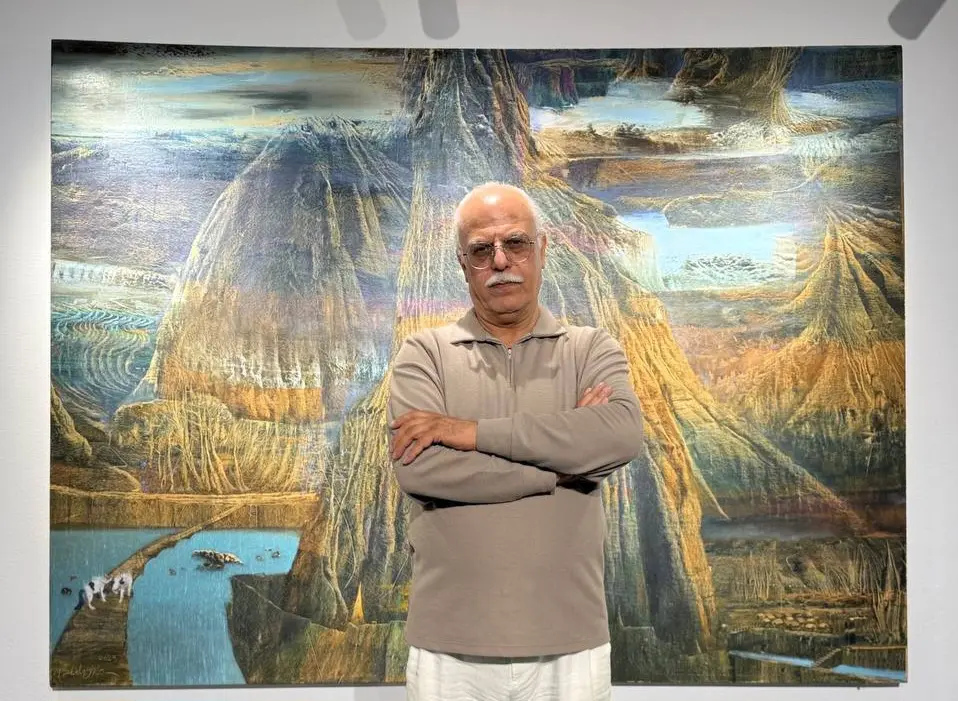
Yet the traces of human presence are unmistakable in this imagined world. Furrows across ploughed fields, upright gravestones, electricity poles and power lines, rocky roads, and stone steps beside rural houses all bear witness to people who seem to have lived here once, amid nature’s immensity, yet found no opportunity to assert themselves against its grandeur. These are unknown people from a distant past, now concealed among the countless cavities, recesses, and protrusions of the rock formations, inviting the eye to search for them. The sense of wonder inspired by this uncanny landscape hints at a profound mystery within nature. It draws the imagination towards contemplation amid mist-covered ponds, faded skies, and barren ground, recalling the enduring solitude of humanity within the boundless universe.
These rocks, rooted in the earth yet reaching towards the heavens, have witnessed the lives of human beings whose brief existence is spent striving for immortality, devoting themselves to changing, building, and leaving their mark on the world. They remain unaware that, in the end, only the grandeur of nature endures.
This human endeavour to leave an imprint upon nature is now reenacted through the painter’s own practice. Kamerani seeks to create a world shaped by the artist’s presence through the removal of paint from the canvas. Rather than applying colour to construct an illusion of three-dimensional rock formations, the painter first lays down a thick layer of paint and then begins to remove it using a rag and a palette knife. This process of scraping and carving away the paint recalls the marks and incisions that human beings have left in caves and rock faces since the earliest days of their existence on earth. Through reductive acts of shaping hard stone, they sought to express their presence and affirm their being.
The hand that, in a distant age, sought to carve stone now reappears in an artistic transformation, scratching and scoring the painted surface. This repetition of an ancient gesture reconstructs, as a profound concept, humanity’s enduring attempt to record its existence and affirm its place in the world.
To achieve delicate textures, the artist employs upholstery needles, traditionally used for stitching thick materials, alongside handmade tools fashioned from wood and metal. These instruments have ultimately enabled him to develop a distinctive personal technique that lends his paintings a unique character. This singular quality redefines art and the creation of artworks as perhaps the only means through which humanity can leave a lasting mark upon nature. From the time when tool-making humans first inscribed images on cave walls to the present moment, when the painter engages in the act of painting, art and artistic practice may be the only means by which human beings can secure a lasting presence. Perhaps this is what lies behind Kamerani’s repeated return to the grandeur of nature, with humanity occupying only a minimal place within it.
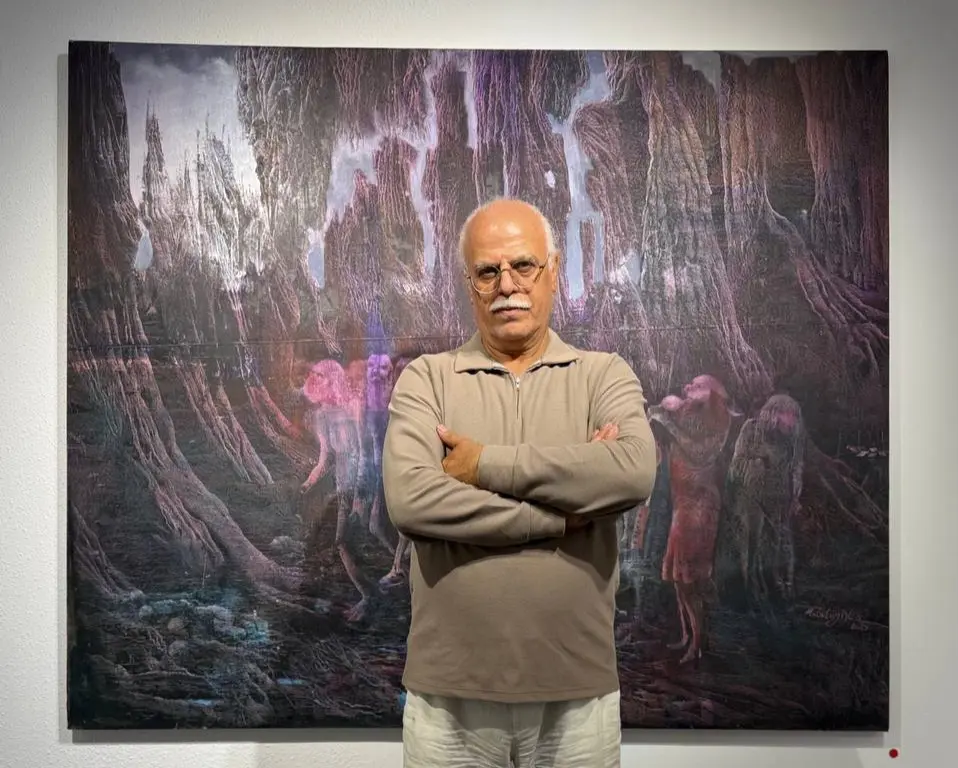
Another distinctive feature of Kamerani’s paintings is his immediate application of paint in layers over the underlying surfaces of the canvas, a process often accompanied by an expressive, spontaneous approach.
Traces of these underlying layers can sometimes be seen along the exposed, unfinished edges of the paintings. In this respect, Kamerani’s works recall contemporary unframed-edge or unprimed-edge painting practices, in which the act of painting itself, and the possibility of imagining the process through which an artwork comes into being, acquire new significance as part of the meaning of art.
Although the treatment of natural elements may appear realistic, particularly through the creation of perspective and spatial depth, Kamerani’s approach to nature is idealistic and aspirational. What emerges on the canvas seems to be less the result of meticulous observation of the external world than a mental exploration and profound contemplation of nature as something pristine and primordial. At the same time, the artist’s mastery of paint application evokes years of sustained practice. Combined with an almost mystic dedication, this mastery reveals his perception of nature as an inward experience.
Another defining characteristic of Kamerani’s paintings is the uncanny silence and stillness that recur throughout his body of work. In this enigmatic world, there is no sign of movement. Everything is submerged in profound silence, perhaps rooted in the artist’s experience of growing up with a deaf mother. It is as though the silent world of a strong, resilient mother finds expression in the mountain-like image of Mother Nature, becoming a sanctuary for the painter’s spirit. In the artist’s signature, Lal Oghlu—a name associated with the idea of a “mute son”—this experience becomes a linguistic sign.
In this extraordinary world, the only living creatures are a dog and a cat, evoking loyalty and companionship in the face of human solitude. They breathe quietly and peacefully amid the overwhelming silence of the rocks.
LEAVE A RELPY