
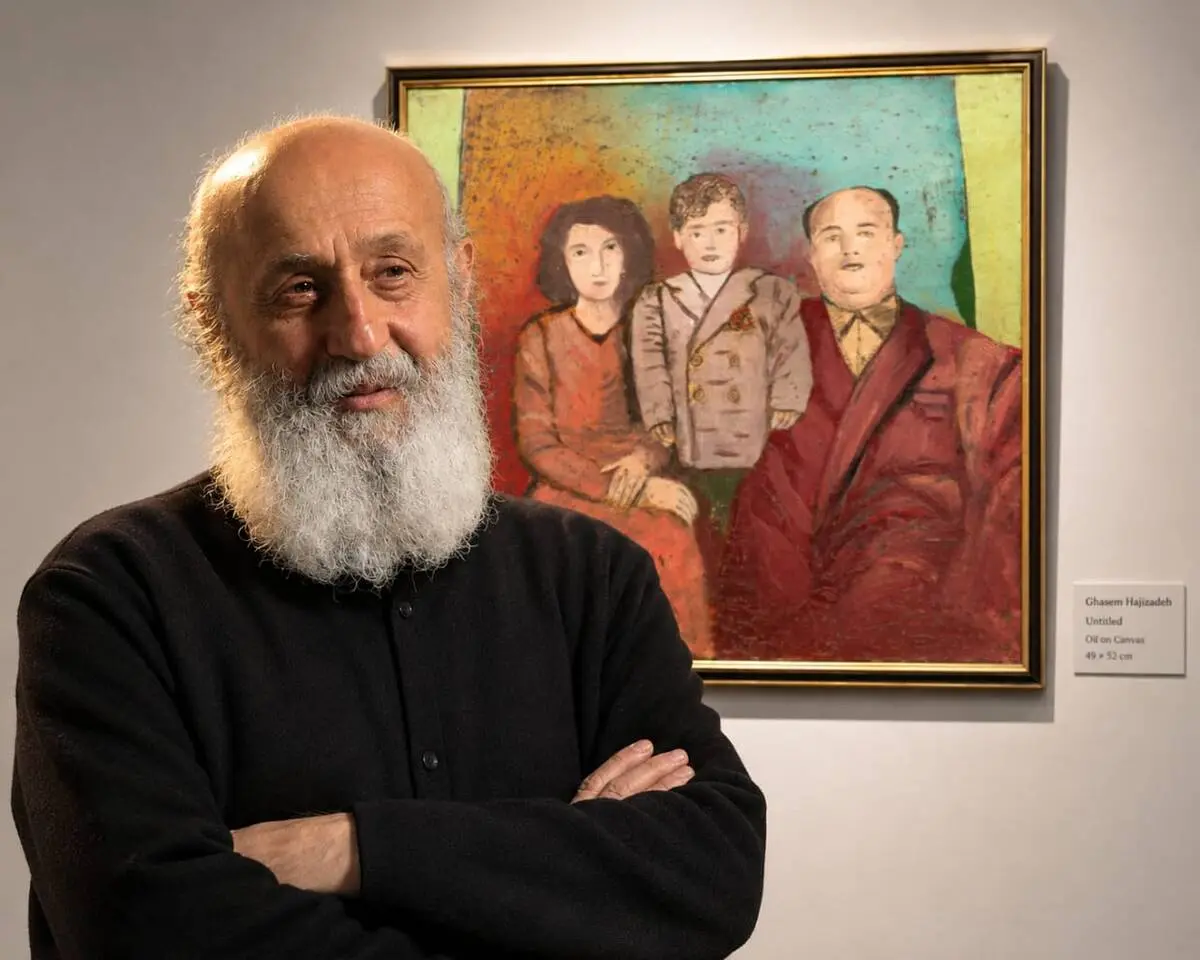
Ghasem Hajizadeh in the Raha Gallery Collection: Celebrating Nostalgia and Family
Ghasem Hajizadeh in the Raha Gallery Middle East Collection: Celebrating Nostalgia and Family.
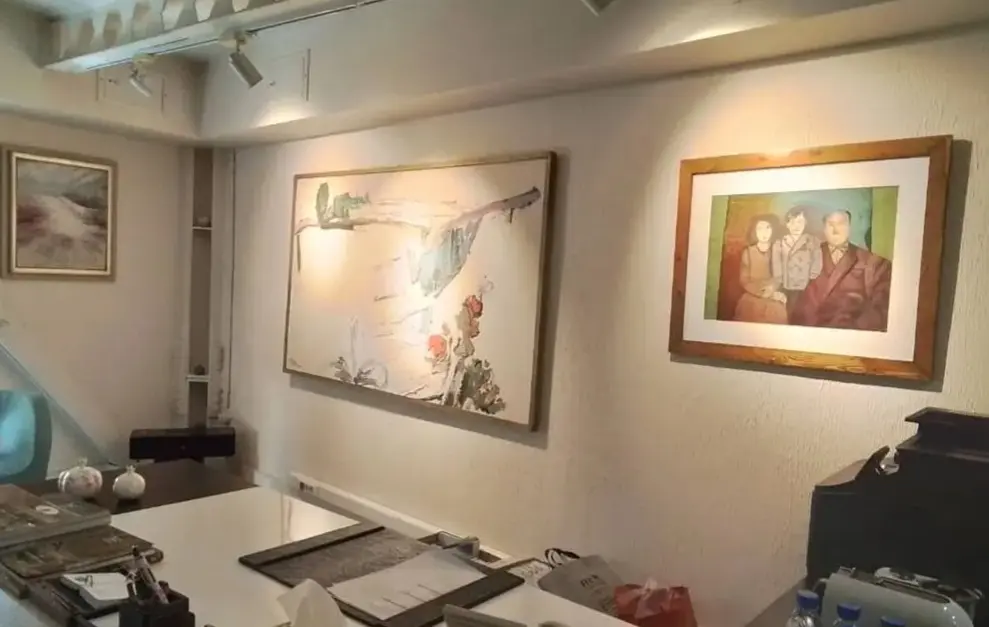
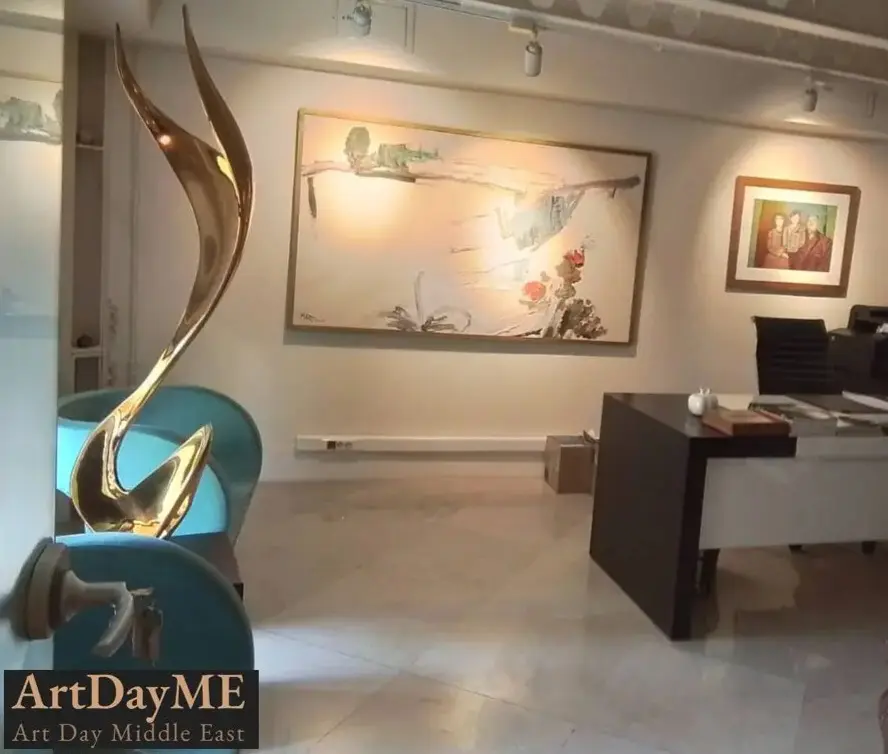
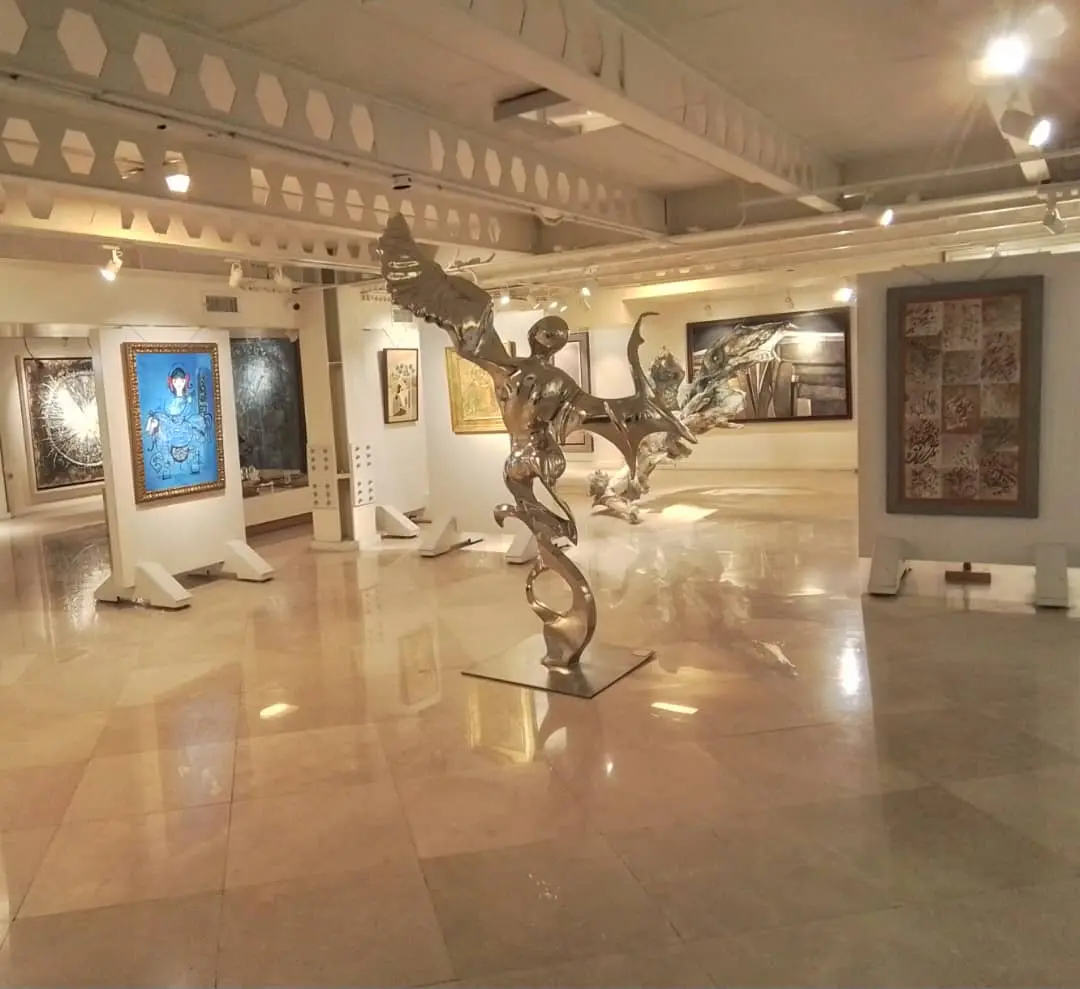
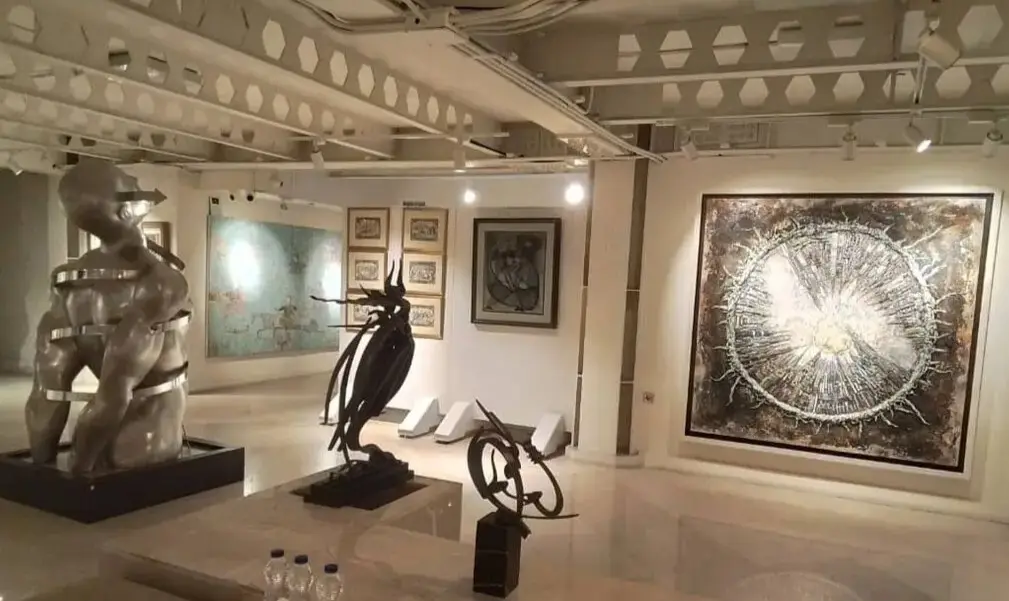
ArtDayMe : The Raha Gallery Collection, founded and directed by engineer Mohammadreza Ghaemmaghami, has maintained a sustained cultural presence for more than two decades, focusing on the promotion of regional art. The collection preserves a diverse range of modernist and contemporary masterpieces by Iranian and Arab artists.
Among these works is a remarkable painting by the distinguished Iranian artist Ghasem Hajizadeh, belonging to one of the artist’s best-known series. Executed in oil on cardboard, the work measures 59 × 42 cm.
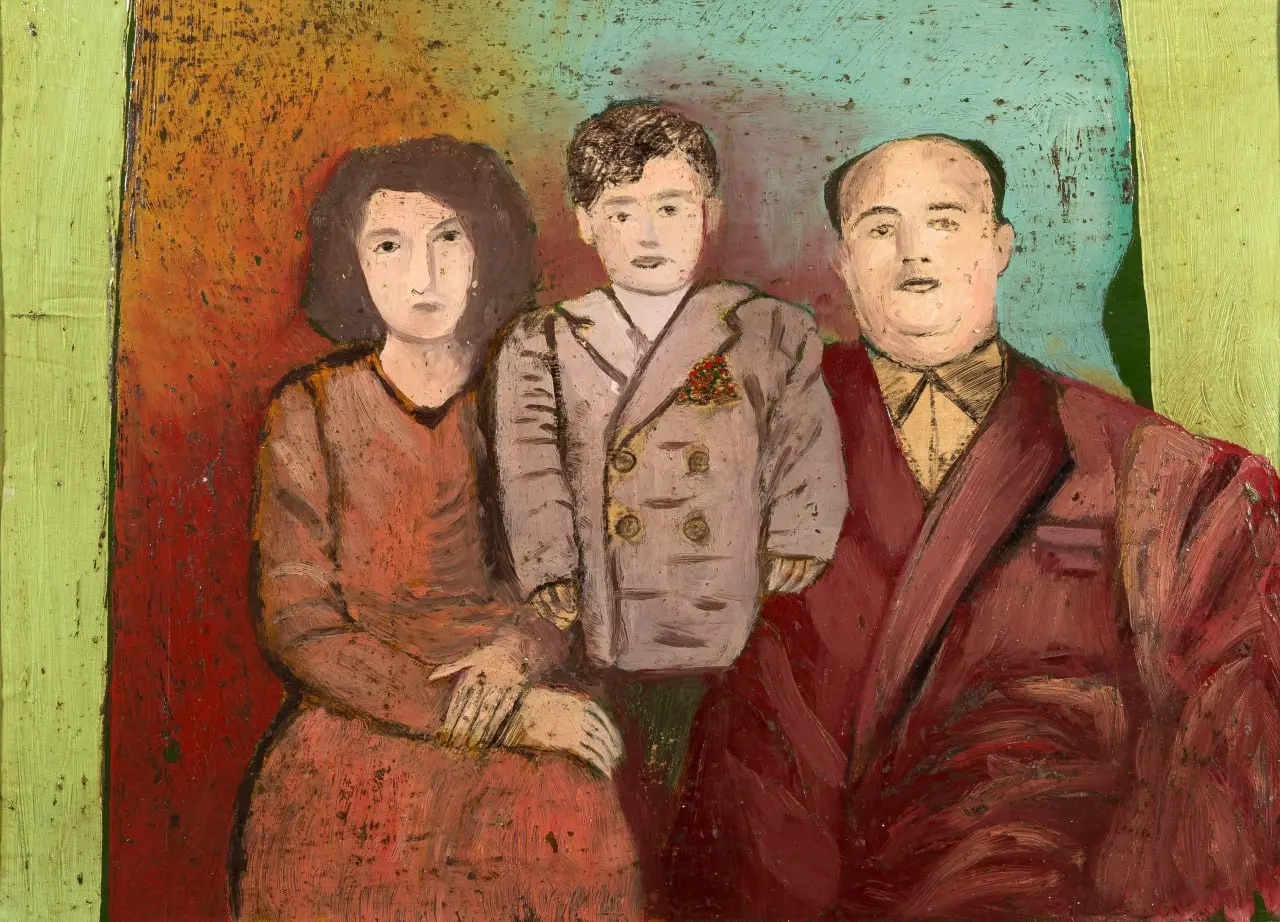
Hajizadeh’s celebrated series of paintings goes beyond the simple depiction of old family photographs or the representation of a particular social setting and historical period. It explores the intersection of memory, identity, family relationships, and the ways in which individuals are recorded in visual history. In this body of work, the past is reconstructed not through documentary precision, but through the painter’s distinctive and personal visual language.
Ghasem Hajizadeh, now approaching the age of 80, was born on 1 April 1947 (12 Farvardin 1326). He has been based in France for approximately five decades. Raised in Langarud, in Iran’s Gilan Province, he studied at the Tehran School of Fine Arts. He is widely regarded as one of the pioneers of Pop Art in Iran.
Hajizadeh turned to figurative painting early in his career and began exhibiting his paintings in Tehran in the late 1960s. His most significant early works drew inspiration from photographs of the Qajar era. In later years, however, his practice expanded towards paintings based on old photographs, ethnographic imagery, and the creation of nostalgic visual environments—a direction he has continued to pursue. Indeed, his sustained engagement with these themes over nearly half a century has allowed his visual language to develop greater depth and complexity, enriching the ways in which these works can be interpreted.
- Celebrating Nostalgia and Family in a Work from the Raha Gallery Middle East Collection
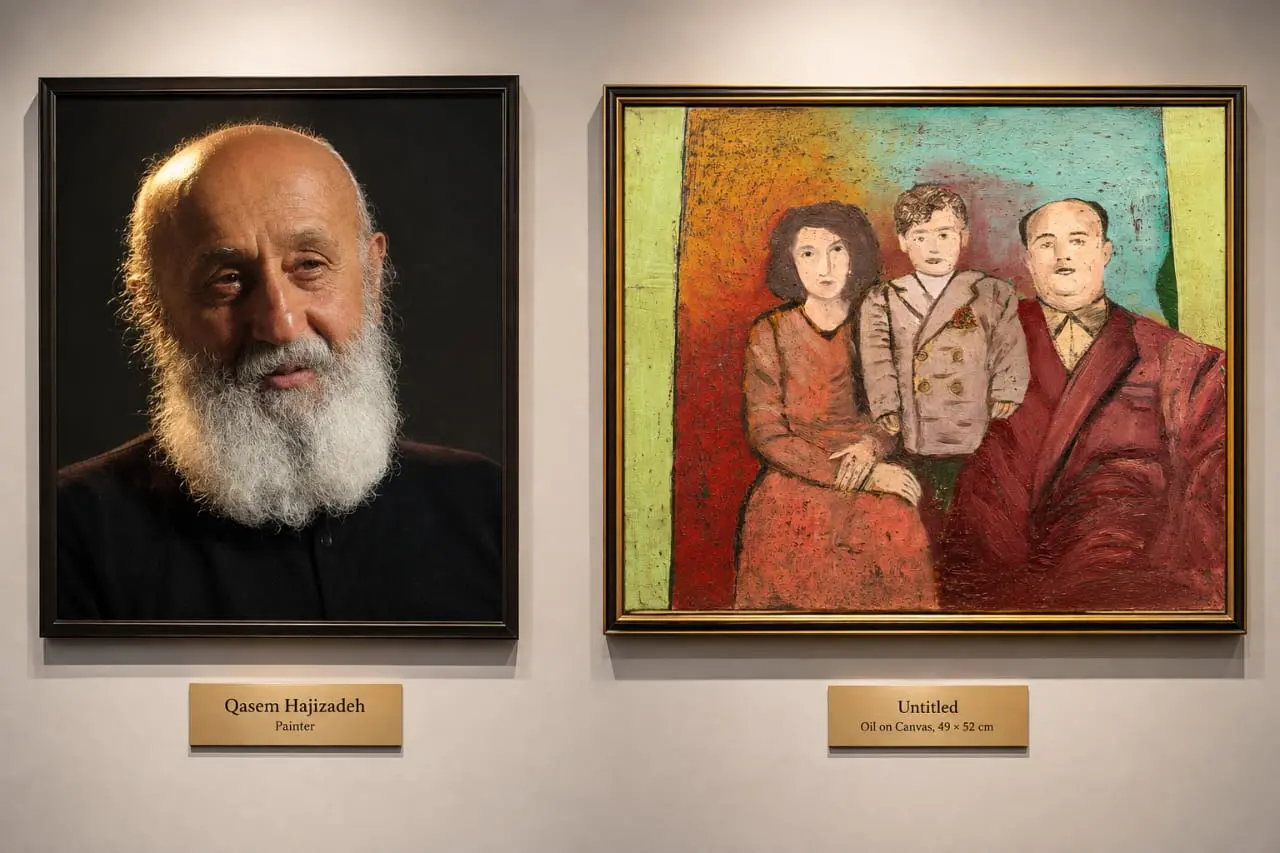
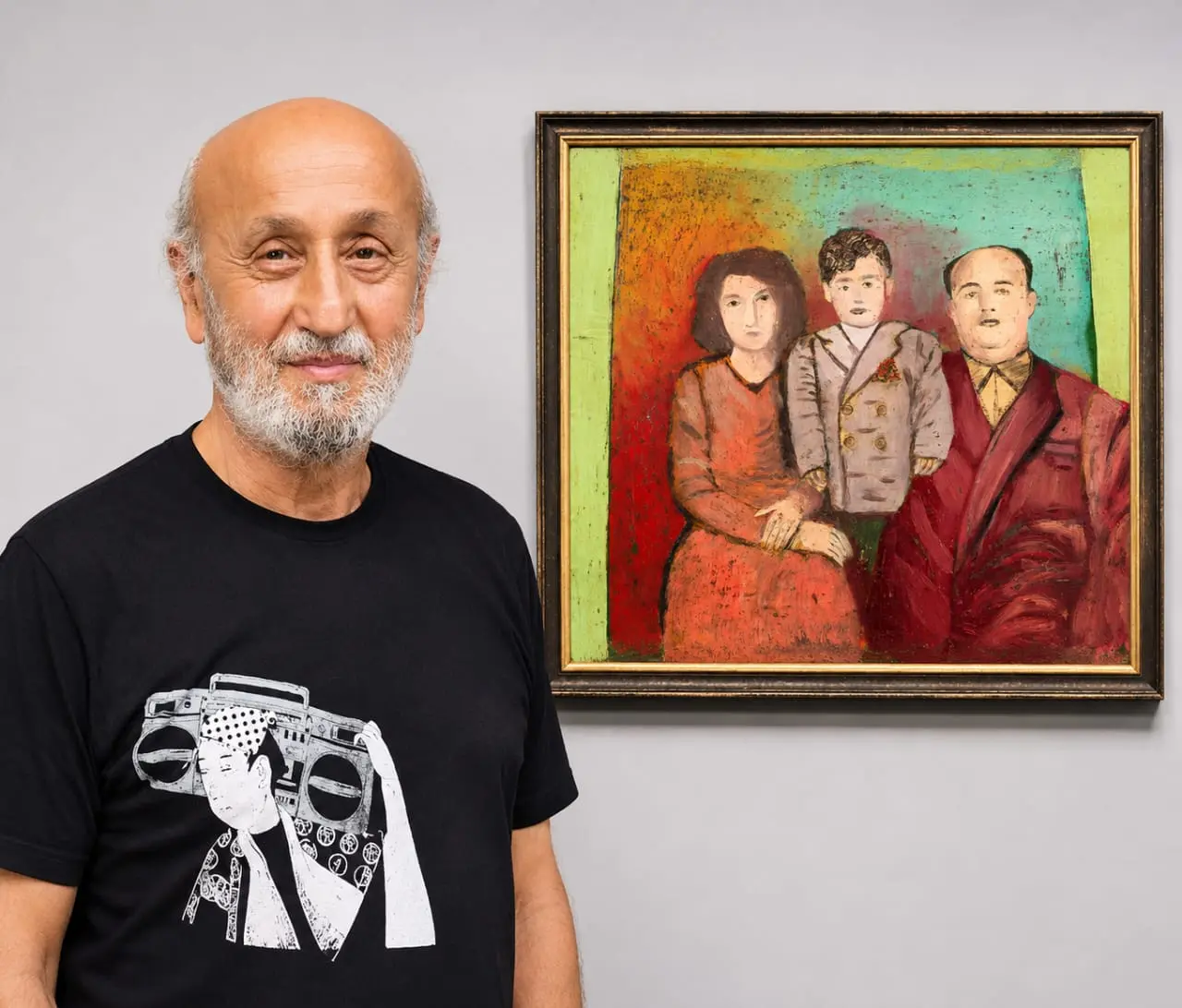
In this painting by Ghasem Hajizadeh, preserved in the Raha Gallery Middle East Collection, we encounter an image of a family that, at first glance, recalls the formal structure of a traditional family portrait: a woman on the left, a man on the right, and a child positioned at the centre of the composition. Yet the painting goes beyond the mere representation of three individuals. The arrangement of the figures, the relationship between their scale and positioning, the treatment of their faces, the colours of their clothing, and the unconventional background all point to a work whose central concern is not simply the recording of individual appearances, but the construction of an image of a social setting and human relationships.
1. Composition and the Arrangement of Figures
The composition of Ghasem Hajizadeh’s painting is built around three figures, with the child positioned at the centre and slightly ahead of the two adults, establishing the primary visual focus. Nevertheless, the child’s scale and placement are carefully conceived: he occupies neither an entirely foregrounded position nor one that disappears into the background. Standing between the two adults, he serves as a visual link connecting them.
The woman and the man, positioned on either side of the composition, create a relatively symmetrical arrangement. This symmetry, however, is neither complete nor strictly geometric. Differences in their postures, clothing colours, and the positioning of their hands prevent the composition from becoming monotonous. Consequently, while the painting maintains an overall sense of coherence, it also introduces a controlled degree of instability into its visual structure.
2. Spatial Structure and the Background
Unlike conventional realist portraits, the pictorial space does not rely on naturalistic depth or linear perspective. Instead, the figures are set against a colourful, relatively flat surface composed of areas of green, orange, red, and turquoise. The colour boundaries in the background function primarily as divisions between visual planes rather than as representations of an actual architectural environment.
This approach shifts the viewer’s attention away from the surrounding environment and towards the figures themselves. The background does not represent a specific location; rather, it serves as a pictorial field for the presence of the characters. The absence of precise geographical or architectural references gives the painting a quality that is independent of any particular time or place.
3. Figurative Simplification and the Treatment of Faces
One of the most striking characteristics of this work by Ghasem Hajizadeh, preserved in the Raha Gallery Middle East Collection, is its departure from academic proportions and naturalistic representations of the human body. The figures are constructed through a process of simplification and controlled exaggeration. Their faces are reduced to relatively simple forms, with the eyes, nose, and mouth rendered using minimal detail. Despite their individual differences, a certain consistency can be observed in the artist’s treatment of facial features.
This simplification distances the figures from fully individualised psychological portraiture, transforming them instead into visual signs of a family unit.
The hands also play an important role. The woman’s hands, resting on her lap, receive greater emphasis through the definition of lines and fingers than do her facial features or clothing. By contrast, the child’s hands remain close to his body, near the pockets of his jacket. These differences in gesture and hand positioning lend each figure a distinct physical and behavioural character.
4. Colour and Visual Organisation
Colour is the principal organising element of the visual space in this painting by Ghasem Hajizadeh. The contrast between the orange and red areas of the background and the turquoise and light green passages creates a chromatic energy that immediately draws the viewer’s attention to the picture surface.
The woman’s reddish-orange dress, the child’s grey jacket with violet undertones, and the man’s burgundy outfit establish three distinct colour zones. Although differentiated, these areas remain connected through the presence of warm and earthy tones. The choice of burgundy for the man’s clothing, particularly against the turquoise background, produces a particularly striking contrast.
Meanwhile, the skin tones are rendered through shades of cream, pink, and pale yellow. Their contrast with the dark hair and surrounding outlines separates the faces from the picture surface.
Equally significant is the presence of scattered patches, scratches, and irregularities throughout the painting. These textural variations prevent the colours from becoming uniform or merely decorative surfaces, preserving a sense of materiality and painterly expression.
5. Brushwork, Texture, and the Relationship Between Line and Form
The surface of Hajizadeh’s painting is highly active in terms of texture. Brushstrokes remain visible in the clothing, background, and even certain areas of the faces, giving the image a distinctly handmade rather than mechanical quality.
The dark outlines surrounding the figures sometimes function as boundaries, while elsewhere they merge with the background colours. This uncertainty in the distinction between figure and ground gives the painting a quality that exists somewhere between drawing and painting.
The clothing, too, is constructed through loose and occasionally irregular lines. Folds and creases are less concerned with the precise logic of light and volume than with expressive possibilities. As a result, the picture surface avoids visual uniformity, continually presenting the viewer with variations in texture and painterly treatment.
6. Light, Shadow, and the Rendering of Volume
In this work, lighting does not follow a clearly defined or realistic light source. In Hajizadeh’s visual approach, faces and bodies are articulated through varying degrees of light and dark, but the shadows do not conform to a coherent system of naturalistic illumination.
Volume is established primarily through colour variations, contour lines, and the application of painterly patches. Consequently, the figures appear somewhat flattened. This flattening, however, does not mean that volume is entirely absent. Certain areas, including the man's face, the woman's hands, and the folds in the child's clothing, are distinguished from the background through subtle shifts in colour and localised darkening.
The combination of limited modelling and a flattened pictorial surface gives the work a visual quality that lies between representation and illustration.
7. Family, Memory, and the Tradition of Photography
The most significant thematic dimension of Ghasem Hajizadeh’s painting in the Raha Gallery Middle East Collection lies in its representation of family. The three figures stand together in a configuration that invites a connection between the painting and the tradition of family photography.
Their arrangement, formal clothing, and direct orientation towards the viewer recall portraits traditionally made to document a family's social standing. Yet rather than faithfully reproducing an existing photograph, Hajizadeh transforms its visual character through his own distinctive artistic language.
This interpretation is consistent with the artist’s well-established approach to historical and family imagery, which has frequently been discussed in art writing in relation to the intersection of figurative painting, popular culture, and visual memory.
8. Clothing as a Marker of Social Identity
Clothing holds particular significance in Hajizadeh’s painting.
The child's double-breasted jacket, pocket square, and the man's formal attire, set alongside the woman's relatively simpler dress, suggest a particular social order and set of family relationships.
These garments establish the figures' social identities. However, the simplified and somewhat impersonal treatment of their faces prevents the image from becoming a definitive narrative about the lives of this particular family. Instead, the clothing functions as a visual indicator of social position, while the figures themselves retain a degree of ambiguity.
9. Nostalgia, Emotional Distance, and the Ambiguity of Memory
The value of this painting lies in the relationship between the structure of the family portrait, its energetic use of colour, the simplification of its figures, and a subtle sense of emotional distance.
Rather than presenting the characters through realistic detail or complex psychological expressions, Hajizadeh reconstructs them within a relatively flat, colourful, and narrative pictorial structure.
Despite its chromatic appeal and apparent intimacy, the work also retains a certain thematic ambiguity. This emerges from the absence of direct interaction between the figures and the distance between their formal appearance and their facial expressions.
Ultimately, the painting operates on two interconnected levels: it evokes the familiarity and intimacy of a family photograph while simultaneously transforming that familiar image into an independent artistic statement. Through this process, Hajizadeh turns nostalgia into more than a sentimental recollection of the past; it becomes a means of examining family, social identity, and the ways in which personal memories are preserved and reconstructed through images.
This artwork belongs to the Raha Gallery Collection of the Middle East
.
LEAVE A RELPY