
Mehrdad Fallah and the “Lion or Tails” Paintings / Innovation within Tradition / Mehrdad and the Act of Moving between Seeing and Reading
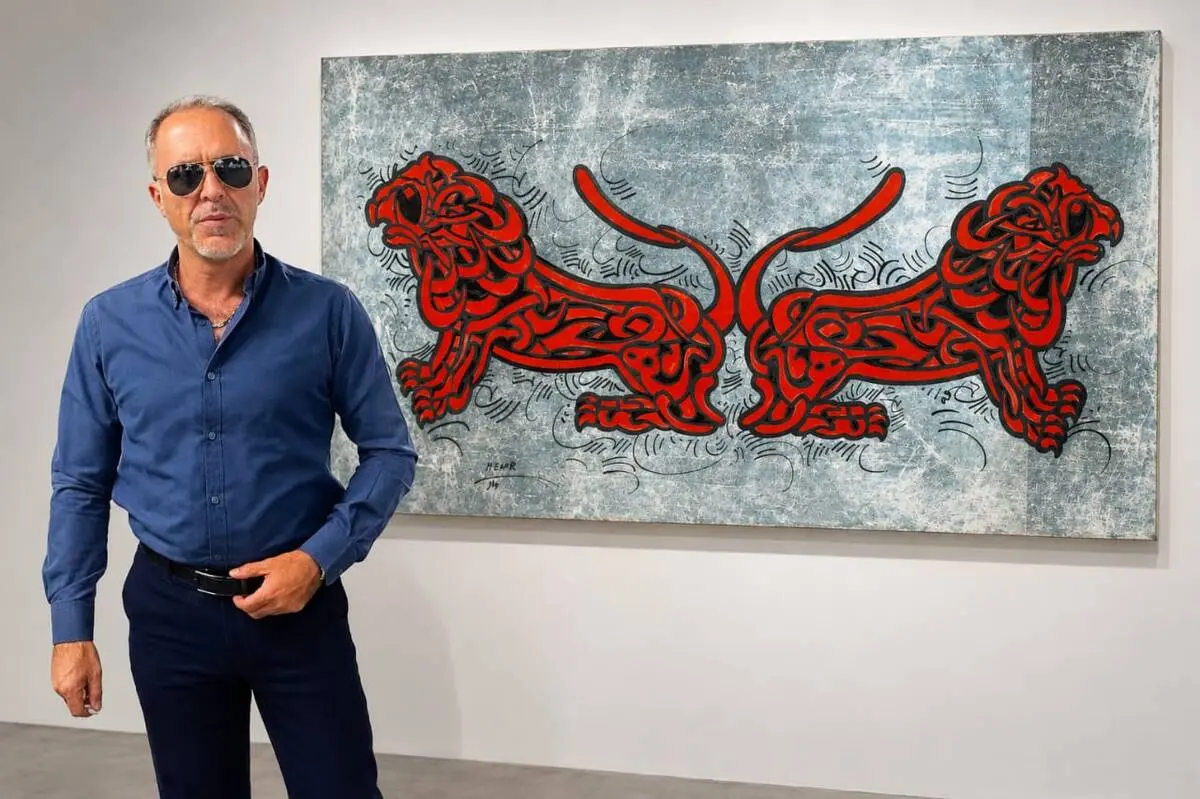
You can see Mehrdad Fallah’s skill in transforming the word into form, form into animal, and animal into sign. In this work, he has not painted a lion; he has written the lion in an international language.
ArtDayMe : We examine one of the paintings by Mehrdad Fallah, a renowned Iranian painter, from his well-known series, “Shir-Khat” (Lion-Line).
In the “Shir-Khat” series, Mehrdad Fallah turns to one of the most familiar visual signs in Iranian—and more broadly, Middle Eastern—culture: the lion.
Yet what matters in his works is not the conventional representation of a lion. Fallah draws the lion out of line. Here, line is no longer merely a means of writing; it becomes a visual material through which the body, movement, power, and even cultural memory can be constructed.
The untitled work, dating from the 2000s in the Iranian calendar, measuring 20 × 30 cm and executed in mixed media, is a compelling example of this approach. It is a work in which the boundaries between calligraphy, painting, image, and sign are constantly shifting.
Two Lions, One Field; A Confrontation in Silence
At first glance, we see two red lions positioned opposite one another on either side of the frame. The composition is based on a form of symmetry, but this symmetry is neither complete nor mechanical.
Subtle differences in the movement of the lines and the details of the bodies prevent the image from becoming merely a decorative pattern.
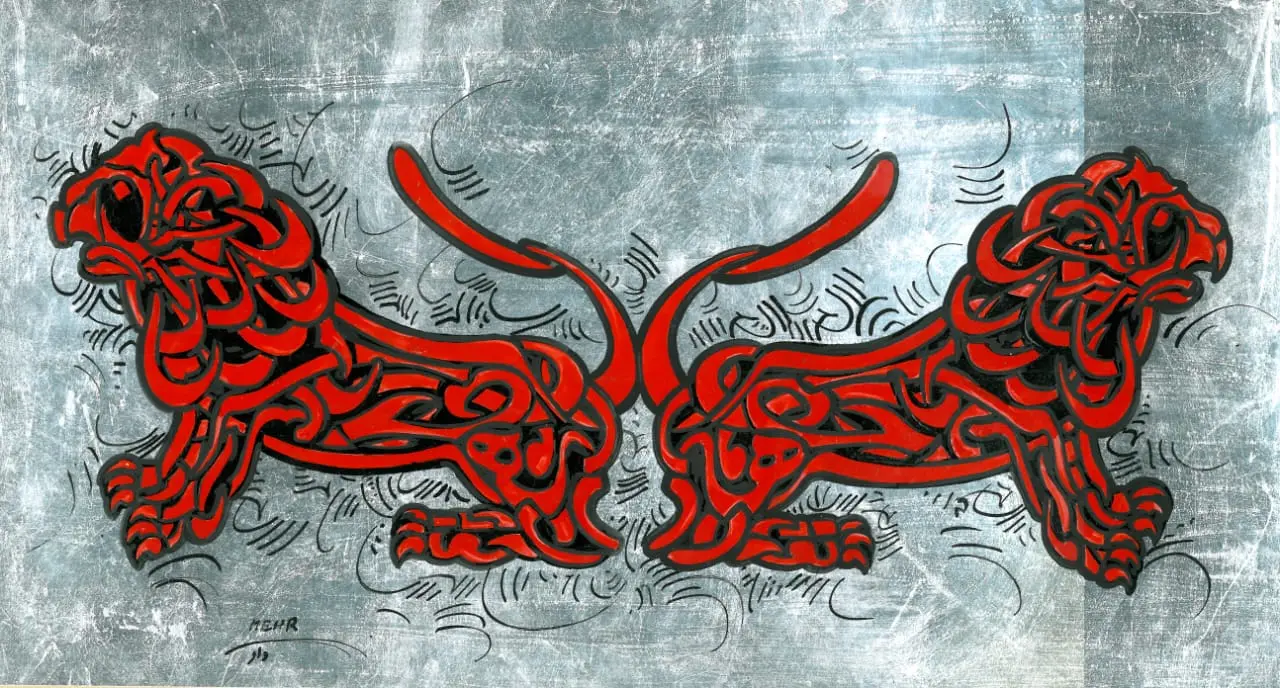
The two lions are drawn toward the center, yet they never meet. The narrow space between them becomes one of the most important elements of the composition: a vertical void that appears empty, yet plays a central structural role within the work.
It is as though two forces have stopped on the threshold of confrontation; neither a battle has begun nor has complete peace emerged.
This very suspension creates the energy of the work.
Lions That Have Been Written
But the main event takes place at close range.
What appears from a distance to be the body of a lion reveals itself, upon closer inspection, as a collection of lines, twists, loops, and brush-like movements. The head, mane, body, legs, and tail are all formed from this linear network. This is where the work moves beyond an animal image.
Fallah constructs the lion with line; he does not first draw an image of a lion and then add lines to it.
As a result, line performs several functions simultaneously in this work: it is the skeleton of the image, the texture of the body, a written sign, and an agent of movement.
In other words, in “Shir-Khat,” line is not decoration; it is the primary, sculptural material of the image.
From Letter to Animal; When Calligraphy Moves beyond Being Read
One of the most compelling aspects of the work is its relationship with the tradition of Iranian calligraphy. Here, lines are no longer necessarily intended to be read. Their twists, extensions, and curves function less as carriers of a specific text than as visual elements.
This is precisely where the experience of calligraphic painting becomes significant: the letter moves away from its obligation to be read and reveals its visual potential.
But Fallah takes this one step further. He uses line not simply to create an abstract composition, but to construct a recognizable creature.
The trajectory of the work can therefore be understood as:
Line → Form → Lion
And in the opposite direction:
Lion → Sign → Line
This constant movement back and forth forms the conceptual core of the work.
Red; The Color of Power, Movement, and Warning
Red in this work cannot be regarded as merely a chromatic choice.
The vivid, concentrated reds of the lions make the first visual impact against the cool gray-blue background.
Color separates the lions from their surroundings and gives them a sign-like quality, as though two living, energetic symbols have been placed upon the surface of the work.
Alongside red, black plays a structural role. The black lines contain the forms, distinguish their details from one another, and give the red weight and depth.
In contrast, the cool, weathered background allows these two colors to breathe.
The chromatic structure of the work can therefore be read as:
Red: energy and presence
Black: structure and restraint
Gray-blue: background and memory
A Background That Has Its Own Story
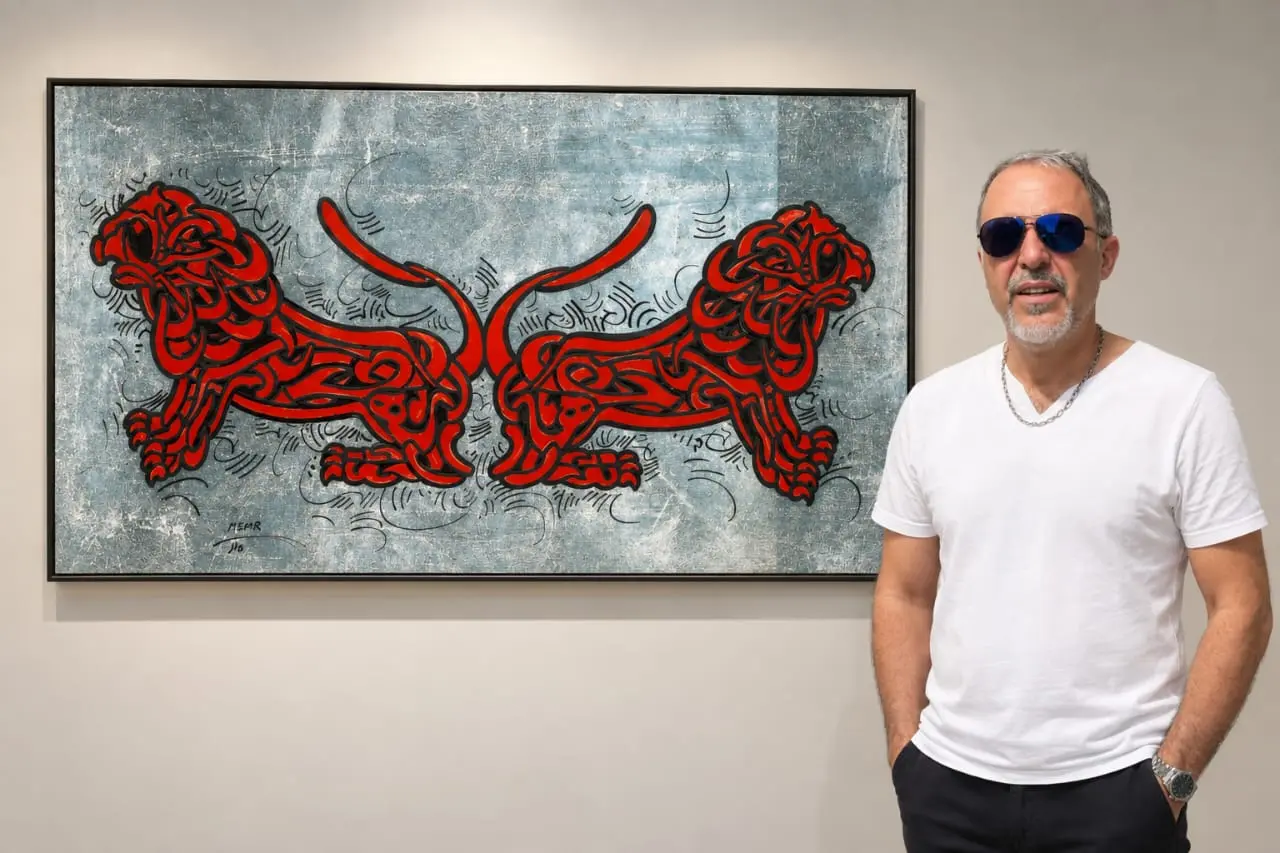
The scratches, stains, and scattered lines across the background give it a curious and historical quality.
At times, the surface resembles an old wall; at others, it recalls a page upon which something has been written, erased, and written again many times.
The loose, scattered lines surrounding the lions also prevent the boundary between “figure” and “ground” from becoming entirely definitive. Even beyond the bodies of the lions, line remains in motion.
Thus, if the lions are the center of energy in the work, the entire surface of the painting becomes the field of that energy.
The Lion; An Animal or a Cultural Memory?
The choice of the lion in Iranian art has always carried a distinctive visual and cultural significance. Within Iran’s visual memory, the lion is associated with concepts such as power, grandeur, heroism, hunting, and authority.
But Fallah does not reconstruct the historical lion.
Rather than repeating a familiar image, he transforms it through the language of contemporary line.
For this reason, the importance of the lion here is not limited to its symbolic meaning. The lion becomes a vehicle for a dialogue between cultural memory and the contemporary language of art.
This is also closely aligned with the title of the series, “Shir-Khat” (Lion-Line): a term itself created through the union of two worlds—lion and line.
Tradition versus Innovation; Or Tradition within Innovation?
One of the important readings of this series can be found in its relationship between tradition and innovation.
Fallah chooses elements that are entirely familiar: the lion, line, symmetrical composition, and visual signs deeply rooted in Iranian culture.
Yet he does not reproduce any of them in their historical form.
They are reorganized.
In this process, tradition functions not as a fixed image, but as raw material for contemporary creation.
From this perspective, “Shir-Khat” can be understood as an exploration of how the past can be used without merely being repeated.
Beautiful Violence
At first glance, the work is attractive and even decorative; the brilliant reds, the symmetry of the two lions, and the abundance of intricate linear movements draw the eye.
Yet beneath this beauty lies a form of visual violence.
The lines are densely packed, the bodies are intertwined, the paws and heads possess an aggressive energy, and the background itself is neither calm nor static.
This tension enhances the work’s attraction: Beauty has emerged from density and linear violence.
Small, Yet Dense
The dimensions of 20 × 30 cm are also significant to the experience of the work.
From a distance, the viewer first encounters the overall image of two lions; as the viewer moves closer, the details of the lines and the intricate movements within them become visible.
The work therefore makes two distinct experiences possible at once:
From a distance: the lion. Up close: the line.
This movement between the overall image and its details is one of the significant characteristics of its visual structure.
Mixed Media; A Surface between Painting and Material
The mixed-media technique is also consistent with the nature of the work. The surface does not appear uniform or made from a single material; layers of color, line, scratches, texture, and graphic elements coexist to create a multilayered surface.
This technical multiplicity also corresponds to the conceptual logic of the work: just as the lion is not constructed from a single language, the surface of the work is not formed from a single material or a single visual behavior.
Line, color, and texture each assume a part in constructing the image.
And Finally; Lion or Tails?
Perhaps the most intriguing question raised by the work is precisely this.
If we look from a distance, we see two lions. If we move closer, we see an accumulation of lines.
But if we pause a little longer, we realize that these two have never really been separate things.
In “Shir-Khat,” Fallah shifts the boundary between seeing and reading; he transforms line into image and then returns the image to line.
From this perspective, “Untitled” is not merely an image of two lions.
It is a visual narrative of transformation: the transformation of word into form, form into animal, and animal into sign.
Perhaps the entire work can be summed up in a single sentence:
Mehrdad Fallah has not painted the lion in this work; he has written it—in an international language.
The Prices of Mehrdad Fallah’s Works
Mehrdad Fallah was born in Tehran in 1975. He grew up in a traditional family, but this was not an ordinary household. One of the most important pioneers of modern Iranian painting had also been born into this family: Sadegh Tabrizi.
The late Sadegh Tabrizi was Fallah’s maternal uncle, and Mehrdad became his special and chosen student.
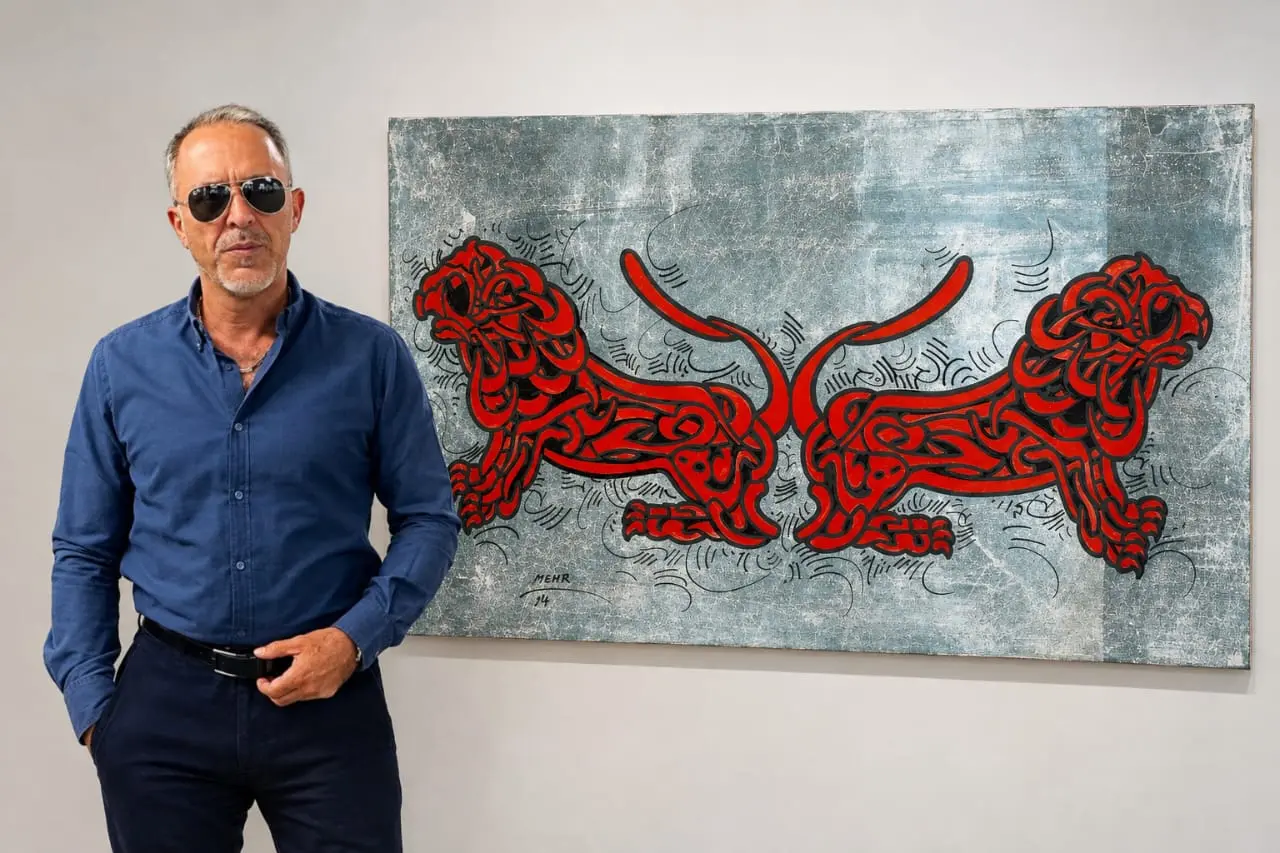
Fallah’s works have so far been presented at four different auctions, with all of them selling above their initial estimates: at the 21st Tehran Auction in October 2024, one of his works sold for 1.87 billion Iranian rials; he also participated in the Second National Auction in 2015, Goharan Auction, and a charity auction in Los Angeles.
Fallah’s works have been exhibited repeatedly in the United Kingdom, Switzerland, Italy, Belarus, Cyprus, Turkey, the United States—particularly Los Angeles—Dubai, and, of course, Iran.
Among these presentations, Fallah’s works were shown in “Persian Whispers” at Aryan Gallery, at the Pars Place complex in Virginia, USA, in November 2025, where ten works were sold.
His “Nostalgia” painting exhibition was also held in October 2025 at the Otto Mauer Zentrum in Vienna, Austria, where seven works were sold.
Fallah’s professional entry into the art world dates back to the age of 23, in 1998, when he presented a painting exhibition behind glass at Gallery 66, a pioneering gallery founded by Sadegh Tabrizi.
This was followed by six solo exhibitions, perhaps the most significant of which, and the one that received extensive attention, was “Lion with Line” at Art Center Gallery in 2015.
Over these years, Fallah has created numerous works combining painting with Iranian symbolism, eventually developing his distinctive artistic signature. He is among the painters who draw upon traditions of Iranian painting to create modern and contemporary works.
Among these, his three series of lions, roosters, and, of course, “Ajayeb al-Makhlouqat” (Wonders of Creation) brought him considerable recognition.
A number of art experts consider Mehrdad Fallah among the artists who have continued and revived the Saqqakhaneh School in the contemporary era.
LEAVE A RELPY