
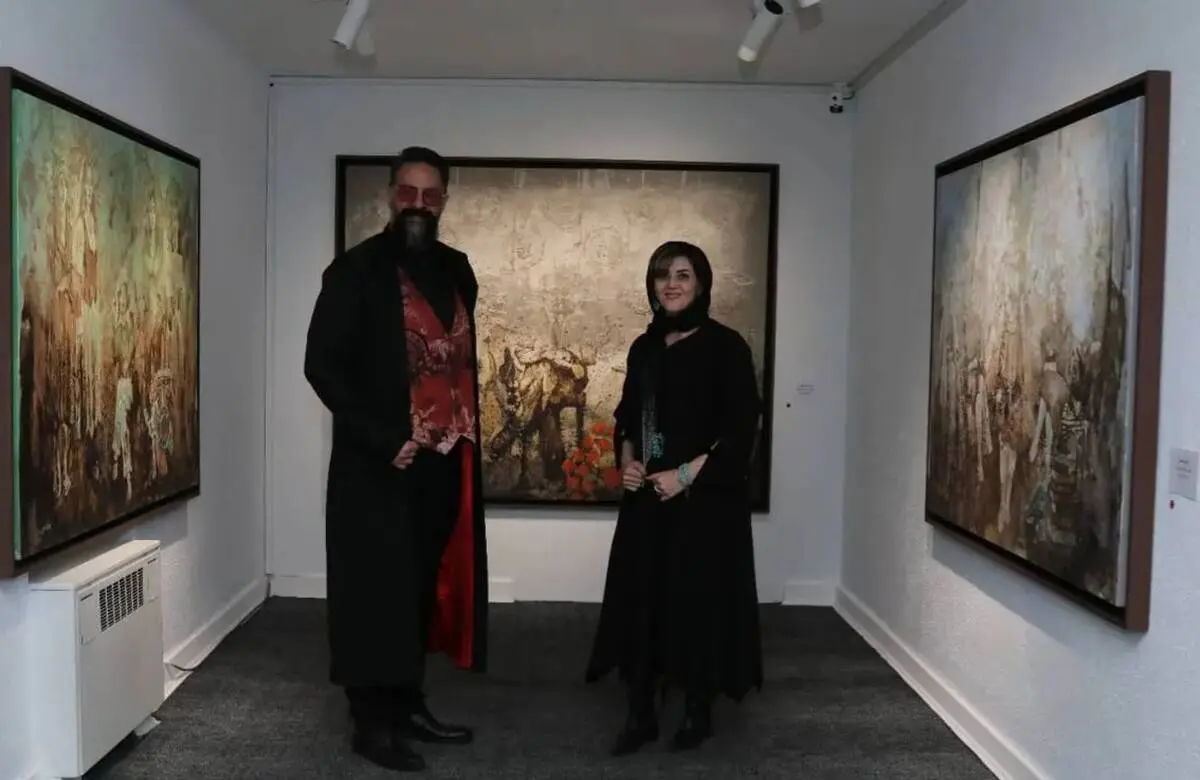
Zohreh Mehraban: Maahyar Charmchi and the Disintegration of Human Identity at Maad Gallery / Why Has Charmchi’s Exhibition Become So Popular?
Zohreh Mehraban, Founder and Director of Maad Gallery, offers an aesthetic and conceptual analysis of Maahyar Charmchi’s painting and sculpture exhibition at Maad Gallery.
ArtDayMe : Zohreh Mehraban, Founder and Director of Maad Gallery :
Maahyar Charmchi’s exhibition at Maad Gallery can be understood as an encounter with one of the most complex issues confronting contemporary humanity: the erosion of individuality under systems that transform human beings into entities that can be defined, controlled and ultimately replaced.
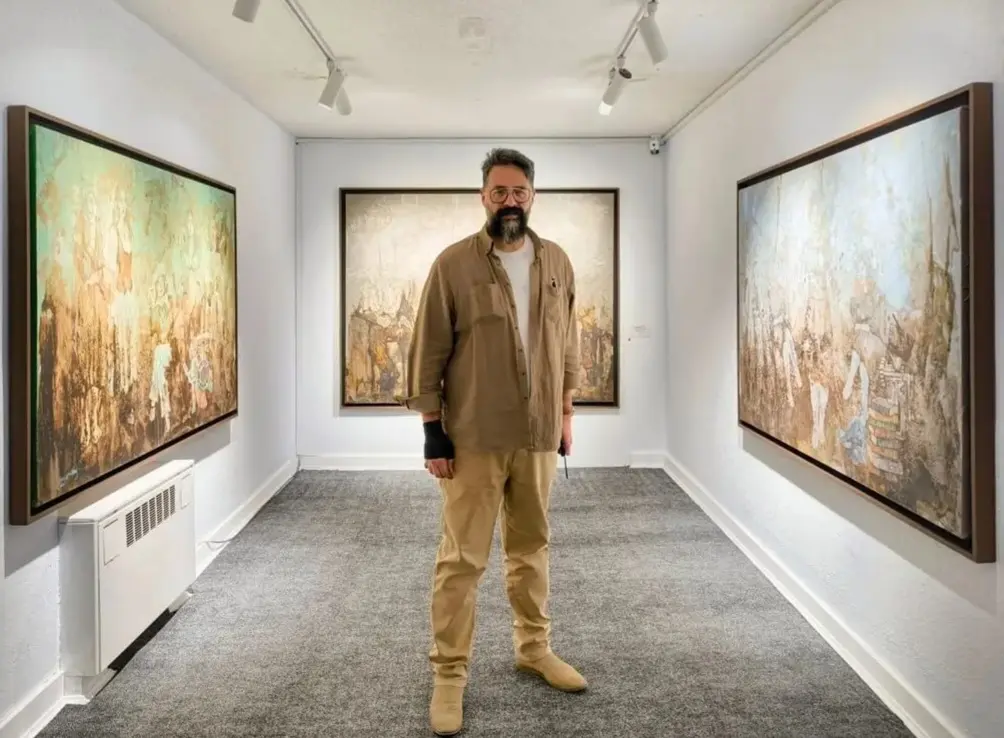
Following a series of notable achievements in Turkey’s art scene, Maahyar Charmchi has returned to the Iranian visual arts scene after a seven-year absence. Bringing a philosophical perspective and a critical outlook, he has presented an exhibition that has attracted considerable attention.
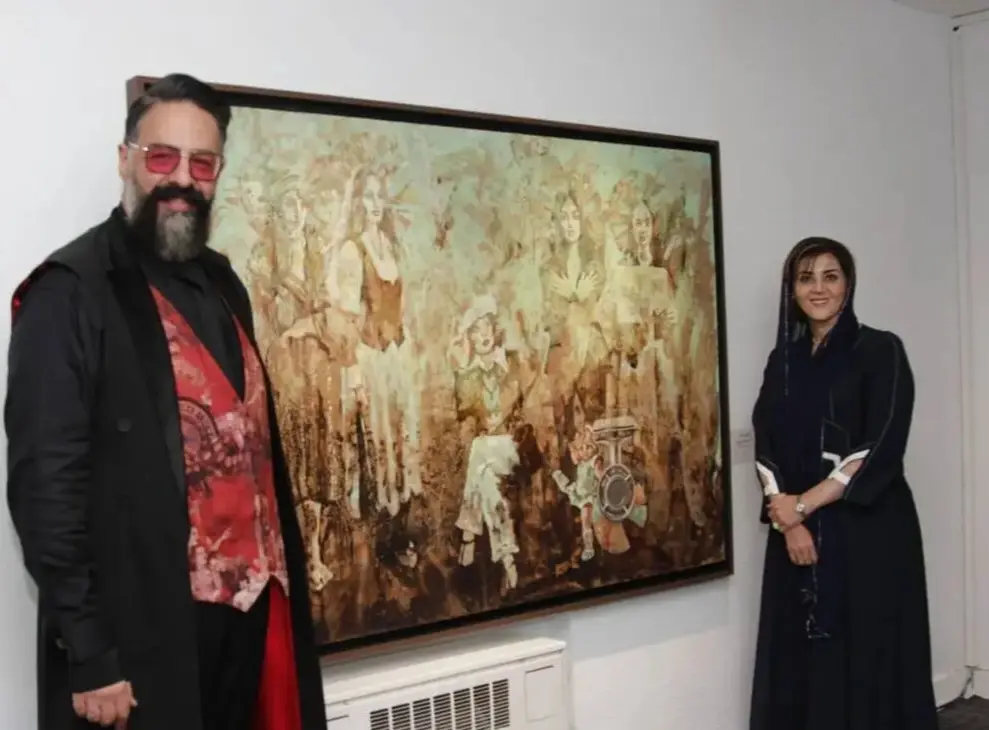
Charmchi is an artist who values dialogue and the critical examination of the world around him. He creates artworks in response to his intellectual concerns, which explains why some viewers interpret the spirit of his work as inherently inquisitive, while others see it as an entirely different approach: an attempt to articulate a global phenomenon often described as globalisation. This multiplicity of interpretations further enhances the appeal of his work.
The exhibition’s title, "Meat Grinder Symphony", offers audiences an immediate key to entering the artist’s conceptual universe.
In everyday terms, a meat grinder is an appliance designed to break down and homogenise. In this collection, however, it becomes a metaphor for the social, cultural and historical mechanisms that wear down differences and dissolve independent identities into a homogenised order.
What is particularly significant is the perspective from which Charmchi examines the process of domination and the transformation of human individuality. In this exhibition, these mechanisms are not merely imposed from outside; they gradually become internalised, take root in collective behaviour and are reproduced from within the individual. Consequently, the world of his works portrays less a specific incident than a broader civilisational and psychological condition.
Maahyar Charmchi seeks to translate the exhibition’s theoretical concepts from the realm of thought into visual expression and artistic practice. One of the most inventive aspects of his approach is his intelligent and context-sensitive reinterpretation of the meat grinder motif in each work. Rather than repeating a fixed symbol, he adapts its structure and metaphorical function to the subject and content of each painting, allowing the central motif to assume a new symbolic form and expressive language.
In doing so, Charmchi demonstrates how mechanisms of domination and the erosion of individuality continually reproduce and update themselves in response to the circumstances and manifestations of different phenomena.
Perhaps the most inventive manifestation of this visual transformation can be seen in "Namous (Honour)" . Here, the meat grinder’s rotating mechanism is transformed into a film reel. This ingenious device not only preserves the exhibition’s central idea but also introduces a new layer of meaning, emphasising the continuity, repetition and reproduction of this cycle within the fabric of social life.
- A Unified Exhibition: When Painting and Sculpture Speak a Common Language
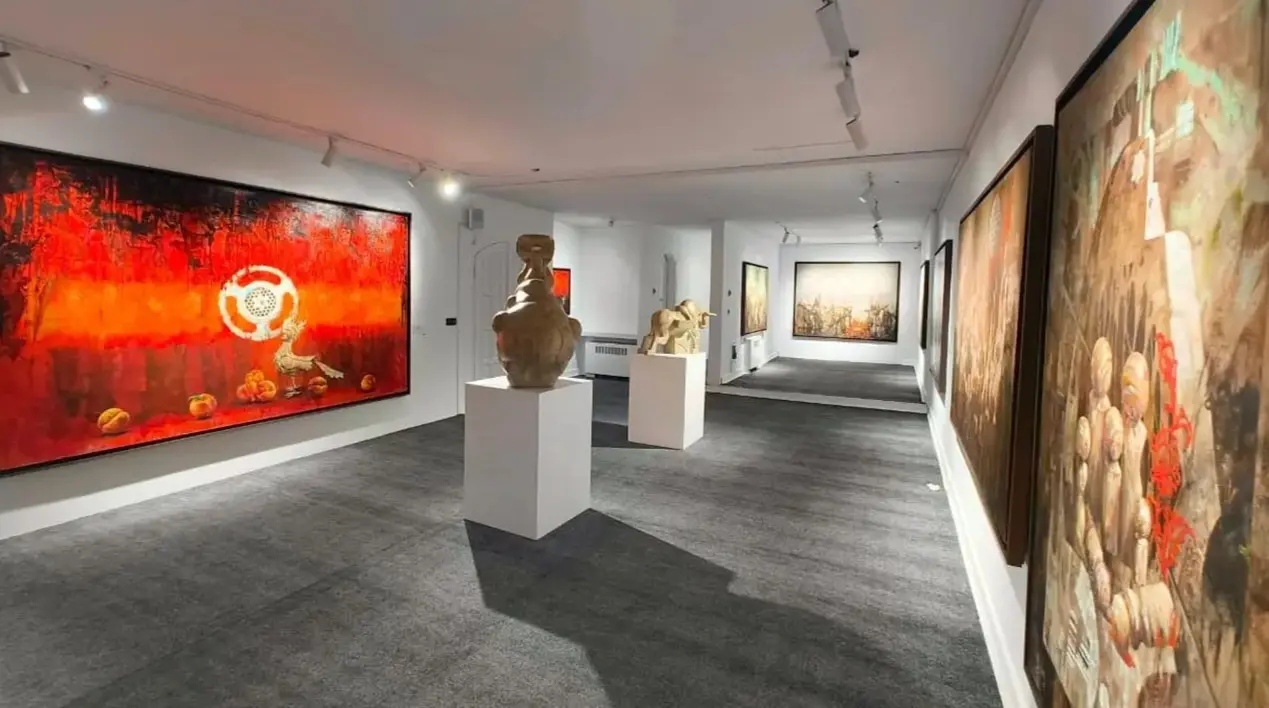
One of the exhibition’s most notable features is the conceptual relationship between its paintings and sculptures. The paintings, with their deformed bodies, partially concealed faces, densely packed figures and dark environments, present an image of humanity trapped in a cycle of pressure and transformation. The sculptures, meanwhile, transfer this same world from the pictorial plane into the realm of material and three-dimensional form.
Here, painting and sculpture are not two separate media but two modes of expressing a shared question: What happens to human beings when external structures and internal forces deprive them of the ability to preserve their independent identities?
In the paintings, figures are frequently caught within layers of colour, texture and visual signs. They rarely retain complete autonomy, appearing instead as fragments of a larger mass or structure. Faces, too, often occupy a space between recognition and anonymity. Viewers can identify traces of the human presence, yet the artist deliberately avoids conventional representations of recognisable faces.
This condition carries considerable aesthetic significance. The deformation of the figures, the distortion of bodily proportions and the dissolution of anatomical boundaries directly serve the conceptual content of the works. Form articulates precisely what the subject matter seeks to convey: the collapse of the human being’s apparent unity.
_ The Aesthetics of Anxiety
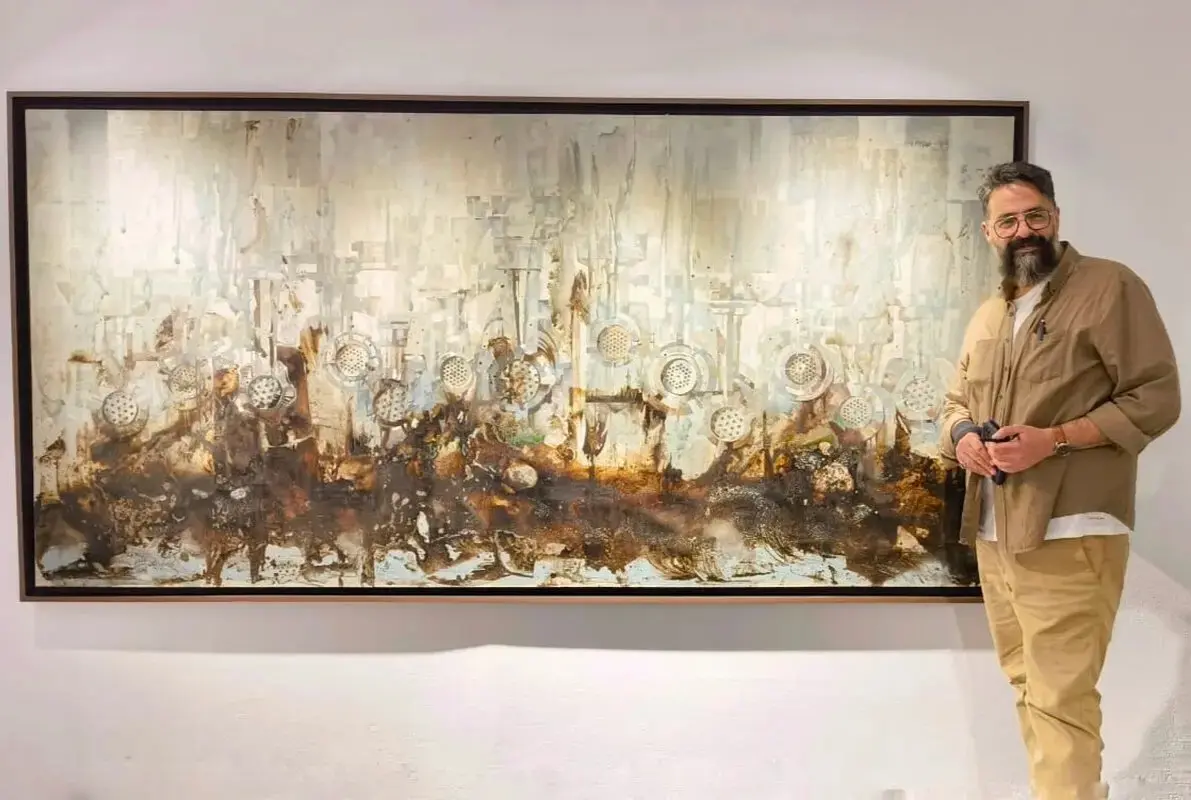
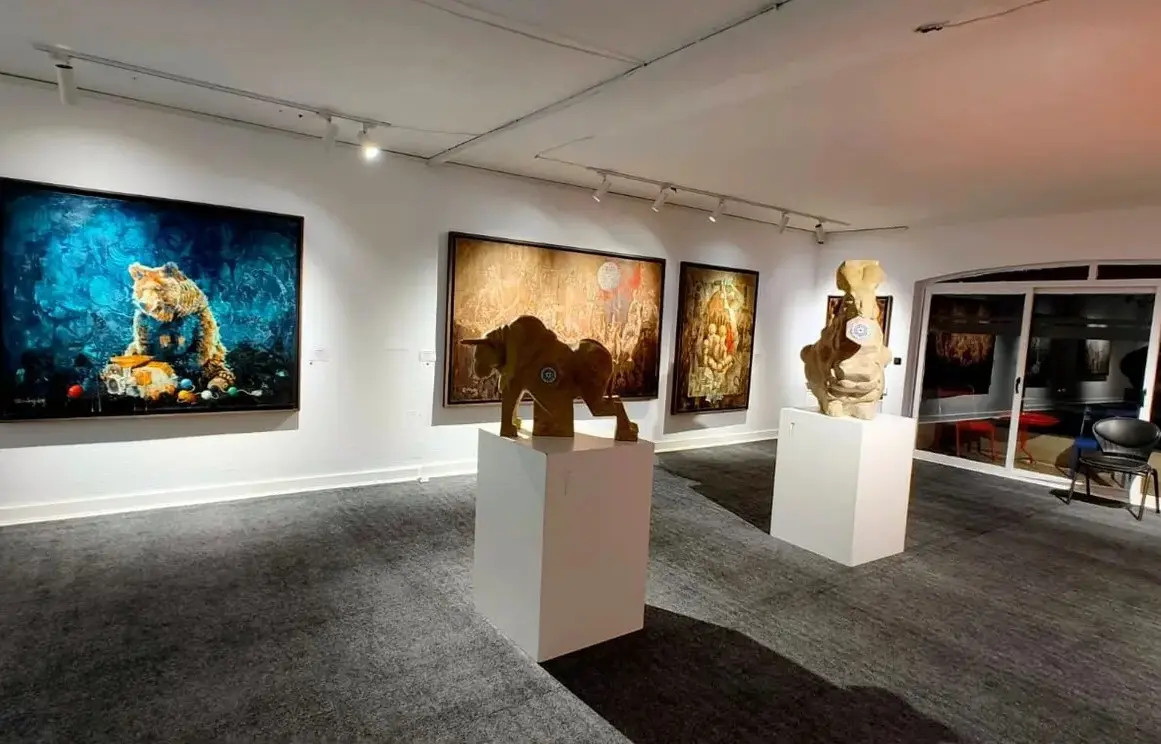
The colour palette of Maahyar Charmchi’s "Meat Grinder Symphony", currently on view at Maad Gallery, is one of the principal elements shaping the psychological atmosphere of the paintings. Intense reds, black, brown, grey and cool shades of blue and turquoise come together to create a contradictory visual environment, one that at times evokes agitation and violence and at others approaches coldness, stillness and exhaustion.
In some works, red recalls blood, danger, inflammation and violence. Yet, when placed alongside darker tones, it ceases to function merely as a direct symbol of brutality and instead becomes an instrument for intensifying visual tension. By contrast, cool blues and greys establish a sense of emotional distance and alienation, as though humanity in this world is not only exposed to violence but has gradually become desensitised to it.
The paintings’ dense, multilayered textures are so saturated with signs, stains and traces of colour that their surfaces begin to resemble something weathered and sedimented. This accumulation can be associated with the concept of historical memory: a memory in which individual and collective experiences have accumulated upon one another, with none easily erased from the surface of the image.
_ From Crowding to the Erasure of Individuality
In a considerable number of the paintings, composition is built around the gathering, overlapping and compression of figures. Unlike classical compositional structures, which generally assign each element a relatively defined position within the pictorial space, this approach creates a sense of instability and imbalance.
Figures sometimes merge into one another, their boundaries dissolve, and the surrounding space, rather than functioning as a neutral background, actively participates in the formation of the visual crisis. In other words, it is not only the human figures that are trapped; the very space surrounding them becomes part of the mechanism of entrapment.
In some paintings, geometric signs, industrial objects, historical symbols and everyday elements appear alongside human figures. Their juxtaposition introduces a layer of narrative ambiguity. The viewer is not presented with a linear, predetermined story but is instead invited to discover the relationships between these elements and approach the possible meanings of the work through its visual signs.
This quality moves the works beyond the direct illustration of a social concept and brings them closer to the territory of conceptual art.
_ Maahyar Charmchi ’s Sculptures at Maad Gallery
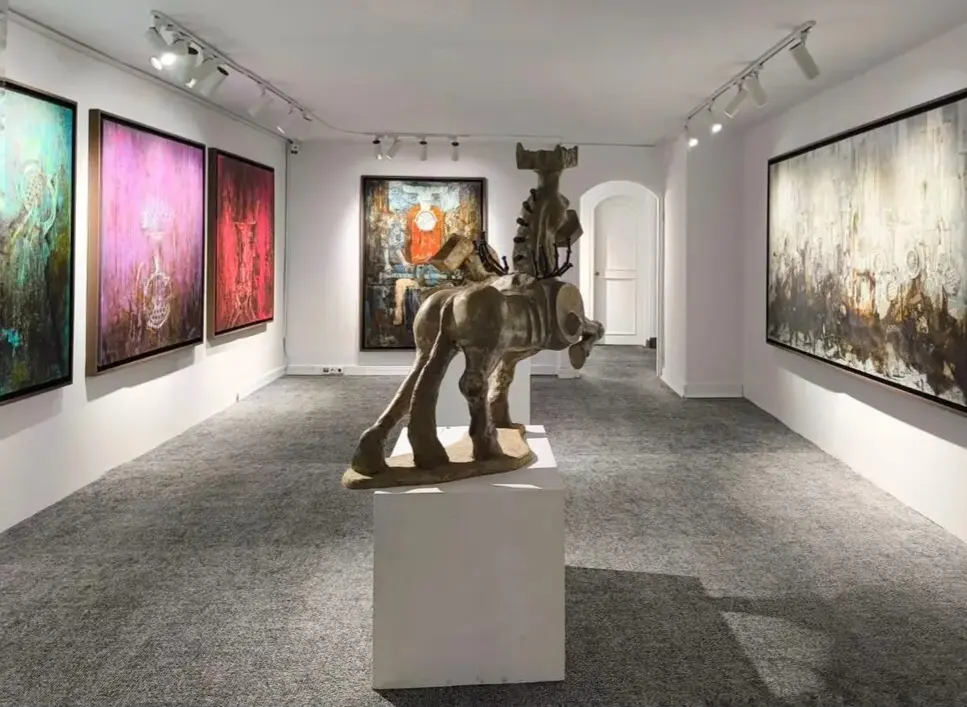
In his sculptures, Maahyar Charmchi extends the world of his paintings into three-dimensional space. His use of papier-mâché, iron, mirrors and steel invites multiple interpretations of the sculptural works.
Each of these materials possesses distinct qualities. Papier-mâché, with its malleability and associations with fragile structures, is placed alongside hard, industrial metals. This juxtaposition establishes a contrast between softness and hardness, vulnerability and resistance, and the body and the machine.
The volumes in these sculptures frequently depart from natural proportions. Their forms become entities moving between human and animal figures and mythological references.
What is particularly significant in these works is the relationship between material and meaning. When the artist combines metal with papier-mâché, he is not simply seeking material diversity. Rather, he creates an opportunity to interpret the internal contradictions of the contemporary world. A lightweight, malleable material placed alongside a hard and resistant one becomes a metaphor for the human condition, suspended between existential fragility and the pressures of power structures.
_ Historical Memory, Mythology and Civilisational Symbols
One of the exhibition’s important dimensions is its use of historical and mythological references. In Maahyar Charmchi’s works, the past is not a concluded or distant territory. History continues to exist within the present, while mechanisms of power and domination persist through newly assumed forms.
This connection between mythology and the contemporary world lends the exhibition cultural depth and prevents the works from being reduced to merely temporary reactions to social circumstances.
_ Cinematic Icons and One of the Exhibition’s Most Popular Paintings
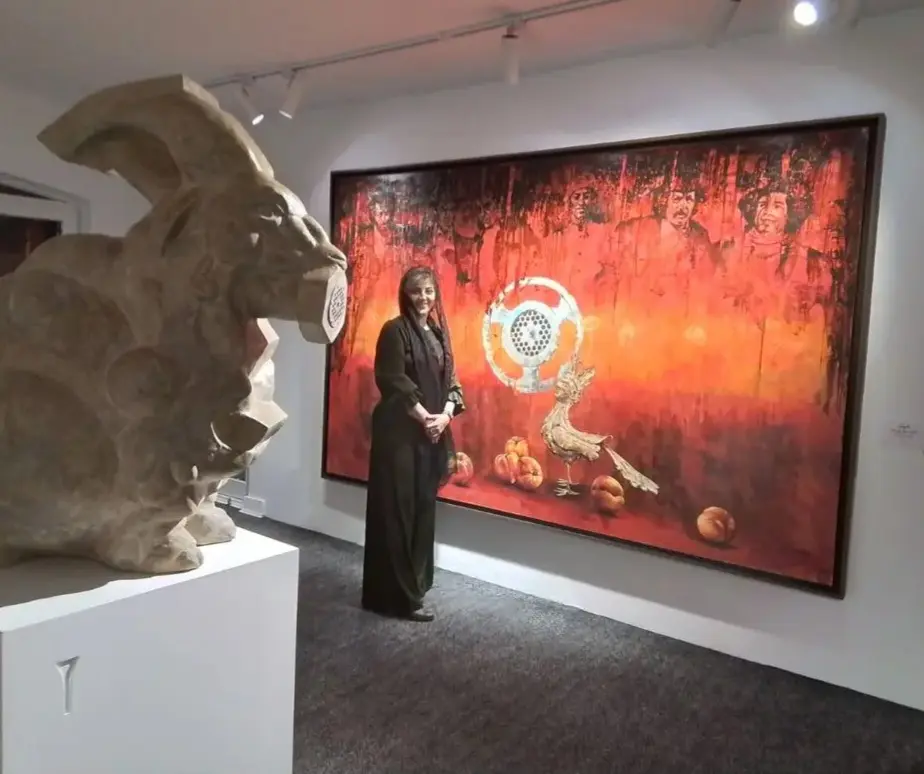
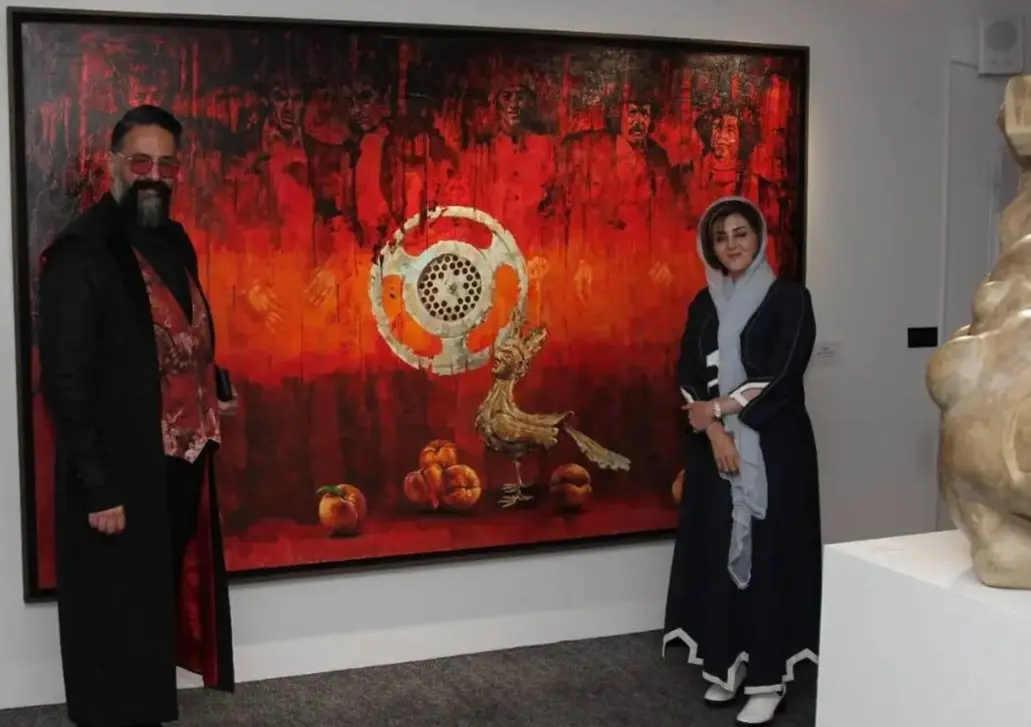
With its arresting red palette, "Namous" (Honour) is among the most popular works in the exhibition at Maad Gallery.
In this painting, Maahyar Charmchi depicts several well-known figures from Iranian cinema, some of whom have portrayed men driven by rigid notions of honour and possessiveness. Combined with the title itself, these cinematic references deliver a pointed critique of a social phenomenon that has been interpreted in different ways throughout history.
Measuring 180 × 290 cm and executed in mixed media on canvas, *Namous* is a work with considerable potential for social and symbolic interpretation.
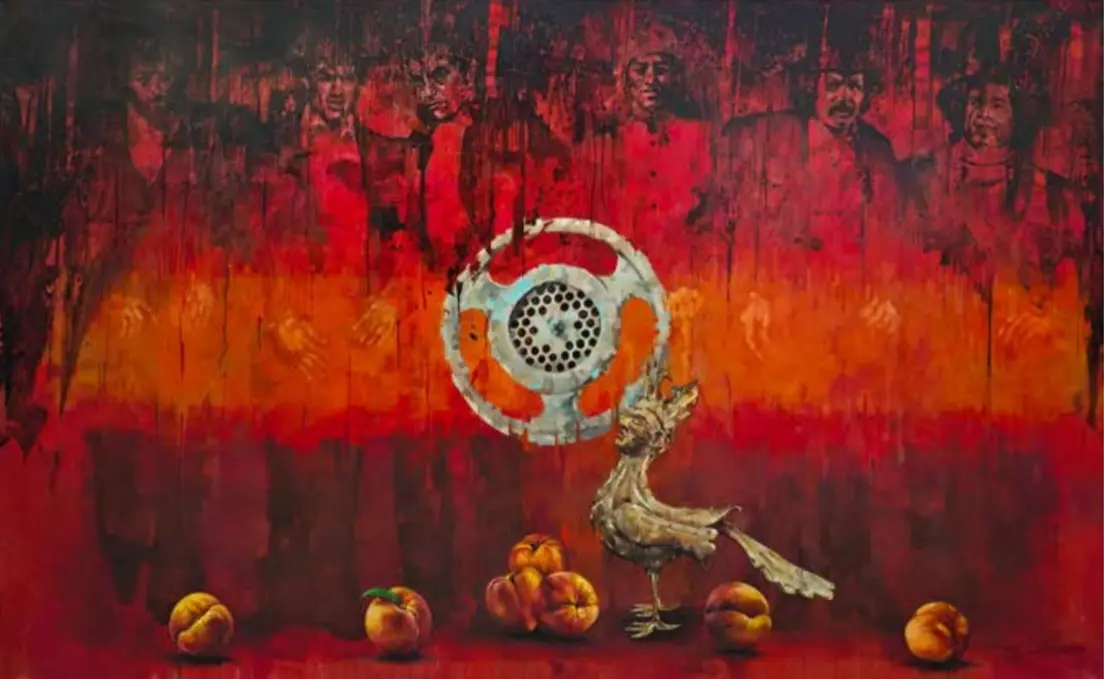
The expansive red and orange background establishes the viewer’s first visual encounter with the painting. Together with the darker areas along the edges and the vertical traces across the surface, this colour field creates an atmosphere charged with agitation and tension. In the upper section, a collection of faces and human figures appears side by side. Despite their individual differences, they are caught within a shared and, to some extent, homogenised space.
At the centre of the composition, the meat grinder is transformed into a film reel, while the peaches positioned in the lower section of the painting invite multiple associations and interpretations in the viewer’s mind.
In this work, red is not simply the colour of violence. It moves between passion, danger, power and agitation.
Through the expansive horizontal format of the canvas, Charmchi shifts the focus away from an individual protagonist towards a collective condition: one in which individual identities are subjected to the pressure of a larger order.
_Humanity Under the Siege of Internal Forces
One of the exhibition’s particularly compelling layers is its examination of a culture of domination and transformation that is not necessarily imposed upon individuals from outside. Part of the contemporary human crisis stems from the internalisation of patterns that gradually become embedded in behaviour, habits, beliefs and even aspects of an individual's personality.
This issue becomes especially significant in relation to the deformed bodies and fragmented figures throughout the exhibition. In this visual world, human beings are not merely victims of external forces; at times, they also participate in reproducing the very mechanisms that lead to the erosion of their individuality.
From a psychological perspective, this condition can be associated with concepts such as collective anxiety, identity crisis, alienation from the self and the disintegration of psychological coherence.
Within this interpretation, the meat grinder is no longer simply a metaphor for a social machine. It can also be understood as an image of a mentality that cannot tolerate difference and continually seeks to return everything to familiar and predictable patterns.
_ An Exhibition About Humanity
One of the reasons Maahyar Charmchi’s exhibition at Maad Gallery has received such a strong response is its compelling and thought-provoking concept, through which the artist constructs a coherent conceptual universe using two distinct media: painting and sculpture.
Charmchi’s exhibition can be examined within the context of contemporary art through an interdisciplinary approach that brings together painting, sculpture, semiotics, mythology and social criticism.
In this universe, colours, textures, deformed bodies, historical references, industrial elements and grotesque sculptural forms all serve a common question: To what extent can human beings preserve their independent identities in the face of mechanisms that threaten their individuality?
At the same time, the diversity of colour and form prevents the visual experience from becoming monotonous. The contrast between the intense, predominantly red paintings and the cooler, grey compositions, together with the presence of mixed-media sculptures, introduces a shifting rhythm throughout the exhibition.
Perhaps the most important question that viewers carry with them as they leave Maad Gallery after experiencing this collection is:
Is the meat grinder merely a machine outside ourselves, one that crushes identities, or has contemporary humanity itself become part of the machine?
LEAVE A RELPY