
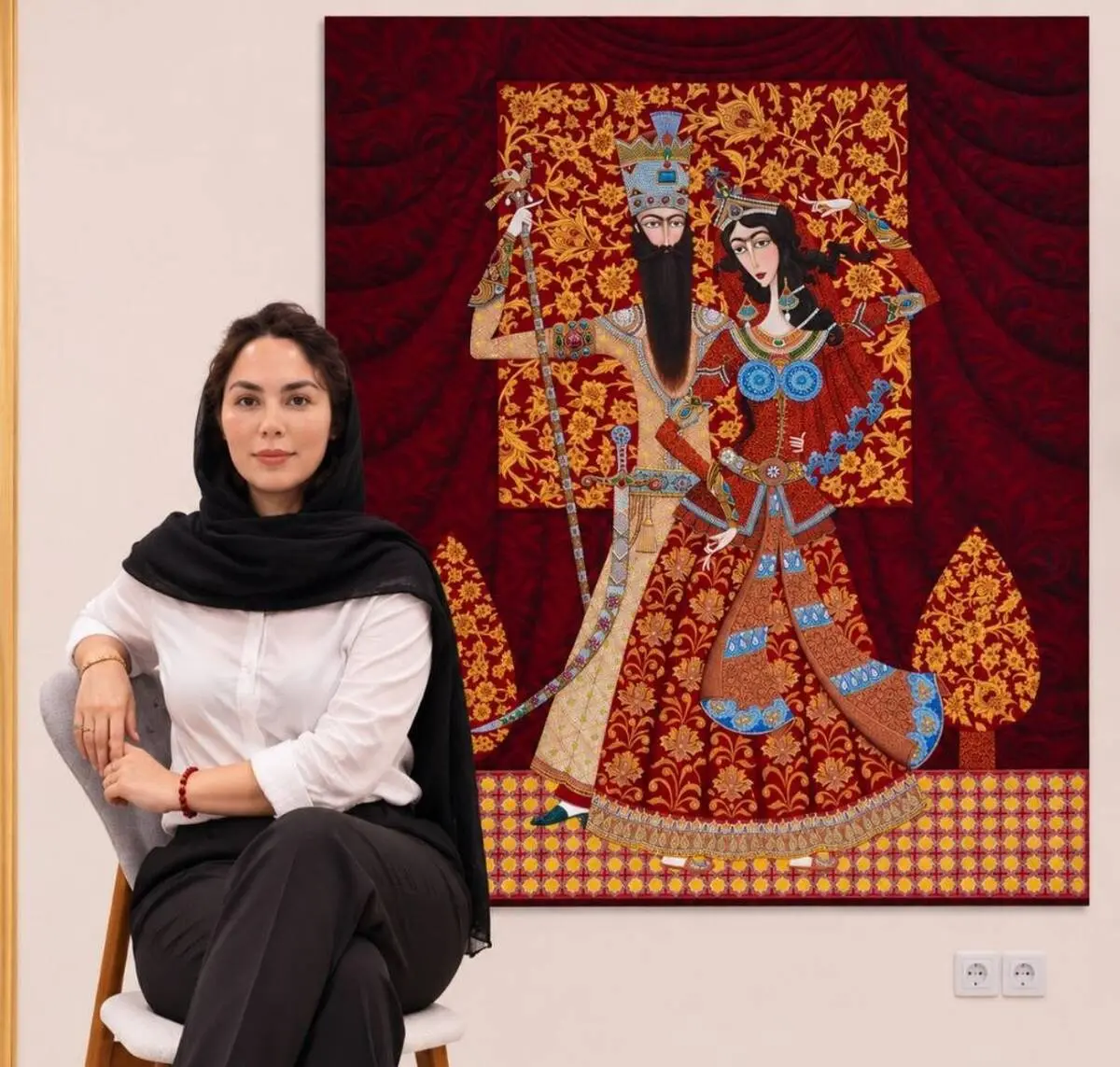
Fatemeh Ahmadian and Her Painting Takht o Bakht (Throne and Fortune)
This work by Fatemeh Ahmadian can be seen as an attempt to revive and reinterpret the visual world of Persian miniature painting—a world in which grandeur, ornamentation, colour and the human figure come together to create an image suspended between historical memory and contemporary artistic expression.
ArtDayMe : in this article, we examine "Takht o Bakht" (Throne and Fortune), a painting by Fatemeh Ahmadian, a young artist whose works are held in Iranian and international collections. Created in 2019, the painting measures 120 × 150 cm and is executed in mixed media on canvas, combining oil, acrylic, ecoline and watercolour.
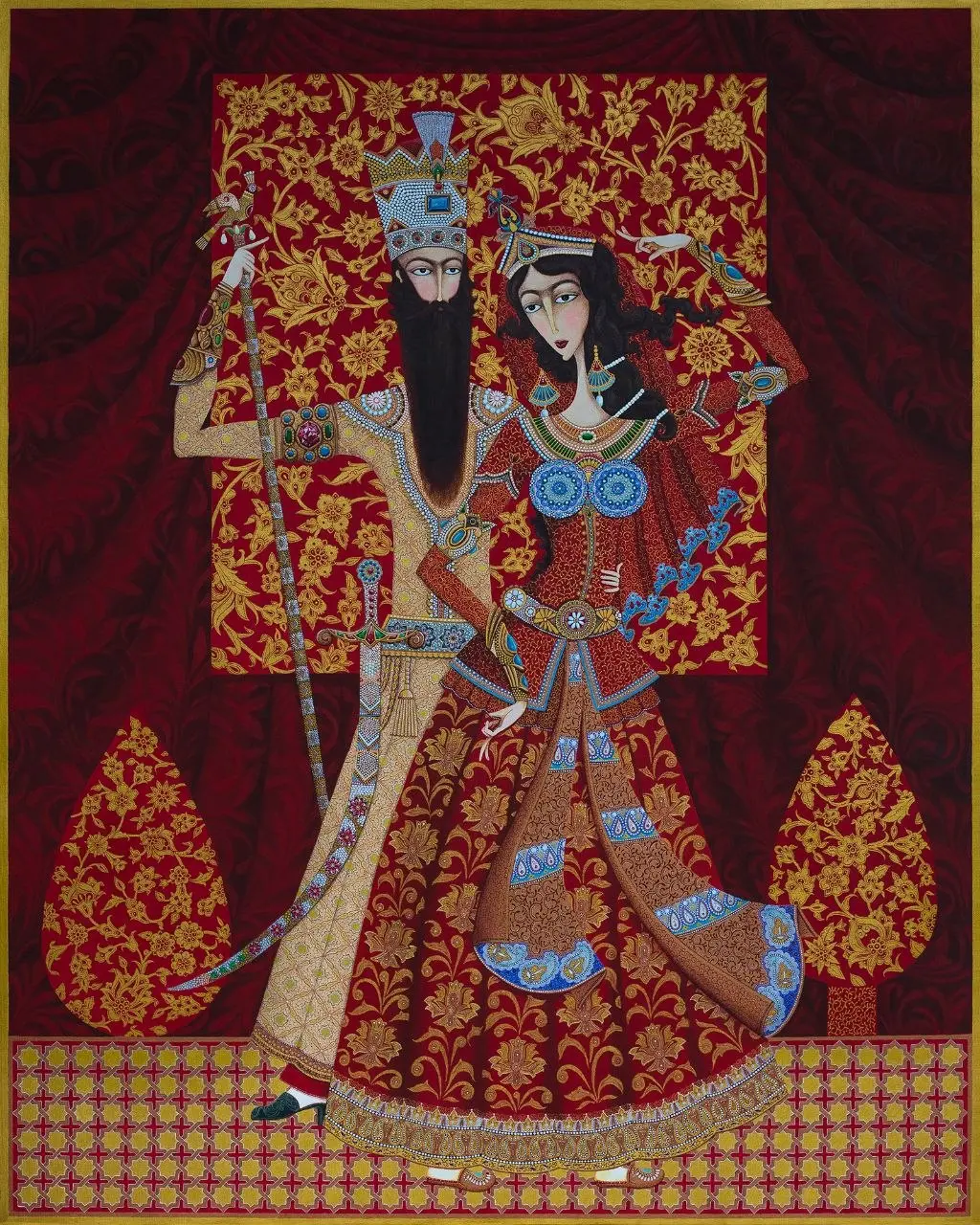
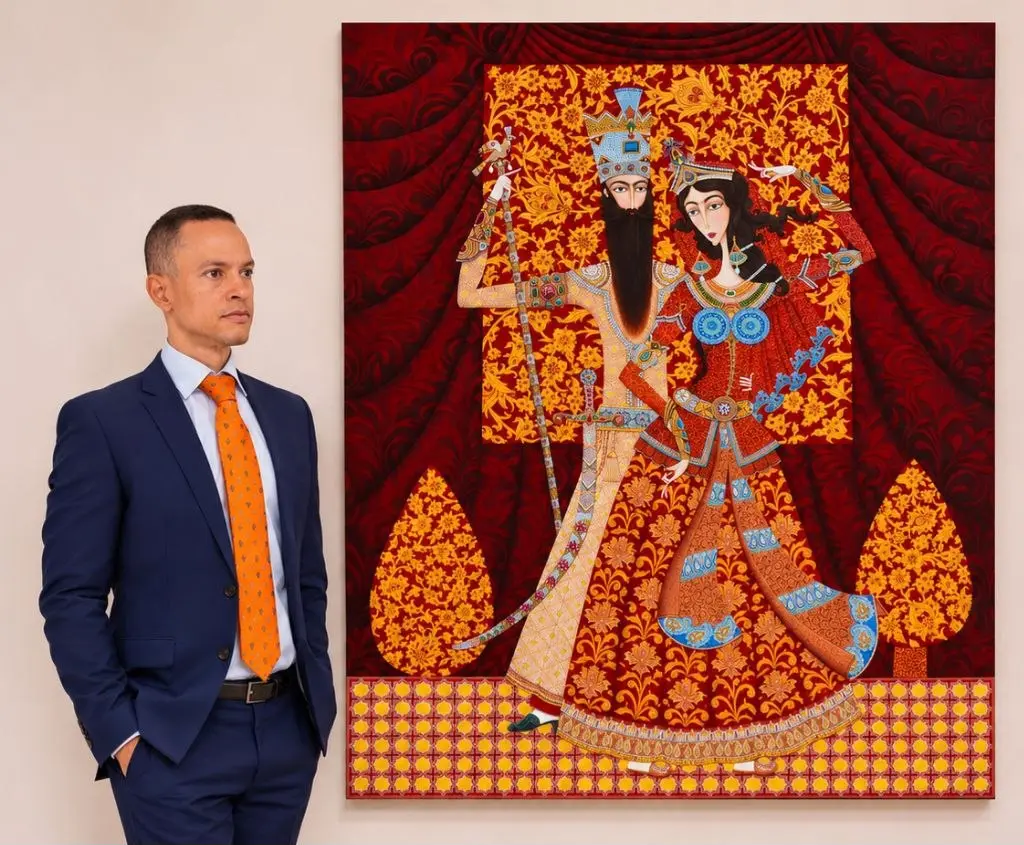
The painting "Takht o Bakht" by Fatemeh Ahmadian was acquired by Jason Carey, a Jamaican art collector based in Dubai, and is now part of his private collection.
Fatemeh Ahmadian’s painting draws on the visual language of Persian miniature painting, court painting and decorative arts to construct a richly coloured world filled with intricate details. Human figures appear alongside botanical motifs, geometric patterns, elaborate garments and jewellery, forming a visual ensemble in which decorative aesthetics take precedence over realistic representation.
One of the painting’s most striking characteristics is the transformation of the canvas into a densely layered space of colour, pattern and detail. Here, the human figure, clothing and surrounding environment function as interconnected elements within a unified visual structure.
From an art-historical perspective, the work can be situated within a broader tradition of revisiting and reinterpreting Iran’s visual heritage. In this approach, historical elements are not simply reproduced; rather, they become resources for developing a new visual language.
The visual significance of Fatemeh Ahmadian’s painting lies primarily in the harmony between colour, line, pattern, texture and composition, as well as in its engagement with the decorative possibilities of Iran’s pictorial heritage.
This work can therefore be understood as an attempt to revive and reinterpret the visual world of Persian miniature painting—a world in which grandeur, ornamentation, colour and the human figure come together to create an image suspended between historical memory and contemporary artistic expression.
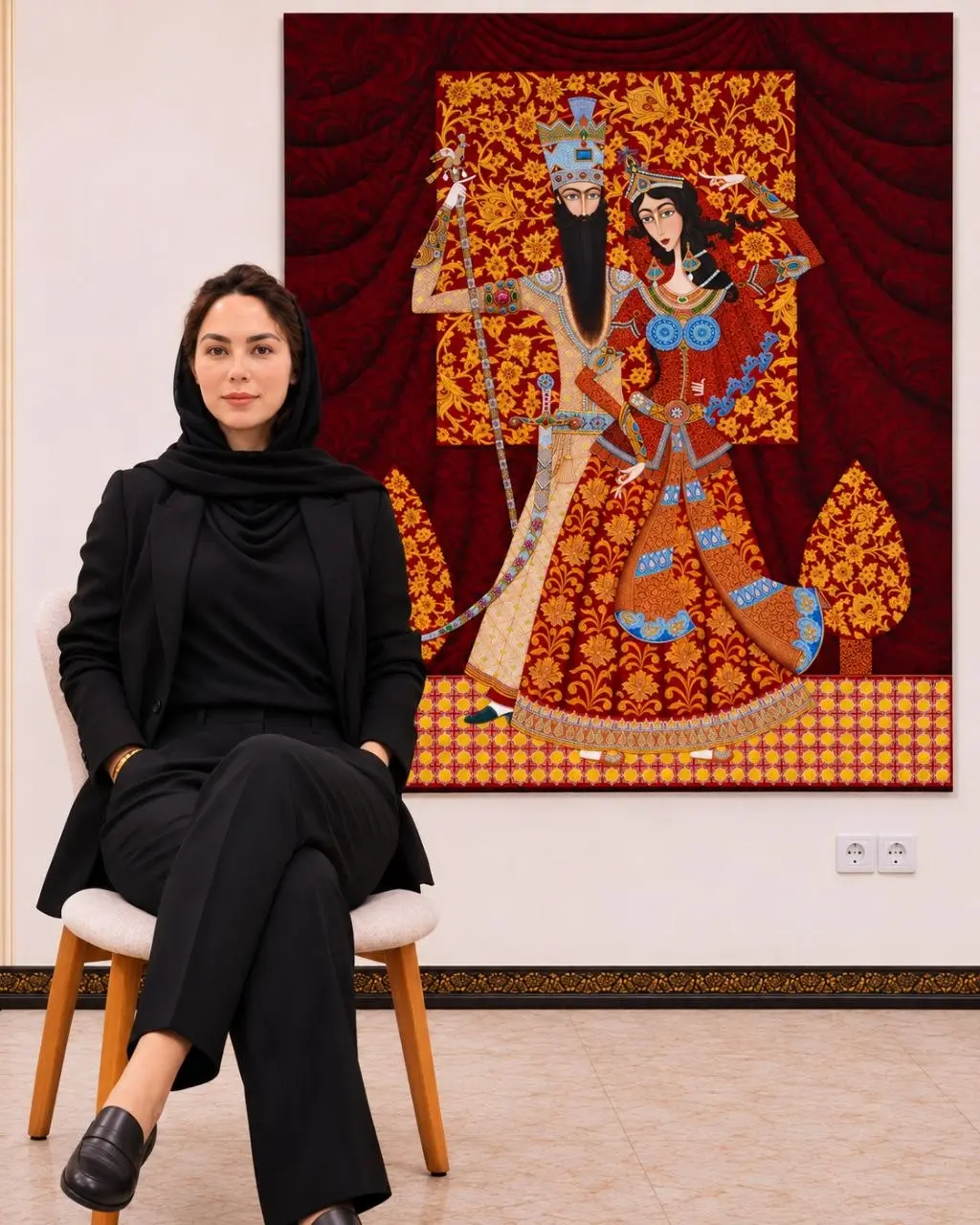
-Fatemeh Ahmadian’s Artist Statement on “Takht o Bakht”
“Takht o Bakht” (Throne and Fortune) is more than just a painting for me; it is a work in which I recognise the beginning of the development of my personal visual language. It was the first piece in which, after years of interest in and studying Iran’s visual traditions, I tried to move beyond simply being influenced by them and instead reconstruct the elements I was drawn to through my own imagination, experience and perspective.
When I look at this work today, what matters most to me is its freedom and boldness. While creating “Takht o Bakht”, I was not thinking about exhibitions, sales or audience reactions. I was like a child who had just begun to walk and had not yet learned to fear falling. Perhaps that is why certain characteristics that later became more restrained in my work appear here in a more exaggerated form: exceptionally large eyes, elongated necks and hands, long fingers and prominent chins. Today, I use these forms in a more controlled manner, but their uninhibited presence remains an essential part of this painting’s identity.
At first glance, the subject appears to be a man and a woman bearing royal attributes. However, the relationship between them was more important to me than their royal status. The man, with his crown, sceptre and upright posture, embodies signs of authority and dignity, yet he is positioned behind the woman in the composition. The woman, by contrast, enters the image through a curved, dancing and dynamic body. If the man's figure can be compared to a vertical line, the woman is composed of a series of curves. This contrast creates a tension between the man's formal, static authority and the woman's visual, emotional and kinetic power.
This relationship continues through the choice of colours. The man's garments, in lighter shades of cream and mustard, appear more subdued and withdrawn, whereas the woman, with her deep reds, bold patterns and dense details, commands the central visual energy of the painting. Even the background, the curtains and the surrounding combination of gold and red seem more closely aligned with her presence, as though the pictorial space itself has come under her influence.
At the time I created this work, my perception of women was different from what it is today. I was then more preoccupied with female power, vulnerability, attraction and women's influence on human relationships, and perhaps unconsciously assigned them a more prominent position. Today, my perspective has become more balanced, and I no longer regard gender as a measure of human superiority. Nevertheless, I believe it is important not to erase or deny that earlier stage of my thinking, because “Takht o Bakht” is an honest record of that particular period in my intellectual and artistic journey.
The title “Takht o Bakht” also emerges from this relationship. For me, “Takht” (Throne) can signify status, authority and formal order, while “Bakht” (Fortune) refers to the more unpredictable dimensions of life: desire, relationships, attraction and the forces capable of changing the course of a person's life. Outwardly, the man possesses the symbols of power, yet within the structure of the painting, the woman occupies a significant part of its visual and emotional territory.
Technically, “Takht o Bakht” is also an experimental work. Unlike many of my later paintings, in which oil paint assumed a more dominant role, this canvas combines oil, acrylic, ecoline and watercolour. Part of the background was developed in oil, while in other sections I allowed myself greater freedom in choosing materials. At that stage, rather than restricting myself to a particular technique, I was primarily concerned with achieving the visual quality that the image demanded.
I still have a deep affection for “Takht o Bakht”, not because I consider it my most accomplished work, but because it is one of my freest and most direct paintings. At that point, I had not yet brought many things under control. Perhaps I could say that this painting captures the moment when my visual language first revealed itself—raw and exaggerated, yet with considerable boldness.
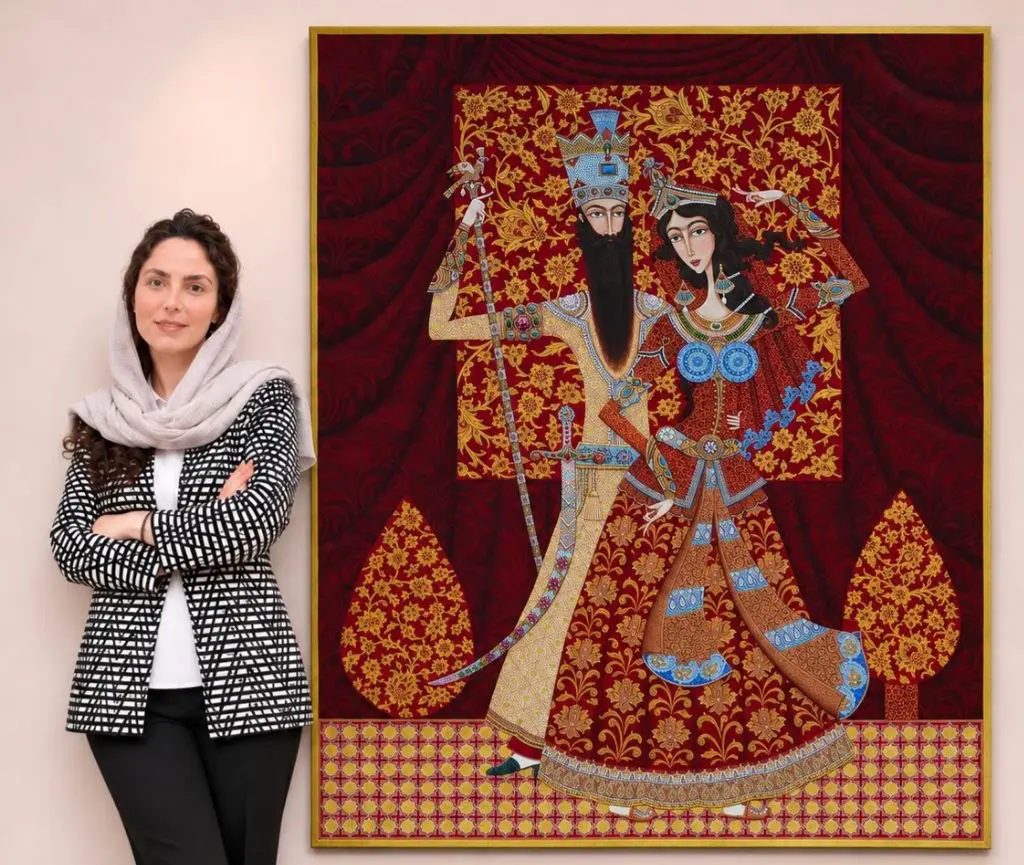
- An Aesthetic Reading of Fatemeh Ahmadian’s “Takht o Bakht”
Created in 2019, Fatemeh Ahmadian’s painting “Takht o Bakht” measures 120 × 150 cm and is executed in mixed media on canvas, combining oil, acrylic, ecoline and watercolour.
The work belongs to the field of reinterpretation and reinvention of Iran’s pictorial and decorative traditions, revisiting elements of Persian miniature painting, court painting and the ornamental vocabulary of traditional Iranian arts.
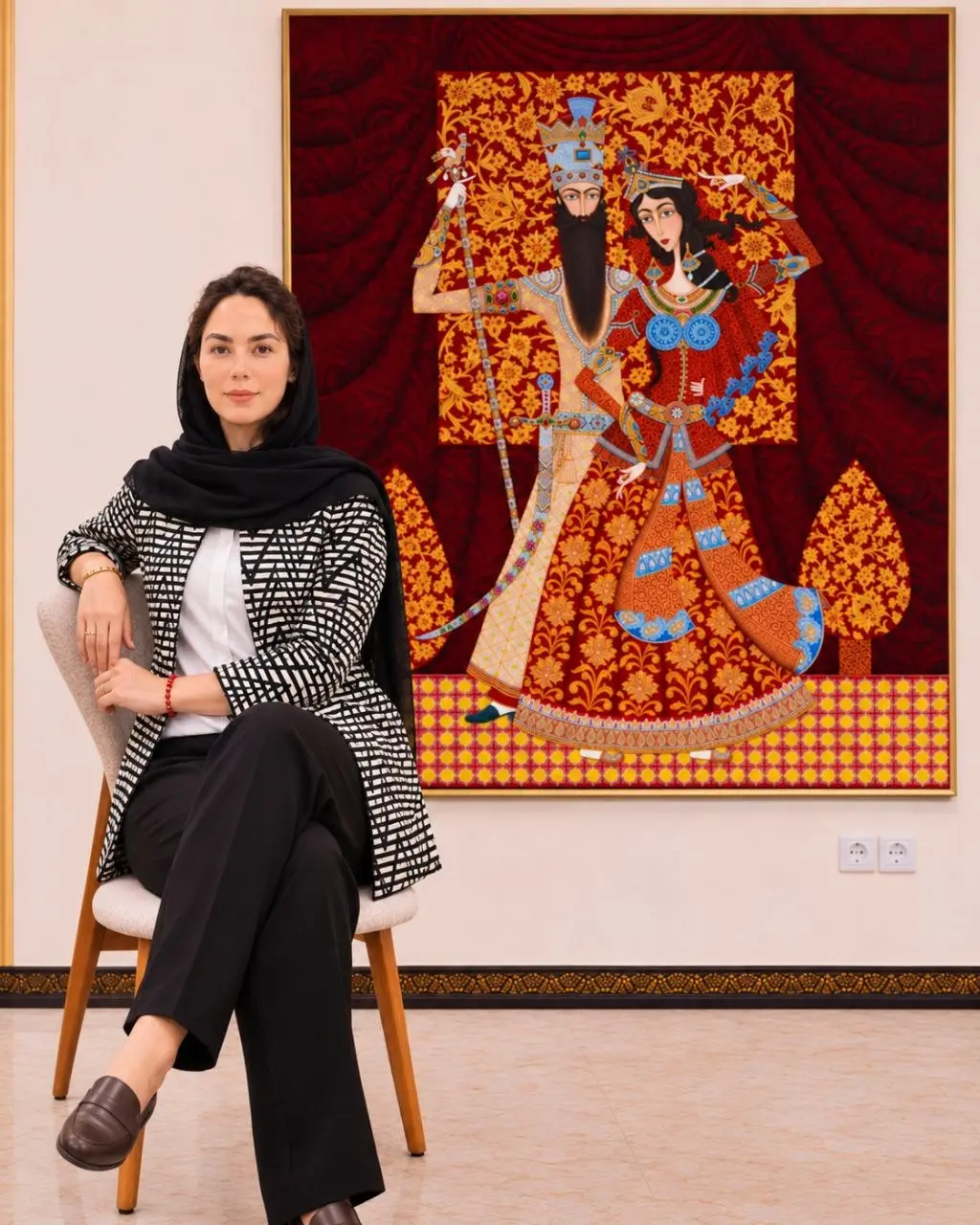
At the centre of the composition are two figures dressed in elaborate ceremonial attire: a man with a tall crown and a full beard on the left, and a woman wearing an expansive gown, jewellery and intricately detailed adornments on the right. The subject extends beyond the representation of an aristocratic couple. The human figures, their clothing and the decorative environment surrounding them exist in a reciprocal relationship. They should be understood as symbolic representations referring to concepts of power, status, beauty and the visual memory of Iranian art.
The composition is vertical and multi-layered. The two figures occupy the centre, with a rectangular surface behind them featuring a red ground embellished with golden botanical motifs. The surrounding burgundy background functions almost like a frame, directing the viewer’s gaze towards the protagonists. Geometric patterns in the lower section introduce another visual layer. Depth is suggested not through linear perspective but through overlapping elements, variations in the scale of motifs and the juxtaposition of surfaces.
The man's figure, crown and beard on the left establish a distinct visual weight, while the woman's expansive skirt, red garments and ornamental details provide a counterbalancing response on the right. The resulting equilibrium is asymmetrical rather than based on complete symmetry.
Line plays a fundamental role in organising the image. Contour lines define the boundaries of the figures; repetitive lines structure the surfaces of clothing and jewellery, while the flowing botanical and arabesque patterns guide the eye across the canvas. Rather than serving primarily to reproduce anatomy, these lines perform structural and decorative functions. The soft curves of the woman's face contrast with the vertical extensions of the man's posture and beard, creating a harmonious diversity of forms.
The colour palette is built around red, burgundy and gold. Red recurs in both the background and the woman's clothing, establishing visual continuity. Gold, appearing in botanical patterns, garments and jewellery, lends the painting an opulent radiance reminiscent of precious courtly objects. Lapis lazuli blue and turquoise in the crown and clothing details provide contrast to the dominant warmth and create points of emphasis. Black, used in the hair, beard and outlines, helps distinguish and define forms. Colour is employed primarily for its decorative qualities rather than to represent natural light or create realistic volume.
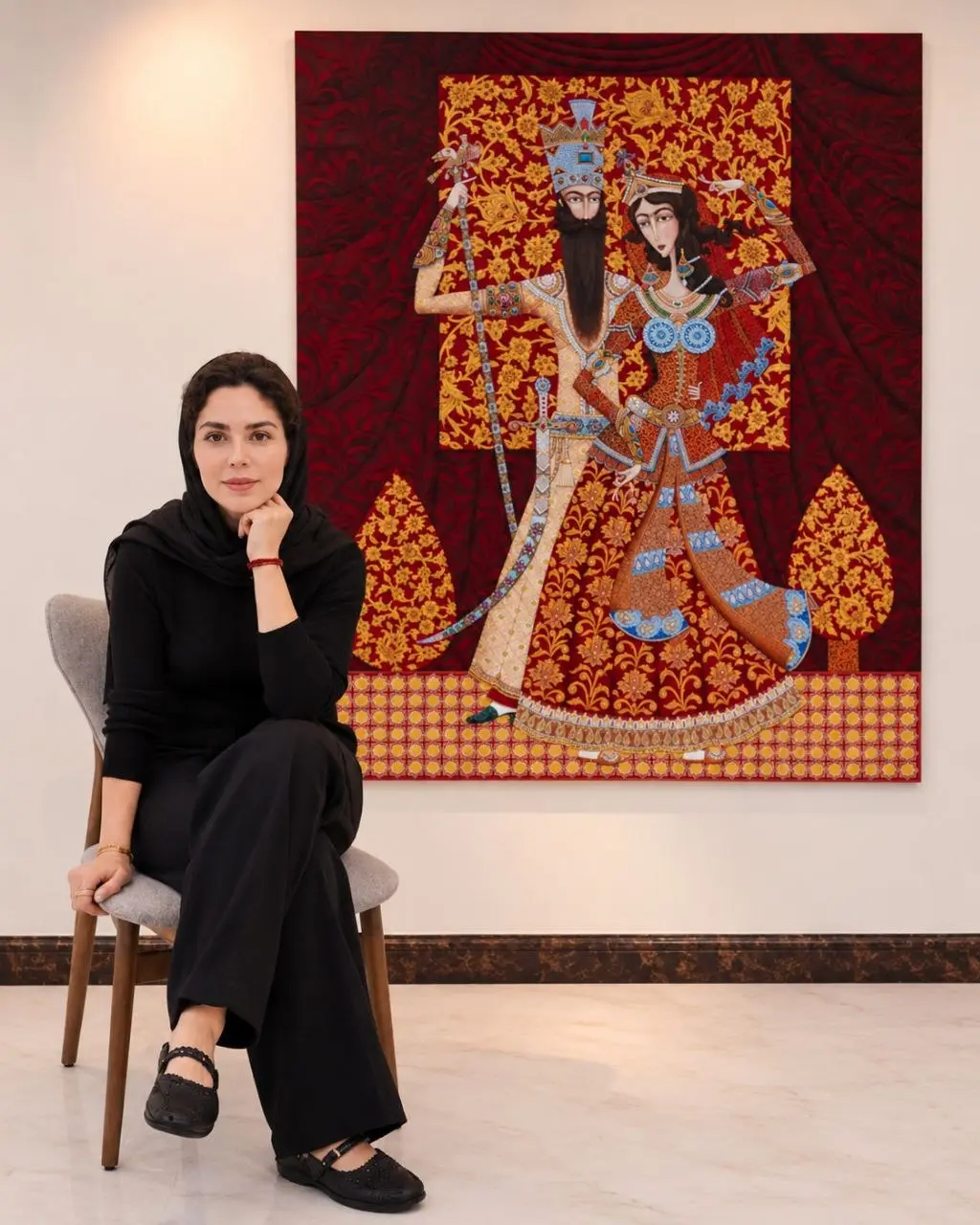
The figures are distinguished from the background through contour lines, colour contrasts and intricate details. Their forms are idealised rather than realistic. The woman's face is rendered with softer lines, while the man's long beard reinforces the vertical emphasis of his features. The garments function less as representations of the natural volume of fabric and more as surfaces for displaying patterns. The woman's expansive skirt also contributes to the balance of the lower section of the composition.
Texture is another defining element of the painting. The diversity of lines, colour patches and density of detail draws the eye from one surface to another. The garments and jewellery contain considerably more detail than the faces. The mixed-media technique also allows for variations in transparency, opacity and colour intensity.
Botanical motifs, flowers, winding branches and arabesques, alongside geometric ornaments, establish the work's decorative identity. The embellishments of the clothing and jewellery also connect the painting to Iran's traditions of textile weaving, metalwork and jewellery-making. Its historical references therefore extend beyond miniature painting alone.
Stylistically, the treatment of the faces, relatively flat colours, emphasis on line and non-perspectival space establish a connection between Fatemeh Ahmadian's work and Persian miniature painting. The aristocratic figures, crowns, jewellery and elaborate garments also recall certain characteristics of Qajar painting. Nevertheless, the work should not be categorised exclusively as either Persian miniature or Qajar painting. A more accurate description would be a contemporary reinterpretation of Iran's pictorial and decorative traditions.
The relationship between the human figures and their ornamented surroundings demonstrates that the protagonists inhabit a richly decorative world in which their visual identities cannot be separated from their environment.
This colourful painting by Fatemeh Ahmadian seems to emerge from a world untouched by conflict or crisis, a world from which beauty simply radiates. Beyond this immediate impression, however, some of the most significant characteristics of “Takht o Bakht” can be identified as follows: the coherence of its visual language, meticulous attention to detail, engagement with Iran's pictorial heritage, the asymmetrical balance between the figures, the confident use of colour and the transformation of the canvas into an active field of pattern and texture.
At the same time, the density of ornamentation occasionally competes with the central figures for attention, weakening the hierarchy between primary and secondary elements. The facial expressions remain largely idealised and decorative, and no clearly defined emotional relationship develops between the two protagonists. Their connection emerges primarily through proximity and compositional harmony.
Fatemeh Ahmadian's painting is an attempt to evoke the visual splendour of the past. Through colour, line, texture and ornamentation, the work constructs a symbolic and narrative world in which the human figures and their surrounding decorative elements form an integrated whole. Its significance lies in bringing Iran's visual memory into dialogue with the possibilities of mixed media and the contemporary canvas, transforming the pictorial surface into a field rich in detail and visual movement.
The painting “Takht o Bakht” by Fatemeh Ahmadian was acquired by Jason Carey, a Jamaican art collector based in Dubai, and is now held in his private collection.
- Prices of Fatemeh Ahmadian’s Artworks
Fatemeh Ahmadian (born 1982 in Khansar) graduated with a Bachelor's degree in Islamic Arts, specialising in Ceramics and Sculpture, from Isfahan University of Art.
In 2021, her painting “Prophet Jonah” (Younes Nabi), measuring 160 × 200 cm, was acquired in a private transaction for $4,500 by a collector based in Dubai.
Another painting by Fatemeh Ahmadian, entitled “The Fourth Trial of Rostam: Rostam’s Battle with the Sorcerer”, was created in 2021 using oil on canvas and measures 160 × 200 cm. The work was acquired by Shahdad Fazeli and is currently held in the Fazel Museum Library in the city of Khansar, Isfahan Province.
Fatemeh Ahmadian’s works have attracted the attention of the art community and the art market because of their distinctive worldview and thematic approach. At first glance, the concepts underpinning her paintings may appear classical and traditional; however, after closer observation, their contemporary dimensions gradually become apparent. This distinctive conceptual quality, together with her strong command of drawing and composition, has contributed to the growing interest in her work.
LEAVE A RELPY