
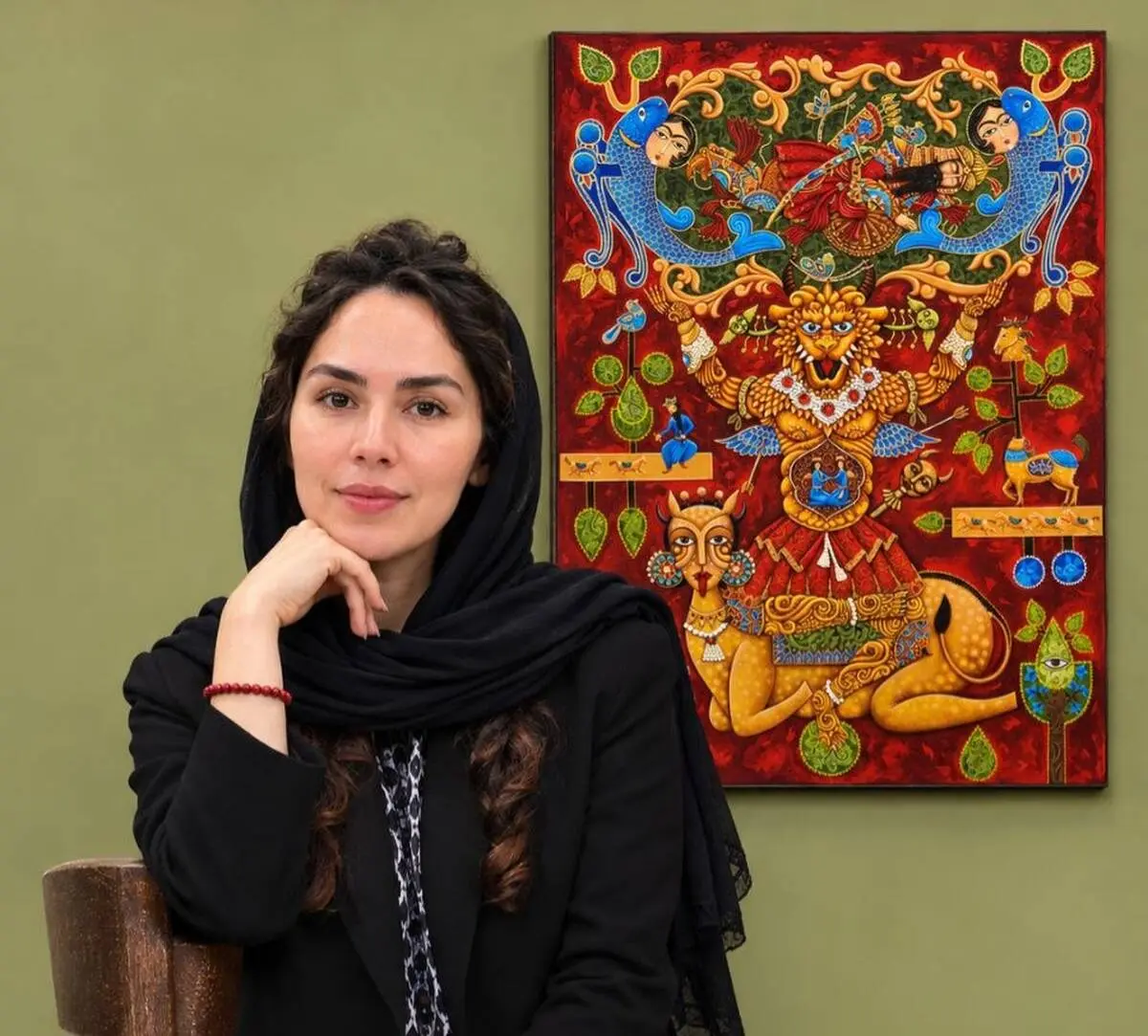
Fatemeh Ahmadian and Her Painting of Akvan Div in Ferdowsi’s Shahnameh
Fatemeh Ahmadian and Her Painting of Akvan Div in Ferdowsi’s Shahnameh.
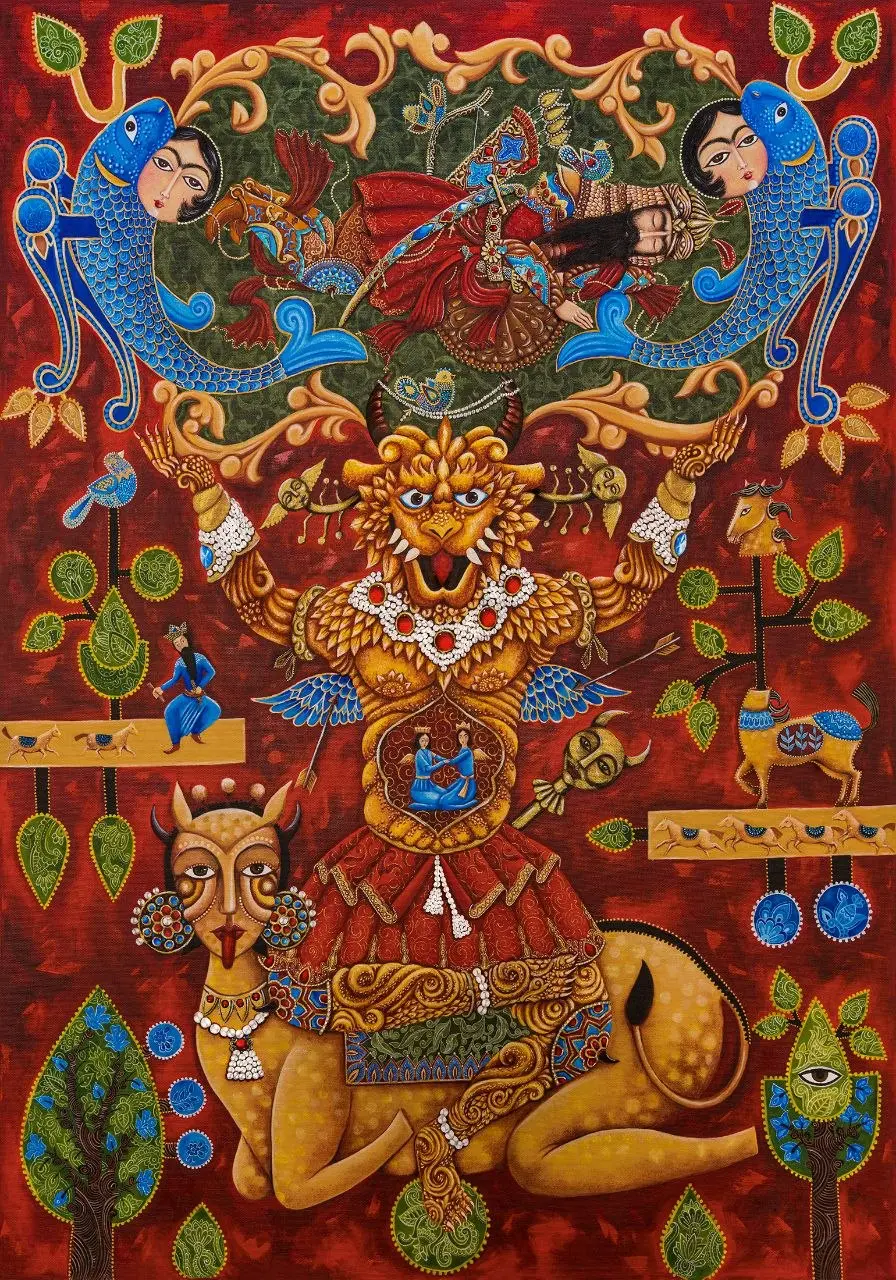
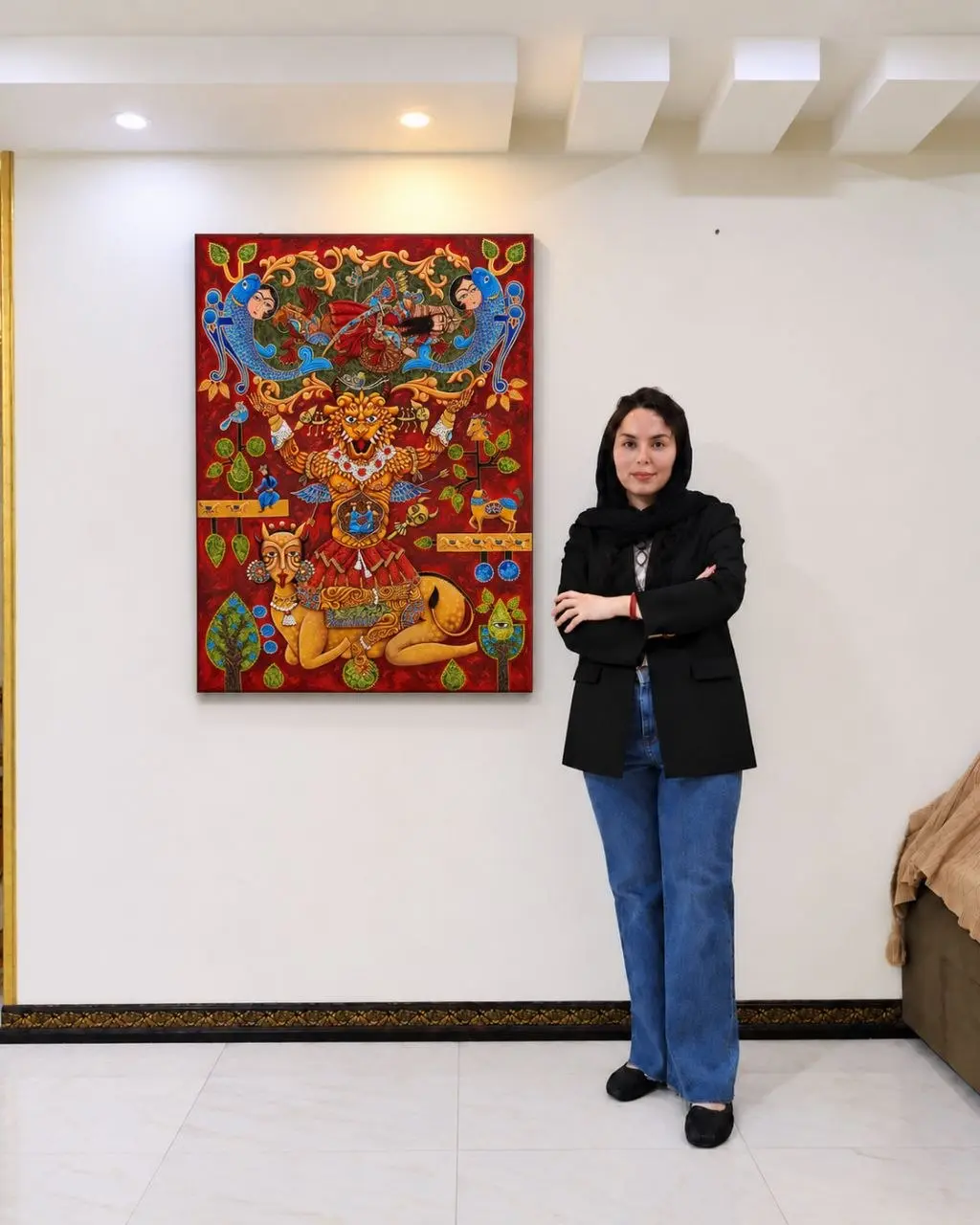
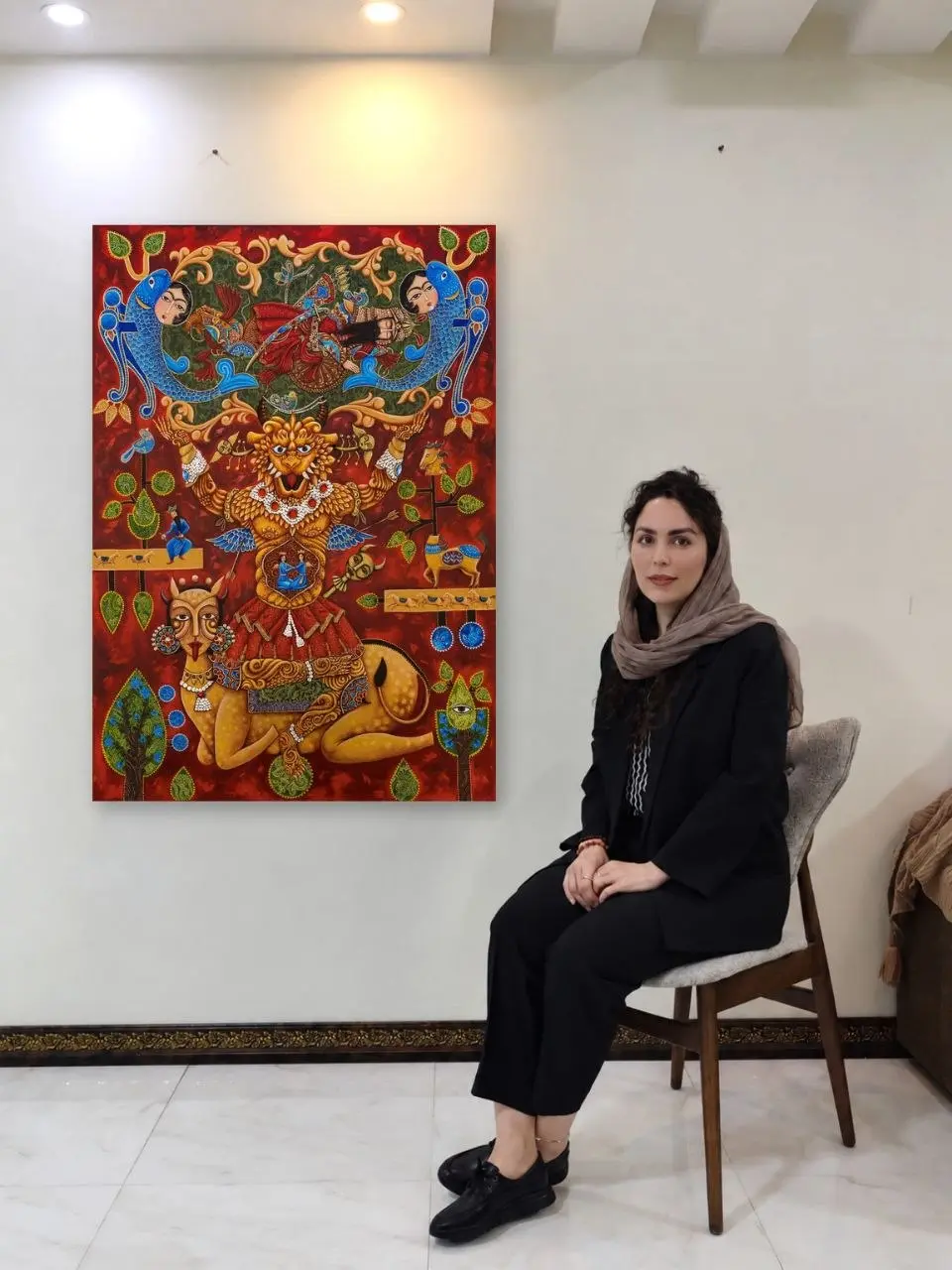
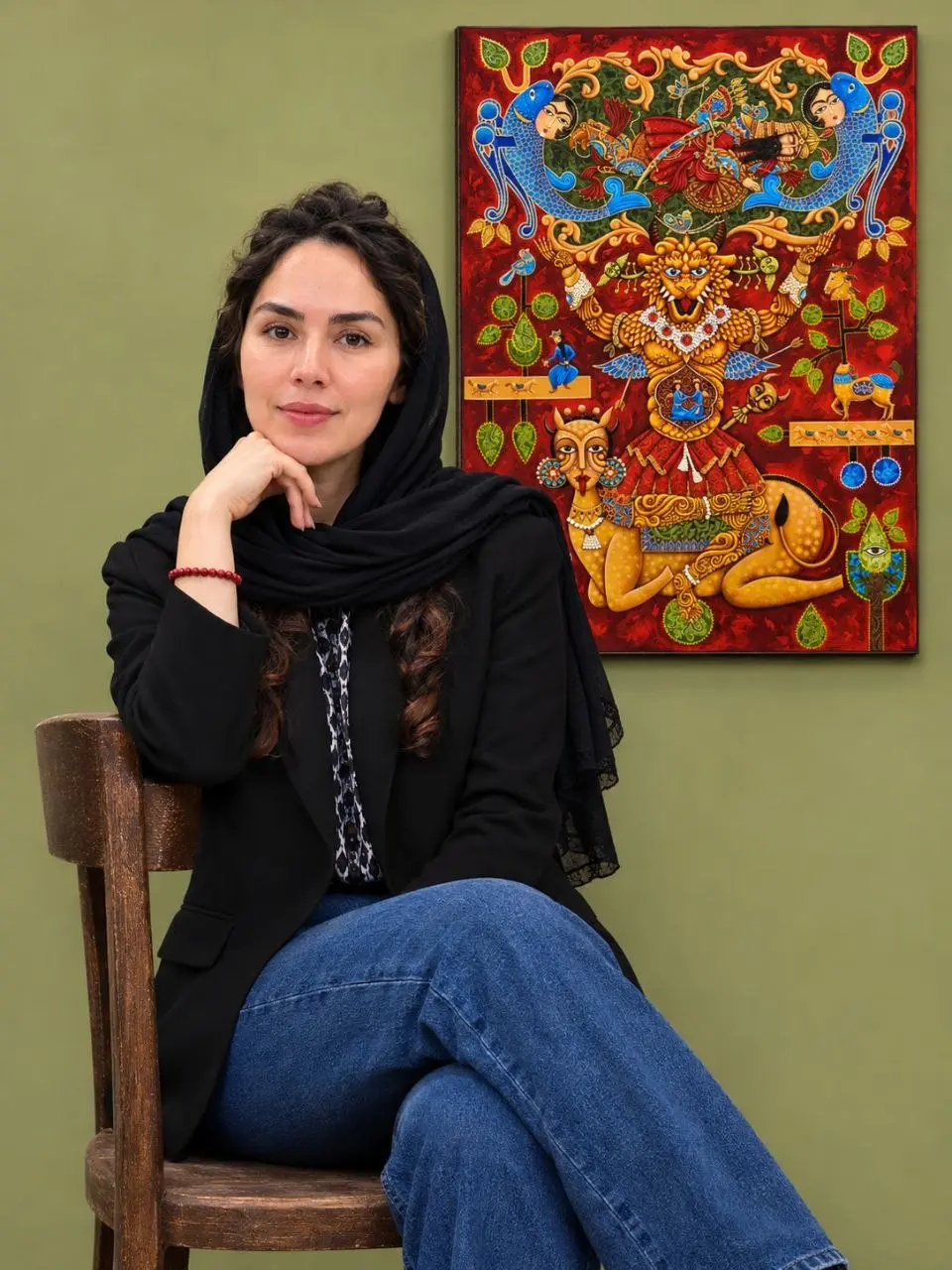
ArtDayMe : In this article, we examine Akvan Div, a painting by Fatemeh Ahmadian, a young painter whose works are held in Iranian and international collections. The painting draws inspiration from the Shahnameh by Ferdowsi, the great epic and mythological book of Iran. Executed in oil on canvas, the work measures 100 × 70 cm.
Fatemeh Ahmadian’s painting Akvan Div was acquired by Shahdad Fazeli and is now housed in the Fazel Museum Library in Khansar, Isfahan Province, Iran.
- An Aesthetic Analysis of Fatemeh Ahmadian’s Akvan Div
Reimagining Myth Through an Ornate and Intricately Structured Composition
Fatemeh Ahmadian’s Akvan Div opens up a visual world in which the epic narrative of the Shahnameh merges with the decorative, symbolic, and imaginative language of painting.
At first encounter, the work resembles an illustrated page from a mythological narrative, distinguished by its expansive red background, multilayered central figure, and abundance of surrounding motifs.
_ The Central Figure and the Movement of the Viewer’s Gaze
The composition is structured around a vertical axis. At its center, the monumental, composite figure of a mythical creature forms the principal element of the visual organization, with almost every other component defining its relationship to this central presence. The lion-like head, human body, blue wings, intricately patterned attire, and yellow animal figure in the lower section appear as interconnected and interwoven elements. This arrangement transforms the natural body into an imaginative hybrid creature.
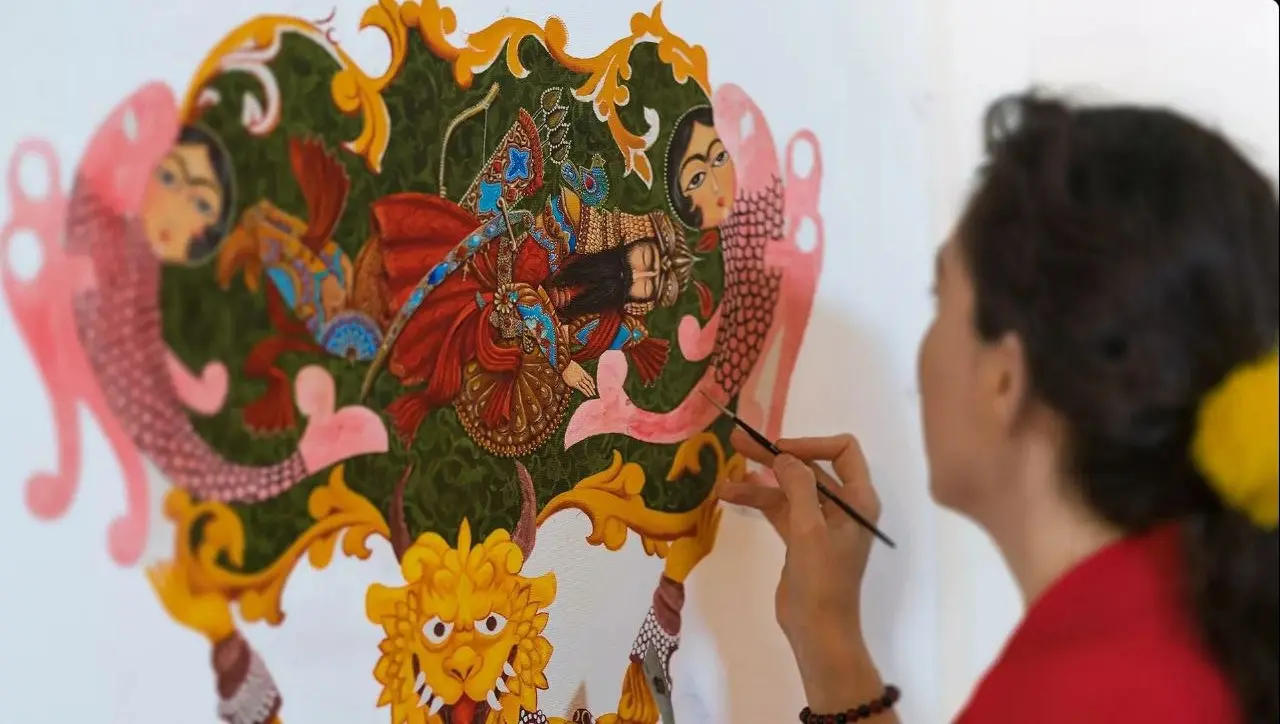
Above this figure, a horizontal scene depicting Rostam and the Div unfolds between two symmetrical blue creatures. Through their curved bodies and repeated scale patterns, these creatures form a living frame around the upper scene. The yellow animal in the lower section, with its elongated body and curling tail, directs the viewer’s gaze toward the surrounding margins.
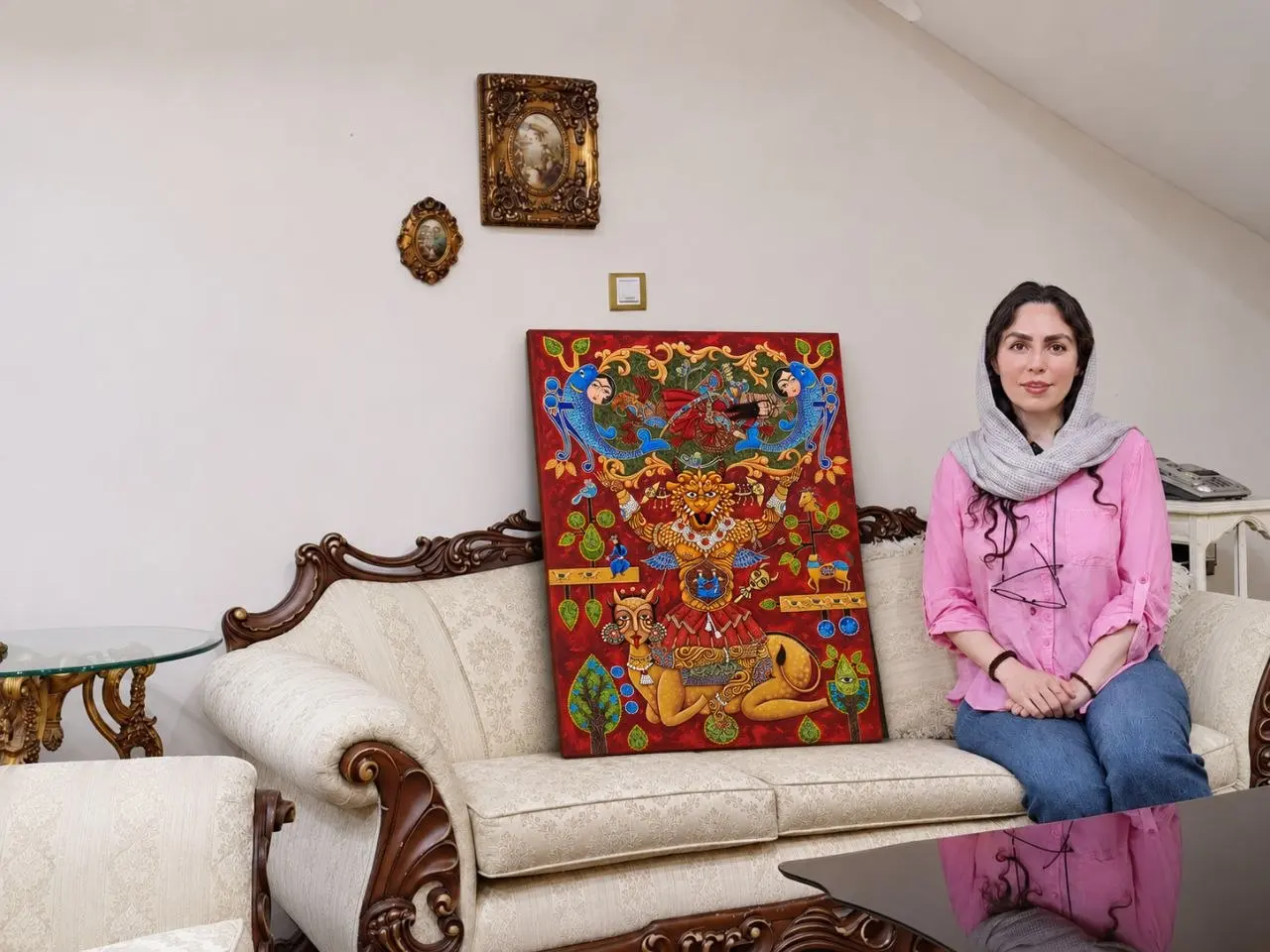
Symmetry is evident on both sides of the upper scene and in the arrangement of the central figure. Yet variations in scale, direction, and ornamental detail prevent the composition from becoming static. Ahmadian employs symmetry to establish stability and grandeur while maintaining the vitality of the painted surface through the diversity of visual elements.
The Red Field and the Directing Power of Color Contrasts
The red background is the most dominant chromatic force in Fatemeh Ahmadian’s Akvan Div. It creates a unified yet charged visual space, bringing all the elements together within a shared field of intensity and presence. Variations in the red tones, ranging from dark shades approaching burgundy to warmer and brighter areas, prevent the background from appearing flat or monotonous.
The turquoise and ultramarine blues of the upper creatures and the central figure’s wings create luminous, eye-catching focal points against the red background. Gold, ochre, and brown tones in the bodies and decorative elements intensify the painting’s warmth, while the whites of the pearls and jewels introduce rhythmic points of brilliance. These white accents function as moments of light within the dense arrangement of colors.
_Line, Ornament, and Surface Quality
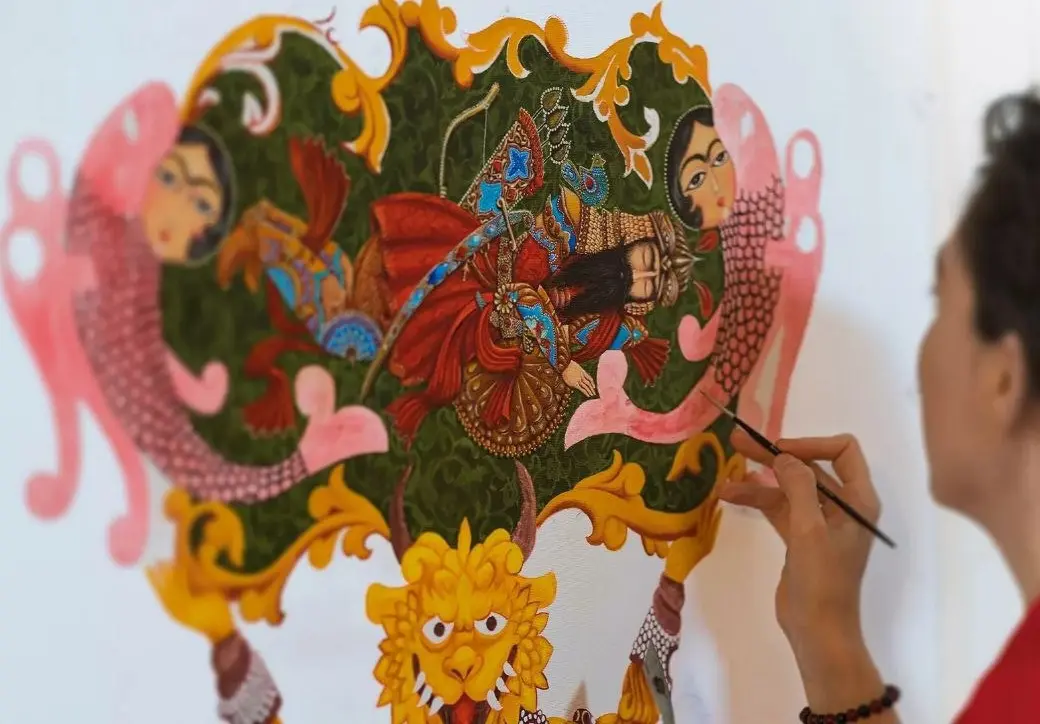
Line plays a decisive role in this painting. The curved lines defining the bodies of the blue creatures, horns, winding plants, and decorative garments create a fluid and ornamental quality. In contrast, the short, repetitive lines used for scales, feathers, seeds, and jewels cover the surface with a fine, continuous rhythm.
The abundance of details, ranging from botanical and geometric patterns to beads, pendants, and embroidered garment borders, reflects Fatemeh Ahmadian’s patient and meticulous painterly process. Rather than simplifying forms, the artist develops them through small, recurring visual signs. The painted surface thus becomes an invitation to close observation and the gradual discovery of detail.
_ Form and the Transformation of the Figure
The most significant formal decision in Fatemeh Ahmadian’s work is the creation of a composite figure.
The fusion of a lion’s head, a human body, wings, and an animal form makes the boundaries between human, animal, and mythical creature fluid and ambiguous. The central face, with its large eyes, open mouth, and exposed teeth, possesses a theatrical presence. Yet the delicacy of the surrounding ornaments brings this intensity into a decorative order. The coexistence of imposing presence and elaborate refinement is one of the painting’s most compelling visual qualities.
_The Painterly Process: Storytelling Through Visual Arrangement
Fatemeh Ahmadian does not follow the Shahnameh narrative through linear, realistic representation. Instead, she brings its narrative elements together within a unified visual field. The upper scene, central figure, animals, trees, narrative bands, and smaller figures each constitute fragments of the mythical world, combining to create a multicentric structure.
The viewer’s gaze can move freely between the battle scene, the central face, the animals, and the botanical motifs. In this way, the narrative becomes an exploratory visual experience.
In this work, Fatemeh Ahmadian’s painterly process is most clearly revealed through her selection, combination, and arrangement of visual signs: transforming the body into a collection of interconnected forms, turning the background into an active chromatic field, and organizing details into a rhythm that unifies the entire canvas. Through this approach, the painting establishes a connection between the visual memory of Persian miniature painting, mythological storytelling, and the artist’s personal expression.
_Myth as a Visual Universe
Akvan Div can be understood as an attempt to recreate the world of the Shahnameh through form and ornament. The significance of the work lies in its transformation of myth into color, line, texture, and figure. Its axial composition, the chromatic contrast between red and blue, the repetition of motifs, and the composite central figure come together to create an image that possesses both the ceremonial grandeur of decorative art and the vitality of an illustrated narrative.
Through the meticulous organization of its numerous elements, Ahmadian invites the viewer into a multilayered act of looking, in which every small detail forms part of the larger architecture of the image.
- Fatemeh Ahmadian’s Artist Statement on Akvan Div
Akvan Div: The Endless Cycle of Evil Behind a Deceptive Appearance
My painting Akvan Div is my reinterpretation of one of the mythological narratives in Ferdowsi’s Shahnameh: Rostam’s encounter with Akvan Div. However, what inspired me to create this work was not simply the depiction of a heroic battle. Beneath the story lies a question about the nature of evil, the deceptiveness of appearances, and the persistence of darkness in the human world—a question I have sought to approach through the language of visual art.
In Ferdowsi’s narrative, Akvan Div appears among a herd of horses in the guise of a magnificent, golden-colored wild ass. Its outward appearance seems disconnected from its true nature. After learning about the creature’s unusual behavior, Kay Khosrow sends Rostam to confront it. During their encounter, Rostam realizes that he is not dealing with an ordinary animal, but with a demon whose very nature is defined by deception and inversion.
What particularly interested me in this narrative was the relationship between Akvan’s outward appearance and its inner nature. In my painting, I have placed the demon upon the body of the same wild ass whose form it assumes in the story. This juxtaposition is a deliberate choice. I did not want to portray the wild ass and the demon as two separate beings or as successive stages of a transformation.
In my view, deceptive appearance and dark inner nature are two simultaneous aspects of a single reality. Evil does not always conceal itself behind a mask that will eventually fall away to reveal the truth. Sometimes, the mask itself is an integral part of its nature. Outward beauty is not necessarily an indication of goodness, just as a frightening appearance alone cannot serve as proof of wickedness.
For this reason, I have sought to depict the wild ass and the demon as inseparable entities, so that the viewer cannot easily regard one as the truth and the other merely as a temporary disguise. Both contribute to the formation of a single existence.
Another concept that holds particular importance for me in this work is the cycle of evil’s continuity and reproduction.
In certain sections of Akvan’s figure, I have depicted small, fantastical creatures that seem to emerge from within the demon and make their way into the outside world. To me, these creatures are signs of the dissemination and multiplication of evil, as though wickedness is not confined to the existence of a single demon but can generate new forms from within itself.
In Ferdowsi’s narrative, Rostam eventually defeats Akvan and severs his head from his body. I have also alluded to the outcome of this battle through the presence of the demon’s severed head. Yet I have not treated this ending in the painting as the definitive destruction of evil.
The demon may perish, but what has emerged from it may continue to exist.
For me, these small creatures embody precisely this idea: evil does not always come to an end with the destruction of a single body. Sometimes, before its destruction, it has already dispersed the signs and possibilities of its own continuation throughout the world. Its original form may disappear, but under different circumstances, it can reappear in another guise.
I present this cycle not as an immutable law governing the world, but as a philosophical interpretation of human experience and history—an experience in which the end of one form of corruption does not necessarily mean the disappearance of all the conditions that could allow it to emerge again.
On the other hand, Rostam does not rely solely on physical strength to defeat Akvan. In one of the story’s most significant moments, when the demon carries him into the sky and offers him a choice between being thrown onto a mountain or into the sea, Rostam understands Akvan’s deceptive nature and deliberately gives an answer contrary to his actual preference. In doing so, he escapes death.
For me, this episode carries profound symbolic significance. Rostam’s victory is achieved through recognition even before the battle is physically concluded. He discovers a way to survive when he understands the deceptive logic of his adversary.
From this perspective, the confrontation between Rostam and Akvan can also be understood as a struggle between awareness and deception: a confrontation in which a human being must first recognize darkness in order to overcome it.
In the composition, I have sought to bring together different events from the story within a single visual space. Rostam, Akvan’s figure, the wild ass, the demon’s severed head, and the other narrative elements do not belong to one specific moment in time. They are placed alongside one another so that the viewer encounters the overall meaning of the story rather than simply following the chronological sequence of events.
For this reason, time in this painting is not linear. The past, the moment of confrontation, and the outcome of the battle converge within a single visual structure. This simultaneity has allowed me to take the mythological narrative beyond the boundaries of a specific event and explore concepts such as recognition, deception, repetition, and continuity.
In selecting the colors, I have also sought to create an atmosphere suspended between beauty and fear. The expansive red background, alongside luminous blues, intense golds, and dark greens, creates a world that is simultaneously charged and alluring. The botanical patterns, composite figures, and decorative elements evoke Iran’s visual traditions and mythological imagination—a world in which the boundaries between humans, animals, and supernatural beings are never entirely clear or fixed.
For me, this visual multiplicity reflects the complexity of evil itself, a concept that cannot be reduced to a single face, form, or moment.
Ultimately, Akvan Div is not merely an image of Rostam’s victory over a demonic creature. It is a meditation on the difficulty of recognizing truth and the possibility of darkness returning in new forms.
Rostam may defeat Akvan, but the question my painting places before the viewer extends beyond the fate of a single demon: Does the destruction of one manifestation of evil also eliminate its roots and the possibility of its re-emergence?
Perhaps this is the central concern underlying my work: the truth of a phenomenon cannot be understood solely through its outward appearance, and victory over one manifestation of wickedness does not necessarily signify the end of all its forms.
Akvan Div is an attempt to visualize the idea that evil can change its face, multiply, and return in new guises—and that awareness and understanding are humanity’s first means of resistance.
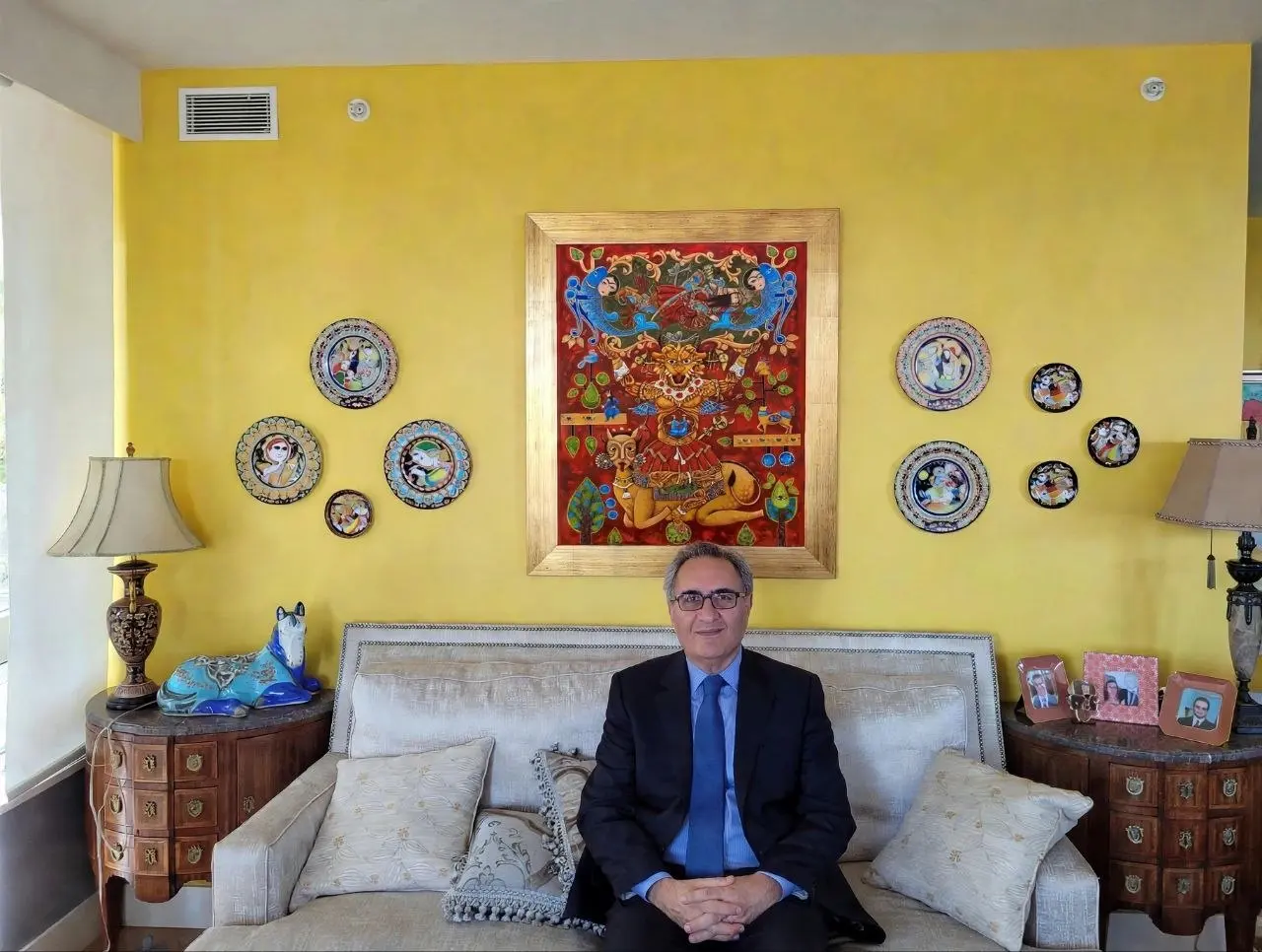
Fatemeh Ahmadian’s painting Akvan Div was acquired by Shahdad Fazeli and is now housed in the Fazel Museum Library in Khansar, Isfahan Province, Iran.
_ Prices of Fatemeh Ahmadian’s Artworks
Fatemeh Ahmadian (born 1982, Khansar) holds a bachelor’s degree in Islamic Arts, specializing in Ceramics and Sculpture, from the Isfahan University of Art.
In 2021, her painting The Prophet Jonah, measuring 160 × 200 cm, was acquired in a private transaction for $4,500 by Jason Carey, a Jamaican art collector based in Dubai.
Fatemeh Ahmadian’s painting The Fourth Trial of Rostam: Rostam’s Battle with the Sorceress, created in 2021 in oil on canvas and measuring 160 × 200 cm, was acquired by Shahdad Fazeli. It is now housed in the Fazel Museum Library in Khansar, Isfahan Province, Iran.
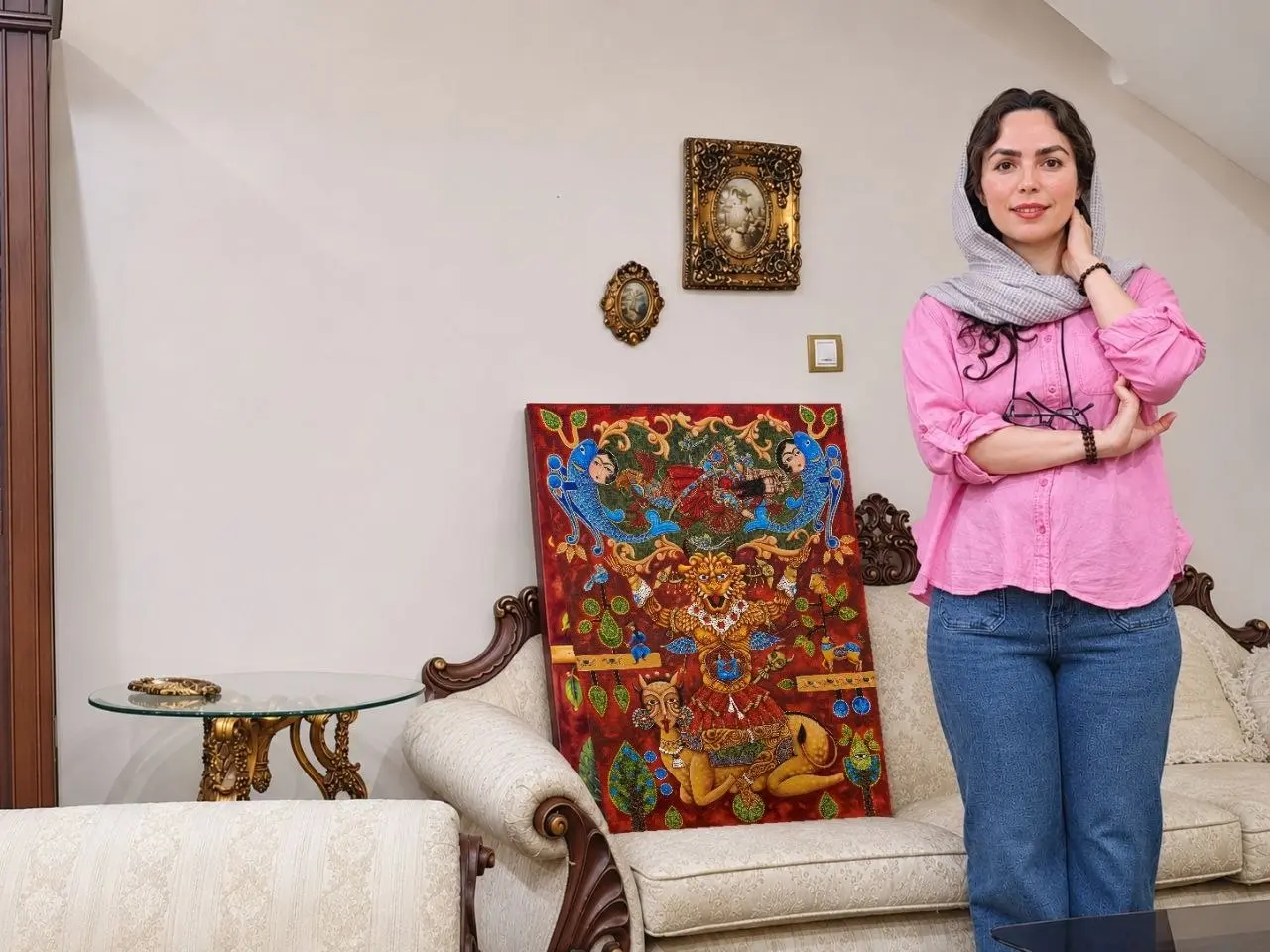
Fatemeh Ahmadian’s works have attracted the attention of both the art community and the art market because of their distinctive worldview and thematic approach. At first glance, the concepts underpinning her paintings may appear classical and traditional; however, after a few minutes of closer observation, their contemporary dimensions gradually become apparent. This distinctive conceptual quality, together with her exceptional drawing skills, has contributed to the growing appreciation and demand for her works.
LEAVE A RELPY